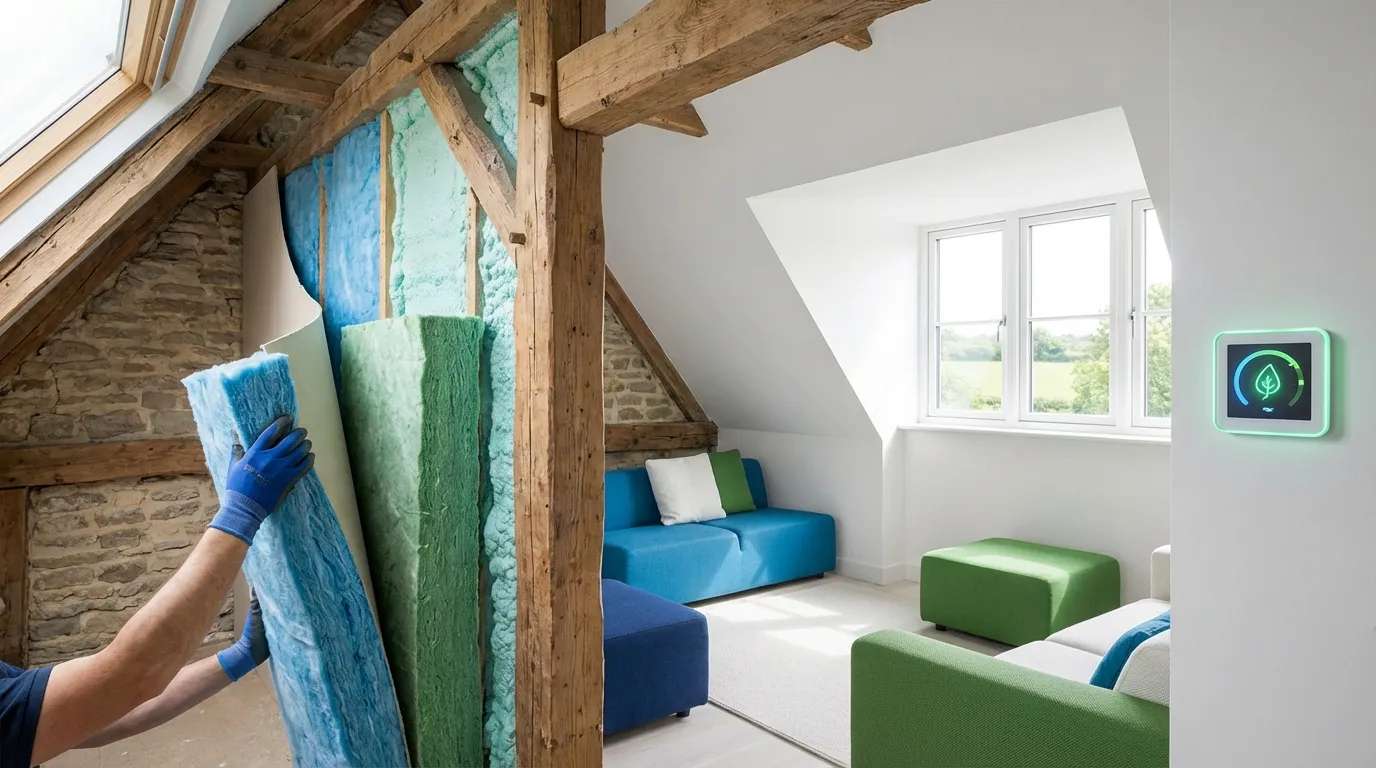
Over 35 million U.S. homes were built before insulation standards were common, leading to severe energy waste. And these older structures leak up to 45% of their heating and cooling energy directly through uninsulated walls, attics, and floors. So homeowners are paying for climate control that never actually stays inside their living space. This inefficiency directly impacts monthly utility bills and overall home comfort, a problem that modern insulation directly solves.
So what does this mean for your wallet? The U.S. Department of Energy estimates that air leaks and poor insulation account for up to 40% of a home's energy loss. But this translates to an average household overspending by $400 to $600 each year on energy bills. And for homes in colder climates, that figure often exceeds $1,000 annually. The financial stakes are clear: without proper insulation, a portion of every utility payment is effectively wasted.
What are the most efficient insulation types for old homes, and what are their typical costs?
Closed-cell spray foam insulation offers the highest R-value of R-6.5 per inch for old homes as of 2026. But its typical material cost is $1.50-$3.00 per board foot. So alternatives like blown-in cellulose provide an R-value of R-3.7 at a lower cost of $1.20-$2.50.
Spray foam (polyurethane) is the most efficient option because it creates both an air and vapor barrier, which is ideal for drafty old houses. And its high R-value per inch means it delivers maximum thermal resistance in shallow wall cavities common in pre-1940s construction. Blown-in cellulose, made from recycled paper, is another excellent choice. So it fills irregular spaces completely, unlike fiberglass batts. But fiberglass batts remain the most affordable option at $0.60-$1.30 per square foot, offering an R-value of R-3.1 to R-3.8 per inch. The choice depends on balancing a budget of $2,000-$7,000 with the specific structural needs of the house. So homeowners must weigh the upfront material cost against long-term energy savings. (See also: crawl space insulation rebates.) (See also: insulation contractor certification for rebates.) (See also: ohio insulation rebates.) (See also: texas insulation rebates.) (See also: The federal Energy Efficient Home Improvement Credit (Section 25C) ended for property placed in service after December 31, 2025 (IRS FS-2025-05). Federal tax credits for this work have ended, but state, local and utility rebates may still apply; check what is available at your address with the DuloCore rebate calculator..) (See also: free insulation programs for seniors.) (See also: insulation rebates with home energy audit.)
What is the total installation cost for various insulation options, and what's the ROI payback period? (See also: colorado insulation rebates.) (See also: basement insulation rebates.) (See also: stacking insulation rebates and tax credits.) (See also: insulation rebate vs hvac rebate.) (See also: insulation for energy efficiency.) (See also: insulation rebate calculator.) (See also: insulation rebates by state.) (See also: epa insulation recommendations.)
Total insulation installation costs for an old home range from $2,100 to $7,400 in 2026, depending on the material and project scope. And the typical return on investment (ROI) payback period is 5 to 7 years, accelerated by federal and state insulation rebates. (See also: washington state insulation rebates.) (See also: insulation and air sealing rebates.) (See also: home insulation tax credit 2026.) (See also: doe insulation rebate programs.) (See also: insulation rebate application process.) (See also: insulation rebate documentation needed.) (See also: insulation cost vs savings analysis.) (See also: best insulation types for rebate eligibility.) (See also: how to apply for insulation rebates.)
An attic insulation project using blown-in cellulose typically costs $1,500 to $3,500. But insulating existing walls with dense-pack cellulose or spray foam is more complex, with costs running from $4,000 to over $8,000. So the payback period is directly tied to energy savings. (See also: best insulation for energy savings.) (See also: insulation rebates for landlords.) (See also: insulation rebates for renters.) (See also: geothermal tax credit.) (See also: best geothermal heat pump brands.) (See also: oregon insulation rebates.) (See also: weatherization assistance program insulation.) (See also: illinois insulation rebates.) (See also: michigan insulation rebates.) (See also: floor insulation rebates.) (See also: insulation r-value requirements for rebates.) (See also: insulation and window replacement rebates combined.)
"By air sealing your home and adding insulation, you can save up to $400 a year on your utility bills." — U.S. Department of Energy (See also: spray foam insulation rebates.) (See also: energy star insulation rebates.) (See also: new york insulation rebates.) (See also: insulation rebates for mobile homes.) (See also: federal insulation rebate.) (See also: california insulation rebates.) (See also: low income insulation programs.) (See also: commercial building insulation rebates.) (See also: spray foam vs blown in insulation rebates.)
And these savings of $400 or more per year are what drive the ROI. For a $3,000 project, the payback period is 7.5 years. But when you factor in a $1,200 federal tax credit, the net cost drops to $1,800. So the payback period shortens to just 4.5 years, making the project's financial return much faster. (See also: blown in insulation rebates.) (See also: fiberglass insulation rebates.) (See also: connecticut insulation rebates.) (See also: minnesota insulation rebates.) (See also: massachusetts insulation rebates.)
How can I qualify for insulation rebates and incentives, and which brands are eligible for old homes? (See also: utility company insulation rebates.) (See also: ira insulation tax credits.) (See also: cellulose insulation rebates.) (See also: insulation rebates vs tax credits difference.) (See also: insulation upgrade before selling home.) (See also: inflation reduction act insulation.) (See also: pennsylvania insulation rebates.) (See also: new jersey insulation rebates.) (See also: wall insulation rebate programs.) (See also: how much can you save with insulation rebates.)
The federal Energy Efficient Home Improvement Credit (Section 25C) ended for property placed in service after December 31, 2025 (IRS FS-2025-05). And eligible brands like Owens Corning, Johns Manville, and CertainTeed often meet these specifications. So check local utility programs for additional cash-back offers.
To claim the federal credit, the insulation materials must be new and expected to last at least five years. And they must meet the prescriptive requirements of the International Energy Conservation Code (IECC) standard in effect at the start of the year two years prior to installation. So for 2026, the 2022 IECC standards apply. Many state and utility programs offer additional incentives. So programs listed in the DSIRE database provide rebates of $0.15 to $1.50 per square foot. Qualifying often requires a pre- and post-installation energy audit. Check the manufacturer's certification statement to confirm a product like JM Corbond III or Owens Corning EcoTouch qualifies for federal energy tax credits.
Related Reading: Learn more about Free Insulation Program and Home Insulation Energy Audit Findings.
Related Reading: Learn more about Best Insulation Types For Rebate Eligibility and Free Insulation Program.
Which insulation alternatives are best suited for my old home's specific climate zone, and how do they compare?
Homes in cold climate zones 5-7 require high R-value insulation like spray foam (R-6.5/inch) for attic R-values of R49-R60. But homes in hot-humid zones 1-2 achieve an R-value of R30-R49 with more affordable blown-in cellulose (R-3.7/inch), meeting 2024 DOE recommendations.
The Department of Energy's climate zone map dictates the necessary R-value for optimal efficiency. And for an old home in Zone 6 (e.g., Minneapolis), the uninsulated attic needs an R-value of R49 to R60. So achieving this with fiberglass batts (R-3.1/inch) requires over 15 inches of material, which may not fit. But closed-cell spray foam achieves the same R-value in just 9 inches. In contrast, a home in Zone 2 (e.g., Houston) only needs an attic R
Ready to Save on Your Home Improvement?
Use our free rebate calculator to find every federal, state, and utility incentive you qualify for.
Updated on April 14, 2026. Fact-checked by DuloCore Editors. About our research team.
Check your California insulation rebate eligibility — see the programs you qualify for and the dollar amounts on our California insulation rebate finder.