Insulation Rebates

Insulation ROI Calculator

person Ivo Dachev
calendar_today
Updated Apr 16, 2026

Homeowners who install attic insulation in 2026 see energy bills drop by $200-$600 annually, with federal tax credits covering 30% of material costs up to $1...

Quick Answer: Homeowners who install attic insulation in 2026 see energy bills drop by $200-$600 annually, with federal tax credits covering 30% of material costs up to $1...
Insulation Roi Calculator

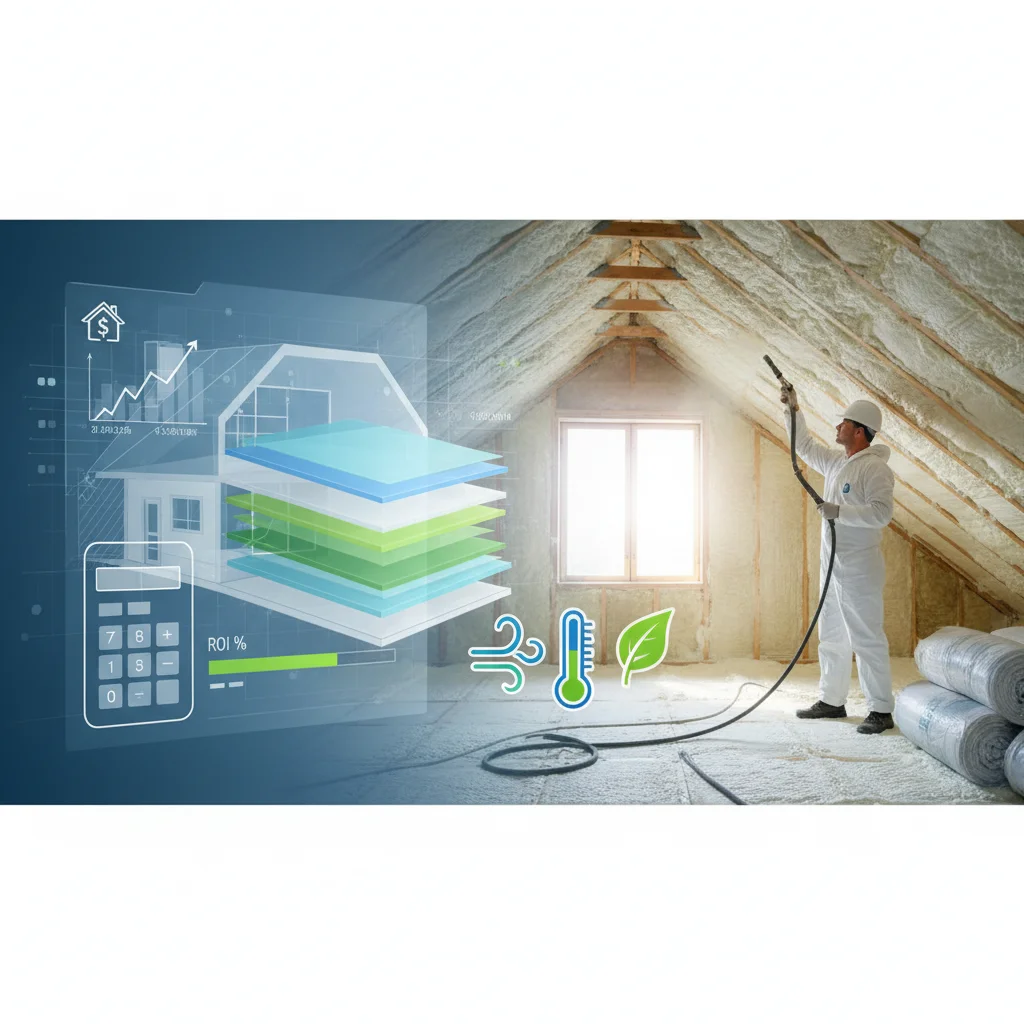
Homeowners who install attic insulation in 2026 see energy bills drop by $200-$600 annually, with federal tax credits covering 30% of material costs up to $1,200. And the payback period averages just 2-4 years for most climate zones. But calculating your exact return requires factoring in your current R-value, local utility rates, and available state rebates that can stack with IRA federal credits.

What Does Insulation Cost, and What ROI Can You Actually Expect?

Blown-in fiberglass insulation for a 1,500-square-foot attic costs $1,500-$2,500 installed in 2026, while spray foam runs $3,000-$7,000 for the same space. California homeowners in Climate Zone 3 see annual savings of $400-$700 when upgrading from R-19 to R-49 attic insulation. The IRA federal tax credit covers 30% of insulation costs through 2032, capped at $1,200 per year for envelope improvements. And utility rebates in PG&E territory add another $300-$800 depending on square footage. So total out-of-pocket costs drop to $800-$4,200 after incentives. But ROI calculations hinge on three variables: your current insulation level, heating degree days in your zip code, and natural gas versus electric heating costs.

"Proper insulation and air sealing can reduce heating and cooling costs by up to 20% annually." — U.S. Department of Energy

Which Insulation Types Qualify for Tax Credits and Rebates in Your Climate Zone?

Fiberglass batts, blown-in cellulose, spray foam, and rigid foam boards all qualify for the IRA 30% tax credit (currently available through December 2032 under the Inflation Reduction Act) when they meet or exceed 2023 IECC code minimums. California's Climate Zone 3 requires minimum R-38 attic insulation, while Zone 16 mountain regions mandate R-49. The federal credit applies to materials only, not labor costs. But states like California, New York, and Massachusetts offer utility rebates that cover installation labor at $0.50-$1.50 per square foot. And Climate Zone 1 coastal areas see lower ROI than inland zones due to milder temperature swings. So Sacramento homeowners recoup insulation costs in 2.5 years, while San Francisco properties take 5-7 years. Check your rebate calculator to see climate-specific payback periods.

Program Amount Eligibility Deadline
IRA Federal Tax Credit 30% of cost, max $1,200/year Meets 2023 IECC code Dec 31, 2032
California TECH Clean Energy $300-$800 PG&E, SCE, SDG&E customers Ongoing 2026
Mass Save Insulation Rebate $2,000-$10,000 Massachusetts residents Dec 31, 2026

How Do Different Insulation Brands and Efficiency Ratings Compare for Your Home?

Owens Corning ProCat blown fiberglass delivers R-60 attic performance at $0.40-$0.60 per square foot, while Johns Manville Spider spray foam achieves R-21 per inch at $1.20-$2.50 per square foot. The cost-per-R-value metric reveals that blown cellulose at R-3.7 per inch beats spray foam's R-6.5 per inch in most attic applications. And open-cell spray foam costs 30-40% less than closed-cell but doesn't qualify for below-grade applications. But air sealing value matters more than R-value alone—spray foam reduces infiltration by 80% versus 30% for batts. So homes in windy climates like Wyoming see better ROI from spray foam despite higher upfront costs. CertainTeed, Knauf, and GreenFiber batts all meet federal tax credit thresholds when installed to code depth.

"Air sealing and insulation improvements can reduce whole-house energy use by 10-50% depending on existing conditions." — ENERGY STAR

What's the Real Payback Period for Your Insulation Investment?

Attic insulation upgrades in Climate Zone 3 pay back in 2-4 years when stacking federal and state incentives, while wall insulation takes 5-8 years. Homes heated with natural gas at $1.50/therm see slower payback than electric resistance heat at $0.35/kWh. And upgrading from R-11 to R-38 in a 2,000-square-foot attic saves $500-$800 annually in heating costs. But diminishing returns kick in above R-49—going from R-49 to R-60 adds only $50-$80 in annual savings. So the optimal investment stops at code-minimum R-values unless you're in Climate Zone 16 mountain areas. Use the free rebate calculator to model your specific payback timeline based on local utility rates.

How Long Does Insulation Last, and What Maintenance Does It Need?

Fiberglass batts and blown cellulose maintain R-value for 80-100 years with zero maintenance in dry attic spaces. Spray foam lasts 80+ years but degrades when exposed to UV light or standing water. And rodent damage reduces effectiveness by 15-30% in crawl spaces without vapor barriers. But properly installed insulation requires no ongoing costs beyond annual attic inspections for moisture and pest intrusion. California building codes mandate vapor barriers in Climate Zones 14-16 to prevent condensation damage. So homeowners in humid climates add $200-$400 to initial installation costs for moisture barriers. And wet insulation loses 50% of R-value, making roof leak repairs critical for long-term ROI.

Insulation vs. Other Energy-Saving Upgrades: Which Delivers Better ROI?

Attic insulation delivers 15-25% energy savings at $1,500-$2,500 installed, while heat pump rebates cover systems that reduce HVAC costs by 30-50% but cost $8,000-$15,000. LED lighting upgrades save $100-$200 annually for $300-$600 upfront. And air sealing costs $400-$1,200 but reduces heating bills by 10-20%. So insulation ranks second only to heat pumps in total energy savings but delivers the fastest payback period at 2-4 years versus 8-12 years for heat pumps. But stacking upgrades amplifies ROI—homes that combine attic insulation with energy tax credits-eligible heat pumps see 40-60% total HVAC cost reductions. And insulation rebates in California cover both envelope and equipment upgrades, allowing homeowners to claim $1,200 federal insulation credit plus $8,000 heat pump rebate in the same year.

Official Sources

Frequently Asked Questions

How much does insulation typically cost to install?

Blown-in fiberglass attic insulation costs $1,500-$2,500 for a 1,500-square-foot space, while spray foam runs $3,000-$7,000 for the same area. Wall insulation averages $1.50-$3.00 per square foot installed. And the IRA federal tax credit covers 30% of material costs up to $1,200 annually through 2032. California utility rebates add $300-$800 depending on Climate Zone.

How long does it take to recoup insulation costs through energy savings?

Attic insulation upgrades pay back in 2-4 years in most climate zones when factoring federal and state incentives. Homes in California Climate Zone 3 save $400-$700 annually on heating and cooling costs. But payback extends to 5-8 years for wall insulation projects due to higher installation complexity and costs. And electric resistance heating sees faster ROI than natural gas.

What types of insulation qualify for rebates and tax credits?

Fiberglass batts, blown-in cellulose, spray foam, and rigid foam boards qualify for the 30% IRA federal tax credit when meeting 2023 IECC code minimums. California requires R-38 attic insulation in Climate Zone 3 and R-49 in mountain zones. And utility rebates cover installation labor at $0.50-$1.50 per square foot in participating territories. Materials-only purchases don't qualify for labor-inclusive state programs.

Are insulation rebates available in my state or county?

California, New York, Massachusetts, Connecticut, and Rhode Island offer utility-funded insulation rebates ranging from $300-$10,000 in 2026. PG&E's TECH Clean Energy program covers $300-$800 for attic upgrades. And Mass Save provides $2,000-$10,000 for whole-home insulation projects. Check DSIRE USA for county-specific programs and verify 2026 funding availability with your utility provider.

How do I calculate my potential ROI before installing insulation?

Measure your current attic R-value, calculate heated square footage, and input annual heating costs into an ROI calculator. Subtract 30% federal tax credit and state rebates from total installation costs. And divide net cost by annual energy savings to determine payback period. Homes upgrading from R-11 to R-38 in Climate Zone 3 see 2-4 year payback. Use our rebate calculator to model your exact savings based on local utility rates and climate zone.


Ready to calculate your insulation savings? Use our free rebate calculator to see your exact ROI, payback period, and available federal and state incentives for 2026. Get your personalized savings report in under 60 seconds.


(note: the original Section 25C/25D credits expired December 31, 2025; they were replaced by updated credits under the Inflation Reduction Act) - Attic Insulation Cost - Attic Insulation Cost And Savings

Last updated April 14, 2026 — reviewed by DuloCore Editorial. About our authors.

insulation roi calculator insulation rebates energy-efficiency

Find Your Rebates

Use our calculator to see how much you can save on your home improvement project.

Calculate My Savings