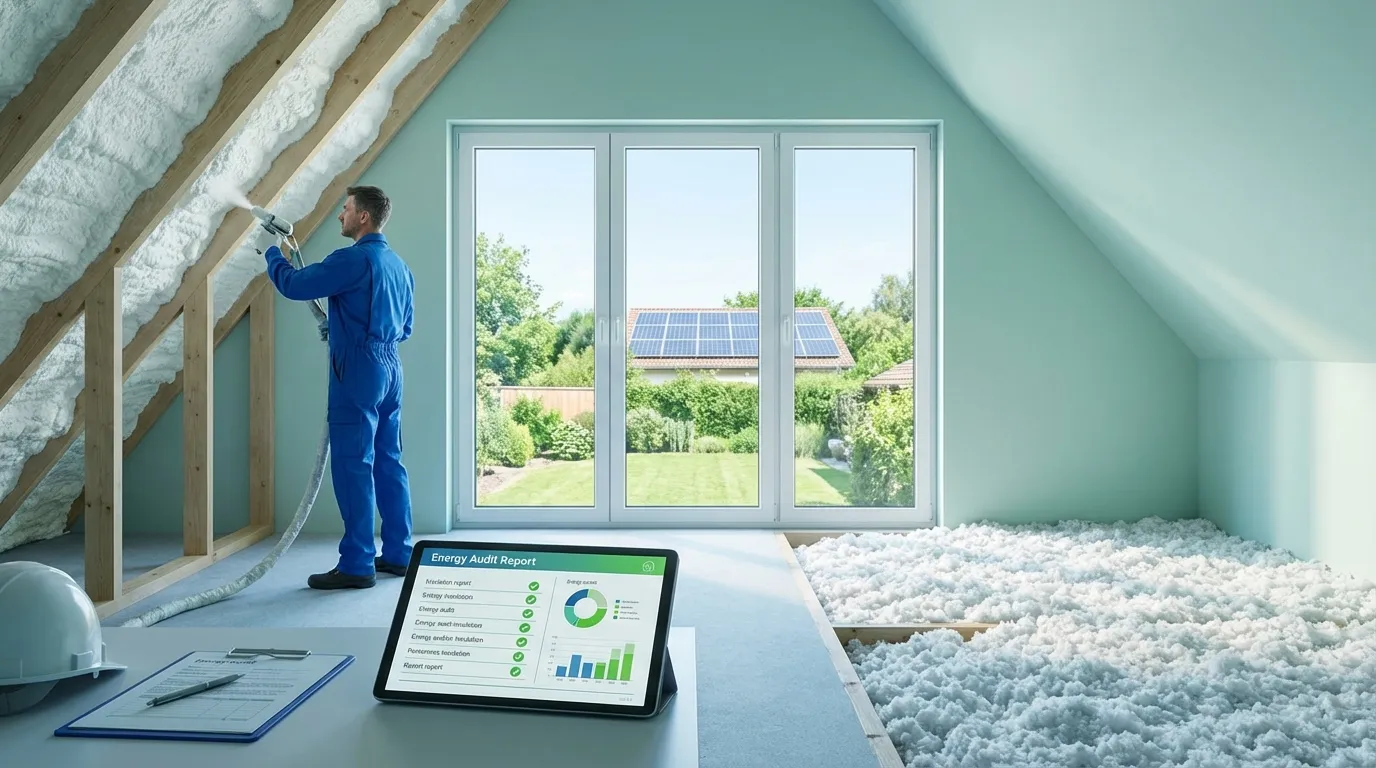
Up to 90% of U.S. homes are under-insulated, leading to an average energy loss equivalent to leaving a window open every day of the year. This inefficiency directly translates into higher utility bills and a less comfortable home. So, federal, state, and utility programs are now offering thousands of dollars in rebates and tax credits to incentivize homeowners to seal these costly air leaks with new insulation.
How Do Rebate Amounts Compare for Spray Foam vs. Blown-In Insulation?
Federal and utility insulation rebates are typically material-agnostic, focusing on performance improvements rather than the specific type of insulation used. The federal 25C (now expired, replaced by the Energy Efficient Home Improvement Credit) tax credit covers 30% of the project cost up to $1,200 annually, applying equally to both spray foam and blown-in installations.
Most rebate programs don't specify different dollar amounts for spray foam versus blown-in insulation. But the total project cost difference impacts the final rebate value. Spray foam insulation has a higher upfront cost, often between $2.00 and $7.00 per board foot. So, a spray foam project is more likely to reach the maximum cap of a rebate, like the $1,200 federal tax credit. Blown-in insulation is less expensive, typically $1.00 to $2.80 per square foot, so the 30% credit on a smaller total bill results in a smaller dollar-value credit. And the decision often comes down to whether you want to maximize the total rebate dollars with a higher-cost project or achieve a faster payback on a lower-cost installation. You can find all available energy tax credits to see how they apply.
What Are the Key Eligibility Requirements for Insulation Rebates, Including Income and Contractor Rules?
Eligibility for insulation rebates depends on the program and includes contractor licensing, project location, and sometimes household income. The federal Energy Efficient Home Improvement Credit (Section 25C) ended for property placed in service after December 31, 2025 (IRS FS-2025-05). Future programs like HEERHA will offer enhanced rebates of up to $1,600 for low-to-moderate-income households.
The federal Energy Efficient Home Improvement Credit (Section 25C) ended for property placed in service after December 31, 2025 (IRS FS-2025-05). Federal tax credits for this work have ended, but state, local and utility rebates may still apply; check what is available at your address with the DuloCore rebate calculator. But state and utility rebates almost always require the installation to be performed by a licensed and insured contractor, often one from their pre-approved network. So, DIY projects typically don't qualify for these local programs. And some of the most generous upcoming rebates are income-restricted. For example, the Home Electrification and Appliance Rebate (HEERHA) program will cover up to 100% of insulation project costs for households earning less than 80% of the Area Median Income. So, checking specific program rules is essential before committing to a contractor or material.
How Do I Apply for Insulation Rebates, and What Are the Deadlines?
The application process for insulation rebates involves submitting project documentation like paid invoices and contractor certifications to the sponsoring entity. Form 5695 only covers qualifying work completed by December 31, 2025 and claimed on a 2025 return; the federal 25C and 25D credits ended after that date (IRS FS-2025-05). Utility program deadlines vary and often depend on funding availability.
Applying for a local utility or state rebate is a post-installation task. You or your contractor will typically submit a completed application form along with the final, paid invoice showing the project's scope and cost. But for the federal tax credit, the process is different. Form 5695 only covers qualifying work completed by December 31, 2025 and claimed on a 2025 return; the federal 25C and 25D credits ended after that date (IRS FS-2025-05). And deadlines are firm. The tax filing deadline is typically April 15th. Utility programs often operate on an annual budget cycle, and funds can be depleted before the year ends, so applying immediately after project completion is critical.
The federal Energy Efficient Home Improvement Credit (Section 25C) ended for property placed in service after December 31, 2025 (IRS FS-2025-05).
Is Funding Still Available, and Can I Stack My Insulation Rebates with Other Programs?
The federal Energy Efficient Home Improvement Credit (Section 25C) ended for property placed in service after December 31, 2025 (IRS FS-2025-05). State and utility program funding is less certain and operates on a first-come, first-served basis. Homeowners can frequently stack a federal credit with a local utility rebate for the same project.
The federal Energy Efficient Home Improvement Credit (Section 25C) ended for property placed in service after December 31, 2025 (IRS FS-2025-05). But local utility and state programs are subject to annual budget appropriations and can run out of money. So, you must confirm that a program is still accepting applications before you begin your project. And the best strategy is to stack incentives. For example, a homeowner can receive a $750 rebate from their local utility for attic insulation and also claim the 30% federal tax credit (up to $1,200) on the remaining project cost. This layering of incentives drastically reduces the net cost of the upgrade. This same stacking principle applies to other upgrades, including heat pump rebates. (See also: insulation rebates for veterans.) (See also: insulation rebates 2026.) (See also: whole home insulation upgrade rebates.) (See also: geothermal tax credit.)
Where Can I Find State and Utility-Specific Rebates for My Insulation Project?
Homeowners can find local insulation rebates by searching their utility provider's website, using the national DSIRE database for state-level incentives, or utilizing a specialized rebate calculator to discover all available programs in their area based on ZIP code.
Your first stop for local incentives should be your electric or gas utility's website, as they often have the most direct and easy-to-claim rebates. Or, for a broader view, you can consult national databases. The Database of State Incentives for Renewables & Efficiency (DSIRE) is a comprehensive tool that tracks programs across the country. And these resources will list specific requirements for both spray foam and blown-in insulation projects. But the most efficient method is using an aggregator tool that automatically finds every available federal, state, and utility rebate for your specific address, saving you from navigating multiple complex websites.
"Check with your state energy office or local utility to see if they offer financial incentives for home energy audits or for making energy efficiency improvements." — U.S. Department of Energy
Which Insulation Type Offers the Best Overall Rebate Potential for My Home?
While rebate programs don't favor one material, spray foam's higher installation cost ($2.00-$7.00 per board foot) means homeowners can more easily maximize the total dollar value of capped incentives like the $1,200 federal tax credit compared to lower-cost blown-in insulation.
The best choice for rebate potential depends on your financial goals. Rebate programs are designed to reward energy savings, not a specific material. But the math works out differently for each. The federal Energy Efficient Home Improvement Credit (Section 25C) ended for property placed in service after December 31, 2025 (IRS FS-2025-05). A comparable blown-in insulation project might only cost $2,500, resulting in a smaller $750 tax credit. So, spray foam provides a clear path to receiving the maximum rebate amount in raw dollars. But blown-in insulation offers a faster payback period due to its lower initial cost, making it a better value proposition for budget-conscious homeowners. You can explore all available insulation rebates to see what fits your home.
Insulation Rebate Program Comparison
| Program Feature | Federal 25C Tax Credit | Typical Utility Rebate | State Program (e.g., NYSERDA) |
|---|---|---|---|
| Rebate Amount | 30% of cost, up to $1,200/year | $0.20-$1.50 per sq. ft., up to $1,000 | Varies, often income-based up to $4,000 |
| Material Eligibility | Spray foam, blown-in, batts, rigid board | Spray foam, blown-in, cellulose | Technology neutral, based on performance |
| Key Requirement | Primary residence, must meet IECC standards | Must use a pre-approved contractor | Often requires a prior energy audit |
| Application Deadline | Annual tax filing deadline (April 15th) | Varies, often until funds are depleted | Program-specific, check website |
Related Reading: Learn more about Spray Foam Insulation Rebates.
Frequently Asked Questions
What are the eligibility requirements for spray foam vs blown-in insulation rebates?
Eligibility is nearly identical for both materials. Requirements typically include using a licensed contractor, the property being a primary residence for federal credits, and meeting specific performance standards like improved R-value or air sealing targets set by the program.
Are rebate amounts different for spray foam compared to blown-in insulation?
No, the rebate amounts are usually the same regardless of material. Programs offer a set dollar amount per square foot or a percentage of the total project cost. Because spray foam is more expensive, it's more likely to hit the maximum dollar cap of a rebate.
How do I apply for rebates on spray foam and blown-in insulation projects?
Form 5695 only covers qualifying work completed by December 31, 2025 and claimed on a 2025 return; the federal 25C and 25D credits ended after that date (IRS FS-2025-05). For state and utility rebates, you typically submit an online or mail-in application after the project is complete, including the paid invoice and contractor's certification.
When do current rebate programs for spray foam and blown-in insulation expire?
The federal Energy Efficient Home Improvement Credit (Section 25C) ended for property placed in service after December 31, 2025 (IRS FS-2025-05). State and local
Ready to Save on Your Home Improvement?
Use our free rebate calculator to find every federal, state, and utility incentive you qualify for.
Official Sources
Updated: April 14, 2026 — fact-checked by DuloCore Research. About our editorial process.
Check your California insulation rebate eligibility — see the programs you qualify for and the dollar amounts on our California insulation rebate finder.