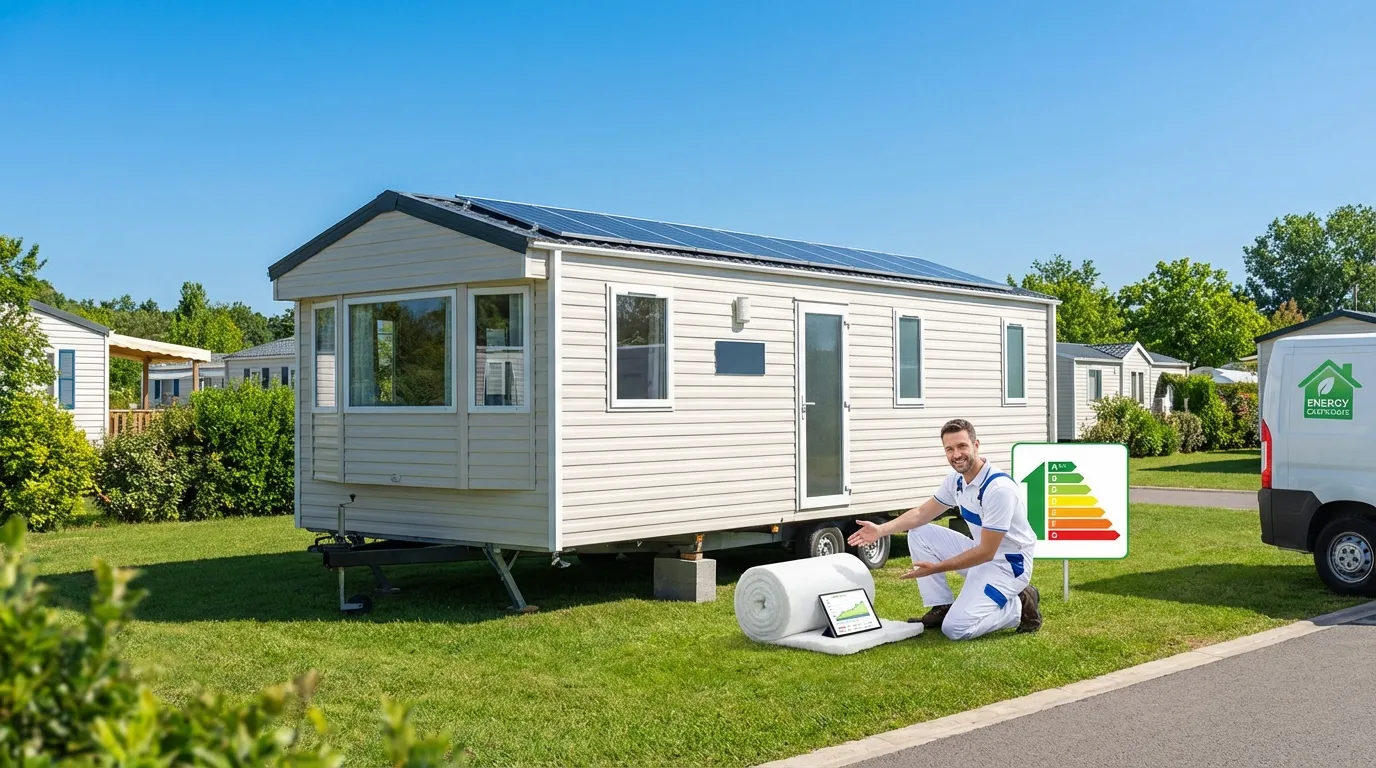
Insulation rebates for mobile homes are hard to find in California. DuloCore checked on October 13, 2026 which official utility and government pages name mobile homes, and which of them list insulation. Several no-cost programs name mobile homes. Two of the three cash insulation rebate programs don't.
Can a Mobile Home Get Free Insulation From a California Utility in 2026?
It may, in some cases. As of October 13, 2026, SCE, PG&E and SDG&E each name mobile homes as eligible for Energy Savings Assistance, and SDG&E lists attic insulation among its no-cost upgrades for qualified households that provide income documents.
Energy Savings Assistance is the utilities' no-cost home upgrade program for lower-income households. This is what each utility's own page states:
| Utility | Does the page name mobile homes? | Does the page name insulation? (October 13, 2026) |
|---|---|---|
| SDG&E | Yes: a single-family or mobile home | Yes: attic insulation, for customers who give income documents |
| SCE | Yes: a single-family home or mobile home | It lists weatherization services and doesn't say insulation |
| PG&E | Yes: a house, mobile home or apartment at least five years old | It names water heaters, furnaces, lighting and refrigerators and doesn't say insulation |
| SoCalGas | Mobile homes aren't mentioned | Yes: attic insulation |
SDG&E's Energy Savings Assistance page sets the income limit at 250% of the Federal Poverty Guidelines. From June 1, 2026 to May 31, 2027 that is $39,900 for one person and $54,100 for two. It also says not all customers will qualify for all products or services.
SCE's program page says services may not be available in all areas. PG&E's program page says an energy specialist decides the improvements during a home assessment. None of the four pages promises insulation to a mobile home. The eligibility check shows which programs fit a household.
Is There a Cash Insulation Rebate a Mobile Home Owner Can Claim?
Two of the three insulation rebate programs checked on October 13, 2026 don't name mobile homes. The third covers only 2025 wildfire ZIP codes.
- LADWP. The Attic Insulation Rebate Program is for LADWP residential customers. It lists $0.50 per square foot above R-19 and $0.30 per square foot at R-19 or below, for batt and roll insulation only. Its terms list four dwelling types: detached single family home, multi residential or attached home, condo or townhome, and apartment unit. Mobile homes aren't on that list.
- SCE Home Performance Plus. SCE's rebates page says the program is offered to SCE residential electric customers who rent or own a single-family detached home or unit in a building with a maximum of four units within Disadvantaged or Low-Income communities. The program's rebates page lists $1.07 per square foot for attic insulation and $1.06 for wall insulation, limited to homes under 3,000 square feet with certain heating and cooling equipment. Neither page mentions mobile or manufactured homes.
- SoCalGas. The 2026 rebate application offers attic and wall insulation rebates only to customers impacted by the 2025 Southern California wildfires who live in its listed ZIP codes, and applications must be postmarked by December 31, 2026. Its property types include a mobile home, and it has instructions for mobile home customers, covered in the questions below.
DuloCore's California insulation rebates guide has more on insulation rebates in the state.
Do Any Programs Serve Only Mobile Homes?
Two official documents describe no-cost upgrade programs for mobile homes, but neither lists insulation. Both cover ducts, thermostats and appliances instead.
SoCalGas's Mobile Home Fire Response Program brochure is for people affected by the January 2025 Southern California wildfires. SoCalGas links it from its wildfire rebuild page, which describes the program as for mobile home homeowners that experienced partial loss of their home. The brochure lists potential upgrades: crossover duct replacement, duct testing and sealing, a high-efficiency furnace, smart thermostats, a smart fan controller, a tankless water heater and water saving measures. Crossover ducts carry air between sections of the heating and cooling system. The brochure says the contractor runs the program through 12/31/2026 and that funds are first-come, first-served.
In Riverside, the city utility's Mobile-Home and Multi-Family Energy Efficiency Program requires an active SoCalGas account and Riverside electric service. Its list includes a refrigerator replacement, a smart thermostat, LED lighting and, for mobile homes only, crossover duct replacement. The page gives no end date and says the program is limited while funding is available.
Does Government Weatherization Cover Mobile Homes?
The federal rule includes them. The Weatherization Assistance Program regulation counts a stationary mobile home as a dwelling unit, and insulation is a typical measure.
The definition is in section 440.3 of the program's federal regulation: it counts a house, including a stationary mobile home, as a dwelling unit. The U.S. Department of Energy's whole-house weatherization page lists wall, floor, ceiling, attic and foundation insulation among typical measures. That page doesn't mention mobile homes.
In California the Department of Community Services and Development (CSD) runs the program through local service providers. Its Weatherization Assistance Program page says eligibility depends on income, household size, energy use and other factors. That page doesn't mention mobile homes, so ask the local provider. The weatherization income guidelines page explains the income test.
Frequently Asked Questions
Do Renters in a Mobile Home Qualify for Energy Savings Assistance?
They can. The SCE and SDG&E pages linked above both say the program is for homeowners and renters. SDG&E adds that property owner approval may be needed for some upgrades.
What If the Mobile Home Park Has a Master Meter?
The SoCalGas rebate application linked above says that when a manufactured or mobile home has no individual meter, the account holder, such as the park owner or property manager, fills in the customer section and signs.
How Do I See What My ZIP Code Qualifies For?
Use the calculator. It takes a ZIP code and gives an estimate.
Insulating a mobile home? Estimate rebates for your ZIP code with the free rebate calculator.