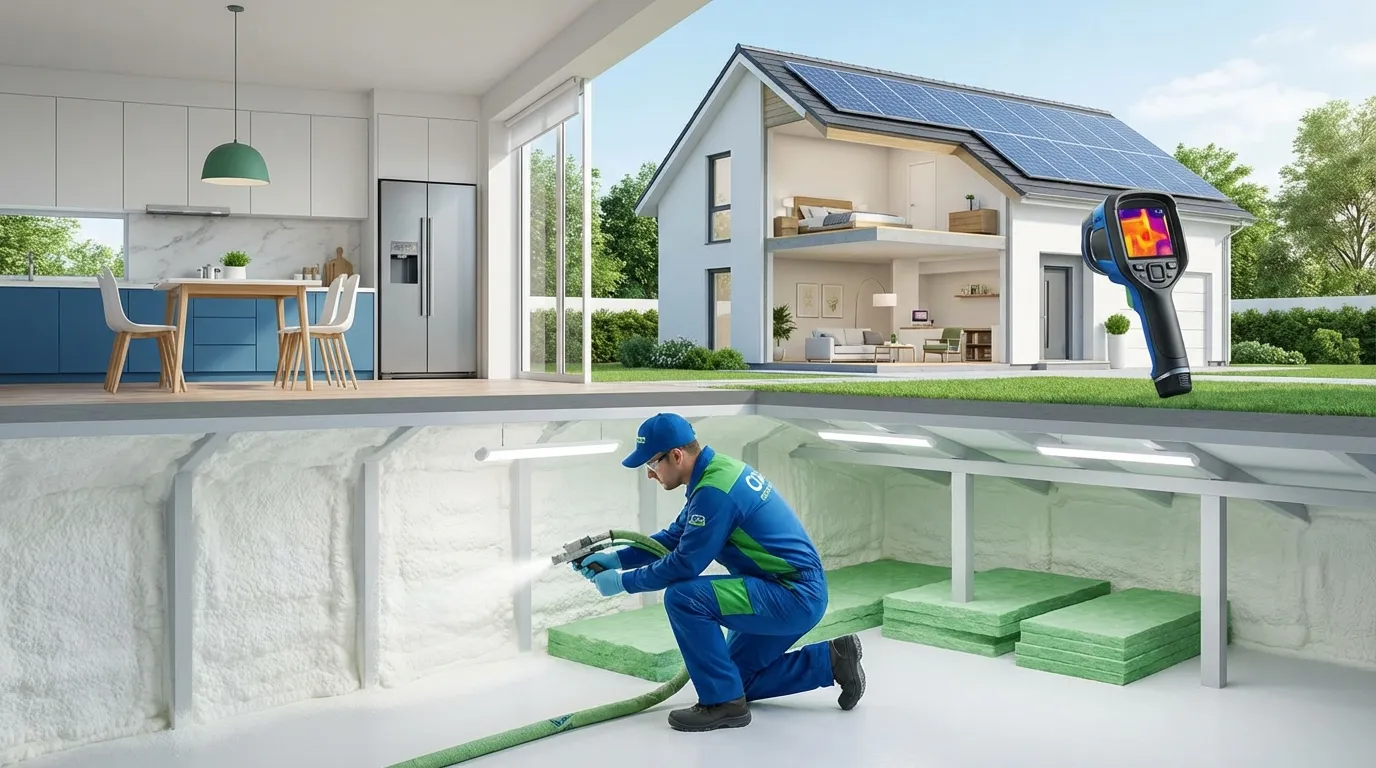
Up to 15% of a home's total heat loss escapes through an uninsulated or under-insulated crawl space. This constant energy drain forces HVAC systems to work overtime, inflating utility bills month after month. So addressing this often-overlooked area of the home is one of the most direct ways to cut energy waste and lower costs immediately.
How Much Can You Save: Understanding Crawl Space Insulation Rebate Amounts?
Crawl space insulation rebates provide direct financial returns, with amounts varying by program. Utility rebates typically offer $0.50 to $1.50 per square foot, while state programs offer flat incentives up to $1,000. So the federal 25C (now expired, replaced by the Energy Efficient Home Improvement Credit) tax credit covers 30% of the project cost, capped at $1,200 annually.
Rebate amounts are not standardized; they depend entirely on the program administrator. And these administrators include your local utility company, state energy office, or the federal government. For example, a utility program offers $0.75 per square foot for insulating a 1,000-square-foot crawl space, resulting in a $750 rebate. But a state program offers a flat $500 for the same project. The federal Energy Efficient Home Improvement Credit (Section 25C) ended for property placed in service after December 31, 2025 (IRS FS-2025-05). Federal tax credits for this work have ended, but state, local and utility rebates may still apply; check what is available at your address with the DuloCore rebate calculator. So by combining these incentives, the total project cost is reduced by $1,000 or more. The key is to check all available insulation rebates to maximize savings on the project. It's not uncommon for stacked incentives to cover over 50% of the total installation cost.
The core issue is that homeowners are paying for heated or cooled air that escapes directly into the ground. So for a typical home, this translates to losing $200 to $400 annually just from the crawl space alone. But crawl space insulation rebates directly address this financial leak by lowering the upfront cost of the project, making the return on investment faster and more accessible.
Who Qualifies? Eligibility Criteria for Crawl Space Insulation Rebates by State, Utility, and Income
Eligibility for crawl space insulation rebates is determined by geographic location, utility provider, and sometimes household income. Homeowners must reside within the specified service area and meet program-defined income thresholds for enhanced LMI (Low-to-Moderate Income) rebates, which often provide 100% of the project cost.
Qualification criteria are strict and non-negotiable. And the first requirement is location; you must be a customer of the sponsoring utility or a resident of the state offering the rebate. For example, programs like Mass Save are only available to Massachusetts residents. So income level is another critical factor. Many states and utilities offer enhanced rebates for low-to-moderate-income households, with eligibility often set at or below 80% of the Area Median Income (AMI). But standard rebates are generally available to all customers regardless of income. The insulation material itself must also meet specific R-value requirements, typically R-19 or higher for crawl space floors. Some programs also require a pre-installation energy audit to confirm the necessity of the upgrade.
"The Database of State Incentives for Renewables & Efficiency® is the most comprehensive source of information on incentives and policies that support renewables and energy efficiency in the United States." — DSIRE
What's the Process? Applying for Crawl Space Insulation Rebates and Meeting Key Deadlines
The application process for crawl space insulation rebates involves pre-approval, installation by a qualified contractor, and submission of documentation before a firm deadline. The typical timeline from application to receiving the check or credit is 6 to 12 weeks, contingent on accurate and complete paperwork submission.
Applying for a rebate follows a clear, multi-step process. So first, you must confirm your eligibility and review the program's specific requirements. And many programs require pre-approval before any work begins, so don't hire a contractor until you have it. After getting the green light, a certified contractor installs the insulation. But be sure to get a detailed invoice that lists the material type, R-value, and total square footage, as this is required documentation. After installation, you'll submit the rebate application online or via mail, attaching the invoice and any other required forms. Deadlines are absolute; most programs run on an annual cycle and close applications in December or when funds are depleted. Check your specific program's deadline to avoid missing out on hundreds of dollars.
Can You Stack Savings? Combining Crawl Space Insulation Rebates with Other Programs
Homeowners can often combine, or "stack," crawl space insulation rebates with other financial incentives. This includes pairing a local utility rebate with federal energy tax credits, effectively reducing the out-of-pocket project cost by 50% or more. But program rules dictate which incentives are stackable.
Stacking incentives is the best strategy for minimizing your upfront cost. So you can start with a rebate from your electric or gas utility, which might offer $1.00 per square foot. The federal Energy Efficient Home Improvement Credit (Section 25C) ended for property placed in service after December 31, 2025 (IRS FS-2025-05). For a $3,000 project, this combination reduces your net cost to under $1,500. Some states also offer their own tax credits or rebates that can be added to the stack. However, you must read the terms for each program. Some utility rebates explicitly state they cannot be combined with other offers from the same utility, like heat pump rebates, but they don't restrict stacking with federal incentives. Always verify the rules to ensure compliance.
Are There Specific Contractor Requirements for Crawl Space Insulation Rebate Programs? (See also: attic insulation cost and savings.) (See also: insulation rebates for manufactured homes.) (See also: whole home insulation upgrade rebates.) (See also: geothermal tax credit.)
Yes, most crawl space insulation rebate programs mandate that the installation be performed by a licensed and insured contractor. Many utilities and state programs require contractors to be part of their approved network or hold specific certifications, such as from the Building Performance Institute (BPI), to qualify.
Using a qualified contractor is almost always a non-negotiable term of the rebate program. So this requirement ensures the work is done correctly and meets building codes, which protects the homeowner and the integrity of the energy-saving program. Utility companies often maintain a list of pre-approved or "trade ally" contractors who are familiar with the rebate application process and technical specifications. And hiring a contractor from this list simplifies the process, as they often handle the paperwork for you. But if you choose your own contractor, you must verify they have the necessary licenses and insurance. An improper installation not only voids the rebate but also leads to moisture issues, negating any potential energy savings.
"Save money and energy at home. Find rebates and tax credits for energy-efficient upgrades." — U.S. Department of Energy
How Do I Check the Funding Status for Crawl Space Insulation Rebate Programs?
To check the funding status of a crawl space insulation rebate program, visit the official website of the sponsoring utility or state energy agency. These sites typically feature a real-time tracker or status update, indicating if funds are still available, running low, or have been exhausted for the year.
Rebate programs operate with a finite budget. So once the allocated funds are depleted, the program closes to new applicants until the next funding cycle, usually the following calendar year. It is critical to check the funding status before you begin your project. And the best source for this information is the program's official webpage. Look for terms like "Program Status," "Funding Availability," or a progress bar. But if the website isn't clear, call the program administrator directly. Because these programs are first-come, first-served, delaying your application by even a week costs you the rebate if funds run out. Acting promptly once you decide to move forward is essential.
Crawl Space Insulation Rebate Program Comparison
| Incentive Program | Typical Amount | Key Eligibility | Application Deadline |
|---|---|---|---|
| Federal 25C Tax Credit | Ended Dec 31, 2025 | — | Ended Dec 31, 2025 |
| State Energy Rebate | $500 - $1,500 flat rate | State residency, specific R-value | Often December 31, or when funds are depleted |
| Utility Rebate | $0.50 - $1.50 / sq. ft. | Must be a customer of the utility | Varies, often when funds are depleted |
Related Reading: Learn more about Crawl Space Insulation Cost.
Frequently Asked Questions
Who is eligible for crawl space insulation rebates?
Eligibility primarily depends on your location. You must be a customer of the sponsoring utility or a resident of the state offering the program. Some programs have income requirements, offering larger rebates for low-to-moderate-income households.
How much money can I get back from crawl space insulation rebates?
Amounts vary. Utility rebates often range from $0.50 to $1.50 per square foot. State programs can offer flat rebates from $500 to $1,500. The federal Energy Efficient Home Improvement Credit (Section 25C) ended for property placed in service after December 31, 2025 (IRS FS-2025-05).
What is the application process for crawl space insulation rebates?
The process typically involves confirming eligibility, getting pre-approval from the program, having the insulation installed by a qualified contractor, and submitting an application with the required invoice and documentation before the deadline.
Are there deadlines to apply for crawl space insulation rebate programs?
Yes, all programs have firm deadlines. Most are tied to the calendar year, ending on December 31, or they close once program funds are fully exhausted.
Can crawl space insulation rebates be combined with other energy efficiency incentives?
Yes, in most cases. It is common to "stack" a utility rebate with the federal 25C tax credit. Always check the terms and conditions of each program to confirm which incentives can be combined.
Ready to see exactly how much you can save? Use our free rebate calculator to find all the incentives available for your home.
Ready to Save on Your Home Improvement?
Use our free rebate calculator to find every federal, state, and utility incentive you qualify for.
Official Sources
Last updated April 14, 2026 — reviewed by DuloCore Editorial. About our authors.
Check your California insulation rebate eligibility — see the programs you qualify for and the dollar amounts on our California insulation rebate finder.