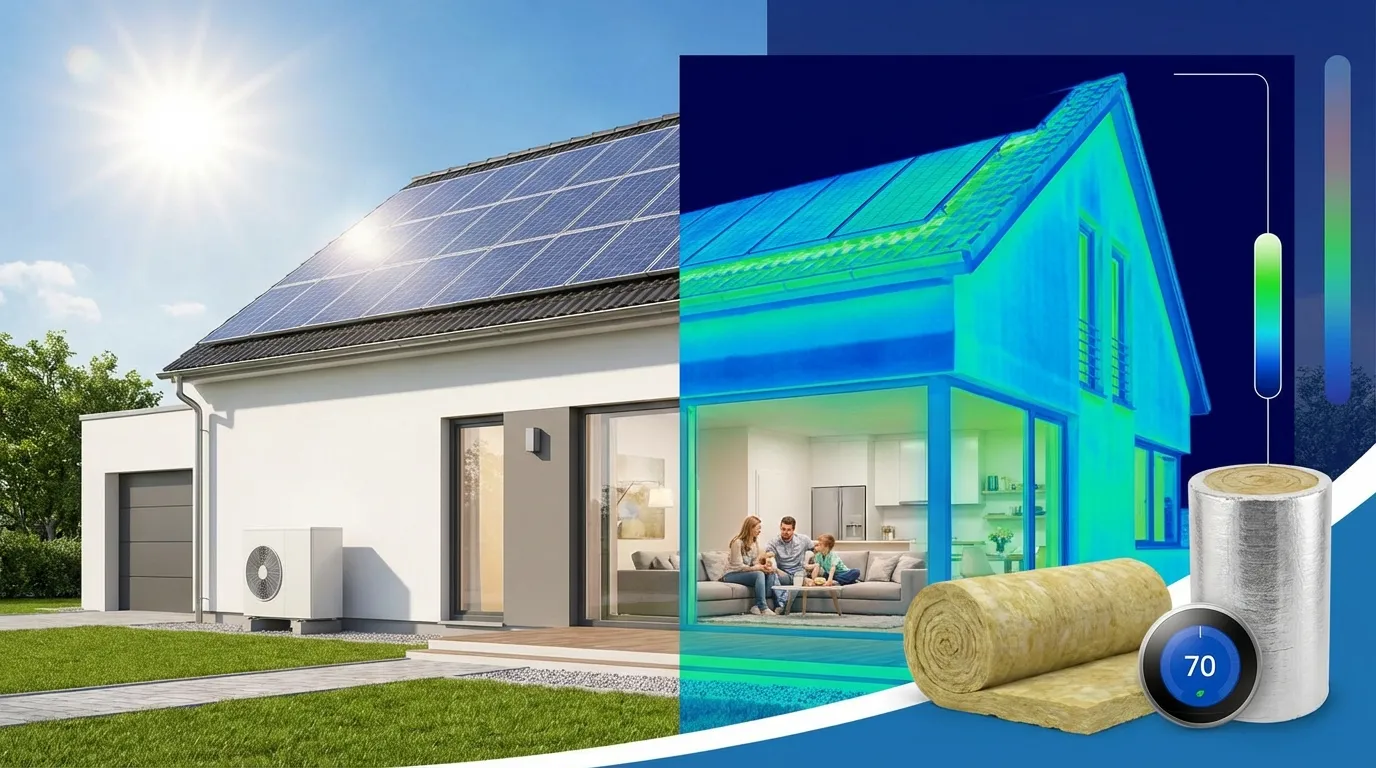
An estimated 90% of U.S. homes are under-insulated, leading to an average energy loss of 20-30% through walls, roofs, and floors. This isn't just a comfort issue; it's a direct drain on your bank account every single month. So the Department of Energy (DOE) is now funding a historic $8.8 billion in home energy rebates to fix this exact problem, making 2024 the year to upgrade.
What DOE Insulation Rebates Are Available and How Much Can You Save?
The Department of Energy (DOE) offers two primary insulation rebate programs in 2026: the High-Efficiency Electric Home Rebate Act (HEEHRA) and the Home Owner Managing Energy Savings (HOMES) Rebate Program. HEEHRA provides a point-of-sale rebate up to $1,600 for insulation, air sealing, and ventilation.
These programs directly address the high upfront cost of energy efficiency upgrades. HEEHRA offers a point-of-sale discount of up to $1,600 specifically for weatherization projects, which include insulation and air sealing. So this rebate is applied instantly when you make the purchase from a participating retailer or contractor. But the HOMES Rebate Program operates differently, providing a rebate between $2,000 and $8,000 based on the modeled or measured energy savings of your entire home project. And homeowners achieving a 35% or greater energy reduction receive the maximum rebate of $4,000, or $8,000 for low-to-moderate income households. You can find detailed information on state-specific insulation rebates as programs roll out.
Who is Eligible for DOE Insulation Rebates: Income, State, and Utility Requirements?
DOE insulation rebate eligibility for 2026 is determined by household income relative to the Area Median Income (AMI) and the specific program rules established by your State Energy Office. HEEHRA rebates are exclusively for low-to-moderate-income households, while the HOMES program is open to all homeowners.
Eligibility for the HEEHRA program is strictly income-based. And households earning less than 80% of the Area Median Income (AMI) qualify for a 100% rebate on insulation costs, up to the $1,600 cap. But households earning between 80% and 150% of AMI qualify for a 50% rebate. So if your project costs $3,000, you would receive a $1,500 rebate. The HOMES Rebate Program is available to all homeowners regardless of income, but the rebate amount doubles for those under 80% of AMI. State Energy Offices administer these funds, so you must check your state's specific portal for availability and local utility partner requirements.
"The Home Energy Rebate programs will provide funding to states and territories to help American families save money on their energy bills..." — U.S. Department of Energy
How Do You Apply for DOE Insulation Rebates and What Contractor Requirements Exist?
The application process for DOE insulation rebates is managed by individual State Energy Offices, not the federal government. Most states will require homeowners to use certified or licensed contractors to ensure the work meets specific energy-saving standards and qualifies for the 2026 rebate programs.
To apply, you first need to confirm your state has launched its program, as rollout dates vary throughout 2024. And once active, the process typically involves getting a quote from a qualified contractor who can verify the project's eligibility. So for HEEHRA, the rebate is often applied as an instant discount at the point of sale. For the HOMES program, you or your contractor will submit project documentation to the state's online portal to receive the rebate after completion. Contractor requirements are strict; they often need BPI (Building Performance Institute) certification or to be listed on a state-approved network. You can use a rebate calculator to find qualifying local contractors.
| Program Feature | HEEHRA Rebate | HOMES Rebate |
|---|---|---|
| Rebate Amount | Up to $1,600 for insulation | $2,000–$8,000 based on energy savings |
| Income Eligibility | <150% Area Median Income | All income levels (higher rebate for LMI) |
| Stacking Rules | Cannot be combined with 25C (now expired, replaced by the Energy Efficient Home Improvement Credit) tax credit | Can be combined with 25C tax credit |
| Application | Point-of-sale discount | Post-project application |
What Are the Deadlines and Funding Status for DOE Insulation Rebate Programs? (See also: attic insulation rebate programs.) (See also: insulation rebates for veterans.) (See also: insulation rebates 2026.) (See also: geothermal tax credit.)
Federal funding for the DOE insulation rebate programs is available until September 30, 2031. But each state receives a fixed allocation from the $8.8 billion total. So these funds are distributed on a first-come, first-served basis and will run out before the 2031 deadline.
While the federal sunset date is 2031, the real deadline is when your state's funding is depleted. And many State Energy Offices are expected to launch their programs in late 2024, with some potentially starting in early 2025. The funding status will be publicly tracked on each state's official program website. So this means homeowners who act quickly have the best chance of securing a rebate. Once a state's allocated millions are claimed, the program in that state will end, regardless of the federal deadline. It is critical to monitor your state's energy office for the official launch announcement.
Can You Stack DOE Insulation Rebates with Other Energy Efficiency Programs?
Stacking rules for DOE insulation rebates depend on the specific program used. The HEEHRA rebate cannot be combined with other federal incentives like the 25C tax credit for the same upgrade. But the HOMES Rebate Program can be stacked with other federal, state, and utility incentives.
This rule prevents "double-dipping" on the same federal incentive. So you cannot claim a $1,600 HEEHRA rebate for attic insulation and also claim the 25C tax credit for that same insulation project. But you can use the HOMES rebate for a whole-house retrofit that includes insulation and still claim other energy tax credits for qualifying equipment like new windows or doors installed during the project. And in many cases, you can combine either the HEEHRA or HOMES rebate with separate rebates offered by your local utility company, potentially covering over 50% of your total project cost.
"A State may not use funds for a high-efficiency electric home rebate program for a rebate for any equipment or improvement for which the homeowner received a rebate under a HOMES rebate program." — DSIRE
Frequently Asked Questions
What are the eligibility requirements for DOE insulation rebates?
Eligibility primarily depends on household income and location. The HEEHRA rebate is for households earning below 150% of the Area Median Income (AMI). The HOMES program is open to all income levels, but provides a larger rebate for households below 80% of AMI. Both are administered at the state level.
How much can I save through DOE insulation rebate programs?
You can save up to $1,600 for insulation, air sealing, and ventilation projects through the HEEHRA program. The HOMES program offers performance-based rebates from $2,000 to $8,000, depending on the total energy savings achieved.
What is the application process for DOE insulation rebates?
The application process is handled by your State Energy Office. It typically requires using a state-approved contractor who helps with paperwork. HEEHRA is often an instant, point-of-sale discount, while the HOMES rebate requires a post-project application.
Are there deadlines for DOE insulation rebate programs?
Yes. The federal funding expires on September 30, 2031. However, each state has a limited pool of money that is distributed on a first-come, first-served basis, so state programs will end once their funds are exhausted.
What types of insulation upgrades qualify for DOE rebates?
Qualifying upgrades include adding or improving insulation in attics, walls, floors, and crawl spaces. The programs also cover professional air sealing to reduce drafts and proper ventilation to ensure indoor air quality.
Ready to Save on Your Home Improvement?
Use our free rebate calculator to find every federal, state, and utility incentive you qualify for.
Updated on April 14, 2026. Fact-checked by DuloCore Editors. About our research team.
Check your California insulation rebate eligibility — see the programs you qualify for and the dollar amounts on our California insulation rebate finder.