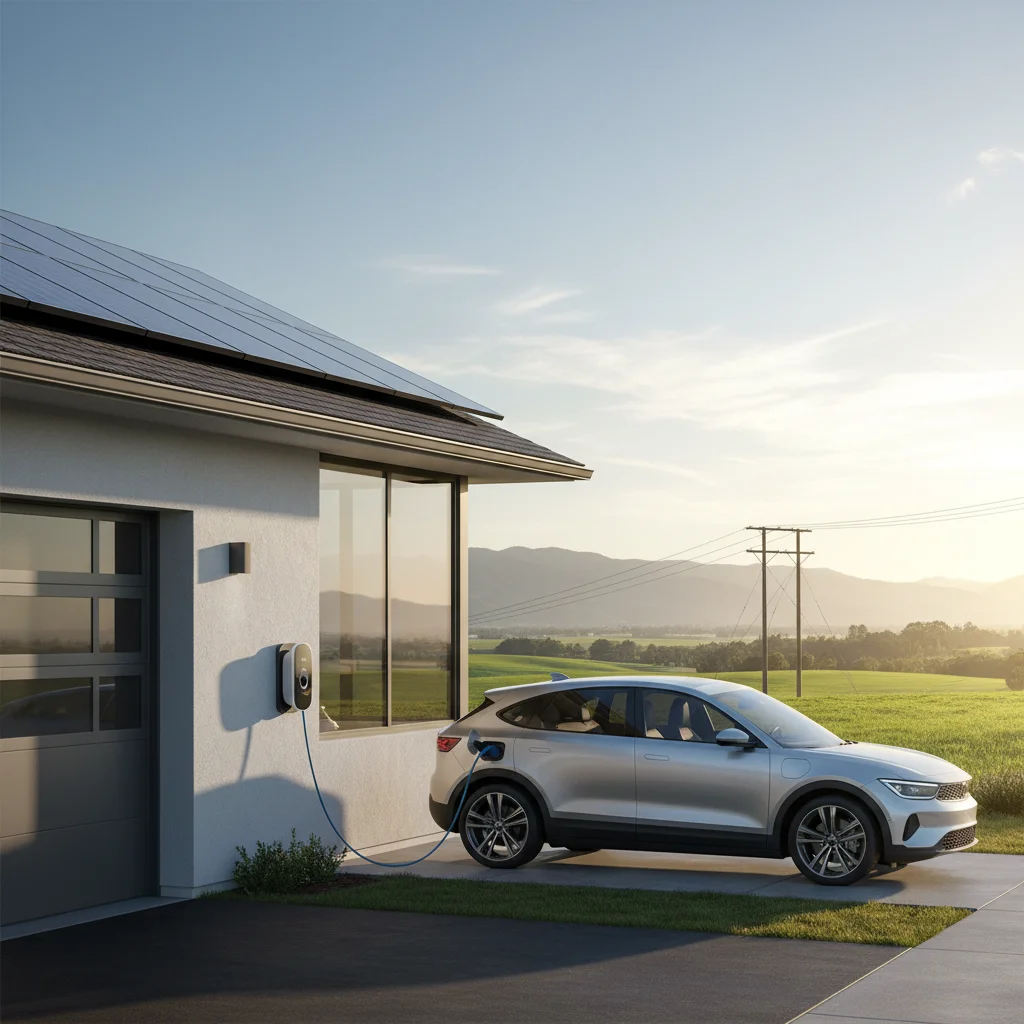
California's Central Valley electric vehicle owners claimed over $18 million in state and utility EV charger rebates during 2025, yet 64% of eligible installations never applied. The region's agricultural economy and longer commutes create unique charging needs, and homeowners who install Level 2 chargers now access up to $7,500 in combined federal, state, and utility incentives through 2026 programs.
What EV Charger Rebates Are Available in the Central Valley Right Now?
Central Valley homeowners in 2026 access three rebate layers: California's Clean Vehicle Rebate Project provides $2,000 for charger hardware and installation, Pacific Gas & Electric offers $1,500 through its EV Charge Network program for customers in Fresno and Sacramento counties, and federal IRA tax credits cover 30% of equipment costs up to $1,000. Combined maximum reaches $4,500 before federal credits.
And the timing matters. PG&E's 2026 allocation funds 3,200 residential installations across its Central Valley service territory, distributed first-come basis. The California Energy Commission tracks real-time availability through its Clean Vehicle Rebate dashboard, showing current funding levels by ZIP code.
But geographic coverage varies. Southern California Edison serves Kern County portions of the Central Valley with different rebate structures—$1,000 flat for Level 2 installations regardless of charger cost. Modesto Irrigation District and Turlock Irrigation District offer $500 rebates for municipal utility customers, stacking with state programs.
So households installing 40-amp Level 2 chargers averaging $1,800 see net costs drop to $300-800 after rebates. Federal Alternative Fuel Infrastructure tax credits add $528-600 in additional savings when claimed on 2026 returns. Calculate your specific savings with our free rebate calculator to see exact amounts based on your utility provider.
How Much Money Can You Get Back on Your Home EV Charger Installation?
Installation costs range $1,200-$3,500 depending on electrical panel capacity and distance from garage to service panel. Central Valley rebates cover 55-75% of total project costs when homeowners combine all available programs. State rebates pay within 45-60 days, utility rebates process in 30-45 days, and federal credits reduce 2026 tax liability.
Income-qualified households earning below 80% Area Median Income access enhanced California rebates of $4,000 instead of $2,000. And Fresno County AMI thresholds for 2026 stand at $68,400 for families of four, while Sacramento County sets limits at $92,300. Eligible households claim up to $6,500 in total state and utility rebates before federal credits.
Equipment costs separate from installation—Level 2 chargers range $400-$1,200 for residential units delivering 7.2-11.5 kW output. But utility rebates require specific hardware certifications. PG&E mandates UL 2594 listing and ENERGY STAR certification, restricting rebates to 127 approved charger models listed on the utility website.
So a Fresno homeowner installing a $700 ChargePoint Home Flex and paying $1,400 for electrical work receives $2,000 state + $1,500 PG&E + $630 federal credit, netting $1,970 in rebates against $2,100 total cost. The installation costs $130 out-of-pocket with 93% coverage.
What Documentation Do You Need to Qualify for Central Valley EV Charger Rebates?
California requires proof of vehicle registration showing EV ownership within 12 months of charger installation. Applicants submit photos of installed equipment with visible serial numbers, itemized contractor invoices showing labor and materials separately, and electrical permits from local building departments. And Sacramento County processes 850 EV charger permits annually—inspections occur within 10 business days of installation completion.
Utility rebates demand additional verification. PG&E requires EV Charge Network enrollment before installation begins, with applicants providing VIN numbers, utility account numbers, and installation addresses matching billing records. The utility validates enrollment within 5 business days, issuing authorization codes needed for contractor rebate assignments.
Income-qualified applicants supply extra documentation—2025 federal tax returns showing adjusted gross income, recent pay stubs covering 60 consecutive days, or participation letters from CalFresh, Medi-Cal, or Section 8 housing programs. And the California Energy Commission accepts W-2 forms as income verification for self-employed applicants without traditional pay documentation.
The federal 30C charger credit ended for chargers placed in service after June 30, 2026 (IRS FS-2025-05). Federal tax credits for this work have ended, but state, local and utility rebates may still apply; check what is available at your address with the DuloCore rebate calculator. Homeowners attach manufacturer certification statements confirming charger eligibility and retain installation receipts showing placed-in-service dates. Learn more about qualifying installations through our energy tax credits guide.
Do You Need Pre-Approval Before Installing Your EV Charger to Get the Rebate?
PG&E mandates pre-enrollment for its EV Charge Network rebate—installations completed before enrollment approval forfeit utility incentives. The utility emails authorization within 3-7 business days after reviewing application details. But California state rebates accept post-installation applications submitted within 90 days of permit finalization.
Southern California Edison operates differently. The utility accepts pre-approval applications or post-installation submissions within 180 days, offering flexibility for homeowners starting projects immediately. And municipal utilities like Modesto Irrigation District require pre-approval forms submitted 30 days before installation, reviewing applications within 15 business days.
Federal tax credits impose no pre-approval requirements. Homeowners claim Alternative Fuel Infrastructure credits on tax returns filed April 2027 for 2026 installations, with IRS accepting claims up to three years after original filing deadlines.
So timing strategies vary by program. Start PG&E enrollment 14 days before scheduling electrical work, complete state applications within 60 days of final inspection, and gather federal documentation throughout the project. Missing pre-approval deadlines costs $1,500-2,000 in utility rebates—the largest single incentive layer for Central Valley residents.
What's the Deadline for Applying for EV Charger Rebates in Your Area?
California's Clean Vehicle Rebate Project 2026 allocation expires December 31, 2026, or when $180 million in statewide funding depletes. The program paid out 47% of annual allocation by March 2026, suggesting September-October fund exhaustion based on current claim rates. And Central Valley applications constitute 14% of statewide volume, equating to roughly 4,200 remaining rebates for the region.
PG&E's program operates on fiscal years ending June 30. The utility's 2026 fiscal allocation covers installations completed through June 30, 2026, with applications accepted until September 30, 2026. But historically, PG&E exhausts residential rebate funds by May in high-demand years—2025 depleted April 18.
Municipal utility deadlines vary. Modesto Irrigation District sets annual caps of 150 residential rebates, typically exhausting by August. Turlock Irrigation District maintains rolling availability with 30-day application windows after installation completion.
The federal 30C charger credit ended for chargers placed in service after June 30, 2026 (IRS FS-2025-05). Check current EV charger rebate availability before starting projects.
How Do Central Valley EV Charger Rebates Compare to Federal Tax Credits?
Federal credits provide 30% of equipment and installation costs up to $1,000 maximum—a household spending $3,333 reaches the cap. California state rebates offer $2,000 flat regardless of project cost, and PG&E adds $1,500 flat. So projects under $3,300 receive better value from state and utility programs delivering $3,500 versus federal $990.
Homeowners claiming $1,000 Alternative Fuel Infrastructure credit see $1,000 lower 2026 tax bills, realizing value only if tax liability exceeds the credit amount. And non-refundable credit structure means households owing less than $1,000 in federal taxes forfeit the difference—unused portions don't convert to refunds.
State and utility rebates arrive as direct payments 30-90 days after installation, independent of tax liability. PG&E deposits funds via electronic transfer to contractor accounts or mails checks to homeowners. California Energy Commission issues rebates through online portals with direct deposit options.
So cash flow timing favors state programs. A Modesto homeowner completes installation March 2026, receives California rebate by May, collects PG&E payment by June, and claims federal credit April 2027. The 13-month delay on federal benefits affects project financing. Explore additional efficiency upgrades through our heat pump rebates guide.
The federal 30C charger credit ended for chargers placed in service after June 30, 2026 (IRS FS-2025-05).
Official Sources
- DOE Alternative Fuels Data Center — Federal tax credit details and state-by-state incentive summaries (note: the federal 25C and 25D credits ended for projects completed after December 31, 2025)
- California Clean Vehicle Rebate Project — Real-time funding availability and application portals
- Database of State Incentives for Renewables & Efficiency — Comprehensive California utility rebate program listings
Related Reading: Learn more about Central Air Conditioning Rebates and Home Ev Charger Rebate.
Frequently Asked Questions
What are the eligibility requirements for EV charger rebates in Central Valley?
California requires vehicle registration showing battery electric or plug-in hybrid ownership, primary residence installation addresses, and completed electrical permits. PG&E customers need active utility accounts with service addresses matching installation locations. Income-qualified enhanced rebates require documentation proving household earnings below 80% Area Median Income—$68,400 for Fresno families of four, $92,300 for Sacramento County. And chargers must carry UL 2594 certification and appear on utility-approved equipment lists containing 127 qualifying models.
How much can you get back from an EV charger rebate in Central Valley?
Combined incentives reach $4,500-7,500 depending on location and income. Standard households claim $2,000 California state rebate plus $1,500 PG&E utility rebate plus $630 average federal tax credit, totaling $4,130. Income-qualified applicants increase state rebates to $4,000, raising totals to $6,130. Southern California Edison Kern County customers receive $1,000 utility rebates instead of PG&E's $1,500. Municipal utility customers in Modesto and Turlock add $500 to state and federal amounts.
What is the application process for Central Valley EV charger rebates?
Start with PG&E EV Charge Network pre-enrollment 14 days before installation, providing VIN and utility account numbers. Schedule licensed electrical contractor installation with permits from local building departments—inspections occur within 10 business days. Submit California Clean Vehicle Rebate application within 90 days of permit finalization, uploading photos, invoices, and vehicle registration. File utility rebate claims within 30-45 days using authorization codes from pre-enrollment. The federal 30C charger credit ended for chargers placed in service after June 30, 2026 (IRS FS-2025-05).
When is the deadline to apply for EV charger rebates in Central Valley?
California state rebates expire December 31, 2026, or when $180 million statewide allocation depletes—current pace suggests September 2026 exhaustion. PG&E accepts applications through September 30, 2026, for installations completed by June 30, 2026, but historically depletes funds by April-May. Municipal utilities maintain rolling 30-180 day windows after installation. The federal 30C charger credit ended for chargers placed in service after June 30, 2026 (IRS FS-2025-05). Apply for state and utility programs within 60 days of installation to secure limited allocations.
How do Central Valley EV charger rebates compare to federal tax credits?
State and utility rebates deliver $3,500 direct payment ($2,000 state + $1,500 PG&E) arriving 30-90 days after installation, independent of tax liability. The federal 30C charger credit ended for chargers placed in service after June 30, 2026 (IRS FS-2025-05). Federal credits reduce tax liability but don't refund unused portions, while state programs pay full amounts regardless of tax situations. Projects under $3,300 gain more value from state/utility programs than federal credits.
Ready to calculate your exact Central Valley EV charger rebate? Use our free rebate calculator to get personalized savings based on your ZIP code, utility provider, and household income. See combined federal, state, and utility incentives in under 60 seconds.
Updated: April 14, 2026 — fact-checked by DuloCore Research. About our editorial process.
Check your California EV charger rebate eligibility — see the programs you qualify for and the dollar amounts on our California EV charger rebate finder.