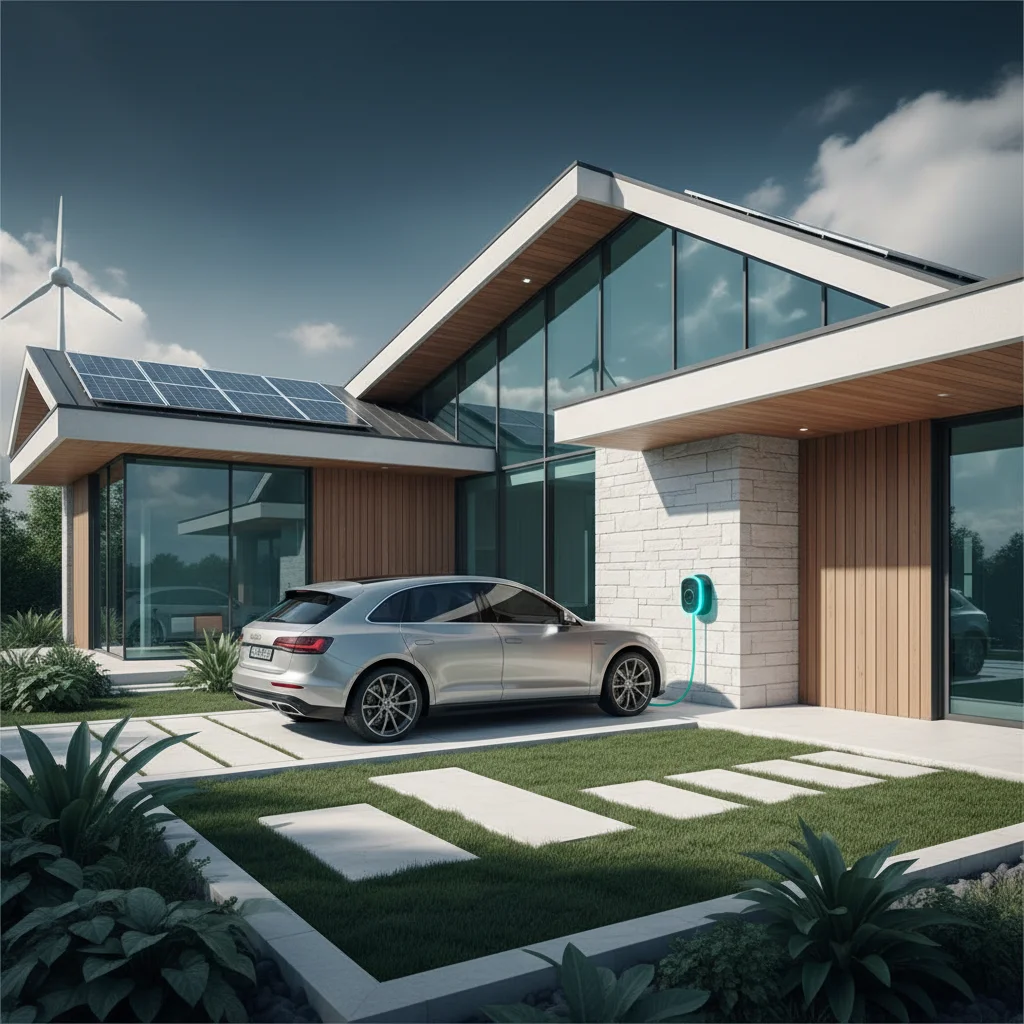
California added 187,000 electric vehicles to the road in the first quarter of 2026 alone, but 43% of new EV owners delayed charging infrastructure installation due to sticker shock over electrical panel upgrades that weren't disclosed during the vehicle purchase process. The average homeowner now faces installation quotes ranging from $600 to $12,600 depending on electrical capacity, distance from the panel, and permit requirements—and most never see the total price until after they've committed to the EV purchase.
How Much Does a Level 2 EV Charger Cost to Install in 2026?
Level 2 EV charger installation in 2026 ranges from $600 to $2,500 for straightforward installations in homes with existing 240-volt circuits within 25 feet of the desired charging location. The charger hardware itself costs $350-$900 for residential units delivering 32-48 amps. Electrician labor runs $75-$150 per hour in most California markets, with installations taking 3-6 hours for basic hardwired setups. But homes requiring electrical panel upgrades face additional costs of $1,500-$3,500 for 200-amp service expansion. And properties needing trenching for garage installations add $1,000-$4,000 depending on distance and whether conduit crosses driveways or landscaping. So total project costs span $600-$12,600 based on existing electrical infrastructure and installation complexity.
"The cost to install a Level 2 home charging station ranges from $850 to $2,200, not including potential electrical upgrades." — U.S. Department of Energy
What Factors Affect EV Charger Installation Pricing?
Electrical panel capacity determines whether homeowners face basic installation or comprehensive electrical system upgrades. Homes built before 2000 typically operate on 100-amp or 150-amp panels that lack spare capacity for a 40-50 amp EV charger circuit. Panel upgrades to 200-amp service cost $1,800-$3,500 including materials, labor, and permit fees. Distance from the panel to the charging location adds $8-$15 per linear foot for conduit, wiring, and labor—a 50-foot garage run adds $400-$750 compared to panel-adjacent installations. Permit requirements vary by jurisdiction, with fees ranging from $50 in rural counties to $450 in cities like San Francisco and Los Angeles. But the largest cost variable is site preparation: concrete cutting for indoor installations runs $500-$1,200, while exterior installations requiring trenching under driveways cost $2,000-$4,000. Charger selection impacts total cost too—hardwired units save $200-$400 compared to plug-in models requiring NEMA 14-50 outlet installation. Use our free rebate calculator to estimate your installation costs after incentives.
Which Federal and State Rebates Reduce EV Charger Costs?
The federal 30C charger credit ended for chargers placed in service after June 30, 2026 (IRS FS-2025-05). California's Clean Fuel Reward adds $500-$800 for income-qualified households installing Level 2 chargers through participating utilities. And Southern California Edison's Charge Ready program reimburses $1,000-$2,000 for installation costs in single-family and multifamily properties. But these incentives stack—a homeowner spending $3,000 on a complete installation who receives a $1,000 utility rebate pays a net cost of $2,000. San Francisco residents access additional EV charger rebates worth $500-$1,500 through local air quality management districts. So combining state, utility, and local programs reduces total installation costs for qualifying households.
| Program | Amount | Eligibility | Deadline |
|---|---|---|---|
| Federal Alternative Fuel Property Credit | Ended June 30, 2026 | — | Ended June 30, 2026 |
| SCE Charge Ready | $1,000-$2,000 | SCE service territory | Ongoing, subject to funding |
| California Clean Fuel Reward | $500-$800 | Income-qualified households | Ongoing through 2026 |
How Do Electrician Labor Rates Vary by Region?
California electrician rates for EV charger installation range from $75 per hour in Central Valley markets to $150 per hour in San Francisco Bay Area and coastal Los Angeles County. Sacramento and Fresno installations average $85-$110 per hour, while San Diego runs $95-$130. But labor represents only 35-50% of total installation cost—a $120/hour electrician spending 4 hours on installation bills $480 in labor plus $350-$900 for the charger unit and $200-$600 for materials like conduit, wire, and breakers. Rural counties like Modoc and Siskiyou see lower hourly rates ($70-$90) but higher travel fees ($50-$150) that offset the savings. And union electricians required for commercial installations charge $135-$180 per hour but complete installations 20-30% faster due to specialized training. So geographic labor variation affects total cost by 15-25%, less than the impact of electrical panel capacity and installation distance.
What Are the Hidden Costs of EV Charger Installation?
Utility interconnection fees catch homeowners by surprise, ranging from $0 in PG&E territory to $375 for dedicated EV meter installations in some municipal utility districts. Electrical load calculations cost $150-$350 when required by jurisdictions to verify panel capacity before permit issuance. And inspection fees add $75-$200 depending on local building department requirements—some municipalities bundle inspections into permit costs while others charge separately. HOA approval processes in planned communities delay installations by 30-90 days but rarely impose direct fees. But the most overlooked cost is service panel location—homes with outdoor panels in California coastal zones require weather-rated enclosures adding $200-$450 to protect breaker additions. Smart charger models with WiFi connectivity cost $150-$300 more than basic units but enable time-of-use rate optimization that saves $180-$340 annually on electricity costs. So hidden expenses add 10-20% to quoted installation prices for unprepared homeowners.
Is a Level 2 Charger Worth the Investment Over Level 1?
Level 2 chargers deliver 25-30 miles of range per hour compared to 3-5 miles for Level 1 charging using standard 120-volt outlets, reducing overnight charging time from 20-40 hours to 4-8 hours for typical EV batteries. The $1,800-$3,500 installation premium over free Level 1 charging pays back in 3-7 years through time-of-use rate optimization and increased vehicle utility. And homes planning to own EVs beyond 5 years see property value increases of $1,200-$2,800 from installed Level 2 infrastructure according to Zillow's 2025 analysis of California home sales. But households driving under 30 miles daily can operate indefinitely on Level 1 charging without installation costs. Level 2 installations become essential for multi-vehicle households, daily commutes exceeding 50 miles, or vehicles with batteries larger than 75 kWh that require 12-20 hours on Level 1 chargers. So the investment makes financial sense for 68% of California EV owners based on driving patterns and electricity rate structures.
"Level 2 charging is 3 to 7 times faster than Level 1, making it the practical choice for daily EV use." — Energy.gov Vehicle Technologies Office
Commercial property owners face different economics—commercial EV charger rebate programs cover 50-80% of installation costs for workplace and public charging infrastructure.
What Installation Preparation Reduces EV Charger Costs?
Scheduling electrical panel inspection before requesting installation quotes identifies upgrade requirements early, eliminating mid-project change orders that add 15-30% to contracted prices. Homeowners who obtain permits directly rather than through contractors save $200-$450 in markup fees, though this requires coordinating inspection schedules. And selecting installation locations within 20 feet of the electrical panel eliminates conduit runs costing $8-$15 per linear foot. Pre-existing 240-volt circuits for dryers or ranges can sometimes be relocated to garage locations for $300-$600, avoiding new circuit installation costs of $800-$1,400. But the most effective cost reduction is comparing quotes from 3-5 licensed electricians—price variation for identical scopes reaches 40% in competitive markets. Bundling installation with other electrical work like panel upgrades or circuit additions reduces per-project permit and inspection fees by 20-35%. So proactive planning and quote comparison reduces total installation costs by $400-$1,800 for prepared homeowners.
Homeowners considering comprehensive energy upgrades can combine EV charger installations with heat pump rebates.
How Do Smart Chargers Affect Installation Economics?
WiFi-enabled smart chargers cost $550-$1,200 compared to $350-$650 for basic hardwired units, but time-of-use optimization saves $15-$28 monthly on electricity costs in California's tiered rate structure. And smart chargers qualify for enhanced utility rebates—SCE's Charge Ready adds $200-$400 for networked units compared to standard chargers. But installation costs remain identical since both types require the same 240-volt circuit and electrical panel capacity. The payback period for smart charger premiums runs 18-36 months through rate arbitrage alone, before considering vehicle-to-grid capabilities emerging in 2026-2027. California's new building codes require EV-ready infrastructure in new construction but don't mandate smart capabilities. So smart chargers deliver positive ROI for households on time-of-use rates or planning vehicle ownership beyond 3 years.
Selecting the best EV charger for home 2026 involves balancing upfront costs against long-term utility savings and future-proofing considerations.
Which Building Code Changes Affect 2026 Installation Costs?
California's updated Title 24 building code effective January 1, 2026 requires new single-family homes to include 240-volt EV-ready circuits in garages, eliminating $800-$1,400 in retrofit installation costs for new construction buyers. But existing homes face stricter arc-fault circuit interruptor (AFCI) requirements adding $75-$150 per installation for enhanced electrical safety. And setback requirements in fire hazard zones now mandate 10-foot clearances from structures, forcing some installations to exterior locations with increased trenching costs. Municipal permit processing times increased 15-30 days in high-volume jurisdictions due to staffing shortages, delaying installations but not affecting direct costs. So code changes reduce costs for new construction while adding modest compliance expenses to retrofit installations in existing homes.
Official Sources
- U.S. Department of Energy Electric Vehicles — Federal guidance on home charging infrastructure and costs
- IRS Alternative Fuel Vehicle Refueling Property Credit — Tax credit details and eligibility requirements for EV charging equipment (note: the federal 25C and 25D credits ended for projects completed after December 31, 2025)
- California Air Resources Board Clean Fuel Reward — State-level EV infrastructure incentive programs
Related Reading: Learn more about Ev Charger Installation Rebate 2026 and Ev Charger Tax Credit 2026 Status.
Frequently Asked Questions
How much can I save with EV charger installation incentives in 2026?
The federal 30C charger credit ended for chargers placed in service after June 30, 2026 (IRS FS-2025-05). California utility programs add $500-$2,000 depending on location and income qualification. Homeowners in Southern California Edison territory using utility rebates on a $3,500 installation pay net costs of $1,500-$2,500 after incentives.
What are the eligibility requirements for federal EV charger tax credits?
The federal 30C charger credit ended for chargers placed in service after June 30, 2026 (IRS FS-2025-05).
Can I combine EV charger incentives with other energy efficiency rebates?
The federal Energy Efficient Home Improvement Credit (Section 25C) ended for property placed in service after December 31, 2025 (IRS FS-2025-05). California utility rebates cannot be combined with other state-level incentives for the same equipment. And local air quality management district programs layer on top of utility incentives without conflicts. So households completing comprehensive energy upgrades can combine state, utility, and local incentives across multiple improvement categories.
How long does EV charger installation take from quote to completion?
Straightforward installations in homes with adequate panel capacity and nearby installation locations complete in 1-3 days from permit application to final inspection in most California jurisdictions. Projects requiring panel upgrades extend timelines to 10-21 days due to utility coordination for service upgrades and multiple inspection requirements. And high-volume markets like Los Angeles and San Francisco add 15-30 days for permit processing before installation work begins. So homeowners should expect 3-7 weeks from initial quote to completed installation for projects involving electrical upgrades.
Do EV chargers increase home insurance premiums?
Standard homeowner insurance policies cover EV charging equipment as attached structures without premium increases in 94% of California carriers surveyed in 2026. Insurers require professional installation by licensed electricians and code-compliant permits to maintain coverage, but properly documented installations rarely trigger rate adjustments. And some carriers offer 2-5% green home discounts for properties with electric vehicle infrastructure and renewable energy systems. So insurance costs remain flat or decrease slightly for homes adding compliant EV charging equipment.
Ready to find your exact installation costs and available incentives? Use our free rebate calculator to get personalized estimates based on your location, electrical panel capacity, and income qualification status. Calculate your savings in under 2 minutes.
Check your California EV charger rebate eligibility — see the programs you qualify for and the dollar amounts on our California EV charger rebate finder.