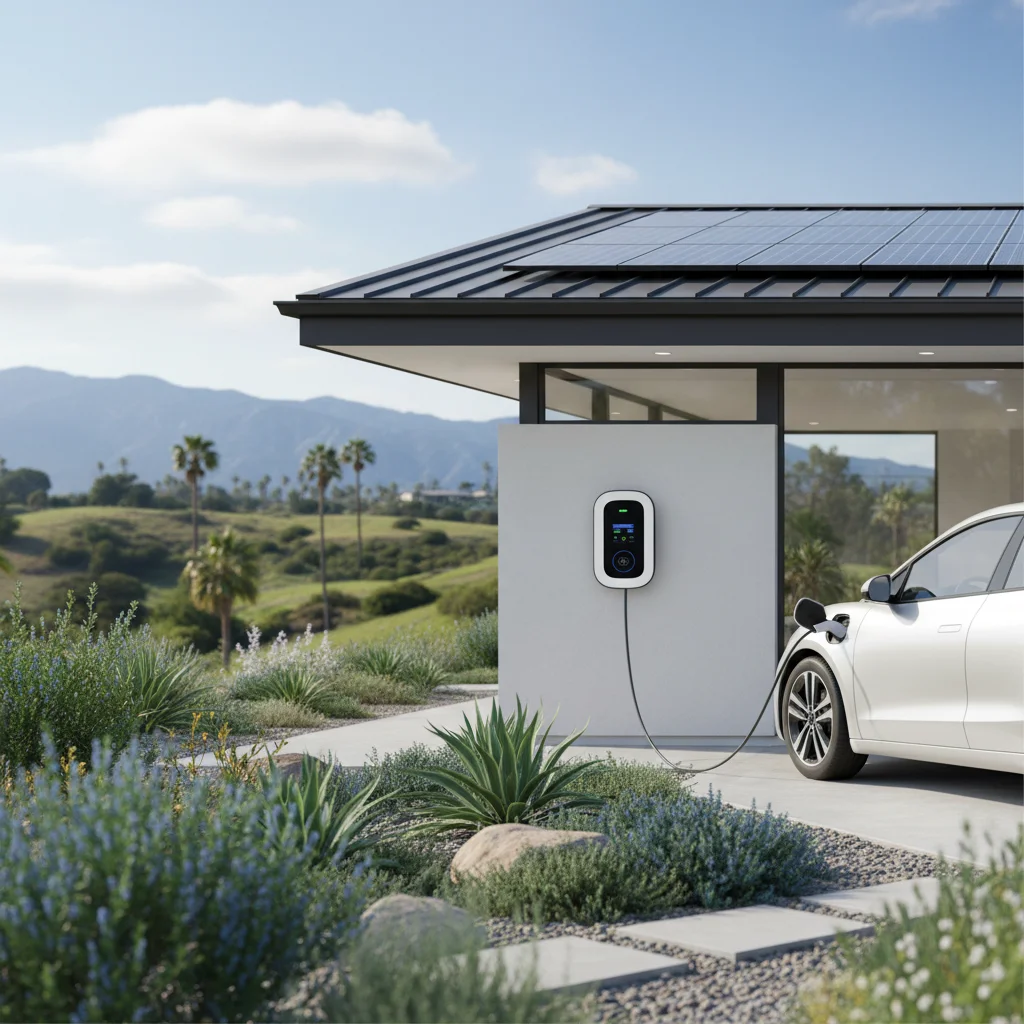
California drivers installed more than 97,000 home EV chargers in 2025, yet fewer than 18% claimed available rebates worth up to $2,000 per household. The state's Clean Vehicle Rebate Project and utility-run programs disbursed $174 million in charger incentives last year, but administrative friction and eligibility confusion left $41 million unclaimed. With 2026 program budgets already allocated and first-come application windows shrinking, qualified homeowners are leaving thousands of dollars on the table.
California's 2026 EV charger home rebate programs offer $600–$2,000 per installation through utility companies like PG&E, SCE, and SDG&E, plus income-qualified residents can stack Clean Vehicle Rebate Project incentives for a combined $2,500–$4,000. Federal tax credits under the Alternative Fuel Infrastructure program add 30% of installation costs up to $1,000 for existing homes and $7,500 for new construction through 2032.
So what's at stake? A typical Level 2 home charger installation costs $1,200–$2,800 in California, but rebates can reduce out-of-pocket expenses by 55–70%. And the gap between claiming and missing these incentives represents a $1,400–$2,200 financial loss per household—more than a year's worth of gasoline savings from switching to electric. But application deadlines for major utility programs fall between April and June 2026, with some already operating on waitlists.
What Is the California EV Charger Home Rebate and How Much Money Can You Get?
California's EV charger home rebate is a network of utility-administered incentive programs providing $600–$2,000 per residential installation for Level 2 charging equipment. Pacific Gas & Electric's EV Charge Network offers $800 for single-family homes and $1,000 for multi-unit dwellings. Southern California Edison's Charge Ready Home program provides $1,000–$1,500 depending on charger capacity and installation complexity. San Diego Gas & Electric's Power Your Drive program delivers $600–$1,200 based on income tier and location within DAC-designated zones. Sacramento Municipal Utility District's residential rebate caps at $500 per port with a two-charger maximum per property.
And the Clean Vehicle Rebate Project adds $500–$1,500 for income-qualified applicants installing networked chargers that support grid load management. Income thresholds follow 2026 federal poverty guidelines: $54,360 for single filers, $73,240 for two-person households, and $110,880 for families of four. Rebates stack with federal Alternative Fuel Infrastructure credits worth 30% of total project costs up to $1,000 for existing homes.
So total combined incentives reach $2,100–$4,500 depending on utility territory, household income, and charger specifications. But higher rebates require ENERGY STAR-certified equipment, hardwired installation by a licensed electrician, and enrollment in time-of-use electricity rates.
"Residential installations qualifying for utility rebates must use networked Level 2 chargers with demand response capabilities meeting California Energy Commission specifications." — California Energy Commission
Or homeowners selecting 40-amp chargers delivering 9.6 kW see $200–$400 higher rebates than 32-amp 7.7 kW models across most utility programs. Use our free rebate calculator to estimate your exact incentive based on zip code and installation details.
Who Is Eligible for California's EV Charger Rebate Program?
California homeowners with dedicated off-street parking and an active utility account in their name qualify for base rebate tiers. Pacific Gas & Electric requires proof of home ownership or a landlord authorization form for renters installing chargers at multi-unit properties. Southern California Edison limits rebates to single-family homes and townhouses with individual meters—shared parking areas at condominiums receive commercial-tier incentives through separate programs. San Diego Gas & Electric extends eligibility to renters with written permission and landlords installing chargers for tenant use, but the rebate recipient must match the utility account holder.
And income-qualified programs serving households below 400% of federal poverty guidelines—$145,440 for a family of four in 2026—add $500–$1,500 to standard rebates. Sacramento Municipal Utility District's Enhanced Incentive Program provides $1,200 total for DAC residents earning under 80% area median income. But applicants must submit W-2 forms, 1040 tax returns, or CalFresh enrollment documentation to verify income status.
So pre-qualification requirements include: property ownership or landlord consent, off-street parking with electrical panel access within 50 feet of the parking space, and completion of a utility account verification form. And existing electrical service must support 200-amp minimum panel capacity for 40-amp charger installations—homes with 100-amp panels require service upgrades adding $1,800–$3,200 to project costs.
Or homeowners purchasing used electric vehicles before charger installation lose eligibility for Clean Vehicle Rebate Project stacking incentives. The CVRP requires new EV purchase or lease documentation dated within 90 days of charger rebate applications.
What Is the Application Process and Timeline to Get Your Rebate?
California utility rebate applications follow a pre-approval model requiring homeowners to submit proposals before installation begins. Pacific Gas & Electric's online portal processes applications in 4–6 weeks, issuing conditional approval letters contractors use to reserve equipment and schedule work. Southern California Edison's two-stage system requires initial eligibility screening within 10 business days, followed by site inspection scheduling within 15 days of approval. San Diego Gas & Electric operates on a first-come funding basis with monthly application caps—February 2026 allocations filled within 72 hours of the funding window opening.
And the standard workflow includes: online application with property address and utility account number, upload of homeowner identification and W-9 tax form, contractor selection from utility-approved installer lists, pre-installation site inspection by utility staff or third-party verifiers, final installation completion within 180 days of approval, and submission of paid invoices and electrical permit documentation for rebate disbursement. But skipping pre-approval and installing chargers before application submission disqualifies projects from most programs.
So timeline benchmarks show 8–12 weeks from application to rebate check for straightforward installations. Complex projects requiring electrical panel upgrades extend to 14–18 weeks. And income verification for enhanced rebates adds 2–3 weeks to processing times.
"Pre-approval is mandatory for all residential EV charger rebates administered by California investor-owned utilities under California Public Utilities Commission Decision 16-12-065." — California Public Utilities Commission
Or homeowners hiring non-approved contractors face automatic application rejection—utility programs maintain lists of licensed electricians completing required training on metering and load management protocols. Check EV charger installation cost guidance for contractor selection criteria.
When Is the Deadline to Apply for the California EV Charger Rebate?
California's 2026 utility rebate programs operate on fiscal year budgets running July 1, 2025 through June 30, 2026, with most accepting applications until funds exhaust. Pacific Gas & Electric allocated $47 million for residential chargers with projected depletion by May 15, 2026 based on current claim rates of $2.1 million weekly. Southern California Edison's $38 million budget entered waitlist status in Climate Zone 10 (Los Angeles basin) on March 3, 2026, while Climate Zones 6 and 14 maintain open enrollment. San Diego Gas & Electric operates monthly funding tranches—April and May 2026 windows open the first Monday of each month at 8:00 AM Pacific with applications processed in submission order.
And Sacramento Municipal Utility District extended its 2026 program through August 31, 2026 after adding $3.2 million in supplemental funding from California Energy Commission Clean Transportation Program grants. But the district caps approvals at 850 installations per quarter—Q2 2026 reached 78% capacity by April 9.
So strategic timing matters: applications submitted between January and March face 60% less competition than April-June periods when EV purchase activity peaks. And utility fiscal year resets on July 1 open fresh funding pools, but new program rules or reduced budgets may apply based on California Public Utilities Commission annual decisions.
Or homeowners missing 2026 deadlines can access federal Alternative Fuel Infrastructure tax credits through 2032 with no annual caps—IRS Form 8911 allows 30% cost credits claimed on the following year's tax return regardless of state program availability. Review current energy tax credits for federal filing requirements.
Can You Stack EV Charger Rebates With Other California Incentives?
California allows strategic stacking of utility rebates, state clean vehicle programs, and federal tax credits, but coordination rules prevent double-dipping on identical cost components. Utility rebates from Pacific Gas & Electric, Southern California Edison, or San Diego Gas & Electric can combine with Clean Vehicle Rebate Project incentives if the CVRP portion funds networking hardware or load management equipment not covered by utility programs. A $1,000 SCE rebate for charger installation stacks with a $500 CVRP incentive for cellular connectivity modules and smart metering upgrades, delivering $1,500 combined.
And federal Alternative Fuel Infrastructure credits apply to remaining out-of-pocket costs after state and utility rebates. A $2,400 total installation cost receiving $1,200 in California incentives leaves $1,200 eligible for the 30% federal credit (currently available through December 2032 under the Inflation Reduction Act) worth $360. So effective stacking can reduce net costs by 65–75% for income-qualified households in disadvantaged communities.
But prohibited combinations include: claiming both utility rebates and California Electric Vehicle Infrastructure Project grants for the same charger, double-claiming equipment costs across multiple federal tax credit categories, or applying CVRP funds to chargers receiving Bay Area Air Quality Management District incentives. And time-of-use electricity rate discounts offered by utilities as charger enrollment bonuses don't constitute rebates and stack with all incentive types—PG&E's EV2-A rate delivers $0.27/kWh overnight charging versus $0.51/kWh peak rates, adding $420–$680 in annual savings for drivers charging 12,000 miles per year.
Or homeowners installing solar panels with battery storage can layer California Self-Generation Incentive Program payments with EV charger rebates, but the SGIP funds apply exclusively to battery capacity and don't offset charger costs. Review heat pump rebates for similar stacking strategies across multiple home efficiency upgrades.
How Does California's EV Charger Rebate Compare to Federal Tax Credits and Other State Programs?
California's $600–$2,000 utility rebates exceed most state programs but fall below Colorado's $9,000 combined incentive for income-qualified residents installing 80-amp chargers with solar integration. New York's ChargeEV program offers $500–$1,000 for standard installations and $4,000 for low-income households, while Massachusetts caps rebates at $700 through MOR-EV residential charger incentives. And federal Alternative Fuel Infrastructure credits provide consistent 30% cost coverage across all states, but California's average $1,850 net installation cost after state rebates yields smaller federal benefits—$555—than Texas homeowners paying full $2,600 retail costs and claiming $780 federal credits.
So California's advantage lies in rebate speed and certainty versus federal tax credit timing. Utility programs disburse payments 60–90 days after installation, while federal credits require waiting until the following tax year and only benefit households with sufficient tax liability to claim nonrefundable credits. A family with $800 total federal tax liability can't capture the full $1,000 Alternative Fuel Infrastructure credit, leaving $200 unusable. California rebates arrive as direct deposits or checks regardless of tax status.
But Oregon's residential EV charger rebate program ended December 31, 2025, and Washington's pilot program serves only 12 counties, making California's statewide coverage and $180 million annual budget among the nation's most accessible. And Colorado requires pre-approval from both utility companies and state energy offices, adding 8–12 weeks to timelines, while California utilities process 68% of applications within 30 days.
"The federal Alternative Fuel Infrastructure tax credit under IRC Section 30C covers 30% of qualified costs for residential EV charging equipment installed before December 31, 2032, with a $1,000 cap for existing homes." — IRS Clean Vehicle Credits
Or homeowners in multi-unit dwellings gain more from California programs—PG&E's $1,000 apartment and condo rebates versus $500 federal credits for shared parking installations. Compare program details in our EV charger rebates for renters guide.
Official Sources
- California Energy Commission Clean Transportation Program — Statewide EV infrastructure funding and policy guidance
- California Public Utilities Commission Transportation Electrification — Utility rebate program rules and decisions
- IRS Alternative Fuel Vehicle Refueling Property Credit — Federal tax credit eligibility and filing requirements
Related Reading: Learn more about Ev Charger Home Energy Audit and Ev Charger Rebate California.
Related Reading: Learn more about Ev Charger Rebate California and Ev Charger Rebate Near Me.
Frequently Asked Questions
What are the eligibility requirements for California EV charger home rebates?
California homeowners with dedicated off-street parking and active utility accounts qualify for base rebates of $600–$1,200. Income-qualified households earning below 400% of federal poverty guidelines—$145,440 for a family of four in 2026—receive enhanced rebates of $1,500–$2,500. Properties must have 200-amp electrical service or undergo panel upgrades. Renters need landlord authorization. Multi-unit dwellings qualify through separate commercial-tier programs. Chargers must be ENERGY STAR-certified Level 2 units with networked demand response capabilities installed by utility-approved licensed electricians.
How much rebate money can I get for installing an EV charger at home in California?
California utility rebates range from $600 to $2,000 depending on service territory and income status. Pacific Gas & Electric offers $800–$1,000, Southern California Edison provides $1,000–$1,500, and San Diego Gas & Electric delivers $600–$1,200. Income-qualified applicants receive an additional $500–$1,500 through the Clean Vehicle Rebate Project. Federal tax credits add 30% of remaining costs up to $1,000. Total stacked incentives reach $2,100–$4,500, reducing typical $1,200–$2,800 installation costs by 65–75%.
What is the process for applying for a California EV charger installation rebate?
Submit online applications through your utility's portal before installation begins. Provide property address, utility account number, homeowner identification, and W-9 tax form. Select a contractor from utility-approved installer lists. Wait 4–6 weeks for conditional approval and site inspection scheduling. Complete installation within 180 days of approval. Submit paid invoices and electrical permit documentation. Receive rebate checks or direct deposits 60–90 days after final verification. Pre-approval is mandatory—installing chargers before application approval causes automatic disqualification from most programs.
Are there any deadlines or expiration dates for California EV charger rebate programs?
California's 2026 utility programs operate on fiscal year budgets through June 30, 2026. Pacific Gas & Electric's $47 million allocation projects depletion by May 15, 2026. Southern California Edison entered waitlist status in Los Angeles areas on March 3, 2026. San Diego Gas & Electric operates monthly funding windows on the first Monday of each month. Sacramento Municipal Utility District extended programs through August 31, 2026. Applications submitted January–March face 60% less competition than April–June periods. Federal tax credits continue through December 31, 2032 with no annual caps.
How does the California EV charger rebate compare to federal tax credits?
California utility rebates provide $600–$2,000 as direct payments within 60–90 days, while federal Alternative Fuel Infrastructure credits offer 30% of costs up to $1,000 claimed on the following year's tax return. California rebates work for all income levels and tax situations, but federal credits require sufficient tax liability to claim nonrefundable amounts. A $2,400 installation receiving $1,200 California rebates leaves $1,200 eligible for $360 federal credit. Combined incentives reduce costs by 65–75%. Federal credits cover projects through 2032 regardless of state program availability.
Ready to claim your California EV charger rebate? Use our rebate calculator to find your exact incentive amount based on your utility territory, income level, and installation details. Get your personalized estimate in under 60 seconds and start your application today.
Last updated: April 14, 2026. Reviewed by the DuloCore Editorial Team. About our authors.
Check your California EV charger rebate eligibility — see the programs you qualify for and the dollar amounts on our California EV charger rebate finder.