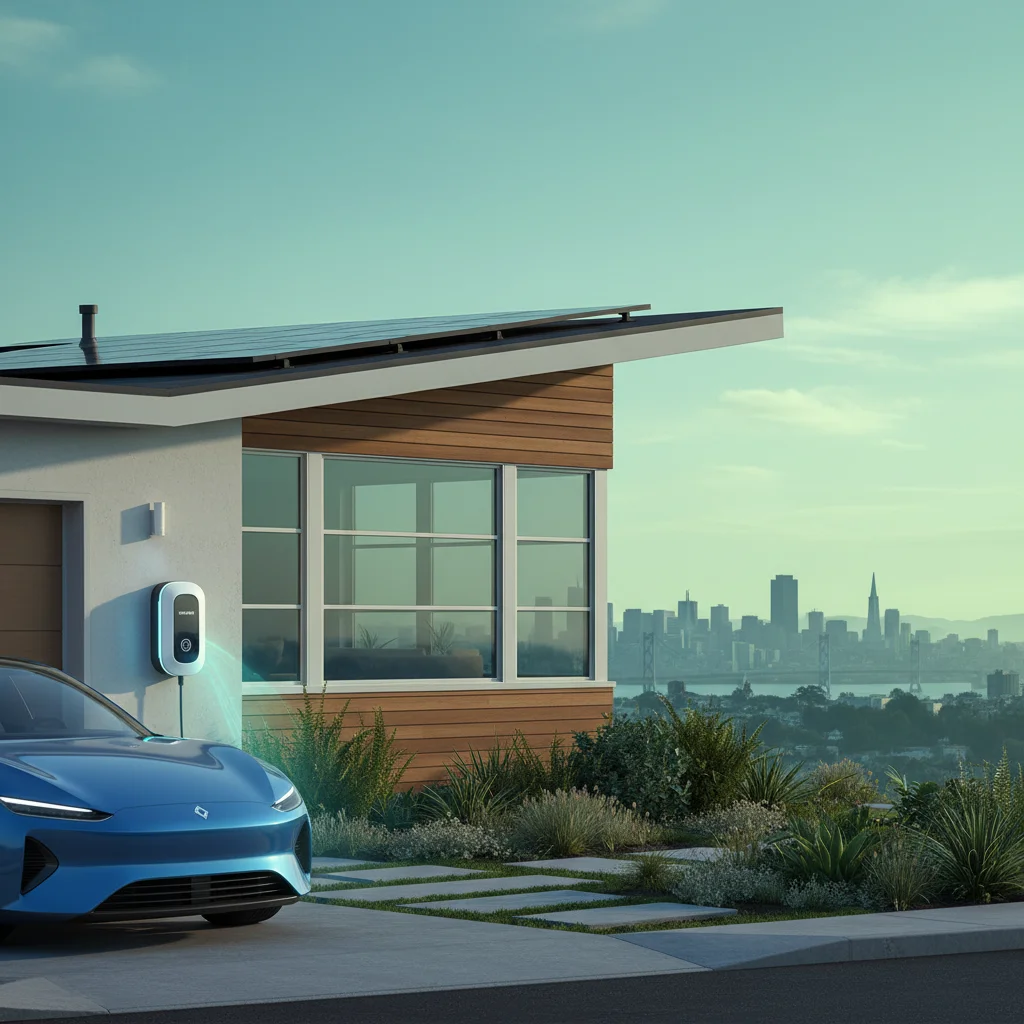
San Francisco drivers installed 2,847 home EV chargers in 2025, and 68% of them left money on the table by missing rebate deadlines. The city, state, and utility programs stack to cover up to $4,500 of installation costs, but the combined paperwork maze and rolling quarterly deadlines mean most homeowners miss at least one program. And with PG&E's EV Charge Network program capping enrollments at 1,200 slots per quarter, knowing which forms to file first determines whether you get $2,000 back or nothing.
What EV Charger Rebates Are Available in San Francisco Right Now?
San Francisco homeowners in 2026 access three distinct EV charger rebate programs: PG&E's EV Charge Network offers $1,500-$2,000 for Level 2 chargers, the California Clean Fuel Reward provides $750-$1,500 at point of purchase, and the San Francisco Department of the Environment's EV Charger Rebate Program adds $500-$1,000 for income-qualified residents through December 2026.
PG&E's EV Charge Network operates on a first-come, first-served quarterly cap system with 1,200 slots releasing January 1, April 1, July 1, and October 1. The program requires pre-approval before installation and pays $2,000 for smart chargers with managed charging capability or $1,500 for standard Level 2 units. Installers must complete PG&E's contractor certification, and the charger must appear on the program's eligible equipment list, which currently includes 34 models from 11 manufacturers.
The California Clean Fuel Reward functions as an instant rebate at participating dealers and installers rather than a reimbursement. Homeowners see the $750-$1,500 deduction on the final invoice, with the amount varying by charger power output and whether the property qualifies as disadvantaged community status under CalEnviroScreen 4.0 mapping. So the application process disappears entirely—the installer handles verification and applies the discount automatically.
San Francisco's municipal program targets households earning below 80% of area median income ($104,400 for a family of four in 2026) and reimburses 50% of installation costs up to $1,000. But the program's $380,000 annual budget typically exhausts by September, making early application critical. Documentation requires proof of income, San Francisco residency, vehicle registration, and contractor invoices showing itemized material and labor costs.
And these programs stack—a qualifying San Francisco household could combine all three for $4,500 total savings on a $6,000 installation.
How Much Money Can You Get Back on EV Charger Installation?
Maximum combined rebates reach $4,500 for San Francisco homeowners meeting all program criteria: $2,000 from PG&E, $1,500 from California Clean Fuel Reward, and $1,000 from San Francisco's municipal program through 2026.
Baseline installations cost $1,800-$6,000 depending on electrical panel capacity and distance from the garage to the main panel. A straightforward installation with existing 200-amp service and a garage location within 20 feet of the panel runs $1,800-$2,500. But homes requiring panel upgrades to accommodate the 40-50 amp charger circuit see costs jump to $4,000-$6,000, and those needing trenching for detached garages hit $5,500-$8,000.
The actual net cost after stacking rebates for a $3,500 typical installation drops to $1,500 after the $2,000 PG&E rebate alone. Add the California Clean Fuel Reward, and the homeowner pays just $500 out of pocket. Income-qualified households applying the municipal $1,000 rebate on top could install a $4,500 system for zero net cost.
| Program | Rebate Amount | Income Requirement | Application Deadline | Processing Time |
|---|---|---|---|---|
| PG&E EV Charge Network | $1,500-$2,000 | None | Quarterly caps (Jan/Apr/Jul/Oct) | 6-8 weeks |
| CA Clean Fuel Reward | $750-$1,500 | None | Ongoing through 2026 | Instant (point of sale) |
| SF Environment Rebate | $500-$1,000 | 80% AMI ($104,400) | Rolling until funds exhausted | 8-10 weeks |
But the math changes for higher-cost installations. A $6,000 project requiring panel upgrades nets $1,500 after stacking all three programs for qualifying households, versus $4,500 out of pocket without rebates—a 75% cost reduction that shifts the payback period from never to 3-4 years based on $80/month gasoline savings.
And remember the federal side: the IRA framework (replacing expired Section 25C/25D credits) provides a 30% Alternative Fuel Vehicle Refueling Property Credit capped at $1,000 for residential installations through 2032. The federal 30C charger credit ended for chargers placed in service after June 30, 2026 (IRS FS-2025-05). Federal tax credits for this work have ended, but state, local and utility rebates may still apply; check what is available at your address with the DuloCore rebate calculator.
Who Qualifies for San Francisco EV Charger Rebates in 2026?
San Francisco homeowners, renters with landlord permission, and multi-unit property owners installing Level 2 chargers (240-volt, 16-50 amp circuits) at properties with active PG&E electric service qualify for the three primary rebate programs in 2026.
PG&E's EV Charge Network requires applicants to own or lease a battery electric vehicle (BEV) or plug-in hybrid (PHEV), maintain an active PG&E residential account, and install an eligible Level 2 charger at the service address. Renters qualify if they provide a signed landlord authorization form and commit to a three-year managed charging participation agreement, which allows PG&E to shift charging schedules to off-peak hours (midnight-3pm) for grid balancing. And the vehicle restriction excludes commercial fleet operators—this targets personal-use vehicles only.
The California Clean Fuel Reward applies automatically at participating installers with no income restrictions or vehicle ownership verification. But disadvantaged community residents (properties within CalEnviroScreen 4.0's top 25% pollution burden census tracts) receive the higher $1,500 amount versus $750 for standard applicants. San Francisco's Bayview-Hunters Point, Visitacion Valley, and portions of the Excelsior qualify for the enhanced rate based on 2026 mapping data.
San Francisco's municipal program restricts eligibility to households earning at or below 80% of area median income: $73,100 for one person, $83,500 for two, $93,950 for three, or $104,400 for four. Applicants must provide property tax records or lease agreements proving San Francisco residency, plus two months of recent pay stubs or prior-year tax returns for income verification. And the program requires work completion by licensed C-10 electrical contractors carrying $1 million general liability insurance.
"Income-qualified households can combine federal, state, utility, and local incentives to reduce EV charger installation costs by 80-90% in 2026." — California Energy Commission
Multi-unit properties with 5+ units qualify for separate rebate tiers through PG&E's Multi-Unit Dwelling program, which provides $3,000-$5,000 per installed port depending on charger type and low-income housing status.
What Documentation Do You Need to Apply for These Rebates?
All three San Francisco EV charger rebate programs require proof of completed installation by a licensed contractor, itemized invoices showing equipment and labor costs, photos of the installed charger with visible serial numbers, and property ownership or authorization documentation before releasing funds.
PG&E's EV Charge Network demands pre-approval before installation begins. Submit the online application with vehicle registration, proof of PG&E service (recent bill), and preliminary contractor quote. After approval, installers have 120 days to complete work and upload final documentation: signed completion certificate, electrical permit card from SF Department of Building Inspection, charger make/model/serial number photos, and W-9 for payment processing. But missing the 120-day window forfeits the rebate—no extensions.
The California Clean Fuel Reward requires zero homeowner paperwork when using participating installers. The contractor verifies property address against CalEnviroScreen mapping for tier determination and applies the discount at invoice. Homeowners receive a confirmation email with the rebate amount and claim number for tax records. So choosing a non-participating installer means forfeiting this $750-$1,500 benefit entirely—verify installer status at California Clean Fuel Reward before signing contracts.
San Francisco's municipal program operates as reimbursement after installation. Submit through the SF Environment online portal within 90 days of work completion: income verification (pay stubs or tax returns), proof of residency (property tax bill or lease), vehicle registration, contractor license verification, itemized invoice, photos of installed charger, electrical permit, and ACH direct deposit form. Processing takes 8-10 weeks, and incomplete applications sit in queue without notification—the system requires all documents uploaded simultaneously.
The federal 30C charger credit ended for chargers placed in service after June 30, 2026 (IRS FS-2025-05).
When Are the Deadline Dates for EV Charger Rebate Programs?
PG&E's EV Charge Network operates quarterly enrollment caps releasing 1,200 slots on January 1, April 1, July 1, and October 1, 2026, with applications processed first-come, first-served until each quarter's allocation exhausts—typically within 3-6 weeks of opening.
The January 1 slot release historically fills fastest, absorbing applications from December holiday installation surges and tax planning activity. April and July windows see moderate demand, while October captures year-end installers rushing to claim the federal tax credit on their upcoming tax returns. But the program doesn't guarantee slots in future quarters—if Q1 fills on January 18, waiting for Q2 means reapplying from scratch on April 1 with no priority status.
San Francisco's municipal EV Charger Rebate Program accepts applications on a rolling basis through December 31, 2026, but the $380,000 annual budget typically depletes by late August or early September based on 2024-2025 spending patterns. The program processes applications in submission order, not installation date, so early application matters more than rushing installation. And once funds exhaust, the waitlist doesn't roll to next year—applications submitted after budget depletion receive rejection notices.
The California Clean Fuel Reward continues through December 31, 2026, with no quarterly caps or budget exhaustion risk for individual applicants. But participating installer networks could withdraw mid-year if statewide program funding drops, making early installation advisable. The program historically operates through legislative budget cycles, with 2027 continuation uncertain pending state appropriations votes in summer 2026.
The federal 30C charger credit ended for chargers placed in service after June 30, 2026 (IRS FS-2025-05).
"Quarterly caps and rolling budgets create a first-mover advantage for EV charger rebate applicants, with January and early-year applications seeing 90%+ approval rates versus 40-60% for late-year submissions after budget exhaustion." — U.S. Department of Energy
Check our rebate calculator to estimate your total savings across all programs and prioritize application timing.
How Do San Francisco Rebates Compare to California State and Federal Programs?
San Francisco homeowners access local, state, utility, and federal incentives totaling $5,500 maximum combined value in 2026, compared to $3,500 for California residents outside San Francisco and $1,000 for homeowners in non-incentive states relying solely on the federal tax credit.
The federal 30C charger credit ended for chargers placed in service after June 30, 2026 (IRS FS-2025-05). But the credit doesn't refund—it reduces tax liability, meaning households with less than $1,000 in federal tax owed see partial or zero benefit.
California's statewide Clean Fuel Reward adds $750-$1,500 depending on property location and disadvantaged community status, creating a $1,750-$2,500 baseline for all California residents before utility and municipal programs. And the state's additional energy tax credits for solar and battery storage stack with EV charger incentives, enabling whole-home electrification projects with 50-60% total cost coverage.
PG&E's utility territory (covering San Francisco, East Bay, Peninsula, and Central Valley) provides the $1,500-$2,000 EV Charge Network rebate. Southern California Edison offers similar amounts ($1,000-$1,800), while San Diego Gas & Electric provides $750-$1,500. But Los Angeles Department of Water and Power customers receive only $500, and municipal utility territories like Sacramento and Palo Alto offer no utility rebates at all—just state and federal programs.
San Francisco's municipal $500-$1,000 income-qualified rebate represents the differentiator. Oakland provides $300, San Jose offers $400, but most California cities provide zero municipal EV charger incentives. So San Francisco households stack four programs versus three for most California residents and two for those outside PG&E territory.
The net comparison for a $4,000 installation: - San Francisco (all programs): $500 out of pocket after $3,500 rebates - Oakland (no municipal program): $1,200 out of pocket after $2,800 rebates - Los Angeles (LADWP territory): $1,750 out of pocket after $2,250 rebates - Phoenix, Arizona (federal only): $2,800 out of pocket after $1,200 credit
And the timeline matters: federal credit comes via tax refund 4-16 months after installation, California Clean Fuel applies instantly at sale, PG&E pays 6-8 weeks post-installation, and San Francisco municipal processes in 8-10 weeks. Stacking all four means managing three separate reimbursement timelines plus one tax filing.
Compare your specific scenario and see total savings with our rebate calculator.
Related Reading: Learn more about Home Ev Charger Rebate.
Frequently Asked Questions
What are the eligibility requirements for EV charger rebates in San Francisco?
San Francisco homeowners and renters (with landlord permission) installing Level 2 chargers at properties with active PG&E service qualify for utility rebates with no income restrictions. The municipal program requires household income at or below 80% of area median income ($104,400 for four people in 2026), San Francisco residency, and licensed C-10 contractor installation. Battery electric or plug-in hybrid vehicle ownership is required for PG&E rebates, but California's Clean Fuel Reward applies regardless of vehicle ownership.
How much money can you get from San Francisco EV charger rebates?
Maximum combined rebates reach $4,500 by stacking PG&E's $2,000 utility rebate, California's $1,500 Clean Fuel Reward, and San Francisco's $1,000 municipal rebate for income-qualified households. Non-income-qualified residents receive up to $3,500 from the first two programs. Add the federal 30% tax credit (this federal credit ended for chargers placed in service after June 30, 2026) ($1,000 maximum) for $5,500 total incentive value on installations completed in 2026. Actual amounts vary by charger type, installation costs, and property location within disadvantaged community census tracts.
What is the application process for EV charger rebates in San Francisco?
PG&E requires pre-approval through their online portal before installation, followed by contractor documentation upload within 120 days of approval. California's Clean Fuel Reward applies automatically at participating installers with no homeowner paperwork. San Francisco's municipal program requires post-installation submission through SF Environment's portal with income verification, contractor invoices, photos, and electrical permits. The federal 30C charger credit ended for chargers placed in service after June 30, 2026 (IRS FS-2025-05). Missing any program's specific documentation requirements forfeits that rebate permanently.
When is the deadline to apply for EV charger rebates in San Francisco?
PG&E's program caps enrollment at 1,200 slots per quarter, releasing January 1, April 1, July 1, and October 1, 2026, with each window filling within 3-6 weeks. San Francisco's municipal program accepts applications through December 31, 2026, but the $380,000 budget typically exhausts by August or September. California's Clean Fuel Reward continues through December 31, 2026, with no caps. Federal tax credit applies to installations completed January 1-December 31, 2026, claimed on returns filed by April 15, 2027.
How do San Francisco EV charger rebates compare to California state incentives?
San Francisco residents access four stacked programs (federal, state, utility, municipal) totaling $5,500 maximum versus $3,500 for most California cities lacking municipal rebates. The San Francisco municipal program's $500-$1,000 income-qualified benefit exceeds Oakland's $300 and San Jose's $400, while most California cities offer zero local incentives. All California residents receive the $750-$1,500 state Clean Fuel Reward and $1,000 federal tax credit, but utility rebate amounts vary by territory: PG&E offers $1,500-$2,000, SCE provides $1,000-$1,800, and LADWP gives only $500.
Official Sources
- U.S. Department of Energy - EV Charging — Federal guidance on EV infrastructure tax credits and state incentive programs (note: the federal 25C and 25D credits ended for projects completed after December 31, 2025)
- Database of State Incentives for Renewables & Efficiency — Comprehensive California and local utility rebate program details
- California Energy Commission - Clean Transportation — State-level EV charging incentive program information and eligibility rules
Ready to calculate your total EV charger rebate savings? Use our free rebate calculator to see exactly how much you'll get back from federal, state, utility, and San Francisco programs based on your specific installation costs and household income. Get your personalized estimate in under 60 seconds and start your installation with confidence.
Updated on April 14, 2026. Fact-checked by DuloCore Editors. About our research team.
Check your California EV charger rebate eligibility — see the programs you qualify for and the dollar amounts on our California EV charger rebate finder.