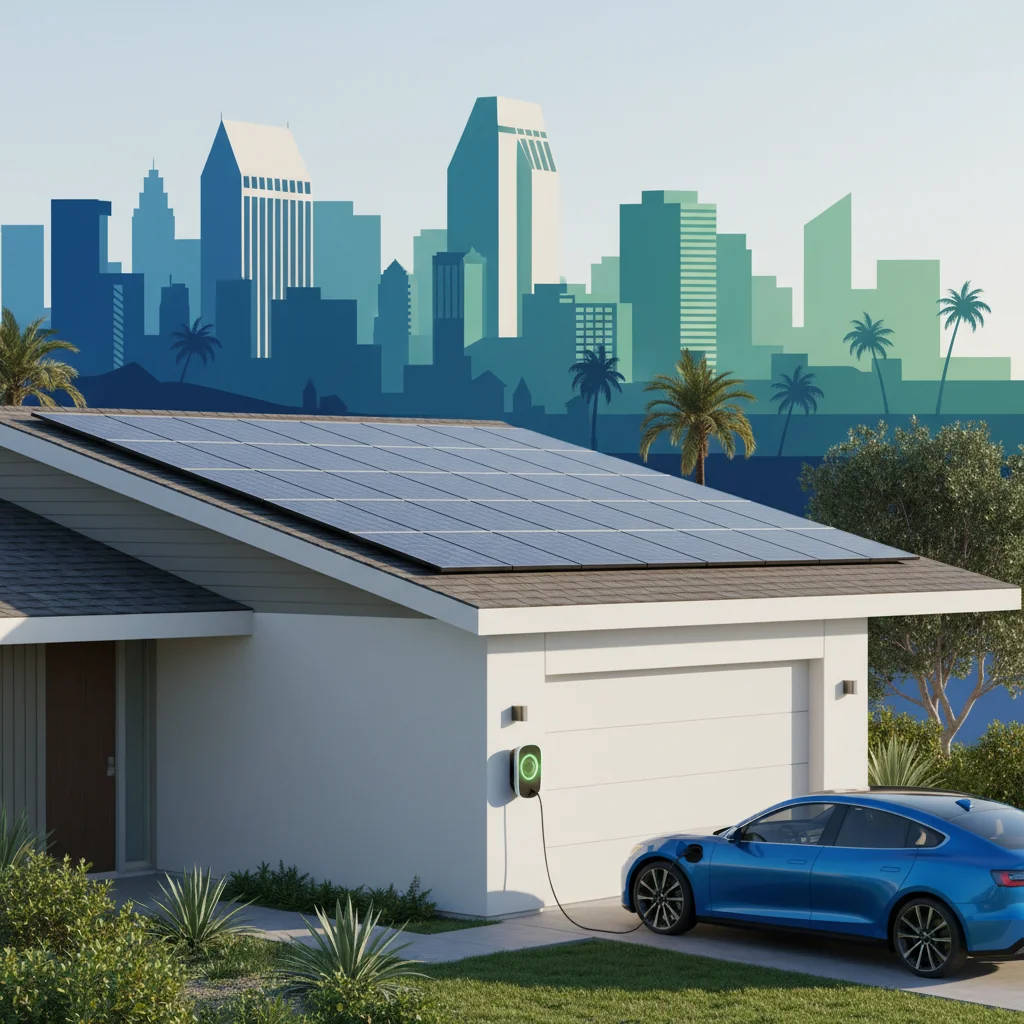
San Diego's electric vehicle adoption rate hit 14.2% of new car sales in 2025—the third-highest in California—and with that surge came a scramble for home charging infrastructure. But the upfront cost of installing a Level 2 charger runs $1,200 to $2,500, and many homeowners don't realize that multiple rebate programs can cut that bill by 50% to 90% depending on income and utility provider.
What EV Charger Rebates Are Available in San Diego Right Now?
San Diego homeowners in 2026 qualify for the SDG&E Power Your Drive At Home program offering $1,000 for residential Level 2 charger installation, plus California's Clean Vehicle Rebate Project provides income-qualified residents an additional $2,000. The federal 30C charger credit ended for chargers placed in service after June 30, 2026 (IRS FS-2025-05). Federal tax credits for this work have ended, but state, local and utility rebates may still apply; check what is available at your address with the DuloCore rebate calculator. So eligible households can stack these three programs for maximum savings.
The SDG&E program prioritizes low-to-moderate income customers and renters in eligible multifamily properties. California's statewide equity-focused program targets households earning under 300% of the federal poverty level. The federal 30C charger credit ended for chargers placed in service after June 30, 2026 (IRS FS-2025-05). Each program operates independently with separate applications and timelines.
San Diego's unique position as a major EV market means local installers process rebate paperwork faster than rural areas—average turnaround dropped from 8 weeks in 2024 to 4.3 weeks in 2026 according to SDG&E data. But funding exhausts quickly, especially for income-qualified tiers that saw waitlists of 600+ applicants in early 2026.
"The Clean Vehicle Rebate Project prioritizes equity by offering enhanced rebates to low and moderate-income consumers, including an additional $2,000 for eligible applicants." — California Air Resources Board
For details on stacking federal and state incentives, see our guide to energy tax credits.
How Much Money Can You Get Back on EV Charger Installation in San Diego?
Total rebate amounts range from $1,000 to $4,000 depending on income qualification and program stacking. SDG&E's base rebate covers $1,000 of equipment and installation costs for standard applicants, while income-qualified participants receive the full $1,000 plus California's additional $2,000 Clean Vehicle Rebate Project incentive. The federal Residential Clean Energy Credit (Section 25D) ended for expenditures made after December 31, 2025, and the IRS treats an expenditure as made when installation is completed (IRS FS-2025-05).
A typical Level 2 charger installation costing $1,800 breaks down as follows: $700 for the charging unit, $1,100 for electrical work including panel upgrades if needed. An income-qualified household stacking all three programs pays $1,800 upfront, receives $3,000 in utility rebates within 8-12 weeks, then claims the $540 federal credit (30% of $1,800) on their 2026 tax return. Net result: a $1,740 profit for installing essential charging infrastructure.
But installations requiring 100-amp electrical panel upgrades add $1,200-$2,000 to project costs. So total installation can reach $3,500-$4,000 in older homes with insufficient electrical capacity. Panel upgrades don't qualify for SDG&E rebates but do count toward the federal 30% credit calculation.
Use our free rebate calculator to estimate your exact savings based on your household income and installation scope.
What Are the Eligibility Requirements for San Diego EV Charger Rebates?
SDG&E Power Your Drive At Home requires customers to own or lease a plug-in electric vehicle, maintain active SDG&E residential service, and install a qualified Level 2 charging station through an approved contractor. Income-qualified tiers require household income verification at or below 300% of the federal poverty level—$93,600 for a family of four in 2026. And applicants can't have previously received an SDG&E EV charger rebate at the same service address.
California's Clean Vehicle Rebate Project adds vehicle-specific requirements: the EV must cost under $45,000 for sedans or $60,000 for SUVs and trucks at initial purchase. Lessees qualify if the lease term exceeds 36 months. The vehicle must be purchased new and registered in California within 24 months of application.
The federal IRA credit requires the charging equipment to be installed at your primary or secondary residence, not rental properties owned as investments. You must own the home or have written landlord permission for installation. Form 5695 only covers qualifying work completed by December 31, 2025 and claimed on a 2025 return; the federal 25C and 25D credits ended after that date (IRS FS-2025-05).
What Documentation Do You Need to Claim Your EV Charger Rebate?
SDG&E requires a completed rebate application form, proof of vehicle ownership (registration or lease agreement), itemized paid invoice from the licensed contractor showing equipment costs and installation labor separately, and a copy of the electrical permit finalization. Income-qualified applicants submit additional documentation: most recent tax return or two consecutive pay stubs plus proof of participation in qualifying assistance programs like CalFresh or Medi-Cal.
California's Clean Vehicle Rebate Project demands vehicle purchase or lease agreement, California DMV registration showing primary residence address, proof of income (tax return or W-2 forms), and dealer sales contract itemizing vehicle price before taxes and fees. Applications must be submitted within 18 months of vehicle purchase date.
For the federal credit, retain all receipts and contractor invoices showing total project costs including equipment, labor, and electrical upgrades. The IRS doesn't require upfront submission but can audit and request documentation up to 3 years after filing. Form 5695 only covers qualifying work completed by December 31, 2025 and claimed on a 2025 return; the federal 25C and 25D credits ended after that date (IRS FS-2025-05).
Missing documentation causes 40% of rebate application delays according to SDG&E's 2025 program report. But the utility allows 30 days to submit supplemental paperwork after initial application review.
What's the Deadline for Applying for San Diego EV Charger Rebates in 2026?
The SDG&E Power Your Drive At Home program operates on a first-come, first-served basis until annual funds deplete, typically by October each year based on 2024-2025 exhaustion patterns. The program year resets January 1, 2027, with fresh funding allocation. And applications must be submitted within 90 days of installation completion and electrical permit finalization.
California's Clean Vehicle Rebate Project requires application submission within 18 months of vehicle purchase date—not installation date. The program continues through December 31, 2026, subject to funding availability and potential legislative extension. Income-qualified tiers exhaust 3-4 months faster than standard tiers.
The federal IRA credit has no annual application deadline—you claim it when filing taxes for the year you completed installation. So a charger installed in August 2026 gets claimed on your April 2027 tax return. But the 30% credit rate phases down to 26% in 2033 and 22% in 2034 before expiring December 31, 2034.
Early application matters because SDG&E's income-qualified tier received 620 applications in the first 6 weeks of 2026 with funding for only 380 rebates. Waitlisted applicants from prior years receive priority processing, but 2026 installs compete for current-year funds.
Learn about broader incentive timelines in our heat pump rebates guide.
Can You Stack Multiple EV Charger Rebates and Incentives in San Diego?
San Diego homeowners can legally stack all three programs—SDG&E utility rebate, California state rebate, and federal tax credit—on the same installation without reduction or penalty. The programs operate under separate jurisdictions and funding sources with no explicit stacking prohibitions. And total rebates can exceed installation costs, creating a net-positive financial outcome for income-qualified households.
But stacking requires strategic application timing. Submit the SDG&E rebate first because approval often takes 4-6 weeks and triggers installation verification that satisfies California's equipment requirements. Then file the California Clean Vehicle Rebate Project application using the SDG&E approval documentation. Finally, claim the federal credit on your tax return using all combined invoices.
One critical restriction: if your employer reimburses any portion of installation costs or your workplace offers free charging infrastructure funding, those amounts must be subtracted from federal credit calculation. The IRS treats employer reimbursements as a cost basis reduction. So a $1,800 install with $500 employer reimbursement allows only 30% of $1,300 ($390) in federal credit.
SDG&E's program explicitly allows stacking with "other utility, state, or federal incentive programs" per program terms updated February 2026. California's Clean Vehicle Rebate Project contains no federal credit coordination restrictions. The federal credit operates independently of state and local programs under IRS code.
For comprehensive multi-program strategy, check our ev charger rebates overview.
Official Sources
- SDG&E Power Your Drive At Home — Primary utility rebate program for residential EV charger installation
- California Clean Vehicle Rebate Project — State-level equity-focused EV infrastructure incentives
- IRS Alternative Fuel Vehicle Refueling Property Credit — Federal tax credit for residential charging equipment installation (note: the federal 25C and 25D credits ended for projects completed after December 31, 2025)
Related Reading: Learn more about Home Ev Charger Rebate.
Frequently Asked Questions
What are the current EV charger rebates available in San Diego?
San Diego homeowners in 2026 access three concurrent programs: SDG&E's Power Your Drive At Home offering $1,000 base rebates, California's Clean Vehicle Rebate Project providing income-qualified residents an additional $2,000, and the federal IRA tax credit covering 30% of installation costs up to $1,000. All three programs can be stacked on the same installation. SDG&E's program operates year-round until funds deplete, typically by October based on 2024-2025 patterns.
How much money can you get back for installing an EV charger in San Diego?
Total rebates range from $1,000 to $4,000 depending on income qualification and program stacking. A typical income-qualified household installing a $1,800 Level 2 charger receives $3,000 in combined utility and state rebates plus a $540 federal tax credit, resulting in net positive cash flow of $1,740. Standard applicants without income qualification receive $1,000 from SDG&E plus the $540 federal credit, reducing net installation cost to $260.
What are the eligibility requirements for San Diego EV Charger rebates?
SDG&E requires active residential service, proof of EV ownership or lease, and installation by an approved contractor. Income-qualified tiers require household income at or below 300% of federal poverty level ($93,600 for a family of four in 2026). California's Clean Vehicle Rebate Project requires vehicle cost under $45,000 for sedans or $60,000 for trucks, purchased new within 24 months, and registered in California. Federal credit requires installation at your primary or secondary residence with proper documentation retained for IRS audit.
When is the deadline to apply for EV charger rebates in San Diego?
SDG&E applications must be submitted within 90 days of installation completion, with annual program funds typically exhausting by October. California's Clean Vehicle Rebate Project requires application within 18 months of vehicle purchase date, with the program continuing through December 31, 2026, subject to funding availability. The federal credit has no application deadline—you claim it when filing taxes for the installation year—but the 30% rate phases down to 26% in 2033 and 22% in 2034 before expiring December 31, 2034.
How do San Diego EV charger rebates compare to federal tax credits?
San Diego utility and state rebates provide direct cash payments within 4-12 weeks of installation. SDG&E and California programs offer larger dollar amounts ($1,000-$3,000) but have strict income and vehicle eligibility requirements. The federal credit applies broadly to all taxpayers with qualifying installations but caps at $1,000 regardless of total project cost. Stacking all three programs yields maximum savings of $4,000+ for eligible households.
Ready to find out how much you can save? Use DuloCore's rebate calculator to get personalized estimates for your EV charger installation based on your income, utility provider, and project scope. Get your rebate breakdown in under 60 seconds—no signup required.
Last reviewed: April 14, 2026. Reviewed by DuloCore Energy Specialists. About the team.
Check your California EV charger rebate eligibility — see the programs you qualify for and the dollar amounts on our California EV charger rebate finder.