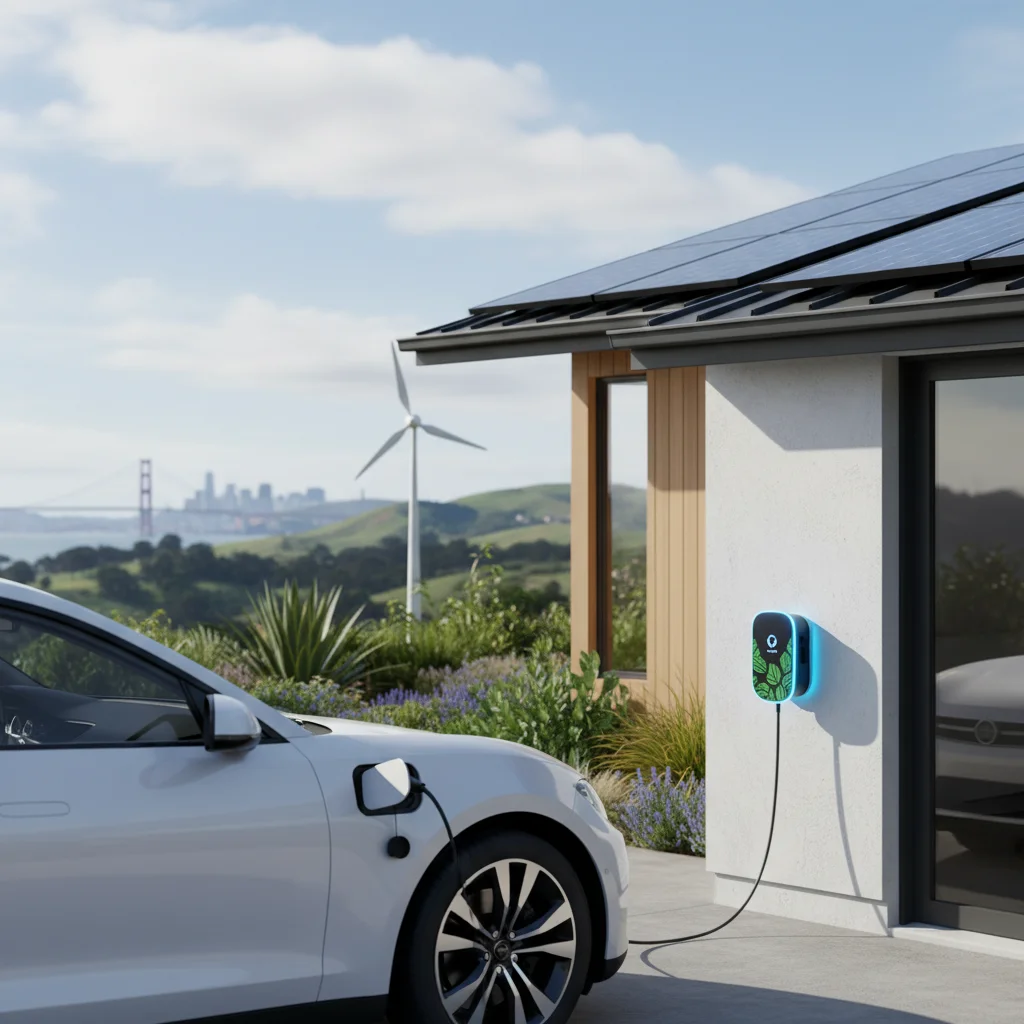
California drivers purchased 292,000 electric vehicles in 2025, and Bay Area counties accounted for 38% of all statewide EV sales. But only 22% of Bay Area EV owners claimed available charging rebates, leaving $47 million in unclaimed incentives on the table. The gap between EV adoption and rebate utilization reveals a persistent problem: most drivers don't know what money they qualify for, how to apply, or when deadlines close.
What EV Charger Rebates Are Available in the Bay Area Right Now?
Bay Area residents in 2026 can access three primary EV charger rebate programs: the federal 30D Alternative Fuel Vehicle Refueling Property Credit (covering 30% of equipment and installation costs up to $1,000 for residential, $100,000 for commercial), Pacific Gas & Electric's EV Charge Network program (providing $500-$2,500 per charger for income-qualified customers and multifamily properties), and local utility rebates from East Bay Community Energy ($300-$500) and Silicon Valley Clean Energy ($800 for Level 2 home chargers). The programs target different installation types and income levels.
And the application process varies dramatically across programs. The federal 30D credit requires Form 8911 filed with annual tax returns, capturing eligible expenses incurred between January 1 and December 31 of the tax year. PG&E's program requires pre-approval through the utility's online portal before purchasing equipment. So homeowners installing a $1,200 Level 2 charger with $800 in electrical work save $600 through the federal credit and potentially $800 through SVCE, reducing net costs from $2,000 to $600.
But not all programs operate on first-come, first-served terms. PG&E allocated $50 million for residential EV charging in 2026, with funds distributed quarterly. When quarterly allocations exhaust, applications move to waitlist status. East Bay Community Energy reopened its EV charger rebate program in March 2026 after suspending it in Q4 2025 due to budget constraints. Check utility program status before purchasing equipment to avoid purchasing ineligible systems.
The Bay Area sits in the largest EV charger rebate ecosystem in the United States. Or more precisely, the region layers federal tax credits with state programs (California's Clean Vehicle Rebate Project historically offered charging incentives but shifted focus to vehicle purchases in 2024) and robust local utility funding. This creates stacking opportunities absent in other regions. And Bay Area drivers who understand program layering maximize returns of 60-80% on total installation costs.
How Much Money Can You Actually Get Back on EV Charger Installation?
The federal new and used clean vehicle credits (Sections 30D and 25E) ended for vehicles acquired after September 30, 2025 (IRS FS-2025-05). Federal tax credits for this work have ended, but state, local and utility rebates may still apply; check what is available at your address with the DuloCore rebate calculator. And qualified costs include the charging station hardware, electrical panel upgrades, dedicated circuit installation, permit fees, and labor. So a $2,000 Level 2 home installation (typical range: $1,200-$3,000) generates a $600 federal tax credit. Commercial installations averaging $15,000-$40,000 per dual-port DC fast charger generate $4,500-$12,000 in federal credits, but reach the $100,000 cap after 8-10 chargers installed at a single property during the tax year.
PG&E's income-qualified residential program offers $2,500 per charger for households earning below 80% of area median income (AMI). And Bay Area AMI varies by county: San Francisco County's 80% AMI threshold sits at $113,300 for a four-person household, while Alameda County's threshold reaches $109,200. Households above 80% AMI typically don't qualify for PG&E's enhanced residential rebates but remain eligible for the federal 30D credit and local utility programs. Silicon Valley Clean Energy's $800 Level 2 rebate requires no income qualification, covering residents in Cupertino, Gilroy, Los Altos, Los Altos Hills, Los Gatos, Milpitas, Monte Sereno, Morgan Hill, Mountain View, Santa Clara, Saratoga, Sunnyvale, Campbell, and unincorporated Santa Clara County.
Or consider a multifamily property installing four Level 2 chargers at $3,500 per unit ($14,000 total). The property qualifies for $4,200 in federal 30D credits (30% of $14,000), $2,000 from PG&E's multifamily program ($500 per port), and potential local utility incentives. Total rebates reach $6,200, reducing net costs from $14,000 to $7,800—a 44% savings. And multifamily properties benefit from simplified applications processing multiple chargers under single submissions.
But rebate amounts depend on charger specifications. Level 2 chargers (240V, 7.2-19.2 kW output) qualify for all programs. Level 1 chargers (120V, 1.4-1.9 kW) typically don't meet minimum power requirements for utility rebates but remain eligible for federal 30D credits. DC fast chargers (50-350 kW) primarily target commercial installations and qualify for the $100,000 federal cap. Home installations almost exclusively use Level 2 equipment due to cost ($500-$2,000 for Level 2 vs. $10,000-$40,000 for DC fast charging) and electrical infrastructure requirements (Level 2 works with standard residential 200-amp panels, DC fast charging requires commercial 3-phase power).
Are You Eligible for Bay Area EV Charger Rebates?
The federal new and used clean vehicle credits (Sections 30D and 25E) ended for vehicles acquired after September 30, 2025 (IRS FS-2025-05). And taxpayers owe sufficient federal tax to claim the nonrefundable credit. But a household with $400 in tax liability receives only $400, forfeiting the remaining $600. The credit doesn't carry forward to future tax years under current IRS rules. Calculate federal tax liability before purchasing equipment to determine usable credit amounts. Or use the rebate calculator to estimate potential savings based on installation costs and tax situation.
PG&E's income-qualified program requires verification of household income below 80% AMI. And applicants submit tax returns, pay stubs, or income verification letters during the pre-approval process. The utility processes applications within 10-15 business days. Multifamily properties (5+ units) qualify for PG&E rebates regardless of income, with higher per-port incentives for properties in disadvantaged communities identified through CalEnviroScreen 4.0 scoring. Properties in the top 25% of CalEnviroScreen scores receive $2,500 per port vs. $500 per port for properties outside disadvantaged community designations.
Silicon Valley Clean Energy requires applicants reside in SVCE service territory and receive electricity through SVCE (not PG&E's default generation). And approximately 95% of residential customers in SVCE territory automatically enrolled in SVCE generation upon launch, but some opted out to remain with PG&E. Check utility bills for "generation" provider. The bill shows "Silicon Valley Clean Energy" under electricity generation if eligible. Customers served by PG&E generation don't qualify for SVCE rebates but remain eligible for PG&E and federal programs.
But property type affects eligibility. Single-family homes qualify for federal 30D and most utility programs. Multifamily properties (apartments, condominiums) access enhanced utility rebates through PG&E's multifamily program. Renters installing chargers with landlord approval qualify for federal 30D credits and utility rebates, though landlords typically claim credits when paying installation costs. Commercial properties (office buildings, retail, hospitality) access the $100,000 federal 30D cap and utility programs targeting workplace charging. And workplace charging programs prioritize installations providing public or employee access over private executive parking.
What's the Deadline for Claiming EV Charger Rebates in 2026-2027?
The federal 30C charger credit ended for chargers placed in service after June 30, 2026 (IRS FS-2025-05). And taxpayers claim the credit on annual returns filed by April 15 of the following year (or October 15 with extension). So chargers installed between January 1, 2026, and December 31, 2026, generate credits claimed on 2026 tax returns filed by April 15, 2027. The credit claims equipment placed in service during the tax year, not purchased. Chargers purchased in December 2026 but installed in January 2027 apply to 2027 tax returns.
PG&E's 2026 program allocation runs through December 31, 2026, with quarterly funding releases. And Q1 allocation ($12.5 million) exhausted by March 28, triggering waitlist status until Q2 funding released April 1. Applicants approved in Q1 receive rebate payments 6-8 weeks after installation verification. But installations must complete within 12 months of approval or applications expire. So approval received March 15, 2026, requires installation by March 15, 2027. Extensions granted for supply chain delays when applicants provide equipment order documentation.
Silicon Valley Clean Energy's $800 Level 2 rebate operates on rolling basis through June 30, 2027, or until $4.8 million allocated funding exhausts. And SVCE suspended its previous EV charger program in November 2024 after depleting $3.2 million in funding within 8 months. The current program launched January 15, 2026, with enhanced funding and monthly tracking. SVCE publishes remaining allocation balances on its website, updated weekly. When funding drops below $200,000, applications shift to waitlist status pending board approval of additional funding.
Or examine East Bay Community Energy's timeline. EBCE reopened its charger rebate program March 1, 2026, after 4-month suspension due to 2025 budget exhaustion. And the 2026 allocation ($2.1 million) supports approximately 4,200-7,000 installations depending on mix of single-family ($300) vs. multifamily ($500) rebates. EBCE processes applications within 5-10 business days and issues payments 4-6 weeks after installation verification. The program runs through December 31, 2026, or until funds exhaust, whichever occurs first.
Can You Stack Multiple Rebates for Maximum Savings?
Federal 30D credit stacks with all utility and local rebates without restrictions. And IRS rules permit taxpayers to claim federal credits on qualified expenses after subtracting state and local grants, but utility rebates don't constitute state grants under federal tax law. So a $2,000 installation receiving $800 from SVCE still claims 30% of $2,000 ($600) through federal 30D, not 30% of $1,200. This interpretation maximizes taxpayer benefits. Consult tax professionals for complex scenarios involving state tax credits (California doesn't currently offer state EV charger tax credits for 2026).
Utility rebates typically don't stack with other utility programs. And residents can't combine PG&E and SVCE rebates because both serve as primary electricity providers (customers receive generation from one or the other, not both). But customers receiving PG&E generation and living in EBCE territory (Alameda County excluding City of Alameda) access PG&E programs and EBCE rebates because EBCE operates as a community choice aggregator layered over PG&E distribution. Check service provider relationships before assuming stacking eligibility.
So optimal stacking combines federal 30D with the highest available local rebate. A Sunnyvale homeowner installing a $2,500 charger stacks $750 federal credit (30% of $2,500) with $800 SVCE rebate, reducing net costs from $2,500 to $950—a 62% savings. But the same homeowner can't add PG&E rebates because SVCE serves as the generation provider. Or a San Francisco homeowner served by PG&E generation and qualifying for income-based rebates stacks $600 federal credit (30% of $2,000 installation) with $2,500 PG&E income-qualified rebate, dropping net costs from $2,000 to negative $1,100 (the homeowner receives $1,100 more in rebates than installation costs).
And workplace charging programs stack with federal credits. PG&E's EV Flex program provides $1,000 per port for workplace Level 2 chargers at commercial properties. A business installing 10 chargers at $25,000 receives $7,500 federal 30D credit (30% of $25,000) plus $10,000 PG&E workplace incentive, reducing costs from $25,000 to $7,500. But commercial properties must maintain chargers for minimum 3-year service periods to avoid rebate recapture provisions. Early removal triggers proportional repayment: removal after 18 months requires returning 50% of received rebates.
What Documentation and Receipts Do You Need to Claim Your Rebate?
Federal 30D credit requires Form 8911 (Alternative Fuel Vehicle Refueling Property Credit) attached to Form 1040. The federal 30C charger credit ended for chargers placed in service after June 30, 2026 (IRS FS-2025-05). Taxpayers don't submit receipts with returns but must retain documentation for 7 years in case of IRS audit. Save itemized invoices showing equipment model numbers, installation dates, electrician labor hours, and permit numbers. Credit calculations require separating qualified costs (charger, installation, electrical work) from nonqualified costs (landscaping, driveway work, unrelated electrical upgrades).
PG&E applications require pre-approval documentation: proof of property ownership or landlord authorization letter, utility account number, proposed installation location (property address and parking spot designation), equipment specifications (charger model, power output, manufacturer), and income verification for income-qualified programs (most recent tax return or three consecutive pay stubs). And post-installation verification requires photos of installed charger showing serial number plate, electrical permit final inspection approval, itemized installer invoice, and charger registration confirmation. PG&E reviews verification packages within 10 business days and issues rebate payments via check or direct deposit.
Silicon Valley Clean Energy requires simpler documentation: online application through SVCE customer portal, proof of SVCE electric service (utility account number), equipment purchase receipt showing charger model and purchase date, and installation invoice showing completion date and total costs. And SVCE accepts applications submitted within 90 days of installation completion. Applications submitted beyond 90 days require exception approval, typically granted for supply chain delays or permitting delays outside customer control. SVCE processes compliant applications within 5-7 business days.
Or review East Bay Community Energy's requirements: completed online application, copy of PG&E electric bill showing EBCE generation service, receipt for purchased charging equipment, and photo of installed charger displaying manufacturer label. EBCE doesn't require electrical permits for standard installations but requests permit documentation for installations involving panel upgrades or service capacity increases. Rebate payments issue 4-6 weeks after verification approval.
But documentation requirements extend beyond rebate applications. Homeowners installing chargers update property records to reflect electrical modifications. And jurisdictions require electrical permits for Level 2 charger installations involving new dedicated circuits (most installations). Permit costs range from $150-$400 depending on county and installation complexity. Permits cover plan review, inspection scheduling, and final inspection approval. Failed inspections delay rebate claims because utilities require final approval before processing applications. Hire licensed electricians (C-10 California contractor license) to ensure code-compliant installations passing first inspection.
Official Sources
- Department of Energy: Alternative Fuels Data Center — Federal 30D tax credit guidance and qualified equipment standards (note: the federal 25C and 25D credits ended for projects completed after December 31, 2025)
- California Energy Commission: Electric Vehicle Charging — State EV infrastructure programs and Bay Area incentive landscape
- DSIRE USA: California Incentives — Comprehensive database of federal, state, and utility energy incentives including EV charging rebates
Related Reading: Learn more about Ev Charger Rebates and Federal Ev Charger Rebate.
Related Reading: Learn more about Ev Charger Tax Credit and Ev Charger Tax Credit 2026 Status.
Frequently Asked Questions
What are the eligibility requirements for EV charger rebates in the Bay Area?
The federal new and used clean vehicle credits (Sections 30D and 25E) ended for vehicles acquired after September 30, 2025 (IRS FS-2025-05). PG&E income-qualified rebates require household income below 80% area median income ($109,200-$113,300 for four-person households depending on county), while multifamily properties qualify regardless of income. Silicon Valley Clean Energy requires residence in SVCE service territory with SVCE as generation provider. Commercial properties qualify for federal 30D and utility workplace charging programs.
How much money can you get back from EV charger rebate programs?
The federal new and used clean vehicle credits (Sections 30D and 25E) ended for vehicles acquired after September 30, 2025 (IRS FS-2025-05). Silicon Valley Clean Energy offers $800 for Level 2 home chargers. PG&E provides $500-$2,500 per charger for income-qualified customers and multifamily properties. And optimal stacking generates 60-80% total cost savings. A $2,000 residential installation receives $600 federal credit plus $800 SVCE rebate, reducing net costs to $600. Calculate savings through our rebate calculator based on specific installation costs.
What is the application process for Bay Area EV charger rebates?
Federal 30D credit claims require Form 8911 filed with annual tax returns by April 15 (installations completed prior calendar year). PG&E requires pre-approval before equipment purchase through online portal, followed by post-installation verification with photos, permits, and invoices. Silicon Valley Clean Energy accepts applications within 90 days of installation through customer portal, requiring utility account verification and installation documentation. And East Bay Community Energy processes applications online within 5-10 business days after receiving equipment receipts and installation photos.
When do EV charger rebates expire in California?
The federal 30C charger credit ended for chargers placed in service after June 30, 2026 (IRS FS-2025-05). PG&E's 2026 allocation operates through December 31, 2026, with quarterly funding releases that may exhaust before year-end. Silicon Valley Clean Energy's program runs through June 30, 2027, or until $4.8 million funding exhausts. East Bay Community Energy's 2026 allocation ($2.1 million) operates through December 31, 2026, or fund depletion. But utility programs suspend when quarterly allocations exhaust, creating waitlists until next funding release.
Are there different rebate amounts for Level 2 vs DC fast charging stations?
The federal new and used clean vehicle credits (Sections 30D and 25E) ended for vehicles acquired after September 30, 2025 (IRS FS-2025-05). Bay Area utility programs primarily target Level 2 residential and workplace charging. And Level 1 chargers (120V) typically don't meet minimum power requirements for utility rebates. DC fast chargers target commercial installations and qualify for federal credits and some utility commercial programs, but residential properties lack electrical infrastructure (3-phase power) supporting DC fast charging equipment.
Ready to find out how much you can save? Use our free rebate calculator to estimate your total EV charger installation rebates based on your location, installation costs, and income qualification. Get your personalized savings estimate in under 2 minutes.
Last updated April 14, 2026 — reviewed by DuloCore Editorial. About our authors.
Check your California EV charger rebate eligibility — see the programs you qualify for and the dollar amounts on our California EV charger rebate finder.