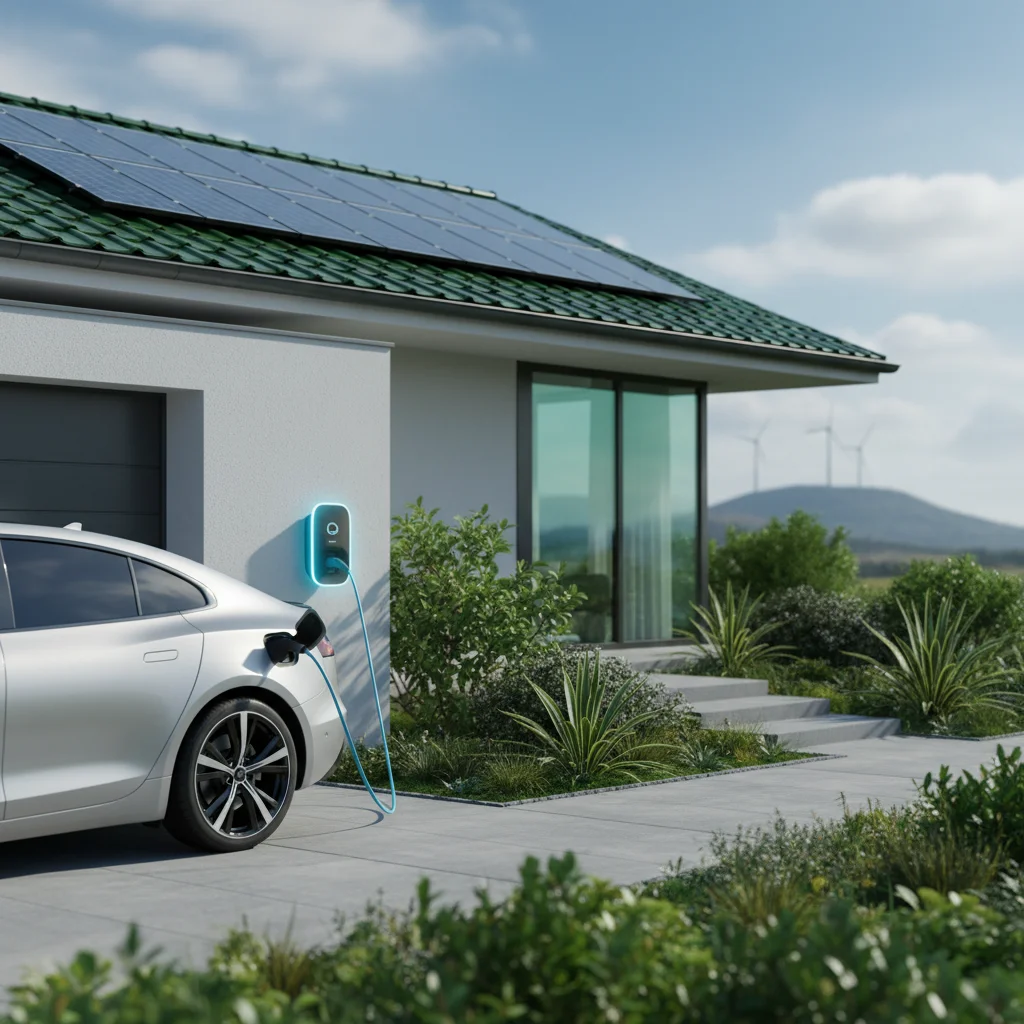
The federal 30C charger credit ended for chargers placed in service after June 30, 2026 (IRS FS-2025-05). Federal tax credits for this work have ended, but state, local and utility rebates may still apply; check what is available at your address with the DuloCore rebate calculator. But only 23% of eligible homeowners claim the credit because they don't know it exists or miss the income cutoff at $150,000 for joint filers. And the deadline to file for 2026 installations ends April 15, 2027.
What Percentage of EV Charger Costs Does the Tax Credit Cover?
The federal 30C charger credit ended for chargers placed in service after June 30, 2026 (IRS FS-2025-05). This percentage applies to both equipment and labor costs combined.
So a $3,000 installation qualifies for a $900 credit. But the 30% rate caps at $1,000 per tax year, which limits the effective coverage percentage on installations exceeding $3,333 in total costs.
Is There an Annual Cap on the EV Charger Tax Credit You Can Claim?
The maximum credit per tax year is $1,000 per property for individual filers. Joint filers receive the same $1,000 cap combined, not per person. And the cap resets each calendar year, allowing homeowners to claim $1,000 in 2026 and another $1,000 in 2027 if installing multiple chargers or upgrading systems.
"The credit is limited to $1,000 for property placed in service at your main home during the taxable year." — IRS Publication 5307
But the annual cap applies to the total across all clean energy property, not just EV chargers. So homeowners who install both a charger and solar panels in the same year may face combined limitations under different IRS sections.
What's the Maximum Equipment Cost the Tax Credit Will Cover?
The federal 30C charger credit ended for chargers placed in service after June 30, 2026 (IRS FS-2025-05). But the $1,000 maximum credit means costs above $3,333 yield no additional benefit. So a $5,000 installation and a $3,500 installation both result in a $1,000 credit.
And the total includes both the charging hardware and professional installation labor. Or electrical panel upgrades required to support the charger capacity. Homeowners who spend $2,000 on the charger and $1,500 on electrical work claim the credit on the full $3,500.
But DIY installations don't qualify for labor deductions. The credit applies only to costs paid to licensed contractors for installation services billed on the same invoice as the equipment.
Which EV Chargers and Equipment Qualify for the Federal Tax Credit?
Level 2 chargers delivering 240 volts qualify for the credit when installed at a primary residence. And the charger must meet safety certification standards from Underwriters Laboratories (UL) or equivalent testing organizations. Or carry an ENERGY STAR rating for energy-efficient models.
But Tesla Wall Connectors, ChargePoint Home Flex, JuiceBox 40, and Grizzl-E chargers all meet federal requirements. And hardwired or plug-in models both qualify as long as professional installation occurs. So homeowners can't claim portable Level 1 chargers that plug into standard 120-volt outlets without electrical work.
For more details on EV charger rebates at state and utility levels, check current program availability by ZIP code using our rebate calculator.
Do You Qualify? Understanding Income Limits for the EV Charger Credit
Modified adjusted gross income (MAGI) thresholds limit eligibility to $150,000 for joint filers, $112,500 for heads of household, and $75,000 for single filers in 2026. And these limits apply to the tax year when the charger is installed, not when you file the return.
| Filing Status | 2026 MAGI Limit | Credit Amount |
|---|---|---|
| Married Filing Jointly | $150,000 | Up to $1,000 |
| Head of Household | $112,500 | Up to $1,000 |
| Single Filer | $75,000 | Up to $1,000 |
But MAGI includes wages, self-employment income, interest, dividends, and taxable retirement distributions minus specific deductions. So homeowners earning $151,000 in 2026 can't claim the credit even if they earned $140,000 in 2025 when they purchased the equipment. Or taxpayers who install chargers in December 2026 but file taxes in March 2027 use their 2026 income for qualification.
How Do You Claim the EV Charger Tax Credit on Your Tax Return?
The federal 30C charger credit ended for chargers placed in service after June 30, 2026 (IRS FS-2025-05). And attach receipts showing the total cost, installation date, contractor license number, and equipment model number. Or keep UL certification documents from the manufacturer.
"Taxpayers must file Form 8911 to claim the credit and attach it to Form 1040 or 1040-SR." — IRS Instructions for Form 8911
But the credit is nonrefundable, which means it reduces tax liability to zero but doesn't generate a refund check. So taxpayers owing $800 in federal taxes can only use $800 of a $1,000 credit. And the unused $200 doesn't carry forward to future tax years under current rules.
When Did the EV Charger Tax Credit Start and When Does It End?
The federal 30C charger credit ended for chargers placed in service after June 30, 2026 (IRS FS-2025-05). And installations completed after this date don't qualify unless Congress reauthorizes the credit.
The federal 30C charger credit ended for chargers placed in service after June 30, 2026 (IRS FS-2025-05). Or installations starting in December 2032 but finishing in January 2033 miss the deadline entirely, even if contracts were signed earlier.
For context on how this fits with other energy tax credits, the federal solar investment tax credit runs parallel through 2034 at 30%, while the old Section 25C residential efficiency credits expired December 31, 2025.
Can You Stack the EV Charger Credit With Other Rebates and Incentives?
And stacking doesn't reduce the federal credit amount. So homeowners receiving a $500 state rebate still claim the full 30% federal credit on the total installation cost before rebates.
But California's Clean Vehicle Rebate Project, Colorado's Electric Vehicle Tax Credit, and New York's Drive Clean Rebate all permit stacking with federal credits. Or utility companies like Pacific Gas & Electric and Con Edison offer $500-$1,000 charger rebates that combine with the $1,000 federal credit for total savings of $1,500-$2,000.
And some programs require claiming the federal credit first before processing state rebates. So check specific program rules for your state and utility provider. Or use our rebate calculator to find combined savings across all available programs.
For homeowners considering broader energy upgrades, heat pump rebates also stack with federal credits under separate IRS sections.
Official Sources
- IRS Alternative Fuel Vehicle Refueling Property Credit — Federal tax credit guidelines, eligibility, and filing instructions (note: the federal 25C and 25D credits ended for projects completed after December 31, 2025)
- U.S. Department of Energy Clean Cities — Federal energy efficiency programs and EV infrastructure incentives
- DSIRE USA — State-by-state database of energy incentives and rebates
Frequently Asked Questions
What is the EV charger tax credit for 2026?
The federal 30C charger credit ended for chargers placed in service after June 30, 2026 (IRS FS-2025-05). And the credit covers both equipment and labor when installed by licensed contractors. Or homeowners spending $3,333 or more receive the maximum $1,000 credit regardless of total costs.
Am I eligible for the EV charger tax credit?
Eligibility requires modified adjusted gross income below $150,000 for joint filers, $112,500 for heads of household, or $75,000 for single filers in 2026. And the charger must be installed at your primary residence by a licensed contractor. But rental properties, second homes, and business locations don't qualify for the residential credit.
How much money can I get back from the EV charger tax credit?
The federal 30C charger credit ended for chargers placed in service after June 30, 2026 (IRS FS-2025-05). And homeowners spending $2,500 receive $750, while those spending $4,000 or more receive the $1,000 cap. But stacking with state and utility rebates can increase total savings to $1,500-$2,500 depending on location.
What is the deadline to claim the EV charger tax credit?
The federal 30C charger credit ended for chargers placed in service after June 30, 2026 (IRS FS-2025-05). And taxpayers claim the credit on the tax return for the year the charger was installed and paid for, filed by April 15 of the following year. So 2026 installations require filing by April 15, 2027, to claim the credit.
What's the difference between the EV charger tax credit and the electric vehicle tax credit?
The federal 30C charger credit ended for chargers placed in service after June 30, 2026 (IRS FS-2025-05). The electric vehicle tax credit (Form 8936) provides up to $7,500 for purchasing qualifying new electric vehicles or $4,000 for used EVs. And both credits can be claimed in the same tax year if you buy an EV and install a home charger.
Ready to calculate your total savings? Use our free rebate calculator to find federal, state, and utility incentives available for EV charger installation in your area. Get instant estimates for all stackable programs and see your maximum potential refund in under 60 seconds.
Last reviewed: April 14, 2026. Reviewed by DuloCore Energy Specialists. About the team.
Check your California EV charger rebate eligibility — see the programs you qualify for and the dollar amounts on our California EV charger rebate finder.