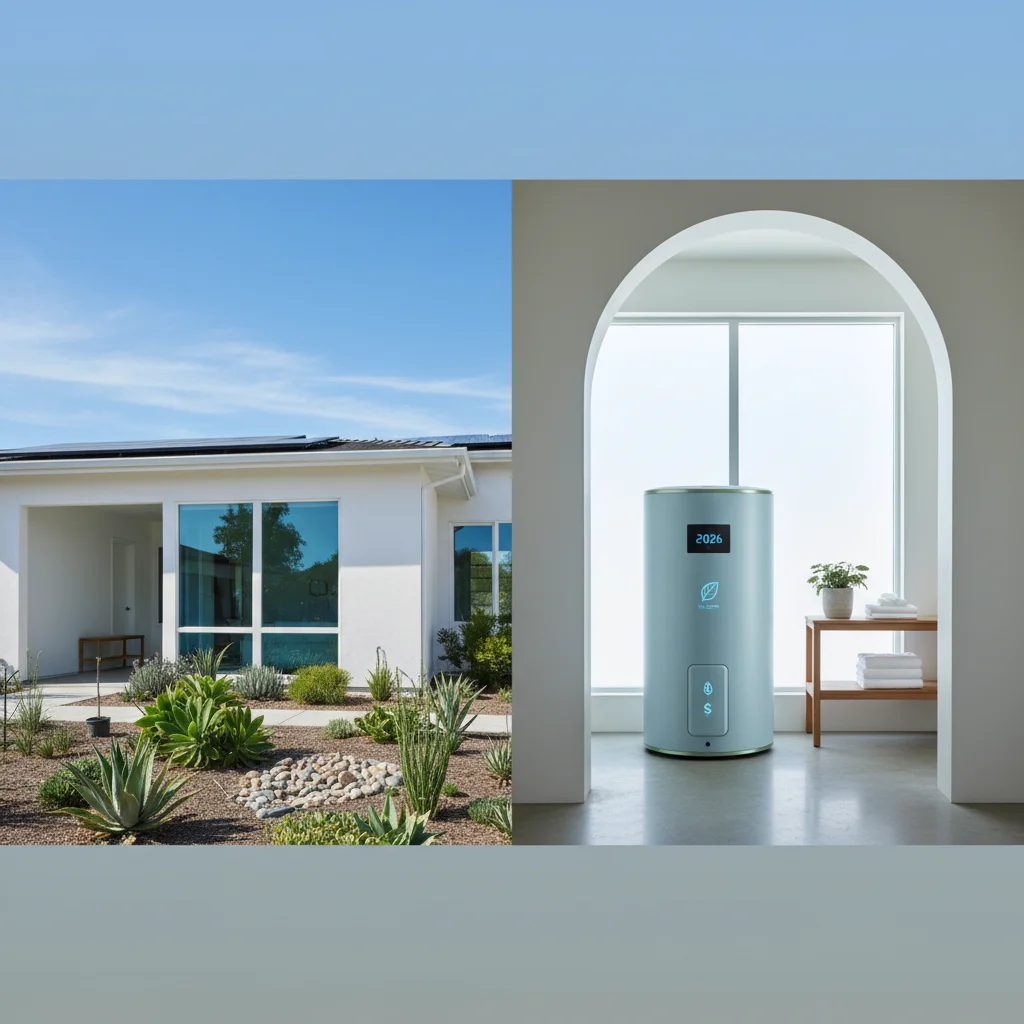
California homeowners who install a heat pump water heater in 2026 can claim up to $8,000 in combined rebates and federal tax credits — but only if they apply before program funds run out. Over 2.4 million California households still use natural gas or electric resistance water heaters, leaving thousands of dollars in savings unclaimed each year. And with new income-based rebate tiers launching through the Inflation Reduction Act, middle-income families now qualify for incentives that were previously reserved for low-income households.
What water heater rebates are available in California for 2026?
California homeowners in 2026 can access three primary rebate programs for water heater upgrades: the federal Home Efficiency Rebates (up to $1,750 for heat pump water heaters), the federal Home Electrification and Appliance Rebates (up to $1,750 for income-qualified households), and utility-specific incentives like PG&E's $3,000 heat pump water heater rebate. These programs prioritize heat pump technology over traditional electric resistance or tankless gas models.
The federal Home Efficiency Rebates program, administered by state energy offices under the Inflation Reduction Act, provides up to $1,750 for heat pump water heater installations that meet ENERGY STAR certification requirements. And the Home Electrification and Appliance Rebates (HEAR) program offers an additional $1,750 for households earning up to 150% of area median income. So a family of four in Los Angeles earning $135,000 annually qualifies for both programs simultaneously.
California utilities add their own incentives on top of federal programs. PG&E offers $3,000 for residential heat pump water heater installations in 2026, while Southern California Edison provides $2,500 for qualifying models. But these utility rebates cannot be combined with federal HEAR rebates — homeowners must choose the more valuable option. And most utility programs operate on a first-come, first-served basis until annual budgets deplete.
"The Home Efficiency Rebates program targets whole-home energy improvements, with heat pump water heaters eligible as part of a broader retrofit project that achieves at least 20% energy savings." — U.S. Department of Energy
The core tension here: federal programs launched in late 2025 with billions in allocated funding, but California's state implementation timeline determines when residents can actually apply. So even though Congress approved these rebates in 2022, most California homeowners couldn't access them until 2026. And with 39 million residents competing for a finite pool of state-allocated dollars, early applicants capture the largest incentives before programs reach capacity or reduce rebate amounts mid-year.
How much money can you save with California water heater rebates?
California homeowners save between $3,000 and $8,000 in combined rebates and tax credits when installing a heat pump water heater in 2026, depending on income level and utility territory. A typical installation costs $4,500 to $6,000 for equipment and labor, meaning rebates cover 50% to 100% of project expenses for qualifying households.
The maximum savings scenario combines four funding sources: $1,750 from federal Home Efficiency Rebates, $1,750 from HEAR (income-qualified), $3,000 from PG&E utility rebates, and a 30% federal tax credit on remaining costs. But this stacking only works if the homeowner qualifies for income-based programs and completes a whole-home energy audit showing 20% or greater energy reduction.
For households above 150% of area median income, savings shrink to $4,750 to $5,250 by combining utility rebates ($2,500-$3,000) and the federal Energy Efficient Home Improvement Credit (30% of costs up to $2,000, or $600 maximum). And these families pay the remaining $1,500 to $2,500 out of pocket after incentives.
Heat pump water heaters reduce energy bills by 60% compared to electric resistance models, saving California households $350 to $550 annually depending on household size and hot water usage patterns. So even without rebates, the technology pays for itself in 8 to 10 years through utility bill reductions alone. And with rebates, payback periods drop to 2 to 4 years for most installations.
Compare this to tankless gas water heaters, which qualify for zero federal rebates in 2026 and only limited utility incentives of $100 to $300. So the financial case for heat pump technology widened significantly after the IRA shifted federal policy away from fossil fuel appliances.
What are the eligibility requirements for California water heater rebates?
Federal rebate eligibility in 2026 requires households to install ENERGY STAR certified heat pump water heaters with a Uniform Energy Factor (UEF) of 3.0 or higher for 50-gallon models. And applicants must use certified contractors registered with the California Energy Commission to qualify for state-administered federal programs.
Income limits determine which federal programs homeowners access. The Home Electrification and Appliance Rebates restrict participation to households earning 80% to 150% of area median income, while Home Efficiency Rebates impose no income caps but require whole-home energy savings of at least 20%. So a family of four in San Francisco qualifies for HEAR with income up to $189,000, while a family in Fresno qualifies up to $126,000.
Utility rebates impose separate requirements beyond federal standards. PG&E requires homeowners to retire existing gas or electric resistance water heaters permanently, install models from pre-approved equipment lists, and complete installations within 6 months of rebate reservation. And most utilities prohibit DIY installations, requiring licensed contractors with C-36 plumbing or C-20 HVAC credentials.
Properties must serve as primary residences to qualify for federal tax credits and most state rebates. So vacation homes, rental properties, and investment properties receive zero federal HEAR or Home Efficiency Rebates funding, though property owners may still claim the 30% Energy Efficient Home Improvement Credit for rental units where they pay utility bills.
"Rebate-eligible heat pump water heaters must appear on the ENERGY STAR Most Efficient list and carry a UEF rating of at least 3.0, representing a 300% efficiency gain over electric resistance technology." — ENERGY STAR
Previously installed equipment disqualifies homeowners from federal rebate programs. So any heat pump water heater installed before California's rebate program launch date in 2026 receives zero federal HEAR or Home Efficiency Rebates, though it may still qualify for utility incentives and the federal tax credit if installation occurred in 2026.
What's the deadline to apply for California water heater rebates in 2026?
California's federal rebate programs operate on a rolling first-come, first-served basis with no fixed application deadline, but funding exhaustion timelines vary by program. The Home Electrification and Appliance Rebates received $491 million in California allocation through 2031, while Home Efficiency Rebates received $796 million, creating different depletion schedules for each program.
State energy officials project HEAR funds will last 18 to 24 months from the program launch in early 2026, based on 200,000 California households qualifying for the $1,750 water heater rebate tier. And the Home Efficiency Rebates program may extend through 2028 or 2029 given higher funding allocation and lower participation rates for whole-home retrofits requiring 20% energy savings.
Utility rebate deadlines follow annual budget cycles. PG&E allocated $45 million for heat pump water heater rebates in 2026, supporting approximately 15,000 installations at $3,000 per unit. So the utility program typically depletes between September and November based on prior-year application volumes. And SCE's program historically runs out by August given higher rebate demand in Southern California's larger population base.
The federal Energy Efficient Home Improvement Credit (30% tax credit) operates through December 31, 2032, with no annual funding cap since it functions as a tax deduction rather than a direct rebate program. So homeowners who miss state and utility rebate deadlines retain access to federal tax benefits for another 6 years.
Application processing times range from 4 to 12 weeks for utility rebates and 8 to 16 weeks for federal programs, meaning installations completed in late 2026 may not receive rebate payments until early 2027. And most programs require homeowners to reserve rebate funds before installation begins, locking in incentive amounts even if programs reduce rebate levels mid-year due to high demand.
How do you apply for California water heater rebates step-by-step?
Applying for California water heater rebates in 2026 follows a five-step sequence: verify income eligibility, select certified equipment, reserve rebate funds, complete installation with a licensed contractor, and submit documentation within program timelines.
Homeowners start by calculating household income as a percentage of area median income using HUD's online tool, which determines eligibility for the $1,750 HEAR rebate tier. And families earning 80% to 150% of AMI qualify, while those above 150% skip HEAR and pursue only utility rebates plus the federal tax credit.
Equipment selection requires cross-referencing three lists: ENERGY STAR's Most Efficient heat pump water heaters, California Energy Commission's approved equipment database, and individual utility pre-approved model lists. So a Rheem ProTerra Hybrid 50-gallon unit with a 3.75 UEF rating appears on all three lists, guaranteeing eligibility for maximum rebate stacking. But a cheaper 40-gallon model with a 2.8 UEF rating fails ENERGY STAR certification and receives zero federal rebate dollars.
Rebate reservation happens before installation through online portals managed by the California Energy Commission for federal programs and individual utilities for their incentives. Homeowners enter property details, select equipment models, upload income documentation (tax returns or pay stubs), and receive a reservation number valid for 120 to 180 days. And this step locks in rebate amounts even if programs reduce incentive levels later in 2026.
Installation must occur through contractors registered with the California Contractor State License Board holding C-36 plumbing or C-20 HVAC credentials. And programs require contractors to complete installations according to manufacturer specifications, pull building permits, and provide proof of proper refrigerant handling for heat pump systems. So DIY installations disqualify homeowners from all federal and utility rebates, though they may still claim the 30% federal tax credit.
Documentation submission includes four required items: contractor invoices showing equipment cost and labor separately, proof of payment (cancelled check or credit card statement), photos of installed equipment with serial number visible, and disposal receipts for retired water heaters. And applicants upload these files to rebate portals within 30 days of installation completion. Use our free rebate calculator to estimate your total savings across all available programs.
"California's rebate programs require third-party verification for projects claiming over $4,000 in combined incentives, adding 2 to 4 weeks to processing timelines but ensuring compliance with federal fraud prevention requirements." — California Energy Commission
Processing timelines stretch 60 to 90 days from submission to payment for federal programs, while utility rebates arrive in 30 to 45 days via direct deposit or paper check. And homeowners should complete installations by October 2026 to guarantee rebate payment before year-end, given extended processing windows.
How do California water heater rebates compare to federal tax credits?
California's combined state and federal rebate system delivers immediate upfront discounts of $3,000 to $5,500. The federal Energy Efficient Home Improvement Credit (Section 25C) ended for property placed in service after December 31, 2025 (IRS FS-2025-05). So rebates reduce out-of-pocket costs at installation, while tax credits reduce taxable income 4 to 16 months later.
The rebate structure favors low- and middle-income households through income-qualified HEAR funding, while the tax credit provides equal benefits regardless of income level. And households with minimal tax liability gain nothing from credits, making upfront rebates the primary incentive for families earning below the tax filing threshold of $13,850 for single filers or $27,700 for married couples.
Federal programs prohibit stacking HEAR rebates with utility incentives, forcing homeowners to choose the larger amount. So a PG&E customer receiving $3,000 in utility rebates cannot also claim the $1,750 HEAR benefit. But the same customer can combine PG&E's $3,000 utility rebate with the $600 federal tax credit and potentially $1,750 from Home Efficiency Rebates if completing a whole-home retrofit.
Tax credits require itemization on Schedule A for amounts above the standard deduction, creating administrative complexity for households that typically claim the standard $13,850 (single) or $27,700 (married) deduction. And the credit caps at $1,200 annually for all home efficiency improvements combined, meaning homeowners who install heat pumps, insulation, and water heaters in the same year split the $1,200 limit across all projects.
Compare California's system to states like Texas and Florida, which offer zero state-level rebates and force homeowners to rely exclusively on utility programs (typically $300-$500) and federal tax credits. So California residents access 4 to 6 times more financial support than homeowners in non-participating states.
Official Sources
- U.S. Department of Energy Weatherization and Intergovernmental Programs — Federal rebate program details and state implementation timelines
- Database of State Incentives for Renewables & Efficiency — Comprehensive California utility and state rebate program listings
- ENERGY STAR Most Efficient Water Heaters — Pre-qualified equipment lists and efficiency ratings for rebate-eligible models
Related Reading: Learn more about Solar Rebates 2026 and Water Heater Rebates 2026.
Frequently Asked Questions
What water heater rebates are available in California in 2026?
California homeowners access three primary rebate programs in 2026: federal Home Electrification and Appliance Rebates (up to $1,750 for income-qualified households), federal Home Efficiency Rebates (up to $1,750 for whole-home retrofits), and utility-specific incentives ranging from $2,500 to $3,000. And these programs exclusively support heat pump water heater technology meeting ENERGY STAR Most Efficient criteria with UEF ratings of 3.0 or higher. Tankless gas and standard electric resistance models receive zero federal rebate funding under current 2026 guidelines.
Who is eligible for California water heater rebates?
Eligibility varies by program income thresholds and property type. Federal HEAR rebates require household income between 80% and 150% of area median income, translating to $72,000 to $135,000 for a family of four in Los Angeles. And Home Efficiency Rebates impose no income limits but require whole-home energy savings of at least 20% verified through pre- and post-installation audits. All programs mandate primary residence status, ENERGY STAR certified equipment, and installation by licensed C-36 or C-20 contractors registered with California authorities.
How much can you save with a water heater rebate in California?
Maximum savings reach $8,000 when combining federal HEAR ($1,750), Home Efficiency Rebates ($1,750), PG&E utility rebates ($3,000), and the 30% federal tax credit (up to $600). But most households save $3,500 to $5,000 depending on income qualification and utility territory. And heat pump water heaters reduce annual energy bills by $350 to $550 compared to electric resistance models, creating 2- to 4-year payback periods after rebates for typical installations costing $4,500 to $6,000.
What is the process for claiming a water heater rebate in California?
Homeowners follow a five-step process: verify income eligibility through HUD's area median income calculator, select pre-approved equipment from ENERGY STAR and utility lists, reserve rebate funds through online portals before installation, hire licensed contractors to complete installations with building permits, and submit documentation (invoices, photos, disposal receipts) within 30 days of project completion. And processing timelines stretch 30 to 90 days from submission to rebate payment via direct deposit or check.
What are the deadlines for California water heater rebates in 2026?
California's federal rebate programs operate on first-come, first-served funding with no fixed deadline, but state officials project HEAR funds lasting 18 to 24 months from the early 2026 launch date. Utility programs follow annual budget cycles, with PG&E's $45 million allocation supporting 15,000 installations before depletion typically between September and November. And the federal 30% tax credit remains available through December 31, 2032, regardless of state rebate fund status. Homeowners should complete installations by October 2026 to guarantee payment before year-end given 60- to 90-day processing windows.
Ready to maximize your water heater rebate savings? Use our free rebate calculator to see exactly how much you can save based on your income, location, and equipment choices. Get your personalized estimate in under 60 seconds and connect with certified contractors in your area.
Last updated April 14, 2026 — reviewed by DuloCore Editorial. About our authors.
Check your California water heater rebate eligibility — see the programs you qualify for and the dollar amounts on our California water heater rebate finder.