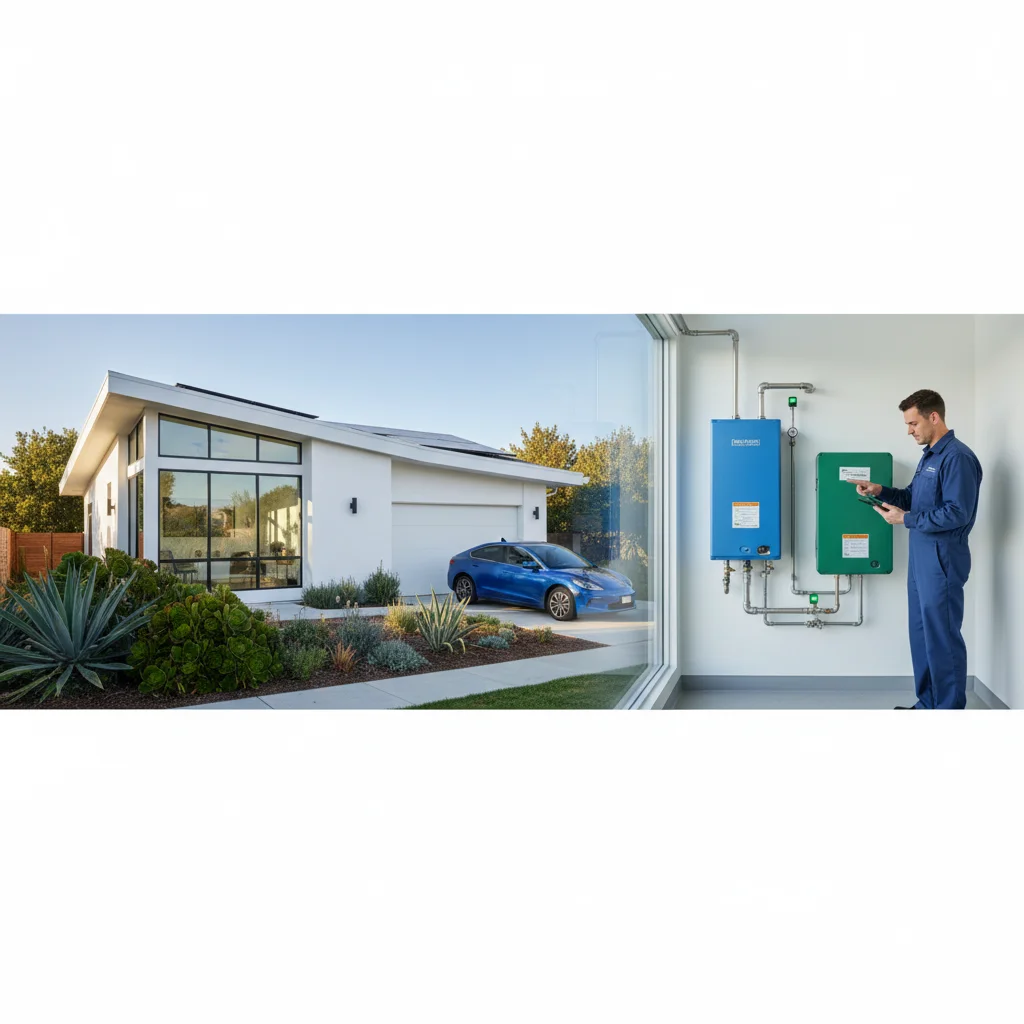
A Bay Area home's water heater accounts for 18-25% of total energy costs, making it the second-largest energy expense after heating and cooling. And yet most homeowners wait until a catastrophic failure—often a flooded garage or ice-cold shower—to consider replacement. But contractors in the Bay Area now install systems that qualify for $2,000-$8,000 in combined federal and utility rebates through 2032 under the Inflation Reduction Act framework. So the old reactive replacement strategy leaves thousands of dollars on the table.
How Much Does a Water Heater Installation Cost from Bay Area Contractors?
Bay Area water heater contractors charge $1,200-$3,500 for standard tank installations, $2,500-$4,500 for tankless systems, and $3,500-$7,000 for heat pump water heaters in 2026. Labor rates average $125-$175 per hour across San Francisco, Oakland, and San Jose. Permit fees add $150-$400 depending on jurisdiction. Installation complexity increases costs when retrofitting older homes without existing 240V circuits or proper venting.
The real cost equation changes when rebates enter the picture. PG&E offers $2,000-$3,000 rebates for qualifying heat pump water heaters. BayREN (Bay Area Regional Energy Network) adds another $1,000-$1,500 for income-qualified households. The federal Energy Efficient Home Improvement Credit (Section 25C) ended for property placed in service after December 31, 2025 (IRS FS-2025-05). Federal tax credits for this work have ended, but state, local and utility rebates may still apply; check what is available at your address with the DuloCore rebate calculator. A $6,000 heat pump installation drops to $1,500-$2,500 after incentives—less than most conventional tank replacements.
Contractors licensed by the California Contractors State License Board (CSLB) with C-36 (plumbing) or C-61/D-63 (limited specialty) credentials complete 85% of Bay Area installations. But only contractors certified through BayREN or PG&E's Energy Advisor network can process instant rebate applications at point of sale. Homeowners who hire non-certified contractors must submit rebate paperwork themselves, delaying reimbursement by 6-12 weeks.
Labor accounts for 40-60% of total project cost. Removal of old equipment adds $200-$400. Earthquake strapping (required by California code) costs $75-$150. Expansion tank installation adds $150-$250. So a quoted price of $3,000 for a tankless system breaks down to roughly $1,500 equipment, $1,200 labor, and $300 in ancillary work.
Check current water heater rebates for Bay Area programs updated quarterly.
What's the Payback Period for Upgrading to a High-Efficiency Water Heater?
Heat pump water heaters achieve payback in 3-6 years for Bay Area households using 50+ gallons daily, compared to 8-12 years for tankless gas systems replacing electric resistance tanks. Payback calculation hinges on three variables: upfront cost after rebates, annual energy savings, and avoided maintenance costs. A household switching from a 50-gallon electric resistance tank ($480 annual operating cost) to a heat pump unit ($145 annual cost) saves $335 yearly—recovering a $2,000 net investment in 6 years.
But the math shifts dramatically in PG&E territory where tiered electric rates punish heavy users. Homes in Tier 3 ($0.45/kWh) see heat pump water heaters pay back in 2.5-4 years. Gas customers switching to heat pumps face longer payback—8-10 years—unless natural gas rates exceed $2.50/therm, which occurred in 18 of the past 24 months across the Bay Area.
Tankless gas systems save 15-25% on water heating costs compared to conventional tanks, translating to $80-$180 annually for typical households. A $4,000 tankless installation (after no rebates, since most gas systems don't qualify) requires 22-50 years to break even on energy savings alone. So the case for tankless rests on space savings, unlimited hot water, and 20+ year lifespan—not pure financial return.
The avoided replacement cost matters too. Conventional tanks fail after 8-12 years, requiring another $1,500-$2,500 replacement. Heat pump units last 12-15 years. Tankless systems exceed 20 years with proper maintenance. Factoring in avoided future replacements shortens effective payback to 2-4 years for heat pumps in high-use households.
Use our free rebate calculator to model payback scenarios with your actual utility rates and hot water usage patterns.
Is Your Bay Area Home in the Right Climate Zone for Tankless or Heat Pump Water Heaters?
The Bay Area spans California climate zones 3 (coastal mild) and 12 (inland warm-summer Mediterranean), both ideal for heat pump water heater operation year-round. Heat pump efficiency drops below 40°F ambient temperature, but garage and indoor installations maintain 50-70°F environments even in winter. And coastal fog actually benefits heat pump performance by providing cooler ambient air for heat extraction.
Tankless gas systems perform consistently across all climate zones but require minimum flow rates of 0.5-0.75 gallons per minute to activate burners. Homes with low-flow fixtures (1.5 GPM showerheads) sometimes fail to trigger tankless units, causing temperature fluctuation. Climate zone matters less than plumbing fixture specifications.
Inland zones (Walnut Creek, Concord, Livermore) with 90-100°F summer peaks see higher heat pump efficiency when units pull from cooler garage air. Coastal zones (San Francisco, Daly City, Pacifica) maintain steady 55-65°F ambient temperatures that optimize heat pump coefficient of performance (COP) between 2.5-3.5. So geography determines whether heat pumps excel or merely perform well.
Elevation affects venting requirements for tankless systems. Homes above 2,000 feet (rare in the Bay Area but present in parts of Marin and Santa Cruz Mountains) require high-altitude conversion kits reducing BTU output by 4% per 1,000 feet. Standard 199,000 BTU tankless units derate to 191,000 BTU at 2,000 feet, impacting simultaneous hot water delivery.
Check your California climate zone at energy.ca.gov to confirm equipment compatibility. But contractors routinely install both technologies across the entire Bay Area without performance issues.
Water Heater Options Compared: Tank vs. Tankless vs. Heat Pump—Which Saves You the Most?
| Feature | Gas Tank | Tankless Gas | Heat Pump | Electric Tank |
|---|---|---|---|---|
| Installed Cost (2026) | $1,200-$2,000 | $2,500-$4,500 | $3,500-$7,000 | $900-$1,500 |
| After Rebates | $1,200-$2,000 | $2,500-$4,500 | $1,500-$3,000 | $900-$1,500 |
| Annual Operating Cost | $240-$320 | $180-$260 | $120-$180 | $450-$600 |
| Lifespan | 8-12 years | 20+ years | 12-15 years | 8-10 years |
| Energy Factor | 0.58-0.65 | 0.82-0.96 | 2.5-3.5 | 0.90-0.95 |
| Recovery Time (50 gal) | 45-60 min | Instant | 2-3 hours | 90-120 min |
Heat pump water heaters deliver the lowest total cost of ownership over 15 years: $1,800 net install + $2,160 operating costs = $3,960 total. Gas tanks cost $1,500 + $3,900 operating + $1,500 replacement = $6,900. Tankless gas systems reach $4,000 + $3,240 operating = $7,240 but avoid mid-life replacement.
Operating cost calculations assume PG&E baseline rates ($0.37/kWh electricity, $2.40/therm gas) and 50 gallons daily hot water use. Actual costs vary with tier placement and seasonal rates. But the hierarchy remains consistent: heat pumps cost least to operate, followed by tankless gas, conventional gas tanks, and electric resistance tanks.
Heat pumps add a bonus benefit—space cooling. Units extract heat from ambient air, reducing garage or utility room temperatures by 5-8°F in summer. Some households position heat pumps near laundry areas to offset dryer heat. This "free" air conditioning doesn't appear in payback calculations but adds comfort value.
The performance trade-off hits during peak demand. Tankless systems deliver endless hot water at 5-8 gallons per minute. Heat pumps struggle when multiple showers run simultaneously, dropping to 3-4 GPM during recovery. Gas tanks provide 60-75 gallons before temperature drops noticeably. So household size and usage patterns matter as much as operating cost.
Explore detailed comparisons in our energy tax credits guide covering all HVAC and water heating technologies.
How Long Will Your New Water Heater Last, and What Affects Its Lifespan?
Tankless gas water heaters last 20-25 years with annual descaling maintenance, compared to 12-15 years for heat pump units and 8-12 years for conventional tanks. Lifespan correlates directly with water hardness, maintenance frequency, and anode rod replacement intervals. Bay Area water quality varies dramatically—San Francisco delivers 3-6 grains per gallon (soft), while San Jose and East Bay areas reach 12-18 grains (hard).
Hard water deposits mineral scale on heat exchangers and tank surfaces, reducing efficiency by 15-30% and accelerating corrosion. Tankless systems require annual vinegar flush descaling in hard water zones, costing $150-$250 per service. Skipping this maintenance cuts lifespan to 12-15 years. Heat pump tanks with electronic anode rods (replacing sacrificial magnesium rods) extend life by 2-3 years but add $300-$400 to replacement cost.
Temperature settings affect longevity too. Units set at 140°F experience 30% more sediment buildup and anode depletion than those at 120°F. But lower temperatures risk Legionella bacteria growth in stagnant systems. So the CDC recommends 120°F for households without immunocompromised residents, 140°F for high-risk populations.
Annual maintenance extends all water heater types by 20-40%. Tank systems need yearly anode inspection and sediment flushing ($100-$150 service). Heat pumps require air filter cleaning every 3 months (DIY) and refrigerant system checks every 2 years ($175-$250). Tankless units need descaling and burner inspection annually.
Installation quality matters as much as maintenance. Improperly sized expansion tanks (required on all closed-loop systems in California) cause premature tank failure. Inadequate venting on gas units leads to backdrafting and heat exchanger corrosion. So contractor selection impacts lifespan independent of equipment quality.
What Rebates and Tax Credits Can Bay Area Homeowners Claim in 2026?
Bay Area homeowners installing heat pump water heaters qualify for $3,000-$8,000 in combined incentives through 2032 under federal IRA programs and California utility rebates. The federal Energy Efficient Home Improvement Credit (Section 25C) ended for property placed in service after December 31, 2025 (IRS FS-2025-05). So a $6,000 system generates a $1,800 credit (30% of $6,000) capped at the $2,000 maximum.
PG&E offers $3,000 for ENERGY STAR certified heat pump water heaters with Uniform Energy Factor (UEF) ≥2.0. The rebate drops to $2,000 for units between 1.75-1.99 UEF. BayREN adds $1,000-$1,500 for households under 80% area median income. And TECH Clean California provides an additional $500-$750 for all-electric conversions replacing gas units. Stack all programs and a qualifying household receives $5,500-$8,000 total.
Rebates apply only to heat pump technology—tankless gas and conventional storage tanks don't qualify for federal credits or most utility programs. SMUD (Sacramento Municipal Utility District, serving parts of eastern Bay Area) offers $500 for tankless gas units, but PG&E, EBMUD, and San Jose Water provide zero gas equipment incentives.
Application deadlines matter. PG&E processes rebates on a first-come, first-served basis until annual funding exhausts, typically in October-November. The 2025 program ran out of money September 12. Early installation (January-April) ensures funding availability. Form 5695 only covers qualifying work completed by December 31, 2025 and claimed on a 2025 return; the federal 25C and 25D credits ended after that date (IRS FS-2025-05).
Income-qualified programs (Self-Generation Incentive Program, BayREN) require documentation: recent tax returns, pay stubs, or participation in CARE/FERA utility discount programs. Processing takes 8-12 weeks. Non-income-qualified PG&E rebates process in 4-6 weeks with certified contractor instant rebate applications.
Compare current heat pump rebates across all Bay Area utilities and verify 2026 program updates at dsireusa.org.
Official Sources
- Department of Energy - Energy Saver — Federal water heating efficiency standards and technology comparisons
- IRS Energy Credits — Current tax credit amounts and qualification requirements under the Inflation Reduction Act (note: the federal 25C and 25D credits ended for projects completed after December 31, 2025)
- ENERGY STAR Water Heaters — Certified product directory and efficiency specifications
Related Reading: Learn more about Water Heater Rebates Bay Area.
Frequently Asked Questions
What qualifications should a water heater contractor have in the Bay Area?
Bay Area water heater contractors must hold a California Contractors State License Board C-36 (plumbing) license or C-61/D-63 (limited specialty) credential. Permits are required in all Bay Area jurisdictions, with fees ranging $150-$400. Contractors certified through BayREN or PG&E's Energy Advisor network can process instant rebate applications worth $2,000-$3,000, while non-certified installers force homeowners into manual rebate submissions with 6-12 week processing delays. Verify license status at cslb.ca.gov before signing contracts.
How much does a water heater installation cost in the Bay Area?
Standard tank installations cost $1,200-$3,500, tankless gas systems run $2,500-$4,500, and heat pump water heaters range $3,500-$7,000 before rebates in 2026. Labor averages $125-$175 per hour across San Francisco, Oakland, and San Jose. After federal tax credits ($1,800-$2,000) and utility rebates ($2,000-$3,000), heat pump installations drop to $1,500-$3,000 net cost—less than conventional tank replacements. Earthquake strapping ($75-$150), permits ($150-$400), and expansion tanks ($150-$250) add to base quotes.
Are there rebates available for water heater replacement in the Bay Area?
PG&E provides $2,000-$3,000 rebates for ENERGY STAR certified heat pump water heaters in 2026. BayREN adds $1,000-$1,500 for income-qualified households under 80% area median income. The federal Energy Efficient Home Improvement Credit (Section 25C) ended for property placed in service after December 31, 2025 (IRS FS-2025-05). TECH Clean California offers $500-$750 for gas-to-electric conversions. Total incentives reach $5,500-$8,000 when stacked. Tankless gas and conventional tank systems don't qualify for federal credits or most utility rebates.
How long does a water heater installation take?
Standard tank replacements take 2-4 hours when replacing like-with-like models. Tankless installations require 4-6 hours due to gas line sizing upgrades and venting modifications. Heat pump installations span 4-8 hours, especially when retrofitting homes without existing 240V circuits. Permit inspections add 1-3 days to project timelines in most Bay Area jurisdictions. So total project duration runs 1-5 days from contract signing to final inspection approval, depending on equipment type and site complexity.
What is the difference between tankless and traditional water heaters?
Tankless water heaters heat water on-demand using high-BTU burners (150,000-199,000 BTU), eliminating standby heat loss present in 40-50 gallon storage tanks. Traditional tanks maintain 120-140°F water continuously, consuming energy even when no hot water flows. Tankless units deliver 5-8 gallons per minute indefinitely but cost $2,500-$4,500 installed versus $1,200-$2,000 for conventional tanks. Tankless systems last 20+ years compared to 8-12 years for tanks, but require annual descaling maintenance ($150-$250) in hard water areas.
Ready to find out how much you can save? Bay Area homeowners qualify for thousands in combined rebates and tax credits on heat pump water heaters through 2032. Use our rebate calculator to get your personalized estimate in under 60 seconds—no email required.
Updated: April 14, 2026 — fact-checked by DuloCore Research. About our editorial process.
Check your California water heater rebate eligibility — see the programs you qualify for and the dollar amounts on our California water heater rebate finder.