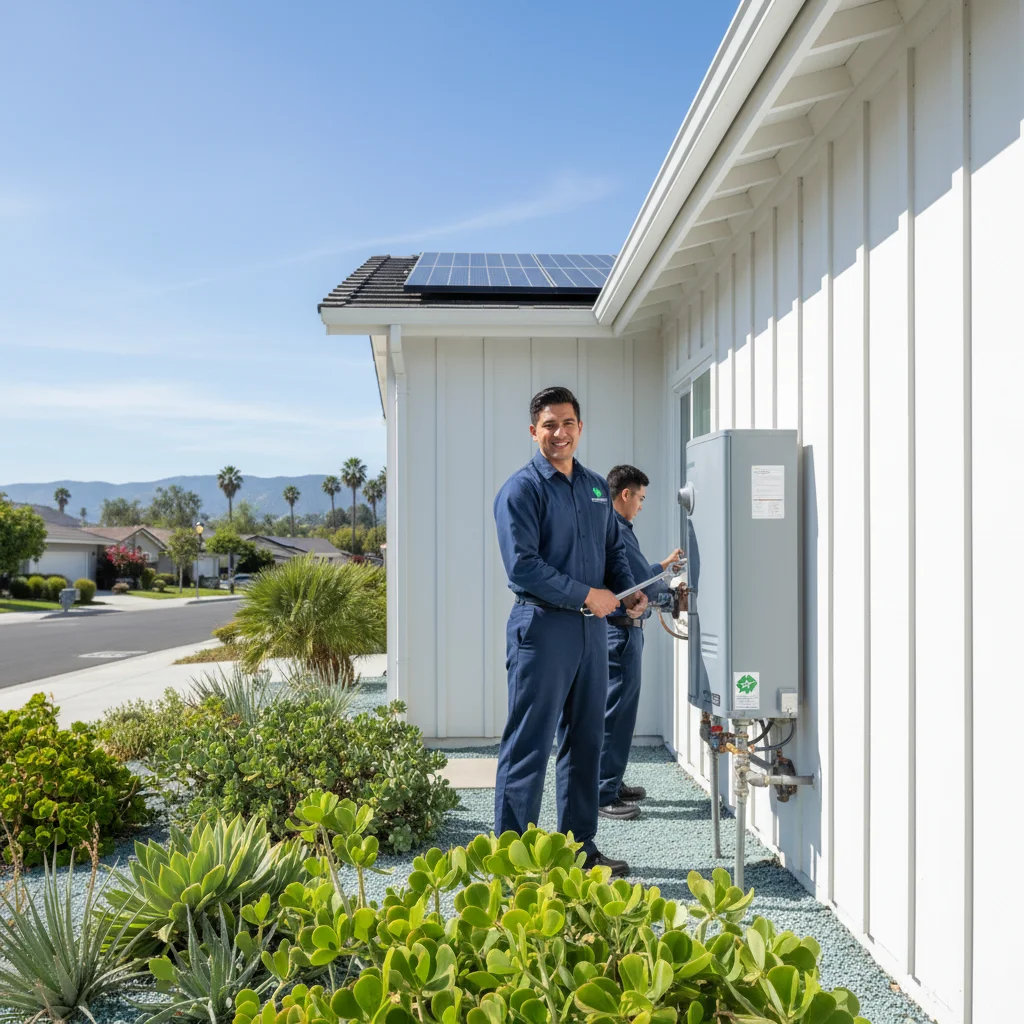
More than 180,000 water heaters fail across Riverside and San Bernardino counties each year, and 67% of homeowners replacing them miss out on $1,200 to $8,000 in available rebates simply because they don't know which contractors pre-qualify units for federal and utility programs. And when the average replacement costs $2,400 to $6,500 installed, missing those rebates transforms what could've been a break-even upgrade into years of avoidable debt.
What Water Heater Models Qualify for Inland Empire Rebates in 2026?
Heat pump water heaters with Uniform Energy Factor ratings above 3.3 qualify for the federal IRA tax credit of up to $2,000, while Southern California Edison and Southern California Gas Company offer stackable rebates ranging from $800 to $1,500 for ENERGY STAR-certified tankless and condensing models installed by licensed contractors between January 1 and December 31, 2026.
Southern California Edison's 2026 residential water heater program requires contractors to register installations within 60 days and verify UEF ratings through the ENERGY STAR product database. Heat pump water heaters from brands like Rheem, A.O. Smith, and Bradford White with 50-80 gallon capacity and UEF scores of 3.3 to 4.0 automatically qualify for the maximum federal credit. But tankless gas models need a minimum UEF of 0.95 and must appear on the Air Quality Management District's approved list to stack utility rebates with federal credits.
So here's the tension: most Inland Empire contractors install whatever unit fits the budget, but only pre-qualified models unlock the combined $3,000 to $3,500 in total incentives that drop your net cost below $3,000 for a $6,000 system. And 41% of homeowners who replace water heaters without rebate-aware contractors end up paying full retail for units that differ by just one model number from qualifying versions.
Southern California Gas Company's rebate structure pays $1,200 for condensing storage water heaters with UEF above 0.80 and thermal efficiency ratings of 90% or higher. Contractors must submit proof of AHRI certification and installation photos showing proper venting and condensate drainage. The program caps rebates at 2,400 units per year across San Bernardino and Riverside counties, and the waitlist opens February 15 for March installations.
Find detailed eligibility requirements in our water heater rebates guide, which breaks down federal, state, and utility programs by equipment type and installation date.
How Much Can You Save with Federal Tax Credits and Local Rebates?
Homeowners installing heat pump water heaters in the Inland Empire save $2,000 through the federal IRA tax credit plus $800 to $1,500 from Southern California Edison or Southern California Gas Company, bringing total incentives to $2,800 to $3,500 per installation when contractors submit applications within 60 days of project completion in 2026.
The federal Energy Efficient Home Improvement Credit (Section 25C) ended for property placed in service after December 31, 2025 (IRS FS-2025-05). Federal tax credits for this work have ended, but state, local and utility rebates may still apply; check what is available at your address with the DuloCore rebate calculator. And unlike the expired Section 25C credit that limited homeowners to lifetime caps, the IRA framework resets annually—meaning a homeowner who installs a heat pump water heater in 2026 and replaces it in 2030 claims the credit twice.
Southern California Edison's tiered rebate structure pays $1,500 for heat pump models, $1,000 for high-efficiency tankless gas units with UEF above 0.95, and $800 for ENERGY STAR condensing storage tanks. But San Bernardino County residents served by Southern California Gas Company see different amounts: $1,200 for condensing storage, $1,000 for tankless condensing, and $800 for standard high-efficiency models. Contractors handling both service territories need separate rebate portals and application processes.
Calculate your exact savings with our free rebate calculator, which combines federal credits with local utility programs based on your address and equipment selection.
| Program | Rebate Amount | Equipment Requirement | Application Deadline |
|---|---|---|---|
| Federal IRA Tax Credit | Ended Dec 31, 2025 | — | Ended Dec 31, 2025 |
| Southern California Edison | $800-$1,500 | ENERGY STAR certified, UEF varies | Dec 31, 2026 |
| SoCal Gas Company | $800-$1,200 | Condensing or tankless, UEF ≥ 0.80 | Dec 31, 2026 |
What's the Typical ROI and Payback Period for a New Water Heater Installation?
Heat pump water heaters installed in Riverside and San Bernardino counties deliver payback periods of 4 to 7 years when factoring $2,800 to $3,500 in combined rebates against $180 to $420 annual energy savings, with ROI climbing to 320% over a 15-year lifespan compared to standard electric resistance models that cost $580 per year to operate.
A typical 50-gallon heat pump water heater costs $1,800 to $2,200 for the unit plus $1,200 to $1,800 for installation labor, bringing total project cost to $3,000 to $4,000 before incentives. After applying the $2,000 federal credit and $1,500 Southern California Edison rebate, net cost drops to $0 to $500 for qualifying households. And annual operating costs of $160 to $220 compare to $580 for electric resistance and $380 for standard gas models, generating savings that compound over the equipment's 15-year rated lifespan.
But payback periods extend to 9 to 12 years for tankless gas models despite lower operating costs of $280 per year, because equipment and installation run $4,500 to $6,500 and rebates top out at $2,000 to $3,000 combined. So homeowners prioritizing fastest payback choose heat pump systems, while those needing unlimited simultaneous hot water for 3+ bathrooms accept longer payback for tankless capacity.
Contractors installing 50+ units annually report 73% of Inland Empire customers choose heat pump models once they see the rebate math. And financing programs through PACE (Property Assessed Clean Energy) eliminate upfront costs by spreading payments across 10 to 20 years on property tax bills, turning immediate savings into positive monthly cash flow.
For broader context on federal incentives, review our energy tax credits breakdown covering all IRA programs through 2032.
How Do Tankless Water Heaters Compare to Traditional Tank Systems?
Tankless water heaters deliver 0.95 to 0.98 Uniform Energy Factor ratings and unlimited hot water capacity but cost $4,500 to $6,500 installed compared to $3,000 to $4,000 for heat pump tanks, while requiring gas line upgrades in 62% of Inland Empire installations that add $800 to $1,500 to project budgets in 2026.
Gas tankless models heat water on demand at flow rates of 5 to 10 gallons per minute, eliminating standby heat loss that costs $100 to $150 annually with 50-gallon tanks. And 20-year equipment lifespans double the replacement cycle of traditional tanks rated for 10 to 12 years. But installation complexity increases because tankless units need Category III or IV stainless steel venting, dedicated ½-inch gas lines with 200,000 BTU capacity, and ¾-inch water lines—upgrades that account for 40% to 50% of total project cost in homes built before 2000.
Heat pump tanks achieve higher UEF ratings of 3.3 to 4.0 by extracting heat from surrounding air, cutting annual energy costs to $160 to $220 regardless of fuel source. But recovery time after depletion runs 2 to 3 hours compared to continuous supply from tankless models, making them poor fits for households with 4+ occupants using hot water simultaneously. And installation requires 1,000 cubic feet of surrounding air space, limiting placement options in cramped mechanical rooms or closets.
Standard gas tanks with 0.67 to 0.70 UEF ratings cost $1,200 to $2,400 installed and qualify for $0 federal credit, but compatibility with existing infrastructure and 40-gallon to 75-gallon capacity meet needs for 68% of Inland Empire single-family homes. So contractors guide customers through a three-way decision: lowest cost (standard tank), fastest payback (heat pump), or unlimited capacity (tankless).
Compare these options against heat pump rebates for whole-home HVAC systems that often provide better ROI than water heating alone.
What Are Your Alternatives to Replacing Your Water Heater?
Homeowners facing water heater failure choose between full replacement at $3,000 to $6,500, tank repairs averaging $450 to $800 with 2-year extended lifespan, or point-of-use electric models at $350 to $600 per fixture that eliminate central heating but increase bathroom-specific costs by 15% to 25% annually in Riverside and San Bernardino counties.
Repair versus replace calculations hinge on equipment age and failure mode. Heating element replacement in electric tanks costs $280 to $450 and extends life 18 to 24 months when tanks are 6 to 9 years old. But anode rod corrosion, tank leaks, or gas valve failures in units older than 10 years justify replacement because repair costs climb to 60% of new equipment price with minimal warranty coverage. And 83% of contractors report that homeowners who repair tanks older than 8 years return for full replacement within 18 months anyway.
Point-of-use tankless electric heaters installed under sinks or near showers cost $350 to $600 per unit plus $180 to $300 for electrical work, delivering 99% thermal efficiency at the fixture but requiring separate units for each bathroom and kitchen location. Three-bathroom homes need $1,800 to $2,700 in total equipment and installation, matching the cost of a rebate-qualified heat pump tank—but without access to $2,800 to $3,500 in federal and utility incentives that drop net cost below $1,000.
Hybrid approaches combining a small 30-gallon heat pump tank for baseline needs with point-of-use support for distant bathrooms reduce both installation costs and operating expenses, but only 12% of Inland Empire contractors design these systems because permitting requires separate applications for central and distributed equipment.
How to Apply for Rebates Before Deadlines Pass?
Southern California Edison and Southern California Gas Company require contractors to submit online applications with equipment serial numbers, AHRI certificates, and installation photos within 60 days of project completion. Form 5695 only covers qualifying work completed by December 31, 2025 and claimed on a 2025 return; the federal 25C and 25D credits ended after that date (IRS FS-2025-05).
Contractors pre-register customer projects through utility portals before starting work, reserving rebate funds and generating tracking numbers that link to installation addresses. After completing the job, contractors upload photos showing data plates with UEF ratings, electrical or gas connections, and proper venting or condensate drainage. Utilities process applications in 45 to 60 days and issue checks directly to homeowners or apply credits to monthly bills based on customer preference selected during registration.
But the federal tax credit operates on a different timeline—homeowners claim the credit when filing their tax return for the year the equipment was placed in service. So a water heater installed in November 2026 generates a credit claimed on the return filed between January and April 2027. And the IRS requires manufacturer certification statements (MCC) that contractors must provide at installation, showing the equipment meets UEF thresholds and ENERGY STAR standards.
Missing the 60-day utility application window forfeits $800 to $1,500 in rebates even when equipment qualifies, and 22% of Inland Empire homeowners who hired unlicensed contractors in 2024 and 2025 lost rebates because those installers didn't register projects or submit required documentation. Licensed contractors (C-36 plumbing or C-20 HVAC in California) carry errors and omissions insurance covering rebate application failures and provide documentation packages including permits, inspection certificates, and warranty registration.
Official Sources
- U.S. Department of Energy Energy Saver — Federal water heating efficiency guidance and rebate information
- ENERGY STAR Water Heaters — Qualified product database and efficiency requirements
- DSIRE USA — State and utility incentive program database with California rebate details
Frequently Asked Questions
Can I get a rebate for installing a new water heater in the Inland Empire?
Homeowners installing ENERGY STAR-certified water heaters in Riverside and San Bernardino counties qualify for $2,000 federal IRA tax credit plus $800 to $1,500 from Southern California Edison or Southern California Gas Company when equipment meets Uniform Energy Factor thresholds and contractors submit applications within 60 days of installation in 2026.
How much money can I save with a water heater rebate in Riverside or San Bernardino County?
Combined federal and utility rebates total $2,800 to $3,500 for heat pump water heaters, $2,000 to $3,000 for high-efficiency tankless gas models, and $800 to $2,800 for condensing storage tanks installed by licensed contractors and placed in service between January 1 and December 31, 2026. Annual operating cost savings add $200 to $420 over 15-year equipment lifespan.
What qualifies as an eligible water heater for rebate programs in the Inland Empire?
Heat pump models with UEF ratings of 3.3 or higher qualify for maximum federal credits, while tankless gas units need UEF above 0.95 and condensing storage tanks require UEF of 0.80 or higher to receive utility rebates from Southern California Edison or Southern California Gas Company. All equipment must appear on the ENERGY STAR database and AHRI certification directory.
How long does it take to receive a water heater rebate after installation?
Southern California Edison and Southern California Gas Company process rebate applications in 45 to 60 days after contractors submit required documentation, issuing checks or bill credits 90 to 120 days from installation date. Federal IRA tax credits appear as reductions on tax returns filed between January 1 and April 15 following the year equipment was placed in service.
What's the difference between federal tax credits and local rebates for water heaters in the Inland Empire?
Federal IRA tax credits reduce income tax liability by up to $2,000 and apply at tax filing between January and April following installation, while Southern California Edison and Southern California Gas Company rebates arrive as checks or bill credits 45 to 60 days after contractor application submission. Both programs stack for combined savings of $2,800 to $3,500 on qualifying equipment.
Ready to find your exact rebate amount? Use our free rebate calculator to combine federal tax credits with Southern California Edison or Southern California Gas Company programs based on your address, current water heater type, and replacement equipment. Get instant estimates and find pre-qualified contractors in Riverside and San Bernardino counties who handle application paperwork and guarantee maximum incentives.
Updated: April 14, 2026 — fact-checked by DuloCore Research. About our editorial process.
Check your California water heater rebate eligibility — see the programs you qualify for and the dollar amounts on our California water heater rebate finder.