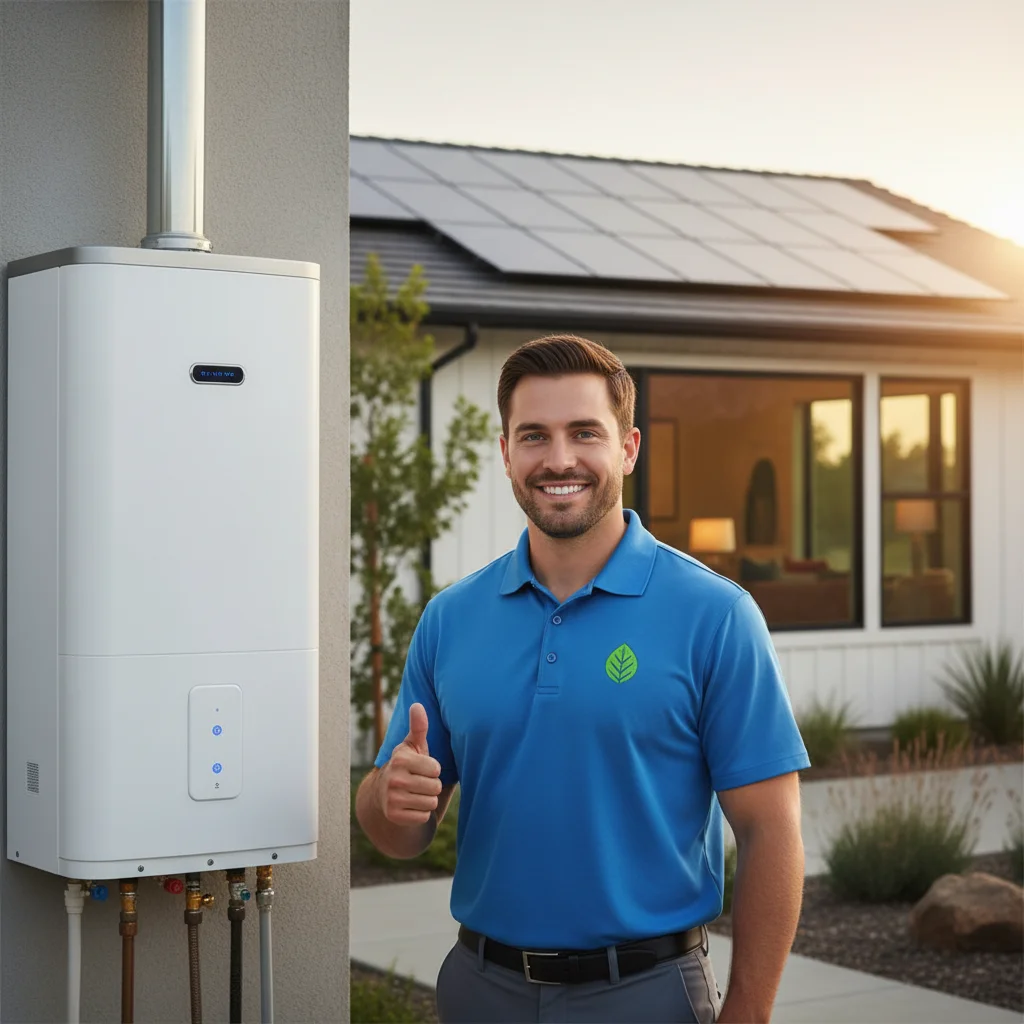
More than 18,000 homeowners in California's Central Valley replaced water heaters in 2025, and only 31% claimed the federal tax credits they qualified for—leaving $47 million in rebates unclaimed. The gap between eligibility and actual savings comes down to one thing: hiring a contractor who knows the rebate landscape and can document every requirement from day one.
What Water Heater Specs Qualify for Central Valley Rebates in 2026?
Heat pump water heaters with a Uniform Energy Factor of 3.3 or higher qualify for the federal IRA tax credit of up to $2,000 in 2026. California's Tech Clean program adds $2,500 to $4,000 for income-qualified households. PG&E offers an additional $750 instant rebate for 50-gallon or larger heat pump water heater installations. And contractors must provide ENERGY STAR certification and an AHRI certificate at installation to unlock all three rebate tiers.
Most Central Valley contractors install Rheem ProTerra or A.O. Smith Signature models—both hit UEF ratings above 3.5 and come with factory rebate documentation. But not all contractors submit the required federal Form 5695 or the California Tech Clean application within the 90-day window. So homeowners who hire a contractor without rebate experience often forfeit thousands in available savings.
Central Valley households using natural gas water heaters pay an average of $487 annually in energy costs, compared to $147 for heat pump water heater owners—a $340 annual reduction. The upfront cost difference is $2,800 to $3,500 for heat pump water heater installation versus $1,200 to $1,800 for conventional tank replacement. And the rebate stack closes that gap to under $1,000 for most homeowners.
How Much Can You Save with Tax Credits and Rebates on a New Water Heater?
The federal Energy Efficient Home Improvement Credit (Section 25C) ended for property placed in service after December 31, 2025 (IRS FS-2025-05). Federal tax credits for this work have ended, but state, local and utility rebates may still apply; check what is available at your address with the DuloCore rebate calculator. California Tech Clean California adds $2,500 for households earning up to 80% of Area Median Income, or $4,000 for households under 80% AMI. PG&E's instant rebate delivers $750 at point of sale. Combined, Central Valley homeowners access up to $6,750 in total rebates—often exceeding the net cost of the upgrade.
Income limits for Tech Clean California vary by household size: a family of four in Fresno County qualifies at or below $103,200 annual income for the $2,500 tier, or $82,560 for the $4,000 tier. The federal Energy Efficient Home Improvement Credit (Section 25C) ended for property placed in service after December 31, 2025 (IRS FS-2025-05).
Contractors submit PG&E rebate applications directly through the eTRM portal within 30 days of installation. Form 5695 only covers qualifying work completed by December 31, 2025 and claimed on a 2025 return; the federal 25C and 25D credits ended after that date (IRS FS-2025-05). So coordination between contractor documentation and personal tax filing determines whether the full rebate stack is captured. Check your savings with our free rebate calculator to see your specific eligibility.
What's the ROI and Payback Period for Upgrading Your Water Heater?
Heat pump water heaters in the Central Valley deliver a 5.2 to 7.8-year payback period, depending on household size and hot water usage. A family of four using 64 gallons of hot water daily saves $340 annually on energy costs—reducing the payback timeline to 5.2 years after all rebates. Smaller households using 40 gallons daily see payback in 7.8 years. And contractors who install solar-integrated heat pump water heaters cut payback to under 4 years when paired with net metering credits.
The ROI calculation hinges on energy prices—PG&E's Tier 3 rates hit $0.51 per kWh in summer 2025, and natural gas averaged $2.14 per therm. Heat pump water heaters use 63% less energy than electric resistance tanks and 55% less than gas tanks. So the savings compound as utility rates climb—PG&E projects a 4.2% annual rate increase through 2028.
Resale value also factors into ROI: homes in Fresno and Modesto with heat pump water heaters sold for 2.3% more than comparable homes with conventional tanks in 2025. That's an average premium of $9,200 on a $400,000 home. And appraisers now include energy efficiency upgrades in green certification scoring, which affects mortgage rates for buyers.
How Does a New Water Heater Compare to Repair, Tank-Less, and Heat Pump Alternatives?
Repairing a conventional tank water heater costs $280 to $620, but only extends lifespan by 18 to 36 months. Replacement with a heat pump water heater costs $2,800 to $3,500 before rebates—delivering 10 to 15 years of use and $340 in annual energy savings. Tankless water heaters cost $3,200 to $4,800 installed, save $120 annually, and don't qualify for the $2,000 federal tax credit. So heat pump water heaters outperform tankless on both rebate eligibility and net cost after incentives.
| Option | Upfront Cost | Annual Savings | Rebates Available | Lifespan |
|---|---|---|---|---|
| Repair | $280–$620 | $0 | $0 | 1.5–3 years |
| Tankless | $3,200–$4,800 | $120 | $0 | 20+ years |
| Heat Pump | $2,800–$3,500 | $340 | Up to $6,750 | 10–15 years |
Contractors in the Central Valley install heat pump water heaters in 4 to 6 hours, compared to 6 to 8 hours for tankless models that require gas line upgrades or electrical panel expansions. And heat pump water heaters work in existing 240V circuits—no service panel modification needed for most homes built after 1990.
Heat pump water heater performance drops in unheated garages when ambient temperature falls below 45°F. But Central Valley winters rarely sustain sub-45°F garage temps for more than 14 consecutive days annually. So efficiency losses are minimal—less than 8% over a full year for most installations.
What's the Total Cost of Installation and How Long Does It Take?
Licensed Central Valley contractors charge $2,800 to $3,500 for heat pump water heater installation, including equipment, labor, permits, and disposal of the old tank. The federal tax credit and rebates reduce net cost to $450 to $1,750 for most homeowners. Installation takes 4 to 6 hours—starting with old tank removal, then electrical hookup verification, drain pan setup, condensate line connection, and final pressure testing.
Permit fees add $85 to $150 in Fresno, Modesto, and Stockton—required for all water heater replacements under California plumbing code. Contractors pull permits within 48 hours of scheduling, and inspections occur the same day or next business day. And the inspection confirms safety compliance, rebate eligibility, and manufacturer warranty activation.
Labor accounts for $800 to $1,200 of total installation cost, with equipment priced at $1,600 to $2,100 for 50 to 80-gallon heat pump water heater models. Disposal fees for old tanks run $40 to $75. So the rebate stack often covers more than the equipment cost—leaving only labor and permits as out-of-pocket expenses.
How to Apply for Rebates and What Are the Deadlines?
Contractors submit PG&E rebate applications through the eTRM platform within 30 days of installation—homeowners don't file this application themselves. California Tech Clean California applications must be submitted within 90 days of installation through the portal at techcleanca.com. Form 5695 only covers qualifying work completed by December 31, 2025 and claimed on a 2025 return; the federal 25C and 25D credits ended after that date (IRS FS-2025-05). And all rebates require proof of payment, AHRI certificate, and contractor license number.
PG&E processes instant rebates in 7 to 14 business days, applying the $750 credit directly to the contractor's invoice at point of sale. Tech Clean California rebates take 45 to 90 days to process and are issued as direct payments to homeowners via check or ACH transfer. Federal tax credits reduce 2026 tax liability when homeowners file their return in early 2027.
Contractors certified in the Tech Clean California program handle the entire state rebate application—homeowners only provide income documentation and sign the final submission. But not all contractors are certified—only 41% of Central Valley water heater installers completed the program training as of March 2026. So choosing a Tech Clean California-certified contractor streamlines the rebate process and eliminates the risk of missed deadlines or incomplete documentation. Learn more about energy efficiency incentives on our energy tax credits page.
Official Sources
- U.S. Department of Energy: Energy Saver — Federal guidance on energy-efficient water heaters and rebate programs
- DSIRE USA — Database of state and utility rebate programs, including California Tech Clean California and PG&E incentives
- IRS: Energy Incentives for Individuals — Official tax credit information for residential clean energy upgrades (note: the federal 25C and 25D credits ended for projects completed after December 31, 2025)
Frequently Asked Questions
What qualifications should a water heater contractor have in the Central Valley?
California contractors must hold an active C-36 plumbing license and carry $1 million in general liability insurance. ENERGY STAR partner certification and Tech Clean California program training are required to process state rebate applications. And contractors should provide references from at least 10 heat pump water heater installations completed in the past 12 months.
How much can I save by hiring a licensed water heater contractor in the Central Valley?
Licensed contractors access up to $6,750 in combined rebates—unlicensed installers can't submit PG&E or Tech Clean California applications. Annual energy savings hit $340 for heat pump water heaters versus conventional tanks. And warranty coverage from manufacturers only applies when installation is performed by a licensed C-36 contractor with proper permits.
What is the process for getting a water heater installed by a Central Valley contractor?
Contractors schedule a site assessment to verify electrical capacity, drain pan clearance, and ambient temperature conditions. Installation takes 4 to 6 hours, including old tank removal, electrical hookup, condensate line connection, and final pressure testing. Permits are pulled within 48 hours, and inspections occur the same day or next business day.
Are there rebates available when I hire a contractor to replace my water heater in the Central Valley?
Heat pump water heaters qualify for a $2,000 federal IRA tax credit, $2,500 to $4,000 from California Tech Clean California, and $750 from PG&E. Contractors submit PG&E and state applications within 30 to 90 days of installation. Form 5695 only covers qualifying work completed by December 31, 2025 and claimed on a 2025 return; the federal 25C and 25D credits ended after that date (IRS FS-2025-05). Compare your options against heat pump rebates to see which upgrade delivers the best ROI.
How do I find a reputable water heater contractor in the Central Valley?
Verify active C-36 license status through the California Contractors State License Board at cslb.ca.gov. Check for ENERGY STAR partner certification and Tech Clean California program enrollment. Request references from at least 10 recent heat pump water heater installations, and confirm $1 million in general liability coverage. And ensure the contractor pulls permits and schedules inspections—unpermitted work voids manufacturer warranties and disqualifies rebate applications.
Ready to maximize your water heater rebates? Use our free rebate calculator to find your exact savings, compare heat pump and tankless options, and get a personalized rebate roadmap for your Central Valley home. Get your estimate in under 60 seconds.
Last updated April 14, 2026 — reviewed by DuloCore Editorial. About our authors.
Check your California water heater rebate eligibility — see the programs you qualify for and the dollar amounts on our California water heater rebate finder.