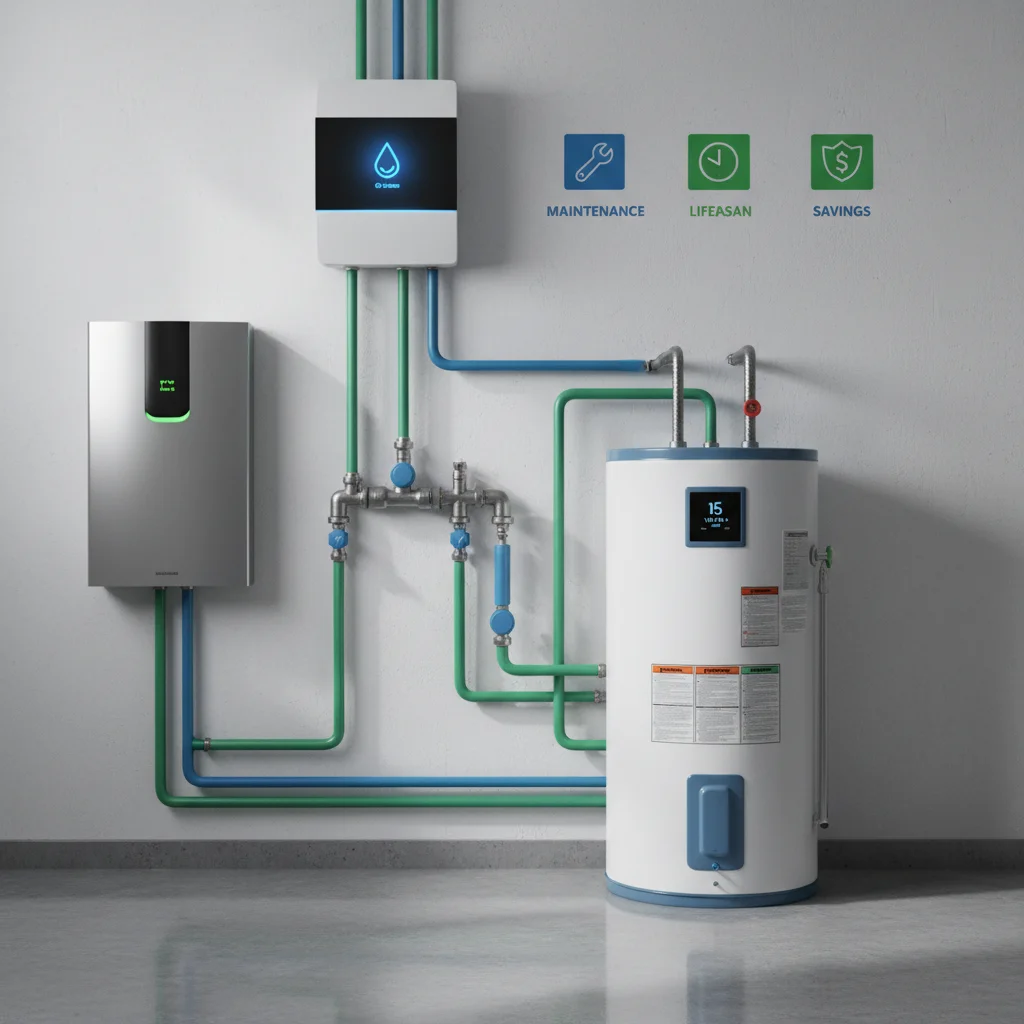
Your water heater sits in a basement corner or utility closet, silently heating water for showers and dishes—until the morning it floods your laundry room with 40 gallons of rusty water. And most homeowners never check the manufacture date stamped on the tank until it's too late. The average American replaces their water heater reactively, not proactively, losing $1,200-$3,500 in emergency plumber fees and water damage that preventive replacement would've avoided.
What's the True Lifespan of Different Water Heater Types?
Conventional tank water heaters last 8-12 years, tankless models operate 15-20 years, and heat pump water heaters deliver 10-15 years of service before requiring replacement. But climate zones, water hardness levels, and maintenance frequency shift these averages by 3-5 years in either direction, making installation date and local conditions more predictive than manufacturer warranties.
The manufacture date—not the installation date—starts the clock. And that six-digit code stamped on the rating plate tells you when your unit was built, not when the previous homeowner installed it. A water heater manufactured in 2014 and installed in 2018 already had four years of shelf degradation before it ever heated water in your home.
So a 10-year-old tank water heater in Phoenix—where inlet water temperatures average 77°F year-round—may outlast an identical 8-year-old unit in Minneapolis, where 37°F groundwater forces the heating element to work twice as hard. The Energy Department confirms that water heaters in colder climates experience 20-30% faster component wear than units in temperate zones.
How Long Does a Water Heater Last in Different Climate Zones?
Water heaters in IECC Climate Zones 1-2 (southern states) last 12-15 years on average, while identical models in Zones 6-7 (northern states) typically fail at 8-10 years due to harder-working heating elements and accelerated sediment buildup from mineral-rich groundwater. And coastal zones with high humidity shorten tank lifespan by 1-3 years through external corrosion.
California's Central Valley—Climate Zone 3—represents the sweet spot where moderate inlet water temperatures and low humidity extend conventional tank life to 11-13 years. But San Diego's coastal fog accelerates external rust, dropping expected lifespan to 9-11 years for the same manufacturer and model. So geographic microclimates matter more than broad regional averages.
The anode rod—a sacrificial metal component that prevents tank corrosion—depletes faster in areas with high total dissolved solids (TDS) in municipal water. And cities like Phoenix, Las Vegas, and parts of the Inland Empire show TDS levels above 500 ppm, cutting anode rod life from 5 years to 3 years. Water heater rebates offset replacement costs but don't extend component lifespan in hard-water regions.
What Are the Best Water Heater Alternatives for Your Home?
Heat pump water heaters deliver 2-3× the efficiency of conventional electric tanks, operating 10-15 years with $300-$550 annual energy savings in moderate climates. Tankless gas models last 15-20 years and eliminate standby heat loss but require $800-$1,200 more upfront than standard tanks. Solar water heaters paired with electric backup systems operate 20+ years in sun-rich regions like Southern California.
Condensing tankless units capture exhaust heat that conventional models vent outdoors, reaching 96% thermal efficiency versus 80% for standard tankless or 62% for traditional tanks. And the federal energy tax credits for 2026 cover 30% of installed costs for qualifying heat pump and solar water heaters, capping at $2,000 per household.
But heat pump water heaters require 1,000+ cubic feet of surrounding air space to extract thermal energy, making them impractical for small closet installations. So homeowners in older homes with cramped utility areas default to conventional tanks or wall-mounted tankless units despite lower efficiency. The rebate calculator factors in installation constraints when estimating total project costs.
How Much Does a Water Heater Replacement Cost?
Conventional 40-50 gallon tank water heaters cost $800-$1,500 installed, while tankless gas models run $2,000-$4,500 depending on flow rate and venting requirements. Heat pump water heaters range from $1,800-$3,500 installed but qualify for $2,000 federal tax credits and $200-$800 state or utility rebates in 2026, dropping net cost to $1,000-$2,300 in California.
Emergency replacements add $200-$500 in rush service fees and often require same-day water damage mitigation if the tank ruptures. And plumbers charge $95-$150 per hour, making a proactive weekend replacement $300-$600 cheaper than a midnight emergency call. So scheduling replacement at year 10 for a conventional tank saves money versus waiting for catastrophic failure.
Permit fees add $50-$150 depending on municipality, and bringing old installations up to current code—earthquake straps in California, expansion tanks in closed-loop systems—can add $150-$400 to replacement costs. But omitting required permits during emergency replacements creates insurance claim issues if water damage occurs within the first year. Compliance costs less than risk.
When Should You Replace Your Water Heater Before It Fails?
Replace conventional tank water heaters at 10 years regardless of apparent function, tankless models at 15 years, and heat pump units at 12 years to avoid emergency replacement costs and water damage averaging $5,000-$10,000 per incident. And three warning signs indicate imminent failure: rusty water from hot taps only, popping or rumbling sounds from sediment buildup, and moisture or corrosion on the tank exterior.
The manufacture date appears as a serial number starting with a letter (month) and two digits (year)—so "D16" means April 2016. And a unit manufactured in April 2016 reaches end-of-life in April 2026 for conventional tanks, April 2031 for tankless models. But waiting until year 12 for a conventional tank means operating on borrowed time.
Temperature and pressure relief (TPR) valve testing reveals internal pressure issues before catastrophic failure. And a valve that discharges water when manually lifted—then continues dripping after release—signals excessive tank pressure from sediment buildup or a failing thermostat. Replacing the TPR valve costs $150-$250 but won't fix underlying tank corrosion in units past year 8.
How Do Traditional vs. Tankless vs. Heat Pump Water Heaters Compare?
| Water Heater Type | Average Lifespan | Installed Cost | Annual Energy Cost | 2026 Tax Credit |
|---|---|---|---|---|
| Conventional Tank (40-50 gal) | 8-12 years | $800-$1,500 | $450-$600 | $0 |
| Tankless Gas | 15-20 years | $2,000-$4,500 | $200-$300 | $0 |
| Heat Pump Electric | 10-15 years | $1,800-$3,500 | $150-$250 | Up to $2,000 |
| Solar + Electric Backup | 20+ years | $5,000-$8,000 | $50-$150 | Up to $2,000 |
Traditional tanks heat and store 40-50 gallons continuously, losing 10-20% of energy to standby heat even when no hot water flows. And this "always on" operation explains why conventional electric tanks cost $450-$600 annually versus $150-$250 for heat pump models in the same climate zone. So a heat pump water heater saves $300-$350 per year, recovering the $800-$1,200 cost premium within 3-4 years.
Tankless models eliminate standby loss but require high-capacity gas lines or 120-150 amp electrical service to deliver 6-10 gallons per minute on demand. And undersized tankless units can't supply simultaneous showers plus dishwasher operation, forcing homeowners to stagger hot water use. So flow rate requirements—not just efficiency numbers—determine whether tankless makes sense for households with 3+ occupants.
Heat pump water heaters pull thermal energy from surrounding air, making them 2-3× more efficient than resistive electric elements but 15-20 decibels louder during operation. And placing them in conditioned living spaces provides maximum efficiency but introduces compressor noise into adjacent rooms. Heat pump rebates offset upfront costs but don't solve acoustic issues in small homes.
Official Sources
- ENERGY STAR Water Heater Guide — Federal efficiency standards and qualified product lists for tax credit eligibility (note: the federal 25C and 25D credits ended for projects completed after December 31, 2025)
- Department of Energy: Selecting a New Water Heater — Comparison tool covering tank, tankless, heat pump, and solar models with lifecycle cost calculators
- DSIRE: Database of State Incentives for Renewables & Efficiency — Searchable database of current rebates, tax credits, and utility programs by ZIP code (note: the federal 25C and 25D credits ended for projects completed after December 31, 2025)
Related Reading: Learn more about Wall Insulation R Value Guide and Water Heating Energy Consumption Guide.
Frequently Asked Questions
How long do water heaters typically last?
Conventional tank water heaters last 8-12 years on average, while tankless models operate 15-20 years and heat pump water heaters deliver 10-15 years of service. But actual lifespan depends on water hardness (TDS levels above 500 ppm shorten tank life by 2-3 years), maintenance frequency (annual flushing removes sediment that accelerates corrosion), and climate zone (colder regions with 37-40°F inlet water experience 20-30% faster component wear).
What factors affect how long a water heater will last?
Water hardness accelerates anode rod depletion and sediment buildup, climate zone determines heating element workload, and maintenance frequency extends or shortens component life by 2-4 years. And installation quality matters—undersized gas lines reduce tankless efficiency, incorrect TPR valve placement creates pressure issues, and missing expansion tanks in closed-loop systems cause premature tank failure through thermal expansion stress.
When should you replace a water heater?
Replace conventional tanks at 10 years, tankless models at 15 years, and heat pump units at 12 years to avoid emergency replacement costs averaging $1,500-$2,500 more than planned replacements. And three warning signs indicate imminent failure: rusty hot water from corroded tank interiors, rumbling sounds from sediment buildup on heating elements, and moisture or corrosion on the tank exterior signaling pinhole leaks.
How do you know if your water heater is failing?
Discolored hot water (rusty or brown) indicates internal tank corrosion, popping or rumbling noises reveal sediment buildup on heating elements, and moisture around the base signals pinhole leaks or TPR valve discharge from excessive pressure. And a TPR valve that drips continuously after manual testing indicates pressure issues requiring immediate attention—replacement costs $150-$250 versus $5,000-$10,000 in water damage from catastrophic tank rupture.
What's the difference between tank and tankless water heater lifespan?
Tankless water heaters last 15-20 years versus 8-12 years for conventional tanks because they operate on-demand rather than maintaining 120-140°F storage temperatures continuously. And tankless models lack the large steel tank that corrodes from constant water contact, eliminating the primary failure mode for traditional water heaters. But tankless units require descaling maintenance every 1-2 years in hard water areas, adding $150-$200 annual service costs that tanks don't incur.
Ready to maximize your water heater replacement savings? Use our free rebate calculator to find federal tax credits up to $2,000, state rebates, and utility incentives available in your ZIP code for 2026 installations.
Last updated April 14, 2026 — reviewed by DuloCore Editorial. About our authors.
Check your California water heater rebate eligibility — see the programs you qualify for and the dollar amounts on our California water heater rebate finder.