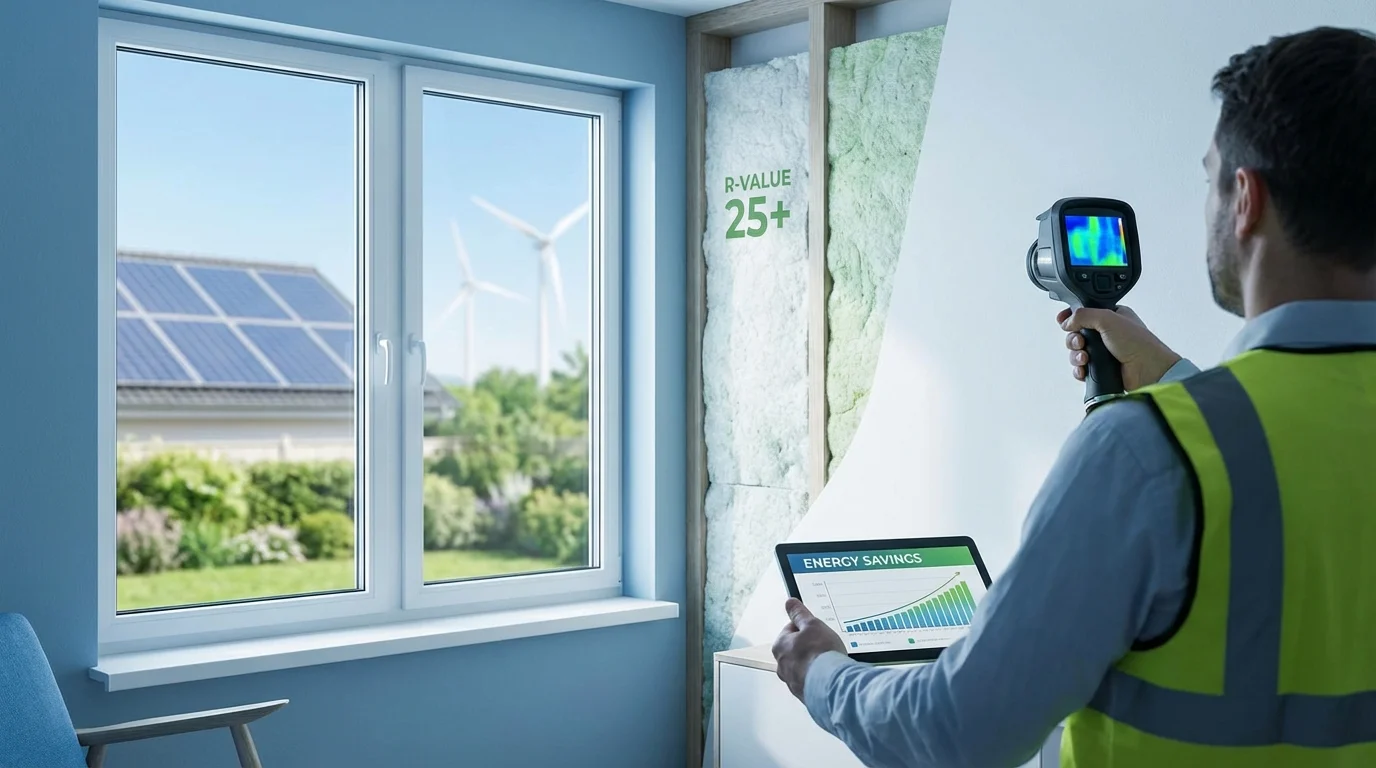
Up to 35% of a home's heating and cooling energy escapes directly through its walls, turning your HVAC system into an expensive, inefficient appliance. This constant energy leak forces systems to run longer and harder, directly increasing utility bills every single month. And with energy costs projected to rise 4% in 2026, sealing these thermal bridges isn't just an upgrade—it's a critical financial defense.
What Wall Insulation R-Value Do I Need for My Climate Zone?
Wall insulation R-value is the material's thermal resistance rating, with higher numbers indicating better insulating performance. For 2026, ENERGY STAR recommends specific R-values based on 8 U.S. climate zones, ensuring optimal energy efficiency from R-13 in hot climates (Zone 1) to R-21+ in colder regions (Zone 7).
Choosing the correct R-value for your home's climate zone is the first step toward reducing energy consumption by up to 20%. For standard 2x4 walls, homeowners typically install R-13 or R-15 insulation. But for 2x6 walls, which are common in newer construction and colder climates, R-19 or R-21 batts are necessary to meet modern energy codes. So, homes in northern states like Minnesota (Zone 7) require a minimum of R-20 in the walls, while a home in Florida (Zone 2) achieves efficiency with R-13. The Department of Energy provides a detailed map to identify your specific zone and its corresponding insulation requirements. This ensures your investment directly translates into lower energy bills and qualifies for available energy tax credits.
How Much Does Wall Insulation Cost to Install and What's My ROI?
Wall insulation installation costs range from $1.50 to $4.50 per square foot in 2026, depending on the material type and labor rates. The return on investment (ROI) for this project is typically 5 to 9 years, driven by annual energy savings of 15% to 25%.
The total project cost for a 1,500-square-foot home runs between $2,250 and $6,750. So, spray foam insulation lands at the higher end of that range, while fiberglass batts are more economical. Homeowners see an average reduction of $400-$600 in annual heating and cooling costs after upgrading wall insulation. The payback period shortens when combined with federal and state rebates, which can cover up to 30% of the material cost. A professional home energy audit pinpoints the exact areas of energy loss, maximizing the project's financial return and ensuring you target the most inefficient parts of your home's thermal envelope first.
How Can I Qualify for Rebates on High-Efficiency Wall Insulation?
To qualify for 2026 home insulation rebates, the installed materials must meet or exceed the ENERGY STAR R-value recommendations for your climate zone. The federal Energy Efficient Home Improvement Credit (Section 25C) ended for property placed in service after December 31, 2025 (IRS FS-2025-05). Federal tax credits for this work have ended, but state, local and utility rebates may still apply; check what is available at your address with the DuloCore rebate calculator.
Eligibility for these incentives hinges on precise specifications. For example, to claim the federal credit, the insulation must be installed in your primary residence and meet International Energy Conservation Code (IECC) standards.
Many state and utility programs offer additional cash-back rebates, often requiring professional installation and proof of purchase. So, homeowners must retain all invoices and manufacturer certifications. Use our free rebate calculator to find specific programs in your area.
What Are the Best Wall Insulation Alternatives and How Do They Compare?
The best wall insulation alternatives for 2026 include spray foam, fiberglass batts, and blown-in cellulose, each offering distinct R-values, costs, and applications. Spray foam provides the highest R-value per inch (R-6.5), while fiberglass batts offer a cost-effective solution at R-3.5 per inch.
Choosing an alternative depends on the project's budget and structural needs. Open-cell spray foam is excellent for air sealing but has a lower R-value than closed-cell foam. And fiberglass batts are the most common DIY option, costing just $0.60-$1.30 per square foot. But blown-in cellulose, made from recycled paper, is ideal for filling existing wall cavities without demolition. These insulation upgrades often work in tandem with other efficiency projects like heat pump rebates, creating a whole-home energy solution that compounds savings.
| Insulation Type | R-Value per Inch | Avg. Cost/Sq. Ft. (Installed) | Lifespan |
|---|---|---|---|
| Spray Foam (Closed-Cell) | R-6.0 to R-7.0 | $2.50 - $5.00 | 80+ years |
| Fiberglass Batts | R-3.1 to R-4.3 | $1.00 - $2.50 | 80-100 years |
| Blown-in Cellulose | R-3.2 to R-3.8 | $1.50 - $3.00 | 20-30 years |
How Long Does Wall Insulation Last and What Maintenance Does It Need?
Modern wall insulation materials like fiberglass and mineral wool last 80 to 100 years, while spray foam insulation lasts for the life of the home. These materials are designed to be maintenance-free, requiring no homeowner intervention unless disturbed by moisture, pests, or renovations.
The longevity of insulation directly impacts its long-term value. Once installed correctly, it performs consistently for decades. And the primary threats to its effectiveness are external factors. For instance, water damage from a roof leak will compress fiberglass or cellulose, reducing its R-value by over 40%. Pests can also nest in and destroy insulation materials. So, annual visual inspections in accessible areas like attics or crawl spaces are sufficient to check for signs of moisture, mold, or pest activity. If the insulation remains dry and undisturbed, its thermal performance won't degrade over its lifespan.
Official Sources
- ENERGY STAR — Federal guidelines on recommended insulation levels and certified products.
- Database of State Incentives for Renewables & Efficiency (DSIRE) — A comprehensive database of state and local energy rebates and policies.
Related Reading: Learn more about Insulation R Value Chart.
Frequently Asked Questions
What R-value is recommended for wall insulation to qualify for most home improvement rebates?
Most 2026 federal and utility rebates require wall insulation to meet or exceed the Department of Energy's ENERGY STAR recommendations for your specific climate zone. This typically means a minimum of R-13 for 2x4 walls and R-20 for 2x6 walls. The federal Energy Efficient Home Improvement Credit (Section 25C) ended for property placed in service after December 31, 2025 (IRS FS-2025-05).
How does wall insulation R-value impact the potential rebate amount I can receive?
Higher R-value insulation generally costs more, which increases the total project cost that a percentage-based rebate is calculated from. The federal Energy Efficient Home Improvement Credit (Section 25C) ended for property placed in service after December 31, 2025 (IRS FS-2025-05). Installing R-21 insulation instead of R-13 increases your material cost, allowing you to claim a larger portion of that $1,200 credit, assuming you don't exceed the cap.
How do I choose the right R-value for my walls to maximize energy savings and rebate eligibility?
To maximize both savings and rebates, first identify your home's climate zone using the DOE's map. Then, select an insulation product that meets the 2026 ENERGY STAR recommendation for that zone (e.g., R-15 to R-21 for Zone 5). This ensures you qualify for federal tax credits and most local utility rebates. Choosing a slightly higher R-value than the minimum requirement often provides a better long-term return on energy savings.
What is the difference between R-13 and R-19 wall insulation in terms of rebate qualification?
For rebate qualification, the key difference is climate zone suitability. R-13 insulation meets the minimum standard for 2x4 walls in warmer climate zones (1-4) and will qualify for rebates there. But R-19 is often the minimum requirement for 2x6 walls in colder zones (5-8). So, installing R-13 in a Zone 6 home will likely fail to qualify for 2026 performance-based utility rebates.
Do specific climate zones have different minimum wall insulation R-value requirements for rebates?
Yes, rebate programs tie their minimum R-value requirements directly to DOE climate zones. A utility rebate in Florida (Zone 2) may require a minimum of R-13 for walls. But a program in Maine (Zone 6) will require at least R-20 wall insulation to qualify for the same type of 2026 rebate. These zone-specific requirements ensure the funded energy upgrades deliver meaningful savings for the local climate.
Find Your Wall Insulation Rebates Now
Don't leave money on the table. Use DuloCore's free rebate calculator to instantly find every federal, state, and utility incentive available for your high-efficiency insulation project.
Calculate Your SavingsLast updated: April 14, 2026. Reviewed by the DuloCore Editorial Team. About our authors.
Check your California insulation rebate eligibility — see the programs you qualify for and the dollar amounts on our California insulation rebate finder.