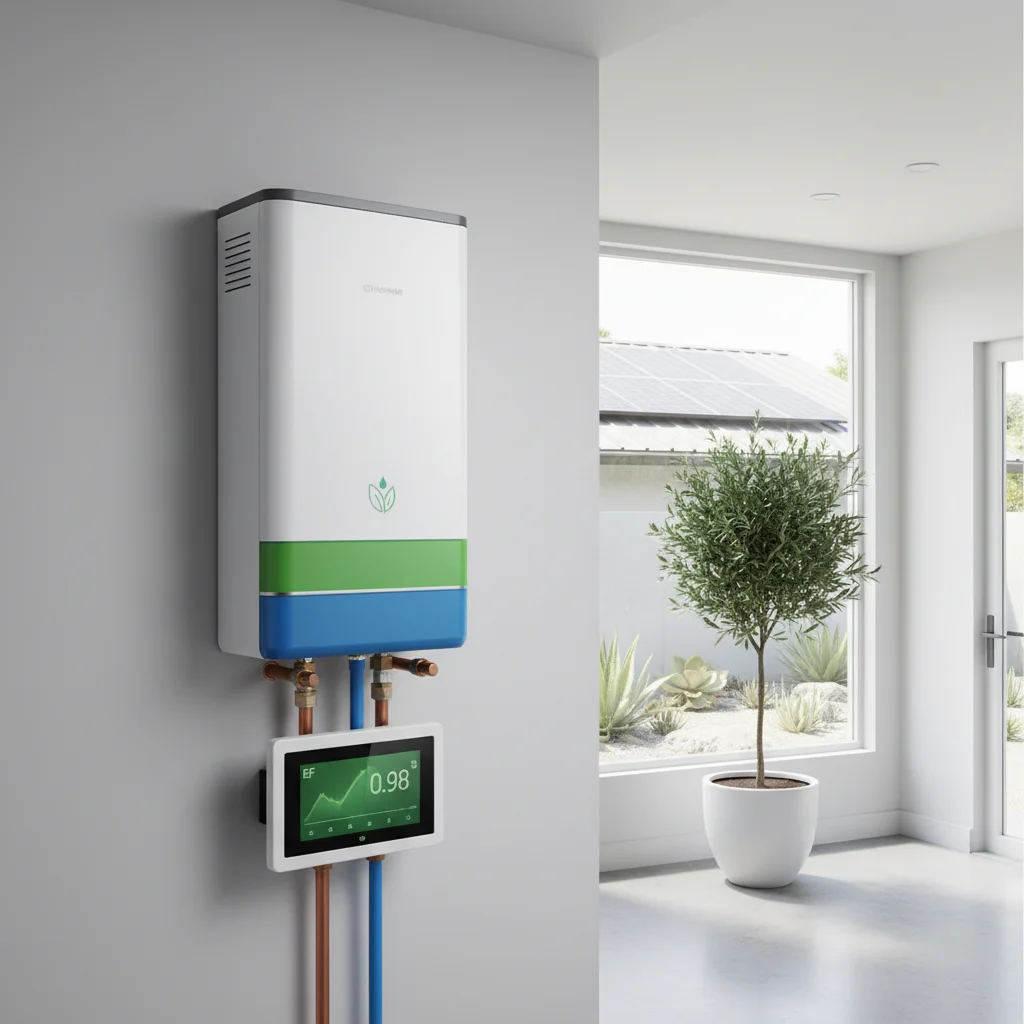
California homeowners waste $1.2 billion annually on inefficient water heating—the second-largest energy expense in most homes after space heating and cooling. And yet most families don't know that a single number printed on every water heater nameplate reveals exactly how much money they're throwing away.
What Is Energy Factor and How Does It Impact Your Water Heater Costs in California?
Energy Factor (EF) measures how efficiently a water heater converts fuel into hot water over a typical day. A gas storage tank water heater with an EF of 0.67 wastes 33% of the energy it consumes, while a condensing gas unit with an EF of 0.96 wastes only 4%. California households using a 0.67 EF gas water heater spend approximately $450 annually on water heating, but upgrading to a 0.96 EF model cuts that cost to $313—a $137 annual savings that compounds over the unit's 13-year lifespan to $1,781 in avoided costs.
But EF ratings became obsolete in 2017 when the Department of Energy replaced them with Uniform Energy Factor (UEF). So older models still display EF, while units manufactured after June 2017 show UEF ratings that account for realistic usage patterns and standby losses. The practical difference: a gas storage water heater labeled 0.67 EF translates to approximately 0.64 UEF, while an electric heat pump water heater with a 2.0 EF converts to roughly 3.5 UEF under the new testing protocol.
"The Uniform Energy Factor provides a more accurate representation of in-home performance than the previous Energy Factor metric, especially for heat pump and tankless water heaters." — U.S. Department of Energy
California's Title 24 building codes now require minimum UEF ratings of 0.64 for gas storage water heaters and 0.92 for electric resistance models in new construction and whole-house replacements. Yet these minimums represent the floor, not the ceiling—homeowners who install units exceeding these baselines unlock accelerated payback periods and qualify for stacked incentives from utilities, regional programs, and federal tax credits.
Which Climate Zones in California Benefit Most From High Energy Factor Water Heaters?
California's 16 climate zones create wildly different payback timelines for water heater upgrades. Inland desert regions like Climate Zone 15 (covering Palm Springs and Indio) see water heaters work 40% harder than coastal Zone 6 (Los Angeles basin) because incoming groundwater temperatures range from 52°F in winter to 78°F in summer versus a stable 58-62°F year-round on the coast.
So a household in Fresno (Climate Zone 13) upgrading from a 0.62 UEF gas tank to a 0.82 UEF condensing model saves $184 annually based on $2.15/therm gas rates and 64-gallon daily usage. That same upgrade in San Francisco (Climate Zone 3) saves only $147 because milder inlet water requires less heating. And the gap widens dramatically for heat pump water heaters: a 3.5 UEF unit in Bakersfield (Climate Zone 13) pulls 240 kWh monthly versus 165 kWh in Santa Cruz (Climate Zone 5), creating a $27 monthly cost difference at $0.30/kWh electricity rates.
The highest ROI zones for premium efficiency upgrades cluster in the Central Valley and inland Southern California:
- Climate Zone 12 (Sacramento): 6.2-year payback on heat pump water heater upgrade
- Climate Zone 13 (Fresno/Visalia): 5.8-year payback
- Climate Zone 14 (Riverside/San Bernardino): 5.4-year payback
- Climate Zone 15 (Palm Springs): 4.9-year payback
Coastal homeowners in Zones 3, 5, and 6 see 8-11 year payback periods for the same upgrades because milder climates reduce the absolute energy savings delta between baseline and high-efficiency models. But even slow-payback zones justify upgrades when factoring in California utility rebates that cut upfront costs by $500-$2,000.
How Long Until Your Energy Factor Investment Pays for Itself?
A 50-gallon electric heat pump water heater with a 3.75 UEF rating costs $1,800-$2,400 installed versus $950-$1,400 for a baseline 0.92 UEF electric resistance tank. That $1,000 premium feels steep until you calculate the annual operating cost difference: the heat pump unit runs $165/year at California's average $0.30/kWh rate, while the resistance tank costs $580/year—a $415 annual savings.
And the math gets better with incentives. The federal Energy Efficient Home Improvement Credit (Section 25C) ended for property placed in service after December 31, 2025 (IRS FS-2025-05). Federal tax credits for this work have ended, but state, local and utility rebates may still apply; check what is available at your address with the DuloCore rebate calculator. California utilities layer on rebates ranging from $500 (Pacific Gas & Electric) to $1,500 (Los Angeles Department of Water & Power) for heat pump water heater installations, while the Tech Clean California Heat Pump Water Heater Program offers $2,000-$3,000 for income-qualified households.
So the real-world payback calculation for that heat pump water heater looks like this:
- Gross cost: $2,100 installed
- The federal Energy Efficient Home Improvement Credit (Section 25C) ended for property placed in service after December 31, 2025 (IRS FS-2025-05).
- PG&E rebate: -$500
- Net cost: $970
- Annual savings: $415
- Payback period: 2.3 years
Condensing gas water heaters follow similar economics: a 0.82 UEF model costs $1,600-$2,200 installed versus $1,100-$1,500 for a 0.62 UEF baseline tank. The $600 premium pays back in 3.8-5.2 years depending on climate zone and usage patterns, and faster with SoCalGas rebates of $400-$800 for qualified ENERGY STAR models.
But tankless gas water heaters defy simple payback analysis because their 0.91-0.96 UEF ratings deliver only modest energy savings over condensing storage tanks while costing $3,000-$4,500 installed. The appeal lies in unlimited hot water capacity and 20+ year lifespan versus 13 years for tank models—making lifecycle cost the better comparison metric than simple payback.
How Do High Energy Factor Water Heaters Compare to Solar and Heat Pump Alternatives?
Heat pump water heaters dominate the efficiency spectrum with UEF ratings of 3.5-4.0, meaning they move 3.5-4 units of heat for every unit of electricity consumed. And that trounces every combustion-based alternative: condensing gas tanks top out at 0.96 UEF, while even the most efficient tankless gas models peak at 0.98 UEF.
But the cost and installation complexity tell a different story. A hybrid heat pump water heater requires 700-1,000 cubic feet of surrounding air space to extract heat, making them impractical for small closets or tight utility rooms where most California homes install water heaters. So builders and homeowners in space-constrained situations default to condensing gas tanks or tankless units despite lower UEF ratings.
Solar thermal water heating systems achieve the highest theoretical efficiency—using free sunshine to heat water with no ongoing fuel costs. Yet the $6,000-$9,000 installed cost and 12-18 year payback period without incentives explain why adoption remains under 1% of California households. And solar thermal faces a fatal competition problem: rooftop solar photovoltaic (PV) panels coupled with heat pump water heaters deliver equivalent energy savings at lower total system cost while providing electricity for the entire home, not just water heating.
The numbers prove it. A 4 kW solar PV system ($12,000 installed after federal tax credit) generates 6,000 kWh annually in most California climates—enough to power a heat pump water heater (2,000 kWh/year) plus offset 4,000 kWh of household electricity consumption. Compare that to solar thermal's single-purpose water heating for $6,000-$9,000 and the choice becomes obvious.
"Heat pump water heaters paired with solar photovoltaic systems represent the most cost-effective pathway to zero-emission residential water heating in California." — California Energy Commission
Geothermal heat pump systems add another dimension: whole-house heating, cooling, and domestic hot water from a single ground-source system with effective UEF ratings exceeding 5.0 for the water heating component. But the $25,000-$45,000 installed cost restricts adoption to new construction and major remodels where the 15-25 year payback period aligns with whole-home energy planning.
How Long Do High Energy Factor Water Heaters Last in California's Climate?
California's hard water accelerates tank corrosion and shortens water heater lifespan by 15-30% compared to national averages. So a standard gas storage tank rated for 13 years of service life fails after 9-11 years in Riverside, San Bernardino, and Fresno where total dissolved solids (TDS) exceed 500 ppm. And the problem compounds with high-efficiency models: condensing gas water heaters run hotter combustion chambers that stress heat exchangers, while heat pump units rely on complex refrigeration components with shorter mean time between failures than simple resistance elements.
Real-world durability data from California utilities shows:
- Standard gas tank (0.62 UEF): 9-12 years average lifespan
- Condensing gas tank (0.82 UEF): 11-14 years
- Tankless gas (0.96 UEF): 15-20 years (but requires annual descaling in hard water zones)
- Electric resistance tank (0.92 UEF): 8-11 years
- Heat pump water heater (3.5 UEF): 10-13 years
But lifespan metrics miss the maintenance burden. Tankless gas water heaters demand annual vinegar flushes or professional descaling ($150-$200) in areas with water hardness above 120 ppm—covering most of inland California. Skip the maintenance and calcium buildup chokes the heat exchanger, triggering $400-$800 repairs or premature replacement.
Heat pump water heaters avoid scaling issues but introduce different maintenance: air filter cleaning every 3 months, evaporator coil inspection annually, and refrigerant leak monitoring. So the "maintenance-free" reputation of tank water heaters doesn't extend to high-efficiency alternatives that trade simplicity for performance.
The longest-lived option remains condensing gas storage tanks that balance efficiency (0.82 UEF) with proven tank-based architecture. These units incorporate corrosion-resistant alloys and powered anode rods that extend service life 2-3 years beyond standard tanks while avoiding the complexity of tankless or heat pump systems.
What Tax Credits and Rebates Can Offset Your Water Heater Upgrade Cost?
The federal Energy Efficient Home Improvement Credit (Section 25C) ended for property placed in service after December 31, 2025 (IRS FS-2025-05).
But utility rebates dwarf federal credits in many service territories. Pacific Gas & Electric offers $500 for qualifying heat pump water heaters, Southern California Edison provides $750, and Los Angeles Department of Water & Power goes up to $1,500 for installations replacing electric resistance tanks. So a Los Angeles homeowner stacking federal and utility incentives captures $2,100 in total rebates on a $2,400 installed heat pump water heater—cutting net cost to just $300.
California's Tech Clean California program layers additional support for income-qualified households:
- $2,000-$3,000 for heat pump water heater installation
- $500-$1,000 for condensing gas water heaters
- Free pre-installation energy assessment
- 0% financing up to $10,000 for comprehensive electrification upgrades
And the program defines income-qualified broadly: households earning up to 80% of area median income qualify in most counties, covering 45% of California families.
Gas utilities SoCalGas and PG&E offer separate rebates for efficient gas water heaters: $400-$800 for condensing storage tanks with 0.80+ UEF ratings, and $500-$1,000 for ENERGY STAR certified tankless models. These rebates can't combine with federal credits (gas water heaters don't qualify for the IRA credit), but they still cut net upgrade costs by 25-40%.
Check current 2026 program availability and amounts using the rebate calculator before purchasing equipment—utility budgets fluctuate annually and popular programs sell out by Q3 in high-demand years.
Official Sources
- U.S. Department of Energy Water Heating Guide — Federal efficiency standards, UEF ratings, and technology comparisons
- Database of State Incentives for Renewables & Efficiency — California rebate programs, eligibility requirements, and application portals
- California Energy Commission Building Standards — Title 24 minimum efficiency requirements and climate zone maps
Related Reading: Learn more about Energy Audit Report Example and Energy Auditor Certification Programs.
Related Reading: Learn more about Energy Auditor Certification Programs and Energy Efficient Home Improvement Credit For Water Heater.
Frequently Asked Questions
What is an energy factor rating for water heaters?
Energy Factor (EF) measured how efficiently water heaters converted fuel to hot water from 1990-2017, with higher numbers indicating better efficiency. But the Department of Energy replaced EF with Uniform Energy Factor (UEF) in 2017 to better reflect real-world performance including standby losses and cycling patterns. A 0.67 EF gas tank translates to approximately 0.64 UEF, while a 2.0 EF heat pump water heater converts to roughly 3.5 UEF.
How much can I save with a high efficiency water heater in California?
California homeowners upgrading from a 0.62 UEF gas tank to a 0.82 UEF condensing model save $130-$185 annually depending on climate zone and gas rates. Switching from a 0.92 UEF electric resistance tank to a 3.5 UEF heat pump water heater cuts costs by $415 per year at California's average $0.30/kWh electricity rate. And those savings compound over the unit's 10-15 year lifespan to $4,150-$6,225 in avoided energy costs.
Are water heaters eligible for California rebates in 2026?
Yes, California utilities offer $500-$1,500 rebates for qualifying heat pump water heaters in 2026, while gas utilities provide $400-$1,000 for condensing and tankless models. The federal Energy Efficient Home Improvement Credit (Section 25C) ended for property placed in service after December 31, 2025 (IRS FS-2025-05). And the Tech Clean California program delivers $2,000-$3,000 to income-qualified households replacing electric resistance tanks with heat pump models.
What energy factor do I need to qualify for rebates?
Federal tax credits require 2.0 UEF minimum for electric heat pump water heaters or ENERGY STAR Most Efficient certification for gas units. California utility rebates set individual thresholds: PG&E requires 3.3+ UEF for heat pump rebates, while SoCalGas demands 0.80+ UEF for condensing gas tank incentives and 0.90+ UEF for tankless models. Check specific program requirements before purchasing equipment.
How long does it take to get a water heater rebate in California?
California utility rebates process in 4-8 weeks after submitting proof of purchase, installation photos, and equipment serial numbers through online portals. Federal tax credits apply when filing annual tax returns, delivering savings 3-15 months after installation depending on purchase timing. Tech Clean California program rebates arrive within 6-10 weeks of completed installation verification by program-approved contractors.
Ready to calculate your exact savings? Use our free rebate calculator to discover which water heater upgrades qualify for federal credits and California utility rebates in your zip code—and see your personalized payback timeline in under 60 seconds.
Last updated: April 14, 2026. Reviewed by the DuloCore Editorial Team. About our authors.
Check your California water heater rebate eligibility — see the programs you qualify for and the dollar amounts on our California water heater rebate finder.