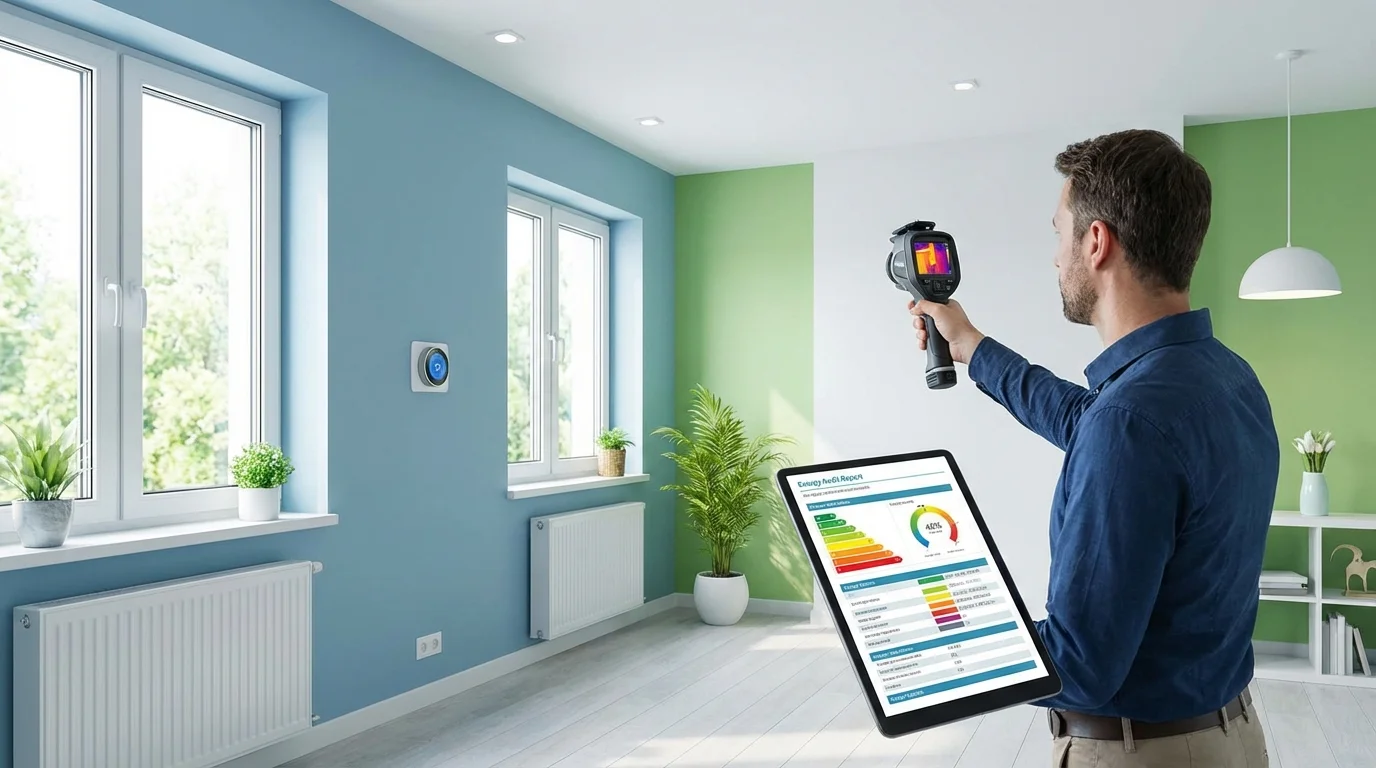
Up to 30% of the energy used to heat and cool the average American home is wasted due to air leaks and inefficient systems. This isn't just a comfort issue; it's a direct drain on your finances, costing homeowners hundreds of dollars every year. So understanding where that energy escapes is the first step to reclaiming those losses and unlocking thousands in savings.
What Should a Comprehensive Energy Audit Report Include and How Do I Understand Its Recommendations?
A comprehensive energy audit report is a diagnostic document that details a home's energy performance, including blower door test results (CFM50), thermal imaging, and a prioritized list of energy conservation measures (ECMs). In 2026, these reports are required for many state and utility rebate applications.
A professional energy audit report acts as a detailed blueprint for improving your home's efficiency. It begins with a baseline assessment, quantifying your current energy usage and pinpointing specific problem areas. So look for key metrics like the blower door test result, which measures air leakage in Cubic Feet per Minute (CFM). And reports include infrared thermography images showing where heat is escaping from walls, windows, and attics. The most critical section is the list of recommended improvements, often prioritized by cost-effectiveness. This list will specify actions like adding R-49 insulation to the attic, air sealing the building envelope to reduce leakage by 20%, or upgrading to a high-efficiency heat pump. Each recommendation in a proper home energy audit report connects directly to available financial incentives. But without this document, accessing those funds is impossible.
The core issue is that homeowners often don't know where to start. An energy audit report provides that roadmap, detailing specific, prioritized actions from air sealing to insulation upgrades. Without this professional assessment, homeowners risk investing in improvements that don't address their home's biggest energy deficits, leaving up to $8,000 in potential IRA rebates on the table.
How Can My Energy Audit Report Help Me Identify Available Rebates and Financial Incentives?
An energy audit report serves as official documentation for rebate eligibility, identifying specific upgrades like heat pumps or insulation that qualify for 2026 federal and state programs. The report's baseline energy usage data and recommended improvements directly map to requirements for programs like the Home Efficiency Rebates.
Your energy audit report is the key that unlocks rebate funding. State and utility program administrators use the report's findings to validate that a proposed project meets their specific efficiency-gain requirements. For example, a program may require a 15% reduction in air leakage, a target confirmed by the pre- and post-improvement blower door test numbers in your report. And the document explicitly lists qualifying equipment, such as a heat pump with a required SEER2 rating of 16 or higher. The report essentially pre-qualifies your project, providing the necessary third-party verification that programs need before issuing payments. So this documentation streamlines the application process and connects your home's specific needs directly to available energy tax credits and local rebates, ensuring you don't miss out on funding.
"A home energy assessment, also known as a home energy audit, can help you understand the whole picture of your home's energy use." — U.S. Department of Energy
What are the Specific Rebate Amounts, Eligible Equipment, and Income Limits for Energy Efficiency Upgrades?
Specific 2026 rebate amounts are tied to audit recommendations, offering up to $8,000 for heat pumps and $1,600 for insulation and air sealing. Eligible equipment must meet ENERGY STAR or CEE Tier standards, with income limits set at 150% of the area median income for maximum incentives.
The 2026 rebate landscape is defined by specific performance tiers and income brackets. For instance, under the federal IRA programs, low-to-moderate income households (earning less than 80% of the Area Median Income) are eligible for rebates covering up to 100% of project costs, capped at $14,000 per household. This includes up to $8,000 for qualifying heat pump rebates. And eligible equipment isn't just any model; it must meet strict efficiency standards, such as ENERGY STAR 7.0 for windows or NEEP Cold Climate specifications for heat pumps. So homeowners must verify that the model numbers on their contractor's quote match the program's eligibility list. But households earning over 150% of AMI generally don't qualify for these direct rebates, though they can still access federal tax credits. Use our free rebate calculator to find your exact savings.
What is the Application Process, Deadlines, and Funding Status for State and Utility Rebate Programs?
The 2026 application process requires submitting the full energy audit report, contractor invoices, and proof of income to a state energy office or utility portal. Deadlines are often tied to program funding, which is allocated annually, so homeowners must check the funding status before starting projects.
Navigating the application process requires careful documentation and timing. Most 2026 state and utility programs operate on a first-come, first-served basis until their annual funding is depleted. The typical process involves getting a pre-project energy audit, submitting a rebate reservation application with the audit and contractor bids, and then completing the work. After installation, you submit the final invoice, post-project audit results, and other required forms. Deadlines are absolute; many programs require applications to be submitted within 90 days of project completion. So it is critical to check the program's website for funding status before signing any contracts. But once funds are exhausted for the year, new applications are rejected until the next funding cycle begins, typically on January 1st.
Can I Stack Multiple Rebates, and What are the Contractor Requirements for Program Eligibility?
Homeowners can stack multiple rebates in 2026, combining federal IRA tax credits with state and utility incentives for a single project. Contractor requirements are strict; installers must be licensed, insured, and often hold certifications like BPI (Building Performance Institute) to ensure the work qualifies for program funding.
Stacking incentives is the primary strategy for maximizing financial returns on energy efficiency projects. For example, a homeowner can receive a $2,000 state rebate for a new heat pump, a $600 utility rebate, and also claim the 30% federal tax credit (up to $2,000) for the same installation. The total savings on a $10,000 system becomes $4,600. But these programs mandate the use of qualified contractors. Many state programs maintain a list of pre-approved installers who meet licensing, insurance, and certification requirements, such as BPI or NATE credentials. So hiring an uncertified contractor, even if their price is lower, will disqualify the project from receiving any rebates. Always verify your contractor's status on the program's official list before work begins. This ensures the installation quality meets the standards required for your geothermal tax credit and other incentives.
2026 Home Energy Rebate Program Comparison
| Program / Incentive | Max Amount | Income Eligibility | Key Requirement |
|---|---|---|---|
| Federal IRA Tax Credit | Ended Dec 31, 2025 | — | — |
| Home Efficiency Rebates | Up to $8,000 (LMI) | <150% of Area Median Income | Modeled or measured energy savings of 20-35% |
| State Clean Heat Program | $1,000 - $4,000 | Varies by state | Installation of cold-climate heat pumps |
Official Sources
- Database of State Incentives for Renewables & Efficiency (DSIRE) — The most comprehensive source for current state, local, utility, and federal incentives.
- ENERGY STAR — Federal program providing efficiency standards and information on qualifying products for rebates and tax credits. (note: the federal 25C and 25D credits ended for projects completed after December 31, 2025)
"DSIRE is the most comprehensive source of information on incentives and policies that support renewables and energy efficiency in the United States." — NC Clean Energy Technology Center
Related Reading: Learn more about How Long Does Energy Audit Take and Humidity Control Energy Audit.
Frequently Asked Questions
What makes an energy audit report eligible for rebate programs?
An energy audit report becomes eligible for 2026 rebate programs when it is conducted by a certified professional, such as a BPI Building Analyst, and includes specific diagnostic results. Key components must include a blower door test measuring air leakage (CFM50), combustion safety testing, and a prioritized list of Energy Conservation Measures (ECMs). Programs require this level of detail to validate the estimated energy savings of at least 15-20%.
Can an energy audit report help maximize my rebate potential?
Yes, an energy audit report directly maximizes rebate potential by identifying all qualifying upgrade opportunities in your home. Instead of guessing, the report provides a data-backed plan. For example, it may show that combining attic insulation (a $1,600 rebate) with a heat pump installation (an $8,000 rebate) will yield a higher total incentive than either project alone, and it provides the documentation needed for both.
What key information is typically included in an energy audit report example?
A typical energy audit report example includes a summary of findings, baseline energy consumption data, and diagnostic test results like a blower door score (e.g., 2,500 CFM50). It also features infrared thermal images showing heat loss points and a detailed list of recommendations with estimated costs, projected annual savings (e.g., $450/year), and simple payback periods for each upgrade.
Is there an expiration date for an energy audit report when applying for rebates?
Yes, most state and utility rebate programs require an energy audit report to be recent, typically completed within the last 12 to 24 months. For 2026 programs, an audit from 2024 is likely expired. This rule ensures the report reflects the home's current condition before upgrades are undertaken, providing an accurate baseline for calculating energy savings and rebate eligibility.
How does an energy audit report differ from a general home inspection for rebate purposes?
An energy audit report is a performance diagnostic, while a home inspection is a visual defect assessment. A home inspector looks for problems like a failing roof or faulty wiring. But an energy auditor uses specialized equipment like blower doors and infrared cameras to measure energy-specific metrics like air leakage and insulation effectiveness, which are required for nearly all 2026 energy rebate applications.
Updated: April 14, 2026 — fact-checked by DuloCore Research. About our editorial process.