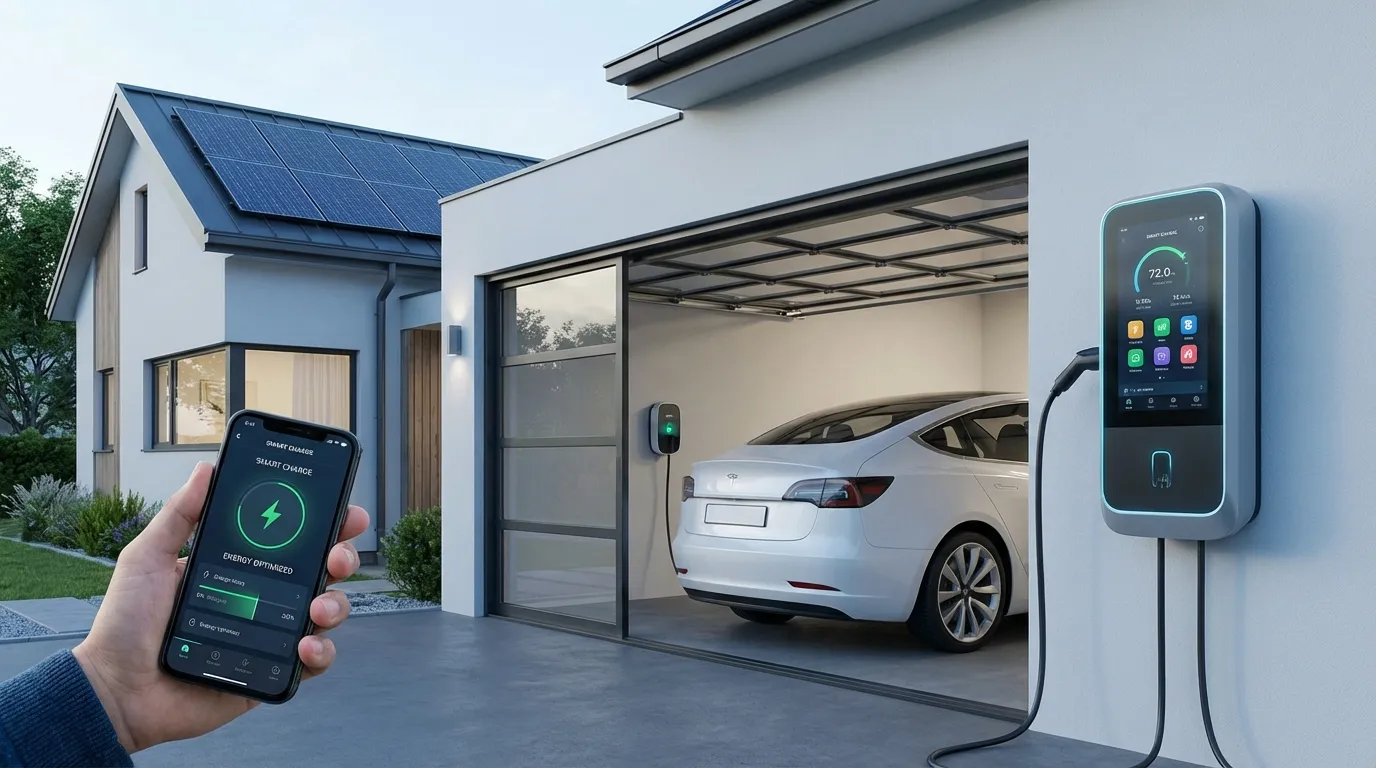
Charging an electric vehicle during peak hours costs up to 400% more than charging overnight. A standard "dumb" charger doesn't know the difference, drawing power at the most expensive times and erasing a portion of the savings you gain by driving electric. So the decision to upgrade to a smart charger directly impacts your wallet every single time you plug in.
What's the Real Cost of a Smart EV Charger and Its Professional Installation?
A Level 2 smart EV charger typically costs between $500 and $900 for the unit itself. So professional installation by a licensed electrician adds another $800 to $2,000, depending on the home's existing wiring and the distance from the electrical panel to the garage, bringing the total to $1,300-$2,900.
The upfront investment for a smart EV charger is a primary consideration for homeowners. But this initial cost is often offset by available EV charger rebates. The installation cost varies based on several factors. For example, a home with a modern 200-amp panel located near the garage will have a lower installation fee, often under $1,000. So an older home requiring a panel upgrade or extensive new wiring faces costs exceeding $2,000. And these installation costs are crucial because many utility and state rebates cover a percentage of the total project cost, not just the hardware. Budgeting for both the charger and the professional installation ensures you can accurately calculate your final out-of-pocket expense after incentives.
How Do Smart EV Chargers Qualify for Rebates and What Brands Are Eligible?
Smart EV chargers qualify for rebates by being ENERGY STAR® certified and Wi-Fi enabled, allowing them to participate in utility demand-response programs. So eligible brands like ChargePoint, JuiceBox, and Wallbox meet these technical specifications, which are required by most state and local incentive programs in 2024.
To qualify for incentives, a smart charger must meet specific criteria set by the utility or state agency. The most common requirement is ENERGY STAR® certification, which guarantees the charger meets federal efficiency standards. But many programs also mandate network connectivity (Wi-Fi or cellular) to enable smart charging features. These features allow the utility to manage grid load by slightly adjusting charging times during peak demand. So brands like Enel X Way, Emporia, and Grizzl-E consistently appear on eligibility lists.
"Many states and utilities offer rebates and other incentives for the purchase and installation of Level 2 charging." — U.S. Department of Energy
Homeowners should always verify a specific model's eligibility on their local utility’s website before purchasing. The Database of State Incentives for Renewables & Efficiency (DSIRE) is another excellent resource for finding local programs.
Do Smart Features Truly Save Money: ROI, Efficiency, and Lifespan?
Smart EV charger features deliver an average annual savings of $200 to $500 on electricity bills by shifting charging to off-peak hours. So with a typical lifespan of 10 years, the charger's return on investment (ROI) is achieved within 2 to 5 years, depending on local utility rates.
The core value of a smart charger is its ability to automate cost savings. By scheduling charging sessions through a mobile app, you ensure the vehicle only draws power when electricity rates are lowest, often overnight. So this simple act of load-shifting reduces charging costs by 50% or more compared to a non-smart charger. And the efficiency of these units, typically rated above 90%, means minimal energy is lost during the charging process. But the long-term savings are what justify the initial cost. Over a decade, a homeowner saves between $2,000 and $5,000, far exceeding the initial hardware investment of $500-$900.
Smart Charger Rebate Program Comparison
| Program / Utility | Rebate Amount | Key Eligibility | Status |
|---|---|---|---|
| Austin Energy (TX) | Up to $450 | Wi-Fi enabled, ENERGY STAR® | Open |
| LADWP (CA) | Up to $1,000 | New EV purchase/lease, ENERGY STAR® | Open |
| Con Edison (NY) | Up to $500 | Smart charging features, network connected | Open |
Which Smart EV Charger is Best Suited for Your Home and Climate Zone?
The best smart EV charger for your home is one with a NEMA 4 rating for outdoor durability in harsh climates and an amperage that matches your electrical panel's capacity, typically 40 or 48 amps. So brands like the Grizzl-E Extreme Edition are built for cold-weather performance.
Choosing the right charger involves matching its specifications to your environment and vehicle. For homeowners in regions with extreme temperatures, a charger's operating temperature range and enclosure rating are critical. A NEMA 4-rated enclosure is waterproof and dust-tight, making it suitable for outdoor installation in any climate. So for charging speed, a 40-amp charger adds about 30 miles of range per hour, which is sufficient for most daily commutes. But if you have a 100-kWh battery pack and need faster turnarounds, a 48-amp or even an 80-amp model is a better fit, provided your home's electrical service supports it. And comparing these technical specs against your needs is more important than brand loyalty. Using a rebate calculator helps you see which high-performance models qualify for savings.
What Maintenance Do Smart EV Chargers Need to Maximize Their Value?
Smart EV chargers require minimal maintenance, primarily involving annual inspections of the charging cable and connector for wear, and ensuring the software is updated. So keeping the unit clean and sheltered from direct sunlight or heavy precipitation extends its 10-year operational lifespan and preserves its value.
Unlike complex appliances such as HVAC systems, smart EV chargers are largely solid-state devices with few moving parts. And this design simplicity means they have very low maintenance needs. The most important task is a visual inspection of the cable and plug every few months to check for cracks, frays, or damage. So wiping down the unit's housing with a damp cloth prevents dirt buildup.
"A qualified electrician can help you determine if any upgrades are needed to your existing electrical system." — DSIRE
For the "smart" features, ensuring the charger remains connected to your home's Wi-Fi is essential for receiving over-the-air software updates. And these updates provide new features, security patches, and improved efficiency. But beyond these simple steps, professional servicing is rarely required unless a fault occurs.
Frequently Asked Questions
A smart EV charger's features, like scheduled charging and utility integration, provide an average household with $200-$500 in annual electricity savings. So this ROI is achieved by automatically shifting charging to off-peak hours when electricity rates are up to 75% lower, maximizing the financial benefit.
How much can smart EV charger features save on electricity costs?
Smart features save EV owners an average of $200 to $500 per year. So by automatically scheduling charging for off-peak hours when electricity rates are lowest, a smart charger avoids the 300-400% price hikes common during peak demand periods.
What are the most beneficial smart features to look for in an EV charger?
The most valuable features are Wi-Fi connectivity for app control, charge scheduling to access off-peak rates, and energy monitoring to track usage. And participation in utility demand-response programs, which provides additional credits or rebates, is also a key benefit.
Is the higher upfront cost of a smart EV charger justified by its benefits?
Yes, the $200-$400 premium for a smart charger is justified. The typical payback period from electricity savings alone is 2 to 5 years. So when combined with energy tax credits and utility rebates that often exceed $500, the smart charger frequently becomes cheaper than its "dumb" counterpart.
How do smart charging capabilities improve daily EV charging convenience?
Smart charging automates the entire process. You plug in your car when you get home, and the charger waits until the cheapest electricity rates kick in overnight. And you wake up to a fully charged vehicle without ever having to think about start times or utility pricing.
Can smart EV chargers qualify for additional rebates or incentives?
Yes. Many utilities offer "demand response" or "time-of-use" incentives exclusively for smart chargers. So enrolling in these programs gives the utility permission to slightly delay your charging on rare high-demand days, and you receive an annual bill credit or cash payment, often between $50 and $200.
Calculate Your Rebates
Find out exactly how much you can save on a new smart EV charger with federal, state, and utility incentives. Calculate Your Rebates
Updated on April 14, 2026. Fact-checked by DuloCore Editors. About our research team.
Check your California EV charger rebate eligibility — see the programs you qualify for and the dollar amounts on our California EV charger rebate finder.