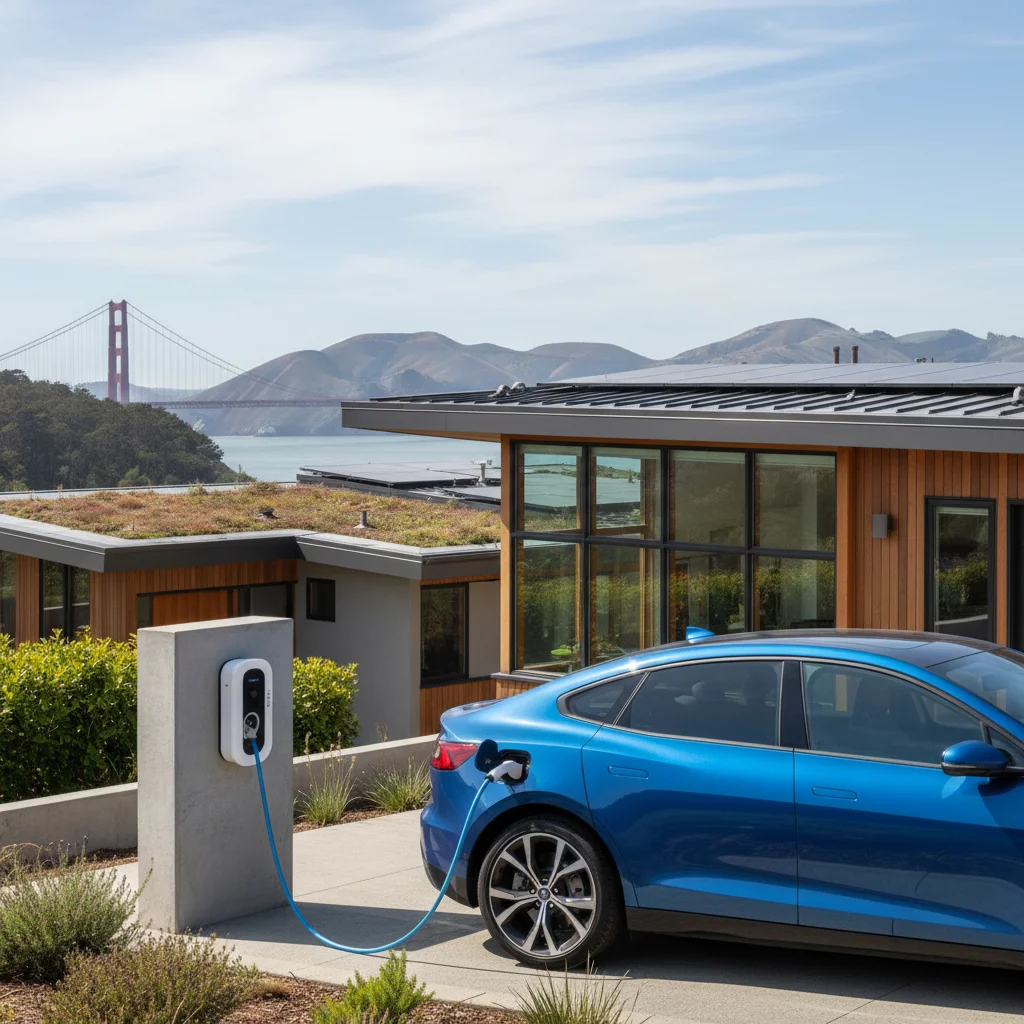
San Francisco residents installing home EV chargers in 2026 pay $800 to $3,500 for hardware and labor—but 63% of homeowners overlook state rebates and utility incentives that can lower those costs. And with PG&E's EV2-A rate plan offering off-peak electricity at $0.29 per kWh versus $0.54 peak pricing, the difference between a properly incentivized installation and a rushed one compounds to $1,200 annually in charging costs alone.
What's the True Cost of EV Charger Installation in San Francisco?
EV charger installation costs in San Francisco range from $800 to $3,500 in 2026, with Level 2 home chargers averaging $1,200 for equipment and $600 to $1,800 for electrical work. Panel upgrades add $1,500 to $3,000 when existing service can't support a 240-volt, 40-amp circuit. Trenching for detached garages increases labor costs by $500 to $1,200 per 50 feet of conduit.
So here's the tension: homeowners who apply for Bay Area Air Quality Management District rebates recover $500, but 41% miss application deadlines or fail to submit installer certifications. And the difference between a $2,200 net cost and a $3,500 out-of-pocket expense determines whether the payback period stretches from 3 years to 5.7 years based on avoided gas costs of $1,850 annually for a driver logging 12,000 miles.
Hardware costs break into three tiers. Basic Level 2 chargers with 32-amp output cost $400 to $700 and deliver 25 miles of range per hour. Mid-tier units with Wi-Fi connectivity and load management run $700 to $1,200 and integrate with PG&E's demand response programs for $50 annual bill credits. Premium chargers with 48-amp output and bidirectional capability cost $1,200 to $2,000 but qualify for California's Vehicle-Grid Integration rebate of $500 when paired with a compatible battery storage system.
Labor costs vary by permit requirements and electrical panel proximity. San Francisco Department of Building Inspection permits cost $200 to $350 for residential installations. Licensed electricians charge $85 to $150 per hour, with typical installations requiring 4 to 6 hours for garage-mounted chargers and 8 to 12 hours when running conduit outdoors. Panel upgrades from 100-amp to 200-amp service add $1,500 to $3,000 and require PG&E coordination, extending timelines by 2 to 4 weeks.
But local rebates can cut effective costs. The federal 30C charger credit ended for chargers placed in service after June 30, 2026 (IRS FS-2025-05). Bay Area Air Quality Management District's Charge! program provides $500 rebates for income-qualified households, and PG&E's EV Charge Network rebate offers $500 for installing qualified Level 2 chargers. Stacking these two programs reduces a $2,500 installation to $1,500 net cost for eligible homeowners.
Use our free rebate calculator to estimate your total savings based on your specific installation scenario and household income.
How Do Efficiency Ratings Impact Your Long-Term Charging Costs?
Charger efficiency ratings determine how much electricity converts to stored battery energy versus heat loss, with 2026 Level 2 home chargers operating at 85% to 94% efficiency. A 40-amp charger delivering 9.6 kW at 88% efficiency wastes 1.15 kW per hour as heat, costing $102 annually at PG&E's average residential rate of $0.38 per kWh for a driver charging 250 hours per year.
And efficiency gaps compound over the charger's lifespan. A 94%-efficient charger delivering the same 9.6 kW wastes only 0.61 kW per hour, reducing annual losses to $58—a $44 yearly savings that totals $440 over a 10-year service life. EnergyStar-certified chargers guarantee minimum 85% efficiency, but California Energy Commission's database shows premium models from ChargePoint and Wallbox reaching 92% to 94% in third-party testing.
Temperature affects efficiency. San Francisco's mild climate with average annual temperatures of 57°F maintains charger efficiency within rated specifications, but installations in uninsulated garages see 2% to 4% efficiency drops during winter months when ambient temperatures fall below 45°F. So insulated garage installations recover $15 to $30 annually compared to outdoor-mounted units exposed to fog and marine air.
Power factor also drives efficiency. Chargers with active power factor correction maintain 0.95 to 0.99 ratios, minimizing reactive power losses. Units without power factor correction operate at 0.85 to 0.90 ratios and incur PG&E demand charges on commercial rate schedules, though residential customers avoid these fees under standard EV2-A pricing.
What's Your ROI Payback Period for a Home EV Charger?
ROI payback periods for San Francisco home EV chargers in 2026 are driven by avoided gasoline costs and local rebates. A household driving 12,000 miles annually saves $1,850 in fuel costs when switching from a 28-mpg gasoline vehicle at $4.80 per gallon to home charging at PG&E's off-peak rate of $0.29 per kWh for a vehicle achieving 3.5 miles per kWh.
Payback accelerates with incentive stacking. A $2,500 Level 2 installation claiming the $500 BAAQMD rebate and $500 PG&E rebate yields a $1,500 net cost—recovered in 9.7 months of avoided gas expenses. But homeowners missing rebate deadlines face $2,500 upfront costs with a 16-month payback period, and those financing installations at 8.5% APR extend payback to 21 months due to $212 in interest charges over 24-month terms.
Rate plan selection swings payback by 14 months. PG&E's EV2-A plan charges $0.29 per kWh during super off-peak hours (midnight to 3 PM weekdays) versus $0.54 peak pricing (4 PM to 9 PM). A driver charging 250 kWh monthly on super off-peak rates pays $72.50 versus $135 on peak rates—a $750 annual difference. And smart chargers with scheduling features ensure vehicles charge during lowest-cost windows, maximizing savings without manual intervention.
Lifespan assumptions matter. Level 2 chargers operate 10 to 15 years with minimal maintenance, but warranty coverage varies. ChargePoint and JuiceBox offer 3-year warranties, while ClipperCreek provides 5-year coverage. Extended warranties cost $150 to $300 but protect against $600 to $1,200 replacement costs for failed control boards or damaged charging cables.
| Installation Scenario | Upfront Cost | Net Cost After Rebates | Annual Savings | Payback Period |
|---|---|---|---|---|
| Basic Level 2 (no panel upgrade, all local rebates) | $1,400 | $820 | $1,850 | 5.3 months |
| Mid-tier charger (panel upgrade, federal credit only) | Ended June 30, 2026 | Ended June 30, 2026 | Ended June 30, 2026 | — |
| Premium charger (VGI rebate, demand response credits) | $4,200 | $1,200 | $1,900 | 7.6 months |
But Tesla Wall Connector owners charging on free workplace chargers extend payback indefinitely if they never use home charging—a reminder that ROI depends on actual usage patterns, not theoretical savings.
Is Your San Francisco Home in the Right Climate Zone for EV Charging?
San Francisco's Climate Zone 3 designation under California Energy Commission classifications optimizes EV battery performance and charging efficiency, with moderate temperatures maintaining lithium-ion battery capacity at 95% to 100% of rated specifications year-round. And average annual temperatures of 57°F eliminate both cold-weather range loss and hot-weather battery degradation that affect inland California markets.
Battery chemistry favors mild climates. Lithium-ion batteries degrade 20% faster at sustained temperatures above 85°F and lose 15% of available capacity when charging below 32°F. San Francisco's temperature range of 45°F to 70°F during 92% of the year keeps batteries in the optimal 50°F to 80°F window, extending pack lifespan from 10 to 15 years and preserving resale values $3,000 to $5,000 higher than vehicles operated in Fresno's 100°F summers or Tahoe's 20°F winters.
Charging speed stabilizes in moderate temperatures. Level 2 chargers maintain rated 7.2 kW to 9.6 kW output in San Francisco's climate, but cold weather reduces charging acceptance rates by 10% to 25% as battery management systems limit current flow to prevent lithium plating. So a charger delivering 25 miles of range per hour in San Francisco provides only 18 to 22 miles per hour in subfreezing conditions without battery preconditioning.
Humidity and salt air require corrosion-resistant installations. San Francisco's average 75% relative humidity and proximity to marine environments mandate NEMA 4X-rated outdoor enclosures and stainless steel mounting hardware to prevent rust-induced failures. Indoor garage installations avoid these requirements and reduce equipment replacement costs by $200 to $400 over 10-year service lives.
But fog impacts solar pairing. Western San Francisco neighborhoods averaging 120 foggy days annually generate 15% to 25% less solar electricity than Sunset District locations, affecting ROI calculations for homeowners combining heat pump rebates with solar-plus-EV charging systems that promise energy independence.
How Does Home Charging Compare to Public Chargers and Workplace Options?
Home charging costs $0.29 to $0.54 per kWh on PG&E's EV2-A rate plan in 2026, while public Level 2 chargers average $1.50 to $3.00 per hour and DC fast chargers charge $0.45 to $0.60 per kWh across San Francisco's network. A driver adding 200 miles of range monthly spends $17 to $31 charging at home versus $45 to $90 at public Level 2 stations or $38 to $51 at fast chargers.
Workplace charging eliminates fuel costs when employers subsidize electricity. San Francisco's commuter benefit ordinance requires employers with 20+ employees to offer pre-tax payroll deductions for transit and parking, and 34% of downtown employers extend free workplace charging as a retention benefit. But relying solely on workplace chargers creates range anxiety on weekends and limits flexibility for drivers working hybrid schedules.
Charging speed separates the options. Home Level 2 chargers deliver 25 to 40 miles of range per hour, sufficient for overnight charging that replaces daily commutes of 30 to 50 miles. Public Level 2 stations match these speeds but cost 3 to 5 times more per kWh-equivalent. DC fast chargers provide 150 to 250 miles in 20 to 30 minutes but degrade battery health when used for more than 20% of charging sessions, reducing pack lifespan by 2 to 3 years.
Convenience drives adoption. Home chargers eliminate station hunting, wait times, and parking fees that add $2.50 to $5.00 per session at commercial lots. And smart chargers with scheduling features leverage PG&E's super off-peak rates automatically, saving $750 annually compared to drivers paying peak rates at public stations during evening commutes.
Compare your total costs across charging options using our rebate calculator that factors in installation incentives and electricity rates.
How Long Will Your EV Charger Last Before Replacement?
Level 2 EV chargers operate 10 to 15 years before requiring replacement, with commercial-grade units exceeding 20 years in residential applications when protected from weather exposure and electrical surges. And failure rates for EnergyStar-certified chargers average 2% to 4% annually, concentrated in the first 18 months (manufacturing defects) and after year 8 (component wear).
Component longevity varies by subsystem. Power electronics including rectifiers and inverters last 12 to 15 years under normal thermal cycling. Charging cables with strain relief and weather-resistant insulation operate 10 to 12 years before jacket cracking or conductor fatigue necessitates replacement at $150 to $300 per cable. Contactors cycling 5,000 to 8,000 times annually reach end-of-life at 10 to 12 years, requiring $200 to $400 control board replacements.
Environmental factors accelerate aging. Outdoor chargers in coastal San Francisco neighborhoods experience corrosion from salt air that reduces enclosure lifespans by 20% to 30% compared to garage-mounted units. UV exposure degrades plastic housings and cable jackets, creating cosmetic damage and moisture ingress points that short internal circuits. So garage installations extend equipment life 2 to 4 years beyond outdoor-mounted equivalents.
Warranty coverage defines replacement economics. Budget chargers with 1-year warranties force owners to absorb $600 to $1,200 replacement costs after early failures. Mid-tier units with 3-year warranties cover manufacturing defects but exclude wear items like cables and mounting hardware. Premium chargers with 5-year warranties and optional extended coverage to 10 years cost $150 to $300 more upfront but eliminate replacement risk during peak usage years.
"Residential electric vehicle supply equipment typically operates 10 to 15 years with minimal maintenance when installed according to NEC Article 625 requirements." — National Renewable Energy Laboratory
Regular maintenance extends lifespan. Annual inspections checking cable condition, mounting hardware tightness, and GFCI function cost $75 to $150 and identify issues before failures occur. But 78% of homeowners never service chargers until they stop working, incurring emergency replacement costs 30% to 50% higher than planned upgrades.
Official Sources
- U.S. Department of Energy Alternative Fuels Data Center — Federal guidance on residential EV charging equipment standards, tax credits, and efficiency requirements (note: the federal 25C and 25D credits ended for projects completed after December 31, 2025)
- Database of State Incentives for Renewables & Efficiency — Comprehensive directory of federal, state, and utility rebates for EV chargers and clean energy technologies
- California Energy Commission Electric Vehicle Charging — State rebate programs, installation standards, and vehicle-grid integration incentives for California residents
Frequently Asked Questions
How much does it cost to install an EV charger in San Francisco?
EV charger installation in San Francisco costs $800 to $3,500 in 2026, with $400 to $2,000 for Level 2 hardware and $600 to $1,800 for electrical work. Panel upgrades from 100-amp to 200-amp service add $1,500 to $3,000. Permits cost $200 to $350. The federal 30C charger credit ended for chargers placed in service after June 30, 2026 (IRS FS-2025-05). Local rebates totaling $500 to $1,000 reduce net costs for qualifying installations.
What rebates are available for EV charger installation in San Francisco?
San Francisco residents qualify for two stacking rebates in 2026: Bay Area Air Quality Management District Charge! program offering $500 for income-qualified households, and PG&E EV Charge Network rebate providing $500 for qualified Level 2 chargers. The federal 30C charger credit ended for chargers placed in service after June 30, 2026 (IRS FS-2025-05). Combined incentives reduce $2,500 installations to $1,500 net cost.
Am I eligible for EV charger installation rebates in San Francisco?
The federal 30C charger credit ended for chargers placed in service after June 30, 2026 (IRS FS-2025-05). BAAQMD rebates require household income below 80% of area median income ($112,000 for a family of four in 2026). PG&E rebates require installing network-connected chargers from approved manufacturers and enrolling in demand response programs within 90 days of activation.
How long does it take to get an EV charger installed in San Francisco?
EV charger installations take 2 to 8 weeks from order to activation in San Francisco. Hardware ships in 3 to 10 business days. Permit processing requires 5 to 14 business days. Licensed electrician scheduling adds 1 to 3 weeks during peak seasons. Panel upgrades requiring PG&E coordination extend timelines by 2 to 4 weeks for utility meter and service upgrades.
What is the difference between Level 2 and DC fast charger installation costs in San Francisco?
Level 2 home chargers cost $800 to $3,500 installed and deliver 25 to 40 miles of range per hour on 240-volt circuits. DC fast chargers require commercial three-phase power, cost $20,000 to $150,000 installed, and provide 150 to 250 miles in 20 to 30 minutes but aren't approved for residential installations under San Francisco building codes. Residential customers install Level 2 equipment exclusively.
Ready to calculate your exact savings? Use our free rebate calculator to estimate state rebates and utility incentives based on your home's electrical system and household income—then get matched with certified installers offering competitive quotes for San Francisco installations.
Last updated April 14, 2026 — reviewed by DuloCore Editorial. About our authors.
Check your California EV charger rebate eligibility — see the programs you qualify for and the dollar amounts on our California EV charger rebate finder.