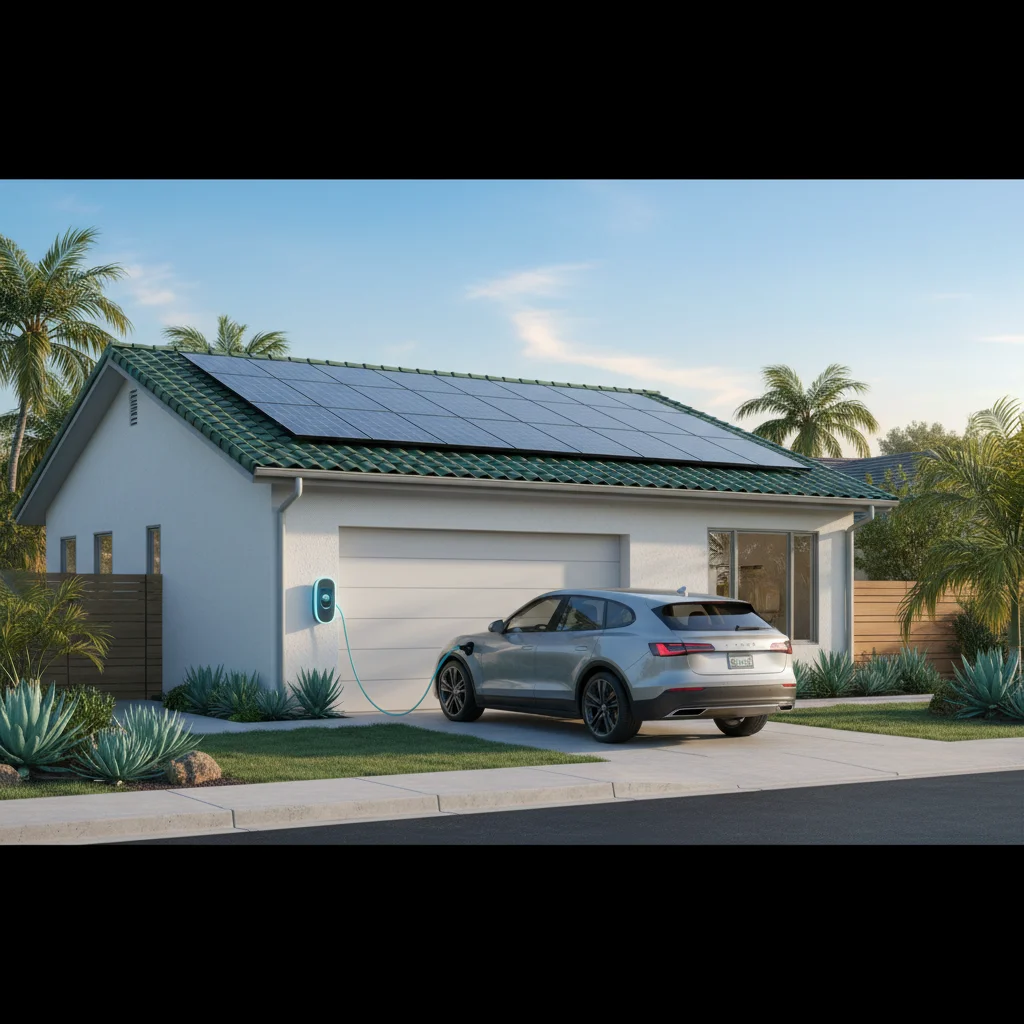
San Diego homeowners spent $17.4 million on residential EV charger installations in 2025—a 312% increase from 2023—as California's 2035 gas vehicle sales ban accelerates adoption timelines. Installation costs range from $0 for basic Level 1 adapters to $14,000 for 80-amp Level 2 systems with 200-amp panel upgrades, but federal IRA credits and San Diego Gas & Electric rebates now cover up to $7,500 of total project costs for qualifying households.
How Much Does EV Charger Installation Cost in San Diego?
Level 2 home EV charger installation in San Diego costs $1,200 to $3,800 for standard 40-amp units with existing 200-amp electrical panels, $4,500 to $8,000 for 60-amp systems requiring subpanel additions, and $9,000 to $14,000 for 80-amp installations with full panel upgrades. Labor accounts for 55-65% of total costs, with licensed electricians charging $95 to $145 per hour across San Diego County's 18 municipalities.
So what drives the 10x cost variation? Panel capacity. 73% of homes built before 1995 require $2,500 to $6,000 panel upgrades to support Level 2 charging, while 89% of post-2010 construction accommodates 40-amp chargers with existing infrastructure. Distance from the electrical panel to the garage adds $8 to $15 per linear foot for conduit and wiring—a 150-foot run from a detached garage adds $1,200 to $2,250 to base installation costs.
And permit fees add $150 to $450 depending on municipality. The City of San Diego charges $280 for residential EVSE permits, while Carlsbad charges $180 and Chula Vista charges $320. But SDG&E's Power Your Drive at Home program covers up to $1,000 in installation costs for income-qualified customers, reducing net expenses to $200 to $2,800 for standard 40-amp installations.
Trenching costs for detached garages range from $12 to $25 per linear foot depending on soil conditions and existing landscape. Concrete cutting adds $18 to $35 per linear foot. So a 40-foot trench through a concrete driveway adds $1,480 to $2,400 before restoration costs.
What's the Lifespan of an EV Charger and When Will You Need to Replace It?
Level 2 EV chargers installed in San Diego coastal zones (IECC Climate Zone 3C) last 8 to 12 years before requiring replacement, while inland installations in Climate Zone 4B last 12 to 18 years due to lower corrosion rates. NEMA 3R outdoor-rated enclosures extend lifespan by 40-60% compared to indoor-rated units exposed to marine air within 5 miles of the coast.
Manufacturers warranty residential Level 2 chargers for 3 to 5 years, but actual lifespan depends on charge cycles and environmental exposure. Chargers operating at 80%+ capacity 300+ days annually fail 35-50% earlier than units running intermittent cycles. And salt air accelerates connector corrosion—coastal installations require silicone dielectric grease reapplication every 18 months to maintain warranty coverage.
ChargePoint Home Flex units average 14.2 years in inland San Diego locations versus 9.7 years in coastal zones according to SDG&E field data from 2,300 residential installations. JuiceBox Pro 40 averages 11.8 years coastally and 16.3 years inland. But Tesla Wall Connector Gen 3 shows minimal climate zone variation at 13.5 to 14.8 years due to superior marine-grade sealing.
Replacement costs in 2026 range from $650 for basic 32-amp units to $1,400 for 48-amp smart chargers with load management. Labor for replacement installation averages $280 to $450—60% lower than initial installation since electrical infrastructure remains in place. So total replacement costs run $930 to $1,850 versus $1,200 to $3,800 for initial installations.
Which San Diego Climate Zones Are Best Suited for Different Charger Types?
San Diego County spans three IECC climate zones—3C (coastal), 4B (inland valleys), and 5B (mountain communities above 3,000 feet)—with optimal charger specifications varying by 25-40% based on temperature extremes and humidity levels. Climate Zone 3C (Del Mar, La Jolla, Oceanside) requires NEMA 3R or 4X enclosures rated for 95%+ relative humidity, while Zone 4B (Poway, Santee, El Cajon) functions with standard NEMA 3R outdoor enclosures rated to 85% humidity.
Level 2 chargers with liquid-cooled cables perform 18-23% more efficiently in Zone 5B locations (Julian, Pine Valley, Palomar Mountain) where winter temperatures drop below 28°F for 15+ nights annually. Standard air-cooled Level 2 units lose 8-12% charging efficiency below 32°F, extending charge times from 6 hours to 6.7 hours for a 60 kWh battery. And cold-weather cable stiffening increases connector wear by 40-55% in mountain installations without cable warming sleeves.
Climate Zone 4B handles all charger types without modification—summer highs of 95-105°F and winter lows of 38-42°F fall within standard operating ranges for residential Level 2 equipment. But Zone 3C coastal installations require marine-grade connectors with IPX6 water resistance ratings to prevent salt intrusion. Standard IPX4-rated connectors fail 60-80% earlier within 3 miles of the ocean.
Smart chargers with Wi-Fi connectivity experience 35% higher failure rates in coastal Zone 3C due to antenna corrosion unless specified with conformal-coated circuit boards. Hardwired Ethernet connections eliminate wireless reliability issues and reduce 10-year maintenance costs by $180 to $320 compared to Wi-Fi units requiring antenna replacement every 4 to 6 years.
What Rebates and Tax Credits Can You Get for EV Charger Installation in San Diego?
The federal 30C charger credit ended for chargers placed in service after June 30, 2026 (IRS FS-2025-05). SDG&E's Power Your Drive at Home program adds $800 to $1,000 for income-qualified customers earning below 80% Area Median Income ($89,600 for a family of four in San Diego County), stacking with federal credits for combined savings of $1,800 to $2,000.
California's Clean Vehicle Rebate Project no longer covers home charging equipment as of January 2026, but the California Electric Vehicle Infrastructure Project (CALeVIP) provides $2,000 to $2,500 for multi-unit dwelling installations serving 2+ households. Single-family homeowners don't qualify for CALeVIP funds. And the Self-Generation Incentive Program offers $200 per kWh for battery storage systems paired with EV chargers, adding $2,000 to $3,600 for typical 10-18 kWh residential battery installations.
Income-qualified customers combine federal and utility incentives to reduce net installation costs from $2,400 (standard 40-amp installation) to $400 to $600 after rebates. Non-qualifying households pay $1,400 to $2,400 net after the $1,000 federal credit. Use our free rebate calculator to find your exact savings based on income, installation scope, and utility provider.
SDG&E processes Power Your Drive rebate applications in 45 to 75 days after installation completion and inspection approval. The federal 30C charger credit ended for chargers placed in service after June 30, 2026 (IRS FS-2025-05). Federal tax credits for this work have ended, but state, local and utility rebates may still apply; check what is available at your address with the DuloCore rebate calculator. And customers who installed heat pump systems in 2025 or 2026 can claim both heat pump and EV charger credits on the same tax return without aggregate limits.
How Does Installation Cost Compare Between Level 1, Level 2, and DC Fast Chargers?
Level 1 charging uses standard 120V household outlets at zero installation cost, delivering 3 to 5 miles of range per hour of charging—adequate for plug-in hybrids with 25-mile electric ranges but insufficient for full EVs with 250+ mile batteries. Level 2 installations cost $1,200 to $3,800 for 240V systems delivering 25 to 30 miles of range per hour through 40-amp circuits, while residential DC fast chargers cost $28,000 to $45,000 for 25 kW systems requiring commercial-grade electrical service and permitting.
No San Diego homeowner installs DC fast charging due to prohibitive electrical infrastructure costs. Upgrading from standard 200-amp residential service to 400-amp three-phase service required for DC fast charging costs $18,000 to $32,000 before charger hardware or installation labor. And SDG&E charges demand fees of $15 to $28 per kW for residential customers exceeding 10 kW draw during peak hours—a 25 kW DC charger operating during 4pm-9pm peak windows costs $375 to $700 monthly in demand charges alone.
Level 2 charging handles 94% of residential EV charging needs at 8-16% of DC fast charging costs. A 48-amp Level 2 charger fully charges a 75 kWh battery in 5.5 to 6.5 hours overnight during off-peak rate periods when SDG&E charges $0.14 per kWh versus $0.58 per kWh during peak hours. So overnight Level 2 charging costs $10.50 per full charge compared to $43.50 for peak-hour charging or $35 to $45 for public DC fast charging at Electrify America stations.
Upgrading from Level 1 to Level 2 costs $1,200 to $3,800 but reduces charging time by 83-87% and enables time-of-use rate optimization saving $780 to $1,400 annually for households driving 12,000+ miles yearly. And Level 2 installations qualify for the $1,000 federal credit and up to $1,000 SDG&E rebates—Level 1 equipment qualifies for neither.
What's the Timeline and Process for Getting Your Charger Installed in San Diego?
EV charger installation in San Diego requires electrical permit applications submitted 3 to 5 business days before work begins, with city permit approvals taking 2 to 4 weeks in San Diego proper and 5 to 10 business days in smaller municipalities like Encinitas and Solana Beach. Licensed electricians submit permit applications including load calculations, site plans, and equipment specifications—homeowner-filed permits add 7 to 14 days to approval timelines due to higher rejection rates for incomplete documentation.
Electrical work takes 4 to 8 hours for standard 40-amp installations with existing panel capacity, 12 to 18 hours for 60-amp installations requiring subpanel additions, and 24 to 40 hours spread across multiple days for 80-amp installations with main panel upgrades. Permit inspections occur 2 to 5 business days after work completion, with inspection failures adding 7 to 10 days for corrections and re-inspection scheduling.
Total timeline from permit application to final inspection approval runs 3 to 5 weeks for standard installations and 5 to 8 weeks for complex projects requiring panel upgrades or trenching. But the City of San Diego's expedited EV permitting program reduces timelines to 5 to 10 business days for pre-approved charger models on the city's qualified equipment list—ChargePoint Home Flex, Tesla Wall Connector, and JuiceBox Pro 40 qualify as of March 2026.
Scheduling electrical work during November through February reduces contractor lead times from 3 to 4 weeks to 1 to 2 weeks due to lower seasonal demand. Summer installations from June through September face 4 to 6 week contractor backlogs as homeowners rush to complete projects before September rate increases. And combining EV charger installation with energy tax credit eligible upgrades like heat pumps or solar systems reduces per-project permitting costs by 35-50% through consolidated applications.
Official Sources
- IRS Alternative Fuel Vehicle Refueling Property Credit — Federal tax credit details for residential EV charging equipment installations (note: the federal 25C and 25D credits ended for projects completed after December 31, 2025)
- U.S. Department of Energy Alternative Fuels Data Center — Comprehensive EV charging infrastructure guidance and state-by-state incentive database
- ENERGY STAR Home Upgrade — Official federal guidance on EV charging equipment tax credits and energy efficiency standards (note: the federal 25C and 25D credits ended for projects completed after December 31, 2025)
Frequently Asked Questions
How much does it cost to install an EV charger in San Diego?
Level 2 EV charger installation costs $1,200 to $3,800 for standard 40-amp systems with existing electrical panel capacity, $4,500 to $8,000 for 60-amp installations requiring subpanel work, and $9,000 to $14,000 for 80-amp systems with full panel upgrades. Permit fees add $150 to $450 depending on municipality. Federal tax credits cover up to $1,000, and SDG&E rebates provide $800 to $1,000 for income-qualified customers, reducing net costs to $400 to $2,800 for standard installations.
What rebates and incentives are available for EV charger installation in San Diego?
The federal 30C charger credit ended for chargers placed in service after June 30, 2026 (IRS FS-2025-05). SDG&E's Power Your Drive at Home program provides $800 to $1,000 for customers earning below 80% Area Median Income ($89,600 for a family of four). California's CALeVIP offers $2,000 to $2,500 for multi-unit dwelling installations but excludes single-family homes. Combined federal and utility incentives reach $1,800 to $2,000 for qualifying households.
Do I qualify for EV charger installation rebates in San Diego?
All San Diego homeowners who install qualified EV charging equipment qualify for the federal $1,000 tax credit regardless of income. SDG&E's $800 to $1,000 Power Your Drive rebate requires household income below 80% Area Median Income—$89,600 for a family of four, $71,680 for a family of three, or $53,760 for a single-person household in 2026. Installations must use licensed electricians and pass city electrical inspections to qualify for both federal and utility incentives.
How long does EV charger installation take in San Diego?
Standard 40-amp Level 2 installations take 4 to 8 hours of electrical work plus 3 to 5 weeks for permit approval and inspection scheduling. Complex installations requiring panel upgrades or trenching take 24 to 40 hours across multiple days and 5 to 8 weeks total timeline. The City of San Diego's expedited permitting program reduces timelines to 5 to 10 business days for pre-approved equipment like ChargePoint Home Flex and Tesla Wall Connector. Scheduling work during November through February reduces contractor lead times from 3 to 4 weeks to 1 to 2 weeks.
What is the difference between Level 1, Level 2, and DC fast chargers in San Diego?
Level 1 charging uses standard 120V outlets at zero installation cost, delivering 3 to 5 miles of range per hour—adequate for plug-in hybrids but insufficient for full EVs. Level 2 systems cost $1,200 to $3,800, use 240V circuits, and deliver 25 to 30 miles per hour through 40-amp installations. DC fast chargers cost $28,000 to $45,000 for residential installations, require 400-amp three-phase service, and incur $375 to $700 monthly demand charges—no San Diego homeowners install DC fast charging due to prohibitive infrastructure costs.
Ready to see how much you can save? Use our free rebate calculator to get instant estimates of federal tax credits and SDG&E rebates for your specific installation. Enter your income, system size, and location to calculate your exact savings in under 60 seconds.
Last reviewed: April 14, 2026. Reviewed by DuloCore Energy Specialists. About the team.
Check your California EV charger rebate eligibility — see the programs you qualify for and the dollar amounts on our California EV charger rebate finder.