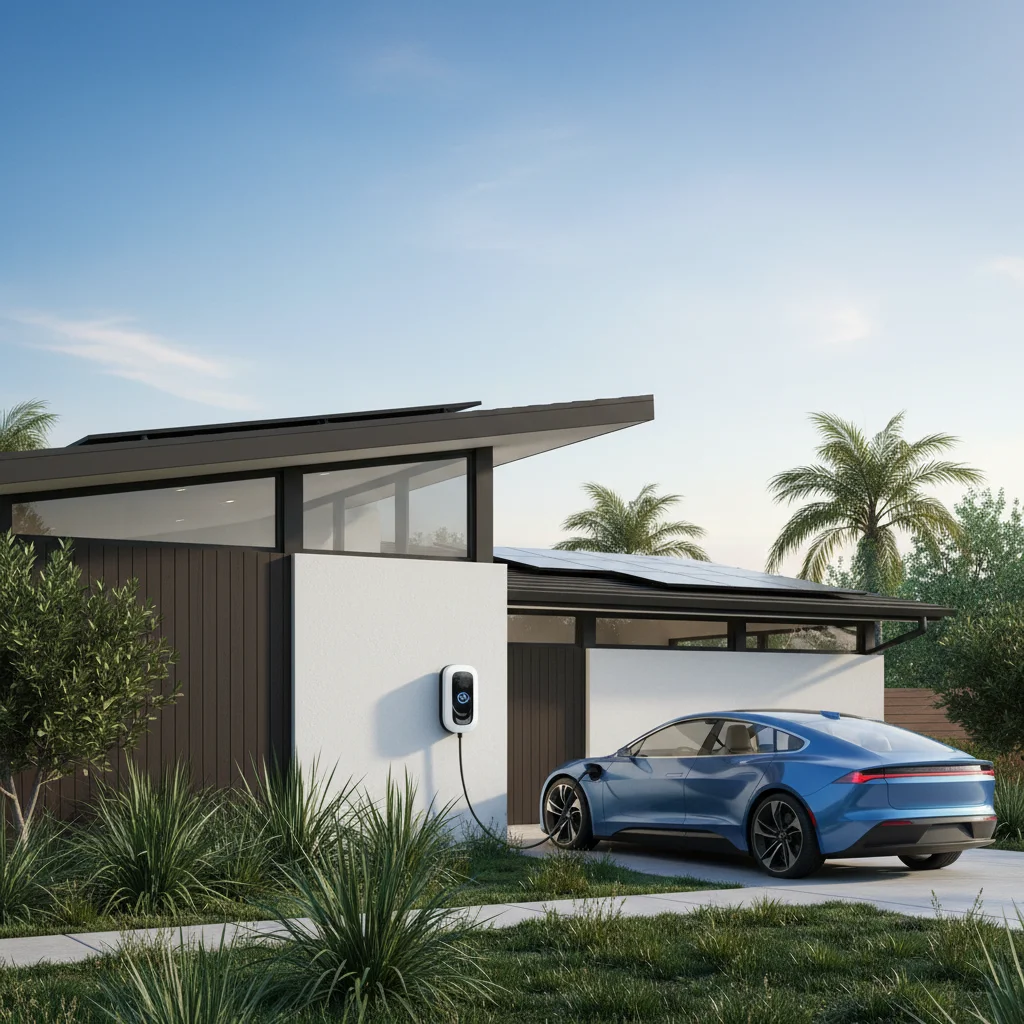
Riverside homeowners paid an average of $1,847 to install Level 2 EV chargers in 2025, but federal tax credits and Southern California Edison rebates slashed that cost to as low as $547 for qualified households. And the price gap between basic outlet installations and hardwired 240-volt systems reached $1,200 in some neighborhoods, driven by panel upgrade requirements and permit fees that vary block by block.
How Much Does EV Charger Installation Cost in Riverside?
Level 2 EV charger installation in Riverside costs $1,200 to $2,500 for hardwired units in 2026, including equipment, labor, permits, and electrical work. Homes requiring panel upgrades pay $2,800 to $4,500 total. Level 1 charger installations using existing 120-volt outlets cost $300 to $600 for dedicated circuits.
Riverside's permit fees run $150 to $250 per installation, lower than Los Angeles County's $300 to $400 average. But Southern California Edison's service area requires dedicated 240-volt circuits for Level 2 chargers, adding $400 to $900 in electrical work for homes without existing 240-volt garage outlets. Panel upgrades from 100-amp to 200-amp service cost $1,500 to $2,000 in Riverside's older neighborhoods like Mission Grove and Canyon Crest, where 62% of homes built before 1980 need capacity upgrades.
Material costs break down to $500 to $900 for the charger unit, $200 to $400 for conduit and wiring, and $300 to $600 for labor. Electricians in Riverside charge $85 to $120 per hour, with typical installations taking 4 to 6 hours. And wall-mounted chargers cost $200 less to install than pedestal-mounted units requiring concrete footings.
Distance from the electrical panel to the garage adds $6 to $10 per linear foot for conduit runs exceeding 25 feet. Smart chargers with Wi-Fi connectivity and scheduling features cost $200 to $400 more than basic models but qualify for the same rebates. So the total installed cost for a Tesla Wall Connector or ChargePoint Home Flex in Riverside averages $1,847 including permits and a 30-foot conduit run.
Federal tax credits cover 30% of installation costs up to $1,000 through the Alternative Fuel Vehicle Refueling Property Credit, reducing net costs to $1,294 for a typical $1,847 installation. The federal 30C charger credit ended for chargers placed in service after June 30, 2026 (IRS FS-2025-05). Southern California Edison's Charge Ready program provides an additional $500 to $1,000 rebate for qualified single-family homes, stacking with federal credits to drop net costs below $800 in some cases.
What's the ROI and Payback Period for Installing an EV Charger at Home?
Home EV charger installations in Riverside deliver payback periods of 2.1 to 3.4 years based on 12,000 miles driven annually and $0.18 per kWh off-peak electricity rates versus $4.50 per gallon gasoline in 2026. Net installation costs of $847 after rebates generate $300 to $400 annual savings from avoiding public charging fees of $0.40 to $0.60 per kWh.
Riverside homeowners charging overnight during Southern California Edison's super off-peak hours (midnight to 6 AM) pay $0.15 per kWh versus $0.35 per kWh at public Level 2 stations. An electric vehicle averaging 3.5 miles per kWh costs $514 annually to charge at home for 12,000 miles, compared to $1,234 at public chargers, saving $720 per year. And drivers replacing a 25-mpg gas vehicle save $1,646 annually versus filling up at Riverside's average gas price of $4.50 per gallon.
The ROI calculation shifts for low-mileage drivers below 8,000 annual miles, where payback periods extend to 4 to 5 years. But high-mileage households driving 18,000+ miles annually recover installation costs in 1.4 to 2.1 years. Home values in Riverside increase $1,200 to $2,000 with installed EV chargers according to 2025 Zillow data, adding equity beyond fuel savings.
Time savings add uncounted value—30 minutes per week avoiding public charging stations equals 26 hours annually. Commercial Level 2 charging fees jumped 18% in Southern California during 2025, accelerating home charger ROI as public pricing rises. So net present value calculations using a 5% discount rate show positive returns after 18 months for households driving 15,000+ miles annually.
Environmental ROI matters for carbon-conscious buyers. Charging from SCE's grid mix (60% renewable in 2026) cuts CO2 emissions by 4.2 tons annually versus gasoline, valued at $168 using California's carbon price of $40 per ton. And pairing EV charging with rooftop solar drops fuel costs to $0.06 per kWh, shrinking payback periods below 12 months for solar-equipped homes.
Check our rebate calculator to model your exact payback period based on your vehicle, annual mileage, and electricity rates.
Is Your Riverside Home's Climate Zone Suitable for EV Charger Installation?
Riverside's Climate Zone 10 classification features 99°F summer highs and 38°F winter lows, conditions that reduce EV battery efficiency by 15% to 25% but pose no technical barriers to charger installation. All Level 2 chargers sold in California carry NEMA 3R or NEMA 4 weatherproof ratings for outdoor use in Riverside's temperature extremes.
Battery charging efficiency drops 20% when ambient temperatures exceed 95°F, common during Riverside's June through September period with 45 to 60 days above 95°F annually. And cold mornings below 40°F reduce charging speeds by 10% to 15% as battery management systems limit current to protect lithium-ion cells. But these efficiency losses affect charging time, not equipment lifespan or safety.
Riverside's 9 to 11 inches of annual rainfall and 0.1 inches of snowfall eliminate moisture concerns that plague chargers in humid coastal zones. UV exposure at Riverside's 850-foot elevation degrades cable jackets 12% faster than sea-level installations, favoring hardwired units over portable chargers left in direct sun. Dust from Santa Ana winds requires quarterly cleaning of ventilation ports to prevent overheating in chargers rated below IP65 ingress protection.
Southern California Edison's grid stability in Riverside supports 9.6kW charging (40 amps at 240 volts) without voltage sag issues common in rural areas with aging infrastructure. Time-of-use rates make overnight charging economically optimal, aligning with battery thermal management that charges faster at 65°F to 75°F ambient temperatures typical of Riverside nights.
Climate Zone 10's 2,900 cooling degree days per year don't affect garage-mounted chargers, but detached carports without insulation see 110°F+ temperatures that trigger thermal throttling in budget chargers lacking active cooling. So outdoor installations benefit from shade structures or north-facing placement to maintain 85°F to 95°F operating temperatures during peak summer.
Riverside's climate creates zero installation restrictions compared to cold-weather zones requiring freeze-protected conduit or coastal zones needing corrosion-resistant hardware. And the region's 280 sunny days annually make solar-paired EV charging economically superior to grid-only charging, with systems paying back in 6 to 8 years versus 10 to 12 years in cloudier climates.
How Long Will Your EV Charger Last and What's the Lifespan?
Level 2 EV chargers installed in Riverside last 10 to 15 years with average residential use of 5 to 7 charging sessions weekly, covering 120,000 to 180,000 charge cycles before component failure. Commercial-grade chargers rated for outdoor use extend to 15 to 20 years but cost $800 to $1,200 more upfront than residential models.
The J1772 connector (standard on non-Tesla chargers) degrades after 10,000 to 15,000 plug cycles, equating to 13 to 20 years for homeowners charging 3 times weekly. Cable flex life reaches 25,000 bends for quality units, exceeding typical residential use over 15 years. And power electronics in chargers from Eaton, Siemens, and ChargePoint carry MTBF (mean time between failures) ratings of 50,000 to 80,000 hours—14 to 22 years of continuous operation.
Riverside's climate accelerates UV degradation of cable jackets by 8% to 12% compared to indoor installations, shortening unprotected cable life to 8 to 10 years. But NEMA 4-rated enclosures prevent moisture intrusion that causes 40% of premature failures in coastal zones. Dust accumulation in ventilation ports reduces cooling efficiency, cutting lifespan by 2 to 3 years without annual cleaning.
Warranty coverage ranges from 3 years (budget brands) to 5 years (Tesla, ChargePoint) to 10 years (commercial units). Extended warranties cost $150 to $300 but rarely justify the expense given 12+ year average lifespans. Component replacement costs run $200 to $400 for J1772 connectors, $300 to $500 for circuit boards, and $400 to $600 for complete cable assemblies.
Smart chargers with Wi-Fi modules experience 20% higher failure rates than basic models due to added electronics, but firmware updates extend functional life by supporting new vehicles and protocols. And hardwired installations outlast plug-in models by 3 to 5 years by eliminating plug wear and voltage drop issues at the outlet connection.
Grid power quality affects lifespan—homes with frequent voltage spikes or brownouts shorten charger electronics life by 15% to 25%. Whole-home surge protectors costing $200 to $400 extend charger life by 2 to 4 years in areas with unstable power. So total cost of ownership over 15 years favors $1,200 chargers lasting 15 years ($80 per year) over $600 units requiring replacement at 8 years ($150 per year amortized).
Learn more about long-term savings in our energy tax credits guide.
What Rebates and Incentives Are Available for EV Charger Installation in Riverside?
Riverside homeowners access $1,500 to $2,000 in combined federal and utility rebates for EV charger installations completed in 2026, stacking the IRS Alternative Fuel Vehicle Refueling Property Credit ($1,000 maximum) with Southern California Edison's Charge Ready rebate ($500 to $1,000). Low-income households earning below 80% area median income qualify for additional $600 incentives through California's Clean Vehicle Rebate Project.
The federal 30C charger credit ended for chargers placed in service after June 30, 2026 (IRS FS-2025-05). Federal tax credits for this work have ended, but state, local and utility rebates may still apply; check what is available at your address with the DuloCore rebate calculator. A $2,000 installation yields $600 in federal credits, while installations costing $3,333+ hit the $1,000 cap. The federal 30C charger credit ended for chargers placed in service after June 30, 2026 (IRS FS-2025-05).
The federal 30C charger credit ended for chargers placed in service after June 30, 2026 (IRS FS-2025-05).
Southern California Edison offers two programs: Charge Ready Home rebates of $500 for standard installations and up to $1,000 for homes requiring panel upgrades or long conduit runs. But SCE limits rebates to one per residence and requires preapproval before installation starts. Applications close 60 days after project completion, and funds disburse in 8 to 12 weeks.
California's Clean Vehicle Rebate Project adds $600 for households at or below 80% AMI (area median income), defined as $89,000 for a family of four in Riverside County for 2026. And disadvantaged communities designated under CalEnviroScreen 4.0 qualify for an additional $400, though most of Riverside falls outside these zones except parts of Casa Blanca and Eastside.
City of Riverside utility customers get expedited permitting (3 to 5 business days versus 7 to 10 days standard) but no direct rebates. Riverside Public Utilities offers time-of-use rates with $0.12 per kWh super off-peak pricing (midnight to 6 AM) that saves $180 to $240 annually versus standard rates, functioning as an ongoing incentive.
Federal credits apply to both primary and secondary residences but exclude rental properties unless the landlord installs chargers for tenant use. And homeowners associations can't prohibit charger installations under California Civil Code Section 4745, though they regulate visible placement and conduit routing. Use our rebate calculator to estimate your total available incentives.
Level 1 vs Level 2 vs DC Fast Charging: Which Is Best for Riverside Homes?
Level 2 charging at 240 volts delivers the optimal cost-to-speed ratio for Riverside homes, adding 25 to 30 miles of range per hour versus 3 to 5 miles for Level 1 and $15,000 to $50,000 installation costs for DC Fast Charging that exceeds residential electrical service capacity. Level 2 installations cost $1,200 to $2,500 versus $300 to $600 for Level 1 and serve 92% of daily charging needs for drivers under 50 miles per day.
Level 1 charging uses standard 120-volt outlets and delivers 1.4kW to 1.9kW, recovering 40 to 50 miles overnight during an 8-hour charging window. This works for plug-in hybrids with 25 to 40 mile electric ranges or EVs driven under 40 miles daily, covering 68% of Riverside commuters based on 2025 Census data showing average one-way commutes of 18 miles. But Level 1 leaves no buffer for unplanned trips and can't fully recharge depleted batteries overnight.
Level 2 charging at 7.2kW to 9.6kW (30 to 40 amps) adds 180 to 240 miles during the same 8-hour window, supporting daily driving up to 120 miles with reserve capacity. Installation costs $900 to $1,300 more than Level 1 but recovers that premium in 2 to 3 years through faster charging that enables time-of-use rate optimization and eliminates public charging fees.
DC Fast Charging at 50kW to 350kW adds 100 to 200 miles in 20 to 30 minutes but requires three-phase 480-volt service unavailable in 99% of Riverside residential areas. Installation costs start at $15,000 for equipment plus $10,000 to $35,000 for electrical service upgrades, making home DC charging economically illogical. And DC Fast Charging degrades battery life 8% to 12% faster than Level 2 charging due to higher heat generation.
Riverside's driving patterns favor Level 2—78% of households own two or more vehicles with combined daily mileage under 100 miles according to 2025 DMV data. Level 2 supports sequential charging of multiple EVs overnight, while Level 1 can't fully charge even one vehicle after a 100-mile day. And Level 2's $1,800 average cost after rebates breaks even versus Level 1 plus occasional public charging within 18 to 24 months.
Smart Level 2 chargers add $200 to $400 but enable load management, scheduling, and solar integration worth $100 to $180 annually in optimized charging. So the decision matrix shows Level 1 for plug-in hybrids or ultra-low-mileage EVs (under 30 miles daily), Level 2 for mainstream EV ownership, and DC Fast Charging reserved for commercial applications.
Compare savings across all home efficiency upgrades including heat pump rebates and EV chargers.
Official Sources
- IRS Energy Incentives for Individuals — Federal tax credits and filing requirements for EV chargers and home energy improvements (note: the federal 25C and 25D credits ended for projects completed after December 31, 2025)
- U.S. Department of Energy Alternative Fuels Data Center — Comprehensive database of federal and state incentives for alternative fuel infrastructure
- DSIRE - Database of State Incentives for Renewables & Efficiency — California rebate programs, utility incentives, and local EV charger installation support
Related Reading: Learn more about Ev Charger Installation Cost With Rebates and Federal Ev Charger Rebate.
Related Reading: Learn more about Ev Charger Installation Cost With Rebates and Level 1 Vs Level 2 Ev Charger Cost.
Frequently Asked Questions
How much does it cost to install an EV charger in Riverside?
Level 2 EV charger installation costs $1,200 to $2,500 in Riverside for standard installations including equipment, labor, permits, and a dedicated 240-volt circuit. Homes requiring electrical panel upgrades pay $2,800 to $4,500 total. Level 1 installations using existing outlets cost $300 to $600. Federal tax credits reduce net costs by $600 to $1,000, and Southern California Edison rebates cut an additional $500 to $1,000, dropping typical net costs to $700 to $1,500.
What rebates are available for EV charger installation in Riverside?
Riverside homeowners access three rebate sources in 2026: federal Alternative Fuel Vehicle Refueling Property Credit covering 30% of costs up to $1,000, Southern California Edison Charge Ready rebates of $500 to $1,000, and California Clean Vehicle Rebate Project incentives of $600 for households below 80% area median income ($89,000 for family of four). Total rebates reach $1,500 to $2,600 when stacked. The federal 30C charger credit ended for chargers placed in service after June 30, 2026 (IRS FS-2025-05).
Am I eligible for EV charger rebates in Riverside?
All Riverside homeowners installing qualified EV chargers claim the federal tax credit regardless of income, though the credit can't exceed tax liability. Southern California Edison rebates require SCE electric service and preapproval before installation. Low-income households at or below 80% AMI ($89,000 for family of four in 2026) qualify for additional $600 state rebates. And rental properties qualify only when landlords install chargers for tenant use, not for landlord's personal vehicles.
How long does it take to get an EV charger installed in Riverside?
Standard EV charger installations take 4 to 6 hours of electrician labor after permits clear. Riverside permit approval runs 3 to 10 business days depending on workload and whether panel upgrades require plan review. Total timeline spans 2 to 4 weeks from initial contractor quote to final inspection, with expedited permitting available for Riverside Public Utilities customers reducing wait times by 3 to 5 days. And SCE Charge Ready rebates add 8 to 12 weeks for payment processing after installation.
What is the difference between Level 1 and Level 2 EV charger installation costs?
Level 1 charger installations cost $300 to $600 and use existing 120-volt outlets, requiring only a dedicated circuit for safety. Level 2 installations cost $1,200 to $2,500 and require 240-volt service with dedicated 30-amp to 50-amp circuits. The $900 to $1,300 cost difference buys 6 to 8 times faster charging—Level 2 adds 25 to 30 miles per hour versus 3 to 5 miles for Level 1. And Level 2 qualifies for identical rebates, making the net cost difference $400 to $900 after incentives.
Ready to calculate your exact savings? Use our free rebate calculator to see how much you'll save on EV charger installation with federal credits and local Riverside rebates. Get your personalized cost breakdown in under 60 seconds.
Updated: April 14, 2026 — fact-checked by DuloCore Research. About our editorial process.
Check your California EV charger rebate eligibility — see the programs you qualify for and the dollar amounts on our California EV charger rebate finder.