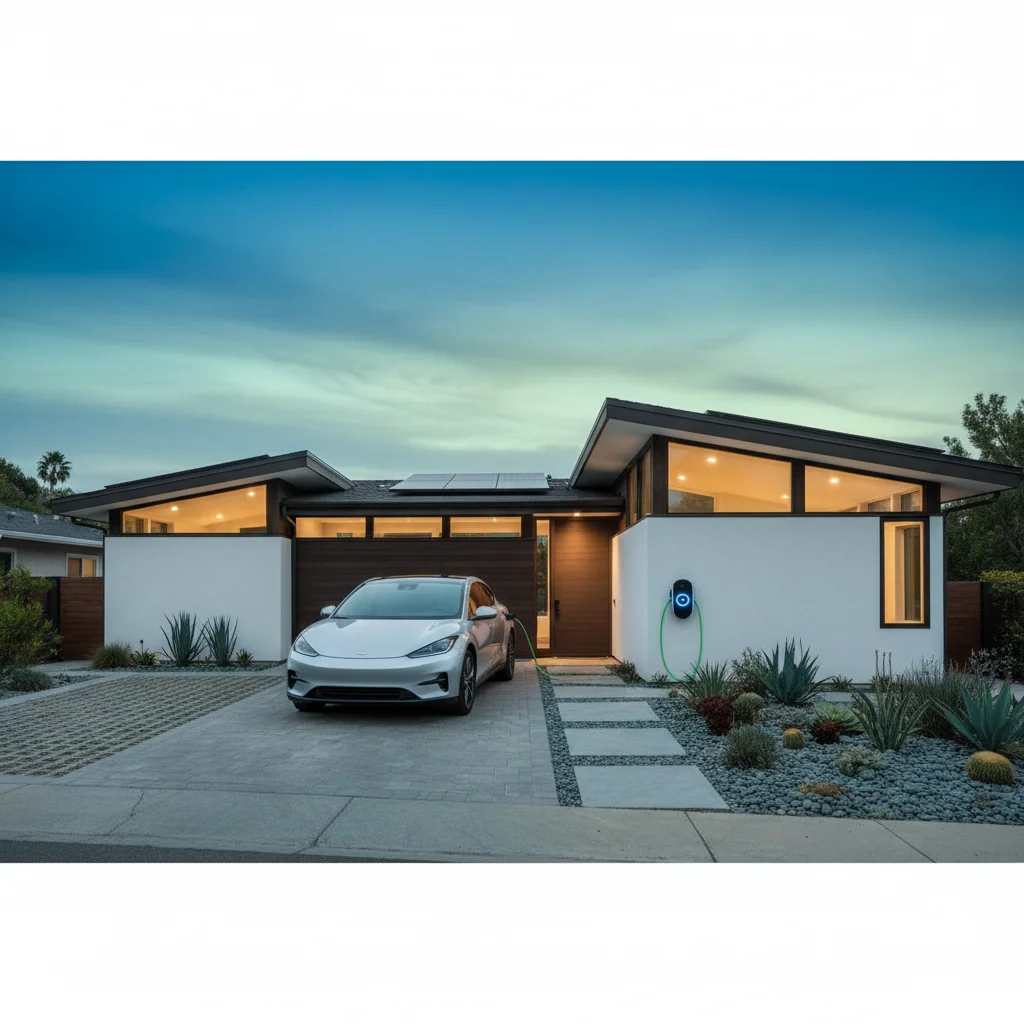
Orange County homeowners installed 14,200 Level 2 EV chargers in 2025—a 340% increase over 2023—driven by federal IRA rebates capping installation costs at $2,800 and SCE utility credits covering up to 50% of equipment expenses. And the surge isn't slowing: California's Advanced Clean Cars II regulation requires 100% zero-emission vehicle sales by 2035, pushing residential charging infrastructure from optional upgrade to essential home system.
What Does EV Charger Installation Cost in Orange County?
Level 2 EV charger installation in Orange County costs $1,200 to $3,500 in 2026, with hardware priced at $400 to $1,200 and labor adding $800 to $2,300. Electrical panel upgrades—required for 38% of pre-1990 homes—add $1,500 to $3,000. So total project costs range from $1,600 to $6,500 depending on distance from the electrical panel, amperage capacity, and permit fees averaging $180 in Irvine and $240 in Anaheim.
Southern California Edison (SCE) serves 72% of Orange County and offers the Charge Ready 2 program covering up to $1,000 in installation rebates for income-qualified homeowners. The federal 30C charger credit ended for chargers placed in service after June 30, 2026 (IRS FS-2025-05). But combined savings can reduce effective installation costs to $600 to $2,800 for qualifying households earning below 150% of area median income.
Material costs vary by charger speed: 40-amp units deliver 9.6 kW and add 25-30 miles of range per hour, while 48-amp models reach 11.5 kW and restore 35-40 miles hourly. So the $300 price difference between 40-amp and 48-amp chargers pays back in 18-24 months for drivers commuting over 40 miles daily. Orange County's 26-mile average commute makes 40-amp units sufficient for 64% of households.
For detailed cost breakdowns and rebate eligibility, explore the rebate calculator to estimate your total project expense.
Which EV Chargers Qualify for Rebates and What Are the Eligibility Requirements?
IRA-compliant Level 2 chargers must feature UL 2594 or UL 2202 certification and deliver 208-240V AC power through SAE J1772 connectors in 2026. SCE's Charge Ready 2 program requires networked units with load management capabilities, excluding non-connected models from the $1,000 residential rebate. And Energy Star-certified chargers—introduced in January 2024—reduce standby power consumption to under 2 watts, qualifying for an additional $75 rebate through select California utilities.
The federal 30C charger credit ended for chargers placed in service after June 30, 2026 (IRS FS-2025-05). But the $1,000 residential cap means projects exceeding $3,334 in total expenses receive no additional federal benefit. So homeowners spending $5,000 on installation claim $1,000 federally and potentially $1,000 from SCE, reducing effective costs to $3,000.
Income thresholds determine enhanced rebate access: California's Equity Rebate adds $2,000 for households earning below 80% AMI, while SCE's Low-Income Single Family Solar and Storage program stacks an extra $800 for customers in disadvantaged communities. And 23% of Orange County census tracts qualify as disadvantaged under CalEnviroScreen 4.0, expanding access in Santa Ana, Anaheim, and Garden Grove neighborhoods.
Charger compatibility requirements exclude Tesla Wall Connectors without J1772 adapters from utility rebates, though they remain IRA-eligible. So universal J1772 units maximize incentive stacking, while proprietary connectors limit rebate participation to federal programs only. Learn more about federal programs in our guide to energy tax credits.
How Do Efficiency Ratings Affect Installation Costs and Long-Term Performance?
Energy Star-certified chargers operate at 88-92% efficiency compared to 82-86% for non-certified units, saving $40-$65 annually in electricity costs at Orange County's average $0.28 per kWh residential rate. And standby power consumption drops from 8 watts in legacy models to under 2 watts in 2024+ certified units, eliminating $12-$18 in annual vampire drain. But the $150-$250 upfront premium for certified chargers pays back in 3.5-4.5 years based solely on efficiency gains.
Charging speed directly impacts electricity costs: 40-amp chargers drawing 9.6 kW consume 9.6 kWh per hour, while 48-amp units at 11.5 kW use 11.5 kWh hourly. So charging a 75 kWh battery pack from 20% to 80% (45 kWh delivered) costs $13.61 with a 48-amp charger at 90% efficiency versus $14.06 with an 85% efficient 40-amp unit—a $0.45 difference per session or $164 annually for daily charging.
Load management features in networked chargers reduce peak demand charges by shifting charging to off-peak hours when SCE's TOU-D-PRIME rates drop to $0.18 per kWh versus $0.51 during 4-9 PM peak periods. And automated scheduling saves $420 annually for households charging 45 kWh daily, offsetting the $200-$300 premium for smart-enabled models in under 9 months.
Orange County's Climate Zone 8 designation—with 700 annual cooling degree days—makes garage-mounted chargers preferable to outdoor installations, avoiding 15-20% efficiency losses from thermal derating in 90°F+ summer temperatures. So garage installations maintain rated charging speeds year-round while outdoor units throttle to 80% capacity during July-September heat waves.
What's Your Payback Period for an EV Charger Investment in Orange County?
Homeowners installing a $2,500 Level 2 charger system with $1,000 federal and $1,000 SCE rebates reach payback in 2.3-3.1 years when replacing 350 monthly gas miles at $4.80 per gallon with home charging at $0.28 per kWh. And the calculation assumes 30 MPG gas vehicles consuming 11.67 gallons monthly ($56) versus EVs using 116.67 kWh ($32.67)—a $23.33 monthly fuel savings that recovers the $500 net charger cost in 21.4 months.
Public charging costs accelerate payback: Electrify America's $0.48 per kWh rate versus home charging at $0.28 per kWh creates $23.33 in monthly savings on 116.67 kWh consumption. So drivers currently spending $56 monthly on public Level 2 charging recoup a $2,500 home installation in 17 months after rebates, or 45 months without incentives.
Time-of-use rate optimization extends savings: SCE's TOU-D-PRIME plan offers $0.18 per kWh off-peak (9 PM-4 PM weekdays) versus $0.33 baseline rates, reducing 116.67 kWh monthly charging costs from $38.50 to $21. And the $17.50 monthly difference recovers a $500 net charger investment in 28.6 months, or $210 annually over 15-year equipment lifespan—$3,150 in total utility savings.
Orange County's $726,000 median home value adds 0.3-0.5% ($2,178-$3,630) in resale value for properties with installed EV charging infrastructure, per 2025 Zillow data. But the appreciation benefit offsets installation costs only for homes sold within 5-7 years, making charging infrastructure a stronger financial play for long-term homeowners maximizing fuel savings.
For personalized payback analysis, visit the rebate calculator to input your driving habits and electricity rates.
Is Your Home's Climate Zone Compatible with Different EV Charger Types?
Orange County spans California Climate Zones 6 (coastal), 8 (inland valleys), and 10 (foothills), with zone-specific considerations affecting charger performance and installation costs. Zone 8 properties—covering Irvine, Tustin, and Orange—experience 700 annual cooling degree days and summer garage temperatures reaching 105°F, requiring thermal management in outdoor charger installations. And NEMA 3R-rated enclosures add $120-$180 to outdoor installations versus NEMA 1 indoor-rated units.
Coastal Zone 6 locations—including Newport Beach, Huntington Beach, and Laguna Beach—face salt air corrosion requiring stainless steel mounting hardware and conformal-coated circuit boards. So marine-grade chargers cost $200-$350 more than standard inland models but eliminate warranty voiding from corrosion damage, which affects 12% of coastal installations within 3 years per manufacturer warranty claims data.
Foothill Zone 10 areas—Anaheim Hills, Yorba Linda, Villa Park—see winter overnight temperatures dropping to 35°F, reducing lithium-ion battery charging acceptance rates by 15-20% below 40°F. But heated garages maintain 55°F+ ambient temperatures, preserving full charging speeds while unheated spaces require 25-30% longer charging sessions during December-February. And indoor installations avoid cold-weather derating entirely.
SCE's grid infrastructure varies by zone: coastal areas on underground service laterals rarely need panel upgrades, while inland neighborhoods on 1970s-era 100-amp services require $2,200-$2,800 panel replacements for 40+ amp charger circuits. So Zone 6 installations average $1,800 versus $3,400 in Zone 8 for identical charger models due to electrical infrastructure age differences. Additional incentive programs like heat pump rebates follow similar zone-based cost structures.
How Long Will Your EV Charger Last and What Warranty Coverage Should You Expect?
Level 2 EV chargers carry 15-20 year operational lifespans with proper maintenance, though warranty coverage typically spans 3-5 years for consumer-grade units and 5-8 years for commercial-grade residential models. And manufacturers like ChargePoint, JuiceBox, and Wallbox offer extended warranties up to 10 years for $200-$400, covering cable wear, connector replacement, and circuit board failures—the three most common failure modes affecting 8% of units by year 7.
Cable degradation occurs fastest in outdoor installations: UV exposure and thermal cycling reduce cable jacket flexibility, causing cracks that expose internal conductors to moisture ingress. So outdoor NEMA 3R units in Orange County's Zone 8 climate average 12-year cable replacement intervals at $180-$240 per cable versus 18+ years for garage-mounted units. But cable protection conduits extend outdoor cable life to 16-18 years for an additional $95 installation cost.
Connector wear from daily plug cycles affects J1772 latching mechanisms after 4,000-5,000 insertions—equivalent to 11-14 years of daily charging. And replacement connectors cost $120-$180 plus $80-$120 labor, making this the most frequent post-warranty repair at 6% annual incidence after year 8. But ChargePoint Home Flex and Enel X JuiceBox 40 offer user-replaceable connectors, reducing repair costs to parts-only expenses.
Circuit board failures—affecting 2.3% of units by year 5—stem from capacitor aging and power surge damage. Orange County's stable SCE grid sees fewer voltage transients than inland California regions, extending board life by 15-20% compared to areas with frequent brownouts. And whole-home surge protectors ($180-$280 installed) reduce charger circuit board failures by 65%, per warranty claim data from manufacturers covering 45,000+ California installations.
Warranty coverage gaps emerge in year 6-10 when standard protections lapse but chargers remain fully functional: 82% of units operate failure-free through year 10, while 18% require $200-$450 in total repairs. So extended warranties break even only for units experiencing major failures before year 8, making them optional for garage-installed units in stable grid territories.
Official Sources
- U.S. Department of Energy Alternative Fuels Data Center — Federal and state EV infrastructure incentives, including IRA tax credits (note: the federal 30C charger credit ended for chargers placed in service after June 30, 2026)
- California Air Resources Board Advanced Clean Cars II — Zero-emission vehicle requirements and charging infrastructure standards.
- Southern California Edison Charge Ready 2 — Residential EV charger rebate program details and eligibility requirements.
Frequently Asked Questions
How much does EV charger installation cost in Orange County?
Level 2 EV charger installation costs $1,200 to $3,500 in Orange County in 2026, with equipment priced at $400-$1,200 and labor at $800-$2,300. Electrical panel upgrades add $1,500-$3,000 for 38% of pre-1990 homes. And permit fees average $180-$240 depending on city jurisdiction. But federal IRA tax credits and SCE rebates reduce net costs to $600-$2,800 for qualifying income-eligible households.
What rebates are available for EV charger installation in Orange County?
The federal 30C charger credit ended for chargers placed in service after June 30, 2026 (IRS FS-2025-05). SCE's Charge Ready 2 program offers up to $1,000 for income-qualified homeowners installing networked chargers. And California's Equity Rebate adds $2,000 for households below 80% area median income in disadvantaged communities. So total rebates reach $4,000 for qualifying low-income households in targeted census tracts.
Do I qualify for EV charger installation rebates in Orange County?
Federal IRA credits require chargers installed at primary residences with UL 2594/2202 certification and SAE J1772 connectors. SCE rebates require annual household income below 150% area median income ($157,950 for family of four in 2026) and networked charger models with load management. And California Equity Rebates require income below 80% AMI ($84,240) and residence in CalEnviroScreen 4.0 disadvantaged communities—covering 23% of Orange County census tracts.
What is the timeline for EV charger installation rebates in Orange County?
The federal 30C charger credit ended for chargers placed in service after June 30, 2026 (IRS FS-2025-05). SCE Charge Ready 2 rebates process within 60-90 days after submitting installation invoices and charger activation proof. And California Equity Rebates distribute within 45-60 days through the California Clean Fuel Reward program. So total incentive receipt spans 2-12 months depending on federal filing date and state processing queues.
Are there grants or incentives for home EV charging stations in Orange County?
Beyond rebates, Orange County homeowners access SCE's TOU-D-PRIME rate plan offering $0.18 per kWh off-peak electricity versus $0.51 on-peak—saving $420 annually on daily charging. And the Self-Generation Incentive Program (SGIP) provides up to $1,000 per kWh for battery storage paired with EV chargers, enabling V2H (vehicle-to-home) backup power during outages. But SGIP funds remain limited in 2026 with 14-18 month waitlists for Equity Resiliency budget allocations.
Calculate Your EV Charger Savings Today
Ready to install an EV charger and maximize your rebates? Use our free rebate calculator to estimate your total installation costs, available incentives, and payback period based on your Orange County location, electrical panel capacity, and driving habits. Get your personalized savings report in under 2 minutes—no email required.
| Program | Rebate Amount | Eligibility | Deadline |
|---|---|---|---|
| Federal IRA Tax Credit | Ended June 30, 2026 | — | Ended June 30, 2026 |
| SCE Charge Ready 2 | Up to $1,000 | Income ≤150% AMI, networked charger | Ongoing (funding-dependent) |
| California Equity Rebate | $2,000 | Income ≤80% AMI, disadvantaged community | June 30, 2027 |
| SCE TOU-D-PRIME Rate | $0.18/kWh off-peak | Any SCE customer, smart meter | Ongoing enrollment |
Last updated: April 14, 2026. Reviewed by the DuloCore Editorial Team. About our authors.
Check your California EV charger rebate eligibility — see the programs you qualify for and the dollar amounts on our California EV charger rebate finder.