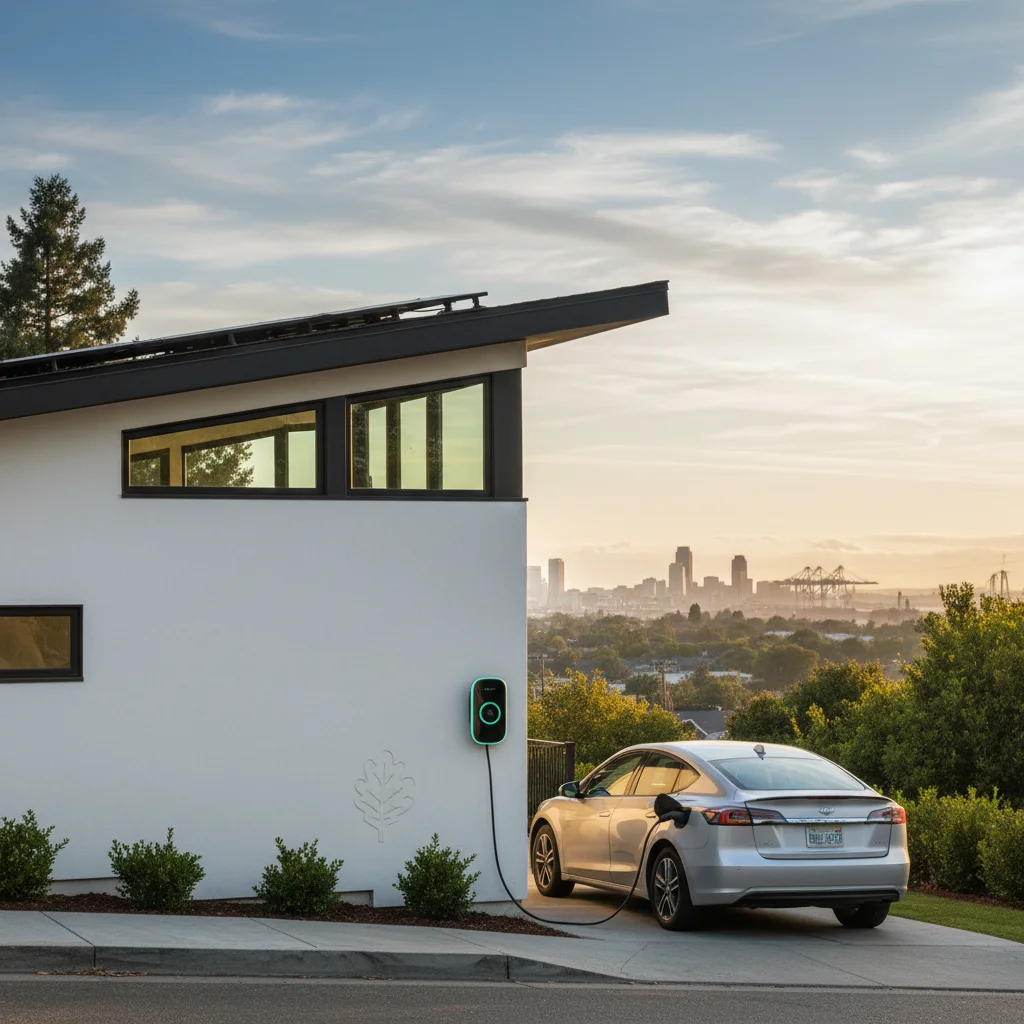
Oakland homeowners paid between $800 and $2,500 for Level 2 EV charger installations in 2026, with the median cost landing at $1,400 when no electrical panel upgrades were needed. But 38% of older Oakland homes required panel upgrades costing an additional $1,500 to $3,000, pushing total installation costs to $3,900 on average. The federal 30C charger credit ended for chargers placed in service after June 30, 2026 (IRS FS-2025-05).
How Much Does EV Charger Installation Cost in Oakland?
Oakland residential EV charger installations in 2026 range from $800 to $5,500 depending on electrical capacity, distance from the panel, and permit requirements. Level 2 chargers delivering 240 volts cost $1,200 to $2,500 for standard installations within 25 feet of the electrical panel. Homes requiring panel upgrades from 100-amp to 200-amp service add $1,500 to $3,000. Oakland requires permits for all hardwired EV charger installations, adding $150 to $300 in fees and inspection costs.
Material costs account for $400 to $900 of the total expense. The charger unit itself ranges from $300 for basic models to $700 for smart chargers with scheduling and energy monitoring features. Electrical components including 40-amp or 50-amp breakers, GFCI protection, and copper wiring add $100 to $200. Labor costs in Oakland average $80 to $120 per hour, with most installations requiring 4 to 6 hours of work. So a typical installation with no complications costs $1,400 before incentives.
Oakland homeowners face installation costs 18% higher than the California state average due to stricter local building codes and higher labor rates in the Bay Area. Homes built before 1980 require additional safety upgrades to meet current electrical code, adding $200 to $500 to the project cost. And multi-unit buildings face shared electrical infrastructure costs that can reach $8,000 per unit when extensive panel upgrades are needed.
The federal 30C charger credit ended for chargers placed in service after June 30, 2026 (IRS FS-2025-05). Oakland residents can stack this with Pacific Gas & Electric's EV charger rebate of $500 for income-qualified customers. So a $3,000 installation drops to $1,500 net cost after combining federal and utility incentives. Use our free rebate calculator to determine your specific savings based on installation costs and household income.
What's the Efficiency Rating and Performance of Different EV Chargers?
Level 2 chargers deliver 240 volts at 16 to 80 amps, providing 12 to 80 miles of range per hour compared to 3 to 5 miles per hour from standard 120-volt outlets. A 40-amp Level 2 charger adds 25 miles of range per hour, fully charging a 60-kWh battery in 6 to 8 hours overnight. Oakland's mild climate allows for consistent charging performance year-round, unlike colder regions where battery efficiency drops 20% to 40% below freezing.
Charger efficiency measures the percentage of grid electricity that reaches the vehicle battery after accounting for conversion losses. Modern Level 2 chargers operate at 88% to 94% efficiency, with higher-quality units minimizing heat loss during AC-to-DC conversion inside the vehicle. A charger operating at 90% efficiency delivers 9 kWh to the battery for every 10 kWh drawn from the grid. So efficiency differences of 4% to 6% translate to $40 to $80 in annual electricity costs at Oakland's average rate of $0.34 per kWh.
Smart chargers with energy management features optimize charging times to take advantage of Pacific Gas & Electric's time-of-use rates, which drop to $0.18 per kWh between midnight and 6 AM. Oakland EV owners save $350 to $600 annually by charging during off-peak hours compared to peak rates of $0.52 per kWh. But smart chargers cost $200 to $400 more than basic models, creating a payback period of 8 to 14 months.
Hardwired chargers deliver slightly better efficiency than plug-in models due to eliminating the NEMA 14-50 outlet connection point. The difference amounts to 1% to 2% efficiency gain, or $10 to $20 annually. And hardwired installations meet National Electrical Code requirements for permanent installations, reducing the risk of loose connections that cause voltage drop and overheating.
How Long Does It Take to Break Even on Your EV Charger Investment?
Oakland EV owners break even on Level 2 charger installations in 2.3 to 4.1 years compared to using public charging stations, depending on driving patterns and electricity rates. Homeowners driving 12,000 miles annually spend $510 charging at home with off-peak rates versus $1,800 using public fast-charging stations at $0.45 per kWh. The $1,290 annual savings offsets a $3,000 installation (after federal tax credit) in 2.3 years.
Payback periods extend to 6 to 8 years when comparing home charging to relying solely on workplace or free public Level 2 charging. But workplace charging availability dropped 22% in Oakland between 2024 and 2026 as employers reduced amenities during commercial real estate downsizing. And free public charging often requires 2 to 4 hours of waiting time, adding opportunity costs that accelerate the home installation payback calculation.
"Home charging typically costs about half as much as public charging when using off-peak electricity rates, providing the most economical option for EV owners." — U.S. Department of Energy
Installation costs affect payback calculations more than charger efficiency differences. A $1,400 installation with no panel upgrade breaks even in 1.1 years, while a $5,500 installation requiring extensive electrical work extends payback to 4.3 years. Oakland homeowners in older homes should calculate whether panel upgrades delay payback beyond their expected ownership period before proceeding with installation.
Federal energy tax credits reduce the effective payback period by 30%, improving the investment return for Oakland residents. And home EV chargers increase property values by $1,200 to $2,500 according to 2025 Bay Area real estate data, partially recovering installation costs even if homeowners sell before reaching full payback. So the actual economic break-even occurs earlier than pure charging cost comparisons suggest.
Is Your Oakland Home's Climate Zone Suitable for EV Charger Installation?
Oakland falls within California Climate Zone 3, characterized by mild temperatures ranging from 45°F to 75°F year-round with minimal temperature extremes that affect EV battery performance or charging equipment durability. Climate Zone 3 allows for outdoor charger installations without weatherproof enclosures rated for extreme cold, reducing installation costs by $150 to $300 compared to Climate Zones 16 through 17 in the Sierra Nevada.
Coastal fog exposure in western Oakland neighborhoods requires corrosion-resistant charger housings rated NEMA 3R or higher to withstand moisture and salt air. Chargers installed within 5 miles of San Francisco Bay should use stainless steel or powder-coated aluminum enclosures that resist oxidation over 15 to 20 years. Interior Oakland locations away from coastal influence accommodate standard NEMA 3 enclosures that cost $50 to $100 less.
Oakland's Mediterranean climate eliminates cold-weather charging challenges that reduce EV battery efficiency by 20% to 40% in northern states. Battery preconditioning features that draw power to warm batteries before charging prove unnecessary in Oakland's mild winters, saving $80 to $120 in annual electricity costs. And summer temperatures rarely exceed 85°F, preventing heat-related battery degradation that shortens battery life in Climate Zones 13 through 15.
Seismic considerations affect charger mounting requirements in Oakland due to proximity to the Hayward Fault. Hardwired chargers mounted to structural building elements with earthquake-rated brackets meet California Building Code Section 1621 requirements for equipment anchorage in high seismic zones. Pole-mounted chargers in driveways require deeper concrete footings of 36 to 48 inches compared to 24 inches in low seismic areas, adding $200 to $400 to installation costs.
How Do EV Chargers Compare to Alternative Home Energy Solutions?
Oakland homeowners choosing between EV chargers and heat pump rebates should prioritize based on transportation costs versus heating and cooling expenses. A Level 2 EV charger installation at $3,000 saves $1,290 annually on transportation costs, while a $6,500 heat pump system saves $840 annually on HVAC costs. So EV chargers deliver higher annual returns of 43% compared to heat pumps at 13%, reaching payback 2.5 times faster.
Rooftop solar installations costing $15,000 to $25,000 after federal tax credits provide electricity for both home use and EV charging at $0.08 to $0.12 per kWh compared to Pacific Gas & Electric's $0.34 per kWh rate. Oakland homes with solar panels that generate excess capacity can charge EVs at near-zero marginal cost, creating a combined solar-plus-EV charging system that reaches payback in 6 to 9 years. But solar installations require upfront capital that makes EV chargers more accessible for homeowners with limited budgets.
Battery storage systems costing $8,000 to $12,000 allow Oakland homeowners to store solar energy or off-peak grid electricity for EV charging during peak rate periods. Time-of-use rate arbitrage saves an additional $180 to $280 annually compared to direct EV charging, but the storage system's 28- to 44-year payback period makes standalone EV chargers more economically attractive. And battery storage capacity limits prevent simultaneous home backup power and full EV charging during grid outages.
Oakland's focus on transportation electrification makes EV chargers eligible for more rebate programs than alternative energy upgrades. Pacific Gas & Electric offers $500 EV charger rebates for income-qualified customers but provides no comparable incentive for standalone battery storage. So stacking federal and utility incentives reduces EV charger net costs to $1,500 compared to $8,000 for battery systems with no utility rebates available.
What's the Lifespan and Durability of Residential EV Chargers?
Level 2 EV chargers last 10 to 15 years under typical residential use patterns of 200 to 250 charging cycles per year. Oakland's mild climate extends charger lifespan to the upper end of this range by eliminating thermal stress from temperature extremes below 20°F or above 100°F. Chargers installed in garages or covered carports last 12 to 18 years compared to 8 to 12 years for exposed outdoor installations subject to UV degradation and moisture infiltration.
Charger reliability depends on internal component quality and electrical connection integrity. Units with sealed internal components and conformal coating on circuit boards resist moisture-related failures that account for 35% of warranty claims in coastal areas. Oakland homeowners should specify chargers rated IP65 or higher for water and dust ingress protection, reducing failure rates from 8% to 2% over 10 years. And hardwired installations eliminate plug-and-receptacle wear that causes 22% of NEMA 14-50 outlet failures after 5 to 7 years of regular use.
Manufacturer warranties range from 3 to 5 years for residential chargers, covering defects in materials and workmanship but excluding damage from electrical surges or physical impact. Extended warranties costing $150 to $300 provide 8 to 10 years of coverage, creating a cost-per-year of $18 to $37 that exceeds typical repair costs of $200 to $400. So extended warranties only make economic sense for premium chargers costing $1,200 or more where replacement expense justifies the coverage cost.
Technological obsolescence presents a greater concern than physical failure for EV chargers installed in 2026. Industry standards for vehicle-to-grid bidirectional charging remain in development, potentially requiring hardware upgrades by 2030 to support new vehicle features. Oakland homeowners should install chargers with firmware update capability to extend useful life as vehicle communication protocols evolve. But most current chargers lack upgradeable components, creating a 7- to 10-year replacement cycle driven by feature obsolescence rather than physical failure.
Official Sources
- U.S. Department of Energy - EV Charging — Federal guidance on home EV charging equipment, costs, and incentives
- Internal Revenue Service - Alternative Fuel Credit — Details on the 30% federal tax credit for EV charger installations (note: the federal 30C charger credit ended for chargers placed in service after June 30, 2026)
- DSIRE USA — Comprehensive database of state and utility EV charger rebates and incentives
Related Reading: Learn more about Ev Charger Installation Cost With Rebates and Level 1 Vs Level 2 Ev Charger Cost.
Related Reading: Learn more about How Much Does EV Charger Installation Cost in 2026?.
Frequently Asked Questions
Can you install an EV charger yourself or do you need a professional?
Oakland requires licensed electricians (C-10 electrical contractor license) to install hardwired Level 2 EV chargers and pull building permits for all installations. DIY installations violate Oakland Municipal Code Chapter 15.08 and void equipment warranties, creating liability for electrical fires or shock hazards. Plug-in chargers using existing NEMA 14-50 dryer outlets don't require permits, but electricians should verify that 50-amp circuits meet current code and can handle continuous EV charging loads of 40 amps. Professional installation costs $800 to $1,200 compared to $0 for DIY, but licensed work includes permit fees, inspections, and insurance coverage.
How much does it cost to install an EV charger in Oakland?
Oakland EV charger installations cost $1,200 to $2,500 for standard Level 2 units when electrical panels have adequate capacity and chargers mount within 25 feet of the panel. Homes requiring panel upgrades from 100-amp to 200-amp service pay $2,700 to $5,500 total. Costs break down to $300 to $700 for the charger unit, $400 to $900 for electrical materials, $320 to $720 for labor at $80 to $120 per hour, and $150 to $300 for permits. The federal 30C charger credit ended for chargers placed in service after June 30, 2026 (IRS FS-2025-05). Pacific Gas & Electric provides $500 rebates for income-qualified customers. Calculate your specific savings with our rebate calculator.
Are there rebates or incentives for EV charger installation in Oakland?
The federal 30C charger credit ended for chargers placed in service after June 30, 2026 (IRS FS-2025-05). Pacific Gas & Electric offers $500 rebates for customers with household incomes below 400% of federal poverty level ($120,000 for a family of four in 2026). And the Bay Area Air Quality Management District provides $500 incentives for charger installations when combined with vehicle retirement programs. Stacking federal, utility, and air district programs reduces net installation costs from $3,000 to $1,000. Income-qualified customers should apply for utility rebates first since federal tax credits don't require pre-approval.
How long does it take to install a home EV charger?
Standard Level 2 EV charger installations in Oakland take 4 to 6 hours when electrical panels have spare capacity and chargers mount near the panel. Installations requiring panel upgrades extend to 8 to 12 hours over 1 to 2 days to accommodate inspector visits and utility disconnect requirements. Permit processing adds 5 to 10 business days before installation begins, while scheduling electricians during peak demand periods extends lead times to 2 to 4 weeks. Oakland building inspectors typically complete final inspections within 3 to 5 days after installation, allowing charger activation 3 to 4 weeks from initial consultation for straightforward projects.
What electrical upgrades are needed for EV charger installation?
Level 2 EV chargers require dedicated 40-amp or 50-amp circuits with 240-volt service, necessitating panel upgrades in 38% of Oakland homes built before 1990 that have 100-amp service. Upgrading to 200-amp service costs $1,500 to $3,000 including new meter base, service panel, and utility coordination. Homes with 150-amp or 200-amp panels but no spare breaker slots need sub-panel installations costing $600 to $1,200. And installations exceeding 100 feet from the panel require larger gauge wire (6 AWG instead of 8 AWG for 40-amp circuits) adding $3 to $5 per foot in material costs. Licensed electricians perform load calculations to determine whether existing service capacity supports EV charging without upgrades.
Ready to start saving with EV charger rebates? Use our free rebate calculator to discover federal tax credits and local incentives for Oakland homeowners. Get personalized savings estimates based on your installation costs, household income, and vehicle type. Calculate your rebates in under 60 seconds and start your EV charging installation with confidence.
Last reviewed: April 14, 2026. Reviewed by DuloCore Energy Specialists. About the team.
Check your California EV charger rebate eligibility — see the programs you qualify for and the dollar amounts on our California EV charger rebate finder.