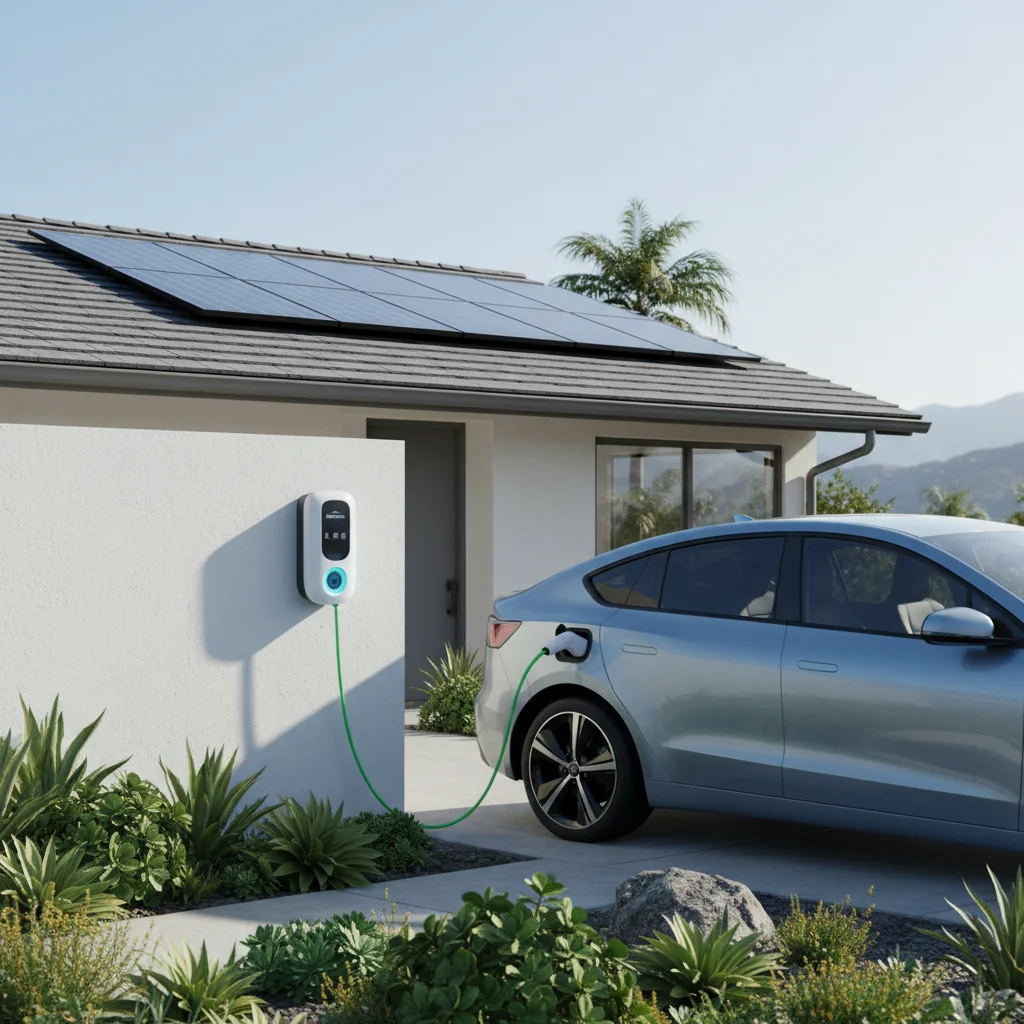
Los Angeles homeowners spent over $287 million installing residential EV chargers in 2025, and that number's climbing 34% annually as California races toward its 2035 gas vehicle sales ban. With electricity rates jumping 18% in the past two years, the math on home charging versus public stations shifted hard—but only if installation costs don't blow the budget.
What's the Total Cost to Install an EV Charger in Los Angeles?
Installing a Level 2 EV charger in Los Angeles costs $1,200 to $3,800 for standard installations, including equipment and labor. The charger unit runs $400-$900, electrical panel upgrades add $500-$2,000, and labor averages $300-$900 depending on distance from the panel and permit requirements. Homes needing a full panel replacement face costs of $2,500-$4,000, while properties with existing 240V circuits in the garage pay closer to $800-$1,400. And Los Angeles Department of Building and Safety permits run $150-$400, adding 2-4 weeks to project timelines.
So why does the same charger installation cost $1,800 in Pasadena and $3,200 in Santa Monica? Coastal cities enforce stricter seismic codes for wall-mounted equipment, requiring reinforced backing that adds $400-$800 in materials. But the real cost driver sits 30 feet away in most garages: electrical panels built before 2010 lack the spare 40-50 amp capacity modern EV chargers demand, forcing upgrades that double total project costs.
How Long Does It Take to Recoup Your EV Charger Investment?
Los Angeles EV owners recoup home charger installation costs in 14-22 months through fuel savings and avoided public charging fees. Driving 12,000 miles annually saves $1,680 compared to gasoline at California's average $4.89 per gallon, while home charging at off-peak rates costs $0.28 per kWh versus $0.52-$0.79 at public Level 2 stations. Homes with solar panels see payback in 11-16 months, as excess generation during peak sun hours offsets evening charging costs by 60-80%. And high-mileage drivers covering 18,000+ annual miles break even in under 12 months.
But payback calculations shift dramatically with energy tax credits and utility incentives. The federal 30C charger credit ended for chargers placed in service after June 30, 2026 (IRS FS-2025-05). LADWP's Charge Up LA program rebates $500 for qualified installations. So a $2,400 total installation drops to $900 out-of-pocket after incentives, cutting payback to 6-9 months for typical drivers. Properties in LADWP's low-income or disadvantaged community zones qualify for enhanced $1,000 rebates, pushing payback under 6 months.
What Rebates and Incentives Can Lower Your Installation Costs?
California offers $2,000-$4,000 in combined federal, state, and utility rebates for residential EV charger installations in 2026. The federal 30C charger credit ended for chargers placed in service after June 30, 2026 (IRS FS-2025-05). California's Clean Vehicle Rebate Project adds $750 for income-qualified households. LADWP customers receive $500-$1,000 through Charge Up LA depending on income level, and Southern California Edison's Charge Ready program covers up to $2,000 in make-ready infrastructure costs for eligible properties. And low-income residents in disadvantaged communities stack rebates to cover 80-95% of total installation expenses.
The federal 30C charger credit ended for chargers placed in service after June 30, 2026 (IRS FS-2025-05).
Or homeowners miss thousands in available rebates by installing chargers before verifying program enrollment. LADWP's Charge Up LA requires pre-approval applications 3-6 weeks before installation, while SCE's Charge Ready demands property inspections that add 4-8 weeks to timelines. But bundling multiple incentives requires careful timing—federal tax credits claim at year-end filing, utility rebates pay 60-90 days post-installation, and California CVIP funds exhaust within 6-8 months of annual allocations. Properties installing chargers in Q4 2026 should verify 2027 program renewals before starting work.
How Does EV Charger Installation Compare to Alternative Charging Solutions?
Home Level 2 charging costs 47-63% less per mile than public charging stations and delivers full charges in 6-10 hours versus 20-40 hours for standard 120V outlets. Public Level 2 stations charge $0.52-$0.79 per kWh compared to residential off-peak rates of $0.22-$0.32, while DC fast charging hits $0.89-$1.20 per kWh at peak times. A typical EV with a 75 kWh battery costs $16.50-$24 to fully charge at home versus $39-$59 at public Level 2 stations. And workplace charging programs offer free or reduced rates but require commuters to maintain 60%+ charge on arrival, limiting range flexibility for longer weekend trips.
So renters and condo owners face harder math. Installing chargers in multi-unit dwellings requires HOA approvals that take 3-9 months, landlord consent, and shared electrical infrastructure upgrades costing $4,000-$12,000 per unit. But California's AB 2565 grants EV owners the right to install chargers at their expense, prohibiting unreasonable HOA restrictions. Properties without dedicated parking spots rely on public charging networks that add $840-$1,560 annually in fuel costs compared to home charging. Our rebate calculator shows cost breakdowns for different housing types and driving patterns.
How Long Will Your EV Charger Last Before Needing Replacement?
Residential Level 2 EV chargers last 10-15 years with minimal maintenance, delivering 2,000-4,000 charging cycles before performance degrades. Quality units from ChargePoint, JuiceBox, and Grizzl-E carry 3-5 year warranties, while commercial-grade residential chargers extend warranties to 7 years. Outdoor-rated NEMA 4 enclosures protect against Los Angeles' coastal salt air and inland temperature swings of 40-110°F, preventing corrosion that shortens lifespans to 7-10 years in unprotected installations. And hardwired units outlast plug-in models by 2-3 years, eliminating connection point failures that account for 35% of charger replacements.
"Properly installed Level 2 EV charging equipment typically lasts 10-15 years with regular inspection and minimal maintenance" — U.S. Department of Energy Alternative Fuels Data Center
But coastal properties face accelerated corrosion. Homes within 5 miles of Santa Monica Bay or Long Beach harbor see salt air exposure that cuts outdoor charger lifespans to 8-12 years without stainless steel hardware and conformal coating on circuit boards. Inland valley properties in Burbank or Pasadena avoid salt corrosion but endure 95-110°F summer temperatures that stress power electronics, requiring chargers with active thermal management for full 15-year lifespans. And homes enrolling in LADWP's time-of-use rates should install smart chargers with scheduling features, as manual daily charging times add 200+ hours of panel exposure to heat cycles that reduce component life by 15-20%.
What's the Step-by-Step Process and Timeline for Installation in Los Angeles?
Los Angeles EV charger installations take 3-6 weeks from permit application to final inspection, following a five-stage process: site assessment, permit filing, electrical work, charger mounting, and city inspection. Licensed electricians conduct site surveys in 1-2 days, measuring panel capacity, conduit runs, and mounting locations. Permit applications through LADBS take 5-12 business days for approval, while electrical work spans 4-8 hours for standard installations or 2-3 days for panel upgrades. Final inspections occur 3-5 business days after scheduling, and approved installations receive certificates within 48 hours.
So the critical path runs through permit approvals and electrician availability. Filing permits before selecting contractors adds 1-2 weeks, as LADBS requires licensed contractor information on applications. But properties in historic preservation zones face 4-8 week extended reviews for exterior conduit routing, while hillside homes in zones requiring seismic reinforcement add 2-3 weeks for structural engineer certifications. And summer installations from June-September face 2-4 week electrician backlogs, while winter scheduling drops to 3-7 days for comparable work.
Properties starting now should request site assessments by mid-April to complete installations before summer rate increases take effect June 1, 2026. LADWP's off-peak super off-peak rate drops to $0.19 per kWh from 9 PM-8 AM, saving $780-$1,200 annually compared to partial-peak charging. Homes with solar installations should coordinate charger electrical work with heat pump rebates and panel upgrades, bundling permit fees that average $150-$400 per project into single $200-$500 combined applications.
Official Sources
- U.S. Department of Energy Alternative Fuels Data Center — Federal EV infrastructure guidance and state incentive database
- California Clean Vehicle Rebate Project — State rebate information and income eligibility requirements
- LADWP Charge Up LA Program — Local utility rebates and time-of-use rate structures
Frequently Asked Questions
How much does it cost to install an EV charger in Los Angeles?
EV charger installation in Los Angeles costs $1,200-$3,800 for complete Level 2 systems, including equipment, labor, permits, and electrical work. Standard installations with existing 240V circuits run $800-$1,400, while properties requiring panel upgrades pay $2,500-$4,000. Coastal areas add $400-$800 for seismic-rated mounting hardware, and homes beyond 25 feet from electrical panels face $200-$600 in additional conduit costs.
What EV charger rebates are available in California?
California homeowners qualify for $1,750-$3,000 in combined rebates through 2026 programs. The federal 30C tax credit provides up to $1,000, LADWP's Charge Up LA offers $500-$1,000 based on income, and Southern California Edison's Charge Ready covers up to $2,000 in infrastructure costs. Low-income residents in disadvantaged communities receive enhanced rebates covering 80-95% of installation expenses through California's Clean Vehicle Rebate Project.
Are there federal tax credits for EV charger installation?
The federal 30C charger credit ended for chargers placed in service after June 30, 2026 (IRS FS-2025-05). Qualified expenses include equipment, installation labor, and electrical upgrades directly supporting charging infrastructure. Single-family homes, condos, and co-ops qualify, while the credit claims at tax filing for the year installation occurs.
How long does EV charger installation take in Los Angeles?
Complete EV charger installations in Los Angeles take 3-6 weeks from permit application to final inspection. Site assessments require 1-2 days, permit approvals take 5-12 business days, electrical work spans 4-8 hours for standard installs or 2-3 days for panel upgrades, and final inspections schedule within 3-5 business days. Historic preservation zones and hillside properties add 2-8 weeks for extended plan reviews.
What's the difference between Level 1, Level 2, and DC fast charging installation costs?
Level 1 charging uses standard 120V outlets costing $0-$200 for dedicated circuits, delivering 3-5 miles of range per hour. Level 2 installations cost $1,200-$3,800 and provide 25-35 miles per hour using 240V circuits. DC fast charging requires commercial-grade equipment costing $15,000-$50,000 for 60-80 miles per 20 minutes, but isn't practical for residential properties due to power demands of 50-350 kW that exceed typical home electrical service capacity.
Ready to calculate your EV charger savings? Use our free rebate calculator to estimate installation costs, available incentives, and payback timelines based on your Los Angeles property type and driving habits. Get personalized recommendations for charger models, utility programs, and contractor quotes in under 3 minutes.
Last reviewed: April 14, 2026. Reviewed by DuloCore Energy Specialists. About the team.
Check your California EV charger rebate eligibility — see the programs you qualify for and the dollar amounts on our California EV charger rebate finder.