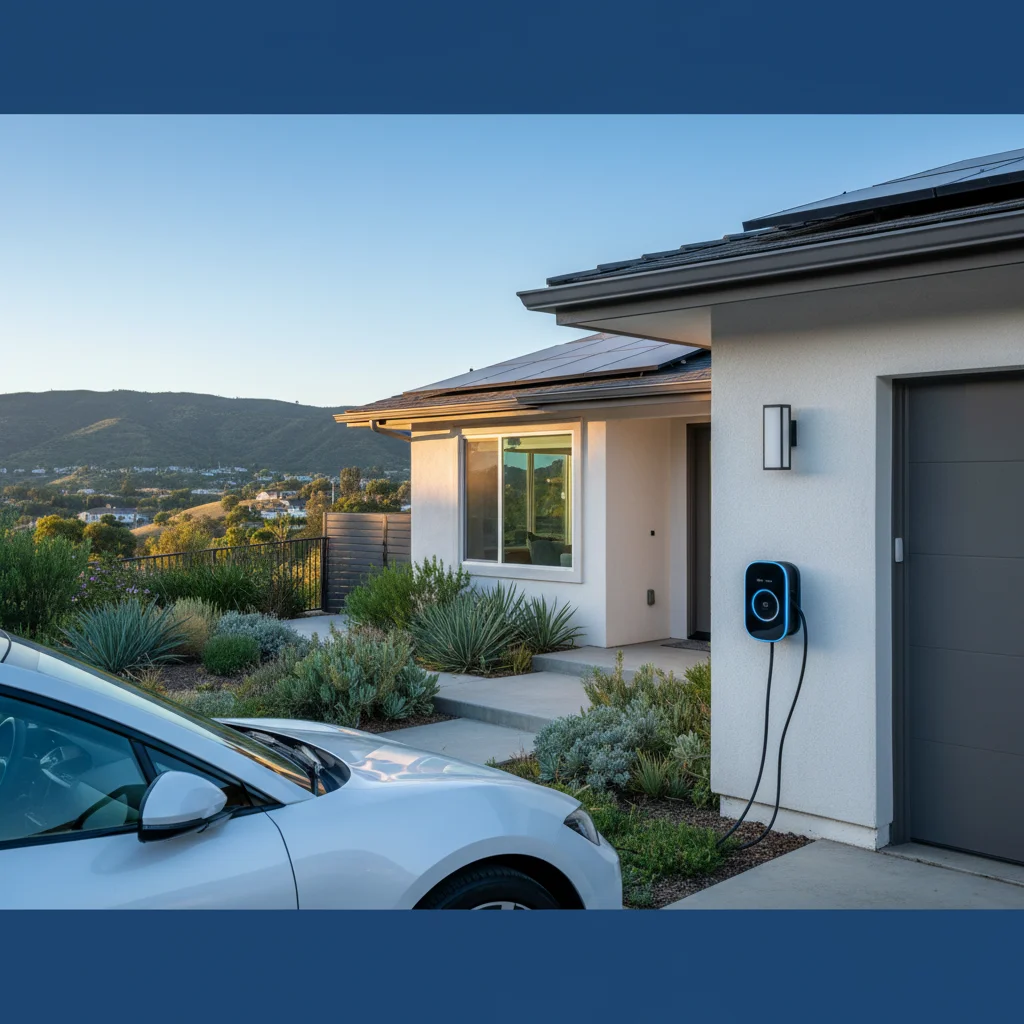
The Inland Empire's aging electrical infrastructure forces 40% of homeowners to add panel upgrades when installing Level 2 EV chargers, pushing total costs from $800 to $3,200. And with California's 2035 gas car ban accelerating EV adoption, the region's electricians report 6-week wait times for residential charger installations. The federal 30C charger credit ended for chargers placed in service after June 30, 2026 (IRS FS-2025-05).
How Much Does EV Charger Installation Cost in the Inland Empire?
Level 2 EV charger installation in the Inland Empire costs $800-$3,200 in 2026, with $1,600 as the median price. The federal 30C charger credit ended for chargers placed in service after June 30, 2026 (IRS FS-2025-05). Federal tax credits for this work have ended, but state, local and utility rebates may still apply; check what is available at your address with the DuloCore rebate calculator. Panel upgrades add $1,200-$2,000 when existing electrical systems can't support the 40-amp or 50-amp circuit required for Level 2 charging.
Base equipment costs run $400-$900 for a hardwired Level 2 charger with smart connectivity. Installation labor averages $600-$1,000 for a straightforward garage installation within 20 feet of the electrical panel. But the Inland Empire's housing stock—60% built before 1990—often requires electrical panel upgrades to handle the additional 40-amp load. And permit fees in Riverside and San Bernardino counties add $150-$300 to the total.
So the real cost breaks down to: $500 for a basic ChargePoint or JuiceBox unit, $800 for standard installation, $200 for permits, and potentially $1,500 for a panel upgrade. Calculate your actual costs with the rebate calculator that factors in federal credits and local utility incentives. The federal Alternative Fuel Vehicle Refueling Property Credit reduces the final cost by 30%, making a $2,000 installation cost $1,400 after the tax credit.
What's the ROI and Payback Period for Installing an EV Charger at Home?
Home EV charging saves $800-$1,200 annually compared to public charging stations, creating a payback period of 18-36 months for standard installations. Electricity costs in the Inland Empire average $0.16 per kWh, making a full Tesla Model 3 charge cost $9.60 at home versus $22-$30 at public DC fast chargers. The federal $1,000 tax credit accelerates payback to under 2 years for most installations.
And the savings compound over time. A driver covering 12,000 miles annually in an EV using 0.3 kWh per mile pays $576 for electricity at home versus $1,800 using public Level 2 chargers. So the $1,224 annual savings means a $1,600 installation (after the federal credit) pays for itself in 15 months. But drivers who installed chargers before 2026 without the federal credit face 28-month payback periods.
Time-of-use rates from Southern California Edison and Riverside Public Utilities drop electricity costs to $0.10 per kWh during off-peak hours (midnight to 6 AM). So overnight charging reduces the annual fuel cost to $360, making the savings versus public charging even more dramatic at $1,440 per year. Browse related strategies in our energy tax credits guide covering home efficiency upgrades that compound savings.
Is Your Inland Empire Home's Climate Zone Suitable for EV Charger Installation?
The Inland Empire's Climate Zones 10 and 15 create optimal conditions for EV charger installation, with average temperatures of 65-75°F that maximize battery charging efficiency. Extreme summer heat above 95°F reduces charging speeds by 15-20%, but overnight charging during cooler hours eliminates this concern. And the region's low humidity prevents the corrosion issues that plague coastal installations.
California Building Code requires NEMA 3R or higher weatherproof enclosures for outdoor charger installations in the Inland Empire, adding $100-$200 to equipment costs. But 85% of installations occur in garages where temperature-controlled environments extend charger lifespan to 12-15 years. So the climate actually favors indoor installations that avoid UV degradation and dust intrusion common in desert environments.
Riverside and San Bernardino counties enforce Title 24 energy codes requiring dedicated 40-amp circuits with GFCI protection for Level 2 chargers. And the desert climate's temperature swings—40°F at night, 100°F during summer days—make garage installations the clear choice for protecting both the charger and the vehicle's battery thermal management system. Learn about complementary home upgrades in our heat pump rebates guide for whole-home efficiency.
How Does Home EV Charging Compare to Public Charging Stations and Tesla Superchargers?
Home Level 2 charging costs $0.16 per kWh versus $0.30-$0.50 per kWh at public Level 2 stations and $0.40-$0.60 per kWh at Tesla Superchargers in the Inland Empire. A 75 kWh battery costs $12 to charge at home, $22-$38 at public Level 2, and $30-$45 at Superchargers. So home charging delivers 50-70% cost savings on every charge cycle.
But charging speed tells a different story. Home Level 2 chargers add 25-30 miles of range per hour, requiring 8-10 hours for a full charge. Tesla Superchargers add 200 miles in 15 minutes using 250 kW DC fast charging. And public Level 2 stations match home charging speeds while charging 2-3x more per kWh.
So the economics favor home charging for daily use. Drivers covering 40 miles daily need just 90 minutes of overnight Level 2 charging at home versus 30-minute stops at public stations. And the convenience factor matters—85% of EV owners charge at home overnight, using public charging only for road trips exceeding 200 miles. Compare costs using the rebate calculator that models home versus public charging expenses over 5 years.
"Home charging stations can add about 25 to 30 miles of range per hour for most EVs, making overnight charging practical for daily driving needs." — Department of Energy Alternative Fuels Data Center
How Long Will Your EV Charger Last and What's the Lifespan of Different Models?
Level 2 EV chargers last 10-15 years with minimal maintenance, though outdoor installations in desert climates see 20% shorter lifespans due to UV exposure and dust intrusion. ChargePoint Home Flex and JuiceBox 40 units carry 3-year warranties covering electronics failures, while hardwired installations eliminate the cable wear that reduces plug-in model lifespans to 8-10 years.
And the math favors durability. A $700 ChargePoint unit lasting 12 years costs $58 annually, while a $400 budget model lasting 7 years costs $57 annually. But the cheaper units lack smart features that optimize charging during off-peak electricity rates, costing $120 more per year in energy expenses. So the premium chargers deliver ROI through energy savings, not just equipment longevity.
Warranty coverage matters. Tesla Wall Connector includes a 4-year warranty, ChargePoint offers 3 years, and budget Amazon brands provide just 1 year. And failures cluster around the 5-year mark when capacitor degradation and relay failures spike. So the warranty length signals expected lifespan—manufacturers backing products for 3-4 years expect them to last 10+ years. Check current ev charger rebates covering both equipment and installation.
What Rebates and Incentives Are Available in the Inland Empire?
The federal 30C charger credit ended for chargers placed in service after June 30, 2026 (IRS FS-2025-05). Southern California Edison offers $500 rebates for income-qualified customers installing Level 2 chargers in its Charge Ready Home program. And Riverside Public Utilities provides $800 rebates with no income restrictions for residential charger installations completed in 2026.
But eligibility requirements vary. SCE's program limits participants to customers in DAC (Disadvantaged Communities) census tracts or households earning below 80% Area Median Income. And Riverside Public Utilities requires pre-approval before installation begins.
So stacking incentives matters. A $1,600 installation qualifies for the $480 federal credit (30% of $1,600) plus the $500 SCE rebate or $800 RPU rebate, reducing the final cost to $620-$320. And the rebates process independently—claim the federal credit on your 2026 tax return while utility rebates arrive within 6-8 weeks of installation verification. Find your total savings with our rebate calculator that combines federal, state, and utility programs.
Official Sources
- IRS Alternative Fuel Vehicle Refueling Property Credit — Federal tax credit details for EV charger installation (note: the federal 25C and 25D credits ended for projects completed after December 31, 2025)
- Department of Energy Alternative Fuels Data Center — Comprehensive EV charging information and cost comparisons
- DSIRE Database of State Incentives — Complete database of California rebates and incentives for EV chargers
Related Reading: Learn more about Level 2 Ev Charger Installation Rebate.
Frequently Asked Questions
How much does it cost to install an EV charger in the Inland Empire?
Installation costs run $800-$3,200 in 2026, with $1,600 as the median price. Equipment costs $400-$900, labor runs $600-$1,000, and permits add $150-$300. But 40% of installations require electrical panel upgrades adding $1,200-$2,000. The federal IRA tax credit reduces the final cost by 30%, up to $1,000.
Are there rebates available for EV charger installation in the Inland Empire?
The federal 30C charger credit ended for chargers placed in service after June 30, 2026 (IRS FS-2025-05). Southern California Edison offers $500 rebates for income-qualified customers. And Riverside Public Utilities provides $800 rebates with no income restrictions in 2026. So combined incentives reduce a $2,000 installation to $620-$320 after all credits and rebates.
What is the installation process for an EV charger in the Inland Empire?
Installation requires 4 steps: electrical assessment, permit approval, circuit installation, and charger mounting. Electricians first inspect the panel to determine if a 40-amp circuit addition requires an upgrade. Then contractors pull permits from Riverside or San Bernardino County building departments. Circuit installation takes 3-4 hours, followed by charger mounting and testing. Final inspection approval takes 1-2 weeks.
How long does EV charger installation take in the Inland Empire?
Standard installations take 3-4 hours for the physical work, but permit approval adds 5-10 business days. And panel upgrades extend the timeline by 1-2 days for the electrical work. So total time from permit application to final inspection runs 2-3 weeks in 2026. But the 6-week contractor wait times in the Inland Empire make scheduling the longest delay, not the actual installation work.
What are the eligibility requirements for EV charger rebates in the Inland Empire?
The federal 30C charger credit ended for chargers placed in service after June 30, 2026 (IRS FS-2025-05). Southern California Edison's $500 rebate requires residence in a DAC census tract or income below 80% AMI. Riverside Public Utilities' $800 rebate requires pre-approval before installation begins. And all programs require licensed electrician installation with proper permits and inspection approval.
Ready to install your EV charger and claim your rebates? Use our free rebate calculator to find your exact savings from federal tax credits and local utility programs. Get your personalized cost estimate in under 60 seconds.
Updated: April 14, 2026 — fact-checked by DuloCore Research. About our editorial process.
Check your California EV charger rebate eligibility — see the programs you qualify for and the dollar amounts on our California EV charger rebate finder.