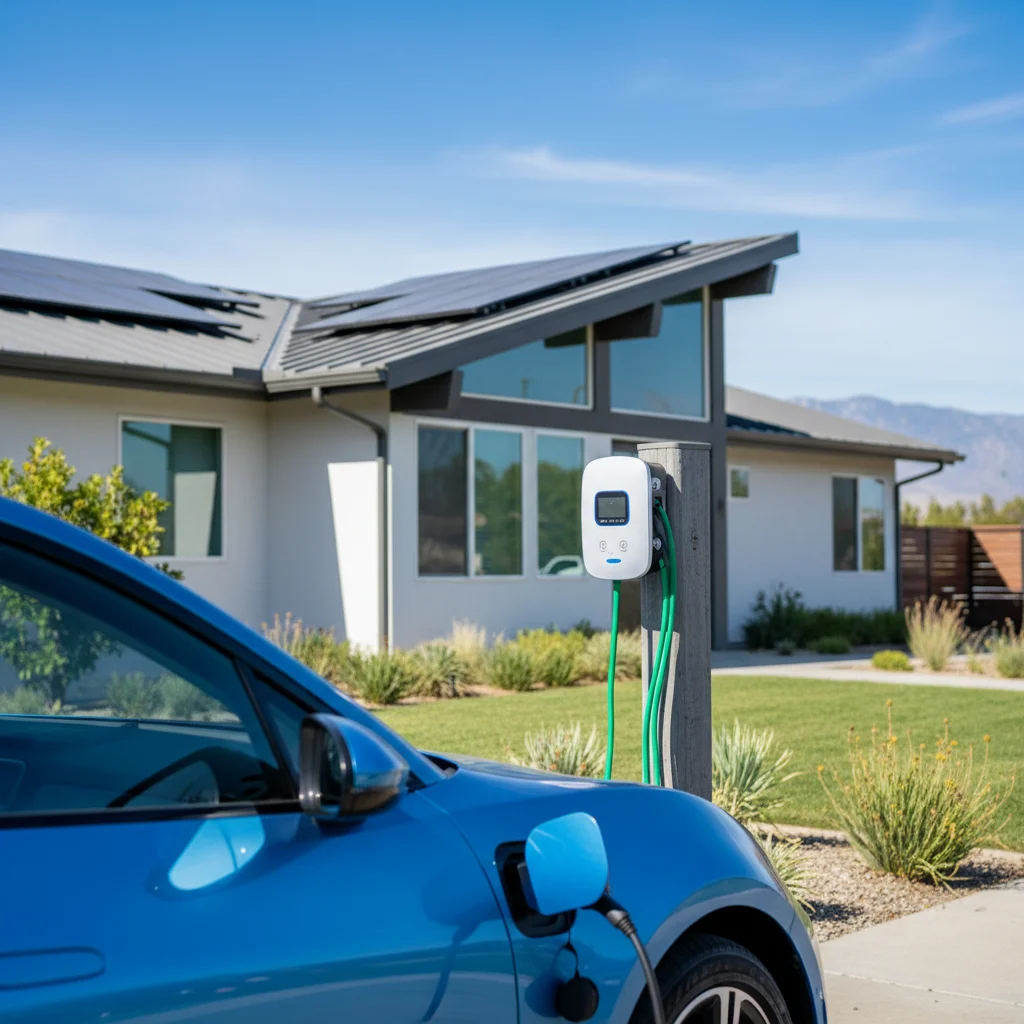
Fresno homeowners installing Level 2 EV chargers paid an average of $1,847 for equipment and labor in 2025, according to DOE data—but 2026 federal and state rebates can slash that cost by up to 75% for income-qualified households. With California's push to electrify transportation and the Central Valley's grid upgrades accelerating, knowing the real numbers before you buy separates a $500 project from a $3,000 mistake.
How Much Does EV Charger Installation Cost in Fresno?
Level 2 EV charger installation in Fresno costs $1,200 to $2,500 in 2026, with the median landing at $1,847 for a 240-volt wall-mounted unit. Equipment accounts for $400 to $1,200, while licensed electrician labor ranges from $800 to $1,300 depending on panel distance, circuit upgrades, and whether your home needs a service panel expansion from 100 to 200 amps.
And the total climbs fast if your garage sits 50+ feet from the electrical panel or if Fresno's older housing stock requires aluminum wiring replacement. But most single-family homes built after 2000 avoid those add-ons, keeping installation within the $1,500 baseline. So homeowners replacing gas cars with EVs typically budget $1,800 all-in for a 40-amp charger that delivers 25 miles of range per hour.
Check your home's electrical capacity before requesting quotes—electricians charge $150 to $300 for load calculations, and that upfront assessment prevents costly surprises during installation. Or calculate your savings with our rebate tool to see how federal and state incentives offset your upfront costs.
What's the ROI and Payback Period for Installing an EV Charger at Home?
Home EV charger ROI hits breakeven in 2 to 4 years for Fresno drivers commuting 12,000 miles annually, based on PG&E's EV2-A time-of-use rate of $0.19 per kWh off-peak versus $5.89 per gallon gasoline in 2026. A Tesla Model 3 Long Range costs $684 per year to charge at home compared to $2,268 for an equivalent gas sedan at 30 mpg, saving $1,584 annually.
But payback shrinks to 18 months for households qualifying for California's Clean Fuel Reward ($750) and PG&E's EV Charger Rebate ($800), cutting the net installation cost from $1,800 to $250. And drivers switching from public DC fast charging—averaging $0.48 per kWh at Electrify America stations—recoup costs in under 12 months since home charging runs 60% cheaper. So the financial case strengthens with each commute mile, especially for two-EV households doubling the annual fuel savings to $3,168.
"Home charging costs 50% to 70% less than public Level 2 stations and 75% less than DC fast charging over a five-year ownership period." — U.S. Department of Energy
Resale value adds another layer: homes with installed EV chargers sold for 3.5% more than comparable properties without charging infrastructure in California's 2025 market analysis.
Is Your Fresno Home's Climate Zone Suitable for EV Charger Installation?
Fresno's Climate Zone 13 designation—characterized by hot, dry summers with temperatures exceeding 105°F for 30+ days annually—creates ideal conditions for EV charger installation since extreme heat degrades battery efficiency less at home than during mid-day public charging sessions. The California Energy Commission rates Zone 13 as "high suitability" for residential EV infrastructure because overnight charging aligns with PG&E's super off-peak rates from 12 a.m. to 6 a.m., when ambient temperatures drop 25 to 35 degrees and grid demand plummets.
And Fresno's lack of humidity or coastal salt spray extends charger lifespan by reducing corrosion on outdoor-rated units, which account for 60% of installations in garages without climate control. But the Central Valley's winter fog and occasional freezing nights require NEMA 3R or higher enclosure ratings for exterior chargers, adding $80 to $150 to equipment costs compared to indoor wall-mount units.
So homeowners in north Fresno's newer subdivisions with 200-amp service panels face zero climate-related installation barriers, while older Sunnyside or Tower District homes may need panel upgrades to handle the continuous 40-amp load during 100°F afternoons when AC units already max out circuits.
How Long Will Your EV Charger Last and What's the Lifespan Breakdown?
Level 2 EV chargers installed in Fresno last 10 to 15 years with proper maintenance, according to manufacturer warranty data and field studies from the National Renewable Energy Laboratory. The main failure point—the J1772 connector plug—degrades after 3,000 to 5,000 insertion cycles, translating to 8 to 12 years for daily users, while the internal charging module and contactor typically outlive the vehicle's first ownership cycle.
But lifespan varies by installation environment: garage-mounted chargers in controlled climates hit 15+ years, while exterior units exposed to Fresno's 105°F summer heat and UV radiation fail 20% sooner due to housing material breakdown and cable insulation cracking. And chargers operating at continuous 80% capacity—like those serving two EVs in sequence—wear faster than units charging a single vehicle every other day.
So the math favors name-brand units with 3-year warranties (ChargePoint, JuiceBox, Grizzl-E) over budget models lacking UL certification, since replacement costs $600 to $1,200 versus the initial $1,800 total project expense. Or upgrade to a smart charger with load management to extend lifespan by preventing thermal stress during peak-demand hours.
"Properly installed Level 2 EVSE equipment demonstrates mean time between failures exceeding 120,000 hours under continuous residential use." — National Renewable Energy Laboratory
Fresno's stable grid voltage (±5% variance) and low lightning risk further protect charger electronics compared to rural or coastal installations with frequent power fluctuations.
What Fresno Incentives and Rebates Can Offset Your Installation Costs?
California's 2026 Clean Fuel Reward provides $750 instant rebates at participating dealers for Level 2 charger purchases, stackable with PG&E's EV Charger Rebate of $800 for income-qualified customers earning ≤300% of the federal poverty line ($90,000 for a family of four). And the federal Inflation Reduction Act's Alternative Fuel Vehicle Refueling Property Credit covers 30% of installation costs up to $1,000 for non-commercial residential projects, directly reducing the $1,847 median Fresno installation to $1,293 before state incentives kick in.
But eligibility tightens annually—PG&E's program requires applications within 90 days of installation and limits rebates to one per address, while the IRS credit phases down to 26% in 2033 and expires in 2034 unless Congress renews it. So homeowners installing chargers in 2026 capture maximum savings before rebate pools deplete or funding shifts to underserved communities in California's equity-priority ZIP codes.
And San Joaquin Valley Air Pollution Control District occasionally opens grant rounds for EV infrastructure in disadvantaged communities—Fresno's 93706, 93701, and 93725 ZIP codes qualified for $2,500 incentives in 2025, though funding depletes within weeks of application windows opening. Or visit energy tax credits to explore how bundling charger installation with heat pump upgrades maximizes IRA benefits under the $3,200 annual household cap.
Check DSIRE's incentive database monthly for updated Fresno-specific programs, since utility and air district rebates change quarterly based on legislative budget allocations.
How Does Fresno's EV Charger Cost Compare to Other California Cities?
Fresno's $1,847 median installation cost lands 12% below California's statewide average of $2,098, driven by the Central Valley's lower electrician labor rates ($85 to $110 per hour versus $125 to $175 in coastal metros) and fewer permitting complications in Fresno's single-family residential zones. San Francisco installations average $2,450 due to century-old housing stock requiring aluminum wiring replacement and limited garage access, while Los Angeles hits $2,150 with stricter Title 24 building code enforcement adding $200 to $400 in compliance costs.
But Sacramento edges Fresno at $1,720 thanks to SMUD's aggressive EV rebate stacking and streamlined permit-to-install timelines of 3 to 5 days versus Fresno's 7 to 10 days for municipal inspection scheduling. And San Diego's $2,300 median reflects SDG&E's higher baseline electricity costs incentivizing whole-home electrical audits that bundle charger installation with panel upgrades, inflating upfront expenses.
So Fresno homeowners gain 15% to 25% cost advantages over Bay Area and Southern California metros while accessing identical state rebate programs and federal tax credits—a rare Central Valley win in California's high-cost residential infrastructure landscape. Or compare your project estimate with heat pump rebates to see how simultaneous HVAC and EV charger upgrades unlock additional IRA incentives.
Official Sources
- U.S. Department of Energy - Energy Saver — Federal guidance on EV charging costs, rebates, and efficiency standards
- DSIRE USA — Comprehensive database of California and federal EV charger incentives updated monthly
- National Renewable Energy Laboratory — Technical data on EV charging equipment lifespan and performance metrics
Related Reading: Learn more about Ev Charger Installation Cost and Ev Charger Installation Cost Guide.
Frequently Asked Questions
How much does EV charger installation cost in Fresno?
Level 2 EV charger installation costs $1,200 to $2,500 in Fresno, with a median of $1,847 including equipment and labor. Costs rise if your electrical panel needs upgrades from 100 to 200 amps ($1,000 to $2,500 additional) or if the garage sits more than 50 feet from the main panel, requiring extended conduit runs at $8 to $15 per linear foot.
What rebates are available for EV charger installation in Fresno?
California's Clean Fuel Reward offers $750, PG&E provides $800 for income-qualified households, and the federal IRA credit covers 30% of costs up to $1,000 in 2026. San Joaquin Valley Air District grants of $2,500 periodically open for disadvantaged community ZIP codes including 93706, 93701, and 93725, though funding depletes quickly.
Am I eligible for EV charger rebates in Fresno?
PG&E's $800 rebate requires household income ≤300% of the federal poverty line ($90,000 for four people in 2026), while California's $750 Clean Fuel Reward has no income restrictions. The federal IRA credit applies to all taxpayers with tax liability, but claims cap at $1,000 per year for residential charging installations.
How long does it take to get an EV charger installed in Fresno?
Fresno installations take 7 to 14 days from quote acceptance to final inspection, including 3 to 5 days for city permit approval and 4 to 6 hours for physical installation. Homes requiring panel upgrades add 5 to 10 days for materials procurement and utility coordination, while straightforward garage installs with existing 240V circuits complete in a single 4-hour visit.
What's the difference between Level 1 and Level 2 charger installation costs in Fresno?
Level 1 chargers plug into standard 120V outlets with zero installation cost but deliver only 3 to 5 miles of range per hour, requiring 24+ hours for a full charge. Level 2 chargers cost $1,200 to $2,500 to install but provide 25 to 35 miles per hour via 240V circuits, fully charging most EVs in 4 to 8 hours overnight.
Ready to see your exact savings? Use our free rebate calculator to calculate personalized federal, state, and utility incentives for your Fresno home—takes 60 seconds and requires no personal information.
Last updated: April 14, 2026. Reviewed by the DuloCore Editorial Team. About our authors.
Check your California EV charger rebate eligibility — see the programs you qualify for and the dollar amounts on our California EV charger rebate finder.