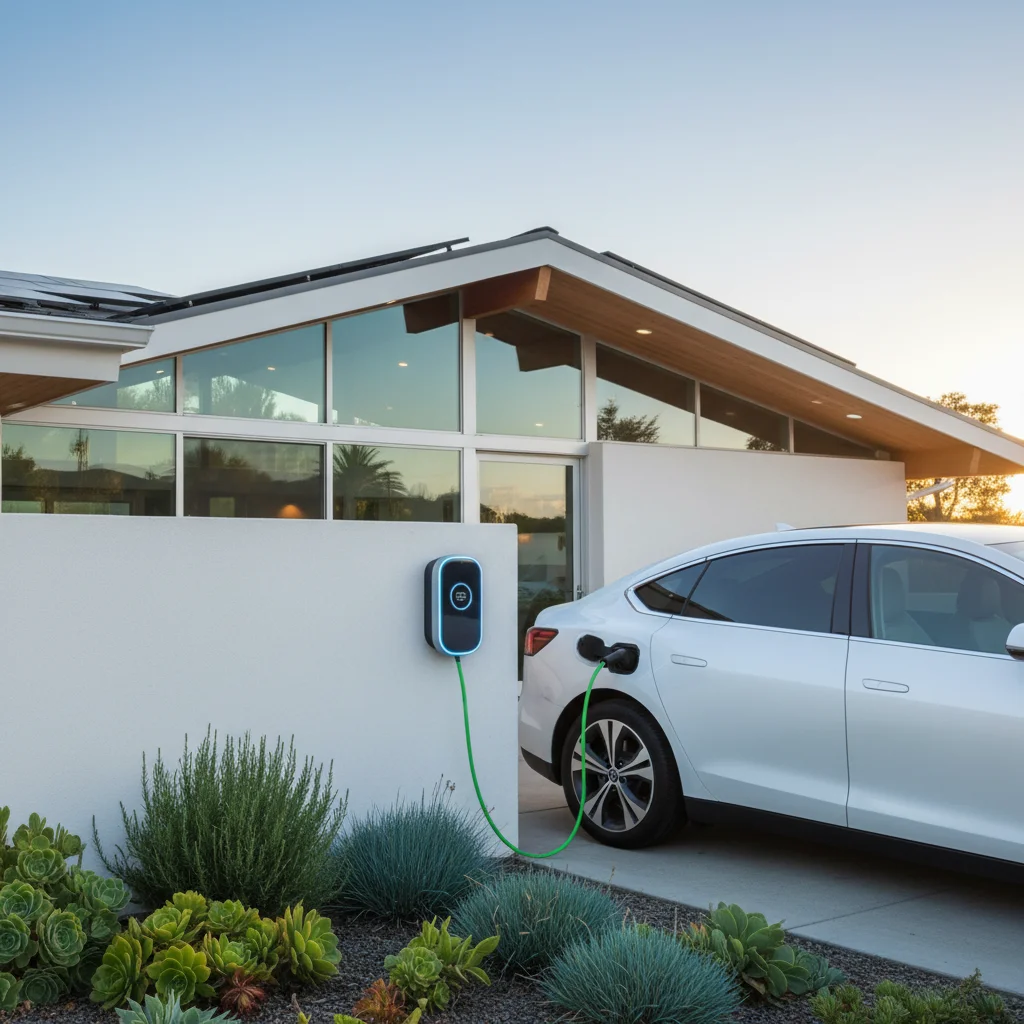
California drivers purchased 329,524 electric vehicles in 2025, creating the largest home charging infrastructure buildout in U.S. history. And the average homeowner who installed a Level 2 EV charger in 2025 spent $1,200-$2,800 on installation alone—but recovered that investment in 18-36 months through fuel savings and rebates that cut installation costs by 40-60%.
How Much Does EV Charger Installation Cost in California?
EV charger installation in California costs $1,200-$2,800 for Level 2 home units in 2026, with equipment adding $400-$900. Total project costs range from $1,600-$3,700 before rebates. Installation complexity—panel upgrades, trenching, permit fees—drives 70% of cost variance. Coastal regions average 15-20% higher labor rates than inland areas.
So what drives the gap between a $1,600 project and a $3,700 one? The answer lies in three cost multipliers: electrical panel capacity, distance from the panel to the charging location, and local permit requirements.
Homeowners with existing 200-amp electrical panels and garage-adjacent parking spend $1,200-$1,600 on installation. But 40% of California homes built before 2000 require panel upgrades costing $1,500-$2,500. And trenching for a charger more than 50 feet from the panel adds $800-$1,400 in materials and labor.
Labor rates vary by region. Bay Area electricians charge $95-$135 per hour, while Central Valley contractors charge $65-$85. A standard 4-6 hour installation runs $260-$810 depending on location. Permit fees add $50-$250 across California jurisdictions.
The charger unit itself costs $400-$900 for residential Level 2 models delivering 7.2-11.5 kW. Budget units like the ChargePoint Home Flex ($449) deliver 32 amps, while premium models like the JuiceBox 48 ($699) provide 40 amps and smart grid integration.
But installation costs drop 30-50% when bundled with solar panel installation or whole-home electrical upgrades, since electricians are already on-site and permits are consolidated.
The federal 30C charger credit ended for chargers placed in service after June 30, 2026 (IRS FS-2025-05).
What's the ROI and Payback Period for Home EV Chargers in California?
Home EV chargers in California deliver 18-36 month payback periods in 2026, driven by $140-$220 monthly fuel cost savings versus gasoline. A driver covering 1,000 miles monthly saves $1,680-$2,640 annually at California's $0.28 per kWh residential rate versus $4.89 per gallon gas. ROI reaches 180-320% over a 10-year ownership period.
California's electricity rates—among the nation's highest at $0.24-$0.38 per kWh depending on utility and tier—still deliver massive savings over gasoline. A Tesla Model 3 consuming 0.26 kWh per mile costs $6.76 to travel 100 miles on electricity, compared to $20.38 for a 30-mpg gas vehicle.
And time-of-use (TOU) rates accelerate payback. PG&E's EV2-A plan charges $0.16 per kWh overnight (midnight-3pm) versus $0.42 during peak hours. Drivers charging exclusively during off-peak windows cut electricity costs 58%, reducing payback to 14-22 months.
Rebates compress payback timelines further. A $2,200 installation receiving a $750 utility rebate and $1,000 federal tax credit nets $450 in upfront costs—recovered in just 3-4 months of fuel savings for most drivers. Learn more about available incentives on our EV charger rebates guide.
Home charging also eliminates public charging station fees averaging $0.43-$0.79 per kWh across California networks. Drivers relying on public fast charging spend $180-$320 monthly versus $70-$110 for home charging, creating additional $1,320-$2,520 in annual savings.
So the ROI calculation isn't just fuel savings—it's avoiding premium public charging rates, capturing off-peak electricity pricing, and stacking multiple rebate programs.
How Does Your Climate Zone Affect EV Charger Installation Costs and Efficiency?
California's 16 climate zones create 8-15% variance in EV charging efficiency and installation costs. Coastal zone 3 (San Francisco) maintains 95-98% battery efficiency year-round, while inland zone 13 (desert regions) experiences 12-18% efficiency loss during 100°F+ summers. Cold-weather battery conditioning in mountain zones adds $80-$140 annually in electricity costs.
Battery chemistry degrades faster in extreme temperatures. Lithium-ion cells in EVs lose 2-3% capacity annually in moderate climates (zones 3, 6, 9) versus 4-7% in desert zones (13, 14, 15) where summer temperatures exceed 105°F regularly.
And cold weather below 40°F reduces battery range 20-40%, forcing more frequent charging cycles. Homeowners in mountain zones (1, 16) consume 15-25% more electricity annually than coastal residents for identical mileage.
But installation costs also vary by climate. Desert zone installations require shade structures ($400-$900) to prevent charger overheating and cable degradation. Coastal installations need corrosion-resistant NEMA 4X-rated enclosures ($150-$300 premium) to withstand salt air exposure.
Climate zone data directly impacts charger sizing decisions. Zone 13-15 homeowners benefit from higher-output 48-amp chargers ($200-$300 premium) to minimize charging time during cooler evening hours, while coastal residents achieve full overnight charging with standard 32-amp units.
Level 2 vs. DC Fast Chargers: Which Alternative Makes Sense for Your Home?
Level 2 chargers deliver 25-44 miles of range per hour at $1,600-$3,700 installed cost, while residential DC fast chargers provide 90-200 miles per hour but cost $12,000-$28,000 installed in 2026. 97% of California homeowners choose Level 2 because overnight charging fully replenishes daily driving needs at one-fifth the equipment and installation cost.
DC fast chargers require three-phase 480V commercial power unavailable in 99% of residential neighborhoods. Installing three-phase service costs $8,000-$15,000 before charger equipment, and most utilities reject residential applications due to grid capacity constraints.
So why do DC fast chargers exist in home contexts? Tesla Powerwall owners with solar arrays sometimes install 50 kW DC units ($18,000-$24,000) to enable rapid mid-day charging from excess solar production, avoiding grid electricity entirely. But this scenario applies to fewer than 2% of California EV owners.
Level 2 chargers meet daily needs for drivers covering under 200 miles daily—98% of California commuters. An 11.5 kW (48-amp) Level 2 unit delivers 44 miles of range per hour, fully charging a 300-mile-range EV in 6.8 hours overnight.
And Level 2 qualifies for rebates that DC units don't. California's Clean Vehicle Rebate Project (CVRP) EV Charging Infrastructure program offers up to $2,000 for Level 2 installations, but excludes residential DC fast chargers due to their commercial classification.
But hybrid approaches exist. Some homeowners install Level 2 at home ($2,200 average) and rely on public DC fast charging networks for road trips, avoiding the $12,000-$28,000 home DC installation entirely.
How Long Do EV Chargers Last and What's the Total Cost of Ownership?
Level 2 EV chargers deliver 10-15 year lifespans in California's climate zones, with total cost of ownership reaching $2,400-$4,900 including installation, electricity, and maintenance. Coastal installations average 12-15 years due to moderate temperatures, while desert zone units last 8-12 years from accelerated UV and heat degradation. Annual maintenance costs run $40-$80 for inspections and connector replacement.
Premium chargers with weatherproof NEMA 4X enclosures and UV-resistant cables outlast budget units by 3-5 years in harsh climates. A $699 JuiceBox 48 with all-weather construction delivers 12-14 years in zone 13, while a $449 basic unit lasts 8-10 years under identical conditions.
And connector wear drives most maintenance costs. The J1772 connector plug experiences 2,500-3,650 insertion cycles during a typical ownership period (one charge daily for 10 years). Replacing worn connectors costs $60-$120 every 4-6 years.
Electricity costs dominate total ownership expense. A driver covering 12,000 miles annually at $0.28 per kWh spends $840-$1,120 yearly on charging. Over 10 years, electricity costs reach $8,400-$11,200—triple the initial equipment and installation investment.
But software-enabled chargers add value through demand response programs. SCE's Charge Ready Home Rebate pays participants $50-$150 annually to shift charging to off-peak hours, reducing net ownership costs $500-$1,500 over a charger's lifetime.
So total cost of ownership calculations should factor in rebates, time-of-use rates, and demand response revenue—not just upfront installation expense. Use our free rebate calculator to model your specific ownership costs.
"California's Self-Generation Incentive Program (SGIP) provides rebates for EV charging systems paired with energy storage, offering $200-$850 per kWh of battery capacity to residential customers." — California Public Utilities Commission
California EV Charger Rebates, Tax Credits, and Incentives Available in 2026
California EV charger installations in 2026 qualify for combined federal, state, and utility incentives worth $1,000-$4,500, reducing net installation costs by 40-75%. The federal 30C charger credit ended for chargers placed in service after June 30, 2026 (IRS FS-2025-05). State and utility programs add $500-$3,500 depending on income, location, and utility service territory.
The federal 30C charger credit ended for chargers placed in service after June 30, 2026 (IRS FS-2025-05). Federal tax credits for this work have ended, but state, local and utility rebates may still apply; check what is available at your address with the DuloCore rebate calculator. And the credit has no income limits, unlike many state programs.
PG&E's EV Charge Network rebate offers $500-$2,500 for residential installations, with higher amounts for low-income households and disadvantaged communities. SCE's Charge Ready Home Rebate provides $1,000 for standard installations and $1,500 for low-income participants, plus free Level 2 charger equipment.
And SDG&E's Power Your Drive program rebates $1,000-$2,000 for home charging installations with smart chargers capable of demand response participation. Income-qualified customers receive priority processing and maximum rebate amounts.
Bay Area Air Quality Management District offers additional $1,500-$2,000 rebates for households in nine-county region, stacking with utility and federal programs. Sacramento Municipal Utility District (SMUD) provides $500-$1,500 rebates plus discounted electricity rates for EV owners.
But rebate funding is first-come, first-served. PG&E's 2026 allocation sold out by March in 2025, forcing applicants to wait for next fiscal year funding. Apply immediately after installation to secure current-year funding.
Income limits apply to enhanced rebate tiers. California defines low-income as 80% of area median income—$66,560 for single-person households in Los Angeles County in 2026. Moderate-income caps reach $99,840 for individuals, qualifying for mid-tier rebates.
Explore all available rebates and estimate your total incentive value using our comprehensive guide to energy tax credits.
Official Sources
- Department of Energy Alternative Fuels Data Center — Federal guidance on EV charging infrastructure, costs, and technical specifications
- Database of State Incentives for Renewables & Efficiency (DSIRE) — Comprehensive database of California EV charger rebates, tax credits, and utility programs updated monthly (note: the federal 25C and 25D credits ended for projects completed after December 31, 2025)
- California Air Resources Board Clean Vehicle Rebate Project — Official portal for California's EV charging infrastructure incentive programs and eligibility requirements
Related Reading: Learn more about Ev Charger Installation Cost and Ev Charger Installation Cost Guide.
Related Reading: Learn more about Ev Charger Installation Cost Bay Area.
Related Reading: Learn more about How Much Does EV Charger Installation Cost in 2026?.
Related Reading: Learn more about Ev Charger Installation Cost Inland Empire.
Frequently Asked Questions
How much does EV charger installation cost in California?
EV charger installation costs $1,200-$2,800 in California for Level 2 home units, with equipment adding $400-$900. Total project costs range from $1,600-$3,700 before rebates. Panel upgrades ($1,500-$2,500) and trenching beyond 50 feet ($800-$1,400) drive costs toward the upper range. Bay Area labor rates run 30-40% higher than Central Valley contractors.
What rebates and incentives are available for EV charger installation in California?
California homeowners access $1,000-$4,500 in combined federal, state, and utility rebates for EV charger installations in 2026. The federal 30C charger credit ended for chargers placed in service after June 30, 2026 (IRS FS-2025-05). PG&E offers $500-$2,500, SCE provides $1,000-$1,500 plus free equipment, and BAAQMD adds $1,500-$2,000 in nine-county region. Low-income households qualify for maximum rebate tiers without income documentation in some programs.
Are there income limits for EV charger installation rebates in California?
Enhanced rebate tiers require income verification at 80% (low-income) or 120% (moderate-income) of area median income. Los Angeles County 2026 limits: $66,560 single low-income, $99,840 moderate-income. Federal tax credit has zero income limits. Standard utility rebate tiers remain available to all income levels. BAAQMD and some municipal programs waive income requirements entirely for baseline rebate amounts.
How long does it take to get an EV charger installed in California?
EV charger installations complete in 4-8 weeks from contractor engagement to final inspection in 2026. Permit approval takes 1-3 weeks, equipment procurement 3-7 days, installation 4-6 hours, and final inspection 1-2 weeks. Panel upgrade projects extend timelines to 6-12 weeks. High-demand seasons (spring, fall) add 2-4 weeks to scheduling. Contractor availability drives most variance.
Can you get a tax credit for installing a Level 2 EV charger at home in California?
Yes. The federal 30C charger credit ended for chargers placed in service after June 30, 2026 (IRS FS-2025-05). No income limits apply. Credit covers equipment and installation labor. State tax credits don't exist in 2026, but utility rebates reduce upfront costs by similar amounts.
Ready to calculate your total EV charger installation savings? Our rebate calculator combines federal tax credits, California state programs, and utility incentives to show your exact net installation cost. Enter your ZIP code, income, and utility provider to see all programs you qualify for—plus estimated payback period based on your driving habits. Get your personalized rebate estimate in under 60 seconds.
Updated: April 14, 2026 — fact-checked by DuloCore Research. About our editorial process.
Check your California EV charger rebate eligibility — see the programs you qualify for and the dollar amounts on our California EV charger rebate finder.