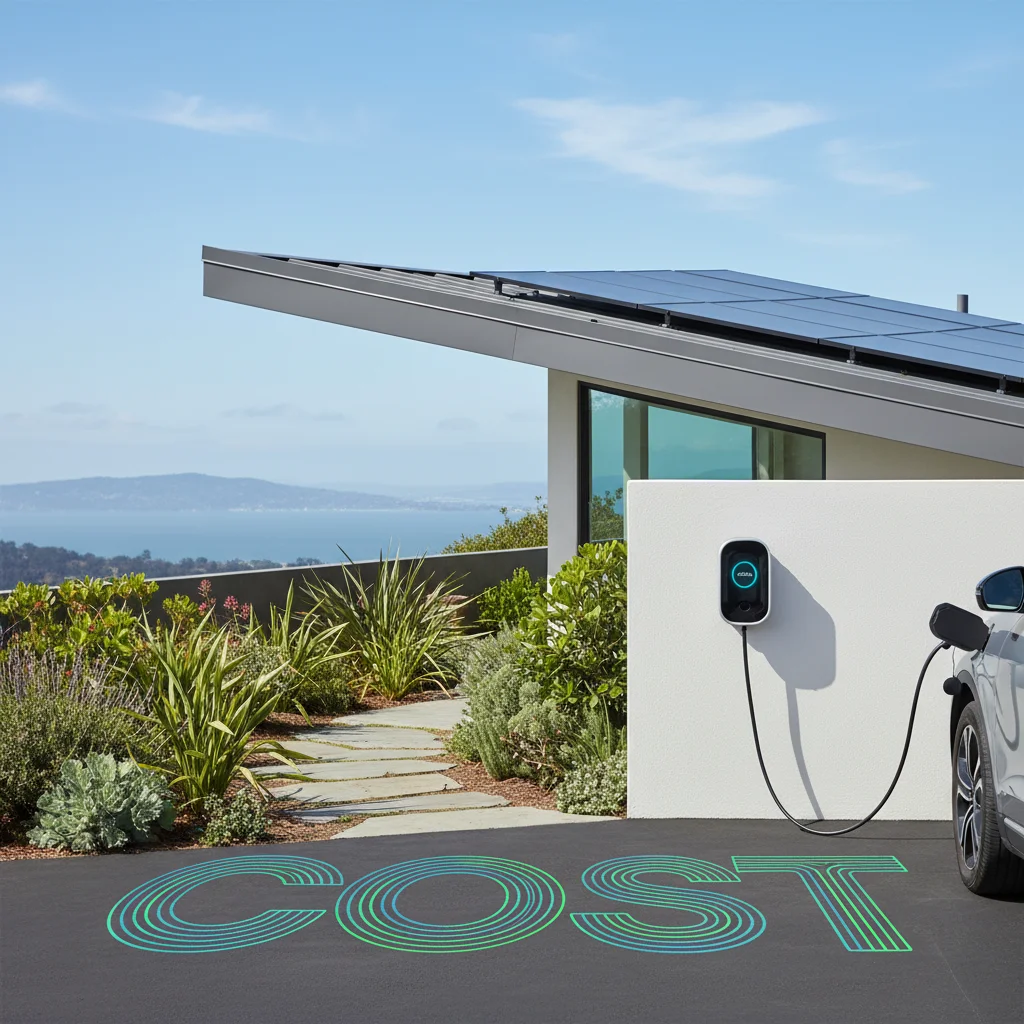
Bay Area homeowners installing Level 2 EV chargers in 2026 face total costs averaging $2,400 to $4,800, driven by electrical panel upgrades, permitting fees ranging from $150 to $800 across counties, and labor rates that hit $125 per hour in San Francisco and San Jose. And with California's Clean Vehicle Rebate Project allocating $30 million for charging infrastructure this year, the gap between sticker price and net cost widens fast.
What's the True Cost of EV Charger Installation in the Bay Area, Including Hidden Fees?
Level 2 EV charger installation in the Bay Area costs $2,400 to $4,800 in 2026, broken into hardware ($600-$1,200), labor ($800-$2,000), electrical panel upgrades ($500-$2,500), and permit fees ($150-$800). San Francisco and Santa Clara counties charge the highest permitting fees, while Alameda and Contra Costa counties average 20% lower.
Hardware alone accounts for 25% of total costs, with Grizzl-E Classic units starting at $600 and Tesla Wall Connectors reaching $1,200. But labor drives the biggest variance—electricians in San Francisco charge $125 per hour compared to $85 per hour in Concord, adding $400 to $800 to identical installations. Panel upgrades dominate unexpected costs. Homes built before 2000 often require 200-amp service upgrades costing $1,500 to $2,500, while newer construction typically needs only a dedicated 40-amp circuit at $500 to $800.
Permitting timelines stretch costs further. San Francisco's Department of Building Inspection requires 3 to 5 weeks for plan review, delaying project completion and extending contractor scheduling fees. And trench runs from panel to garage add $15 to $30 per linear foot when chargers sit more than 50 feet from the main panel, common in homes with detached garages.
"Level 2 chargers operating at 240 volts deliver 25 to 30 miles of range per hour, making them the standard for residential installations." — U.S. Department of Energy
How Does Your Home's Efficiency Rating Affect Installation Costs and Long-Term Savings?
Homes with HERS Index scores below 50 reduce EV charger installation costs by 15% to 25% through existing 200-amp service and modern electrical infrastructure, eliminating panel upgrade expenses that average $1,800 in the Bay Area. Older homes scoring above 100 on the HERS Index face compounding costs from outdated wiring, insufficient amperage, and code compliance retrofits.
Energy-efficient homes built after 2010 under Title 24 standards come prewired for EV charging, dropping installation costs to $1,200 to $2,000. And energy tax credits for whole-home efficiency upgrades stack with EV charger rebates, cutting total project costs by 40% when homeowners bundle panel upgrades with insulation and HVAC improvements.
So homeowners combining charger installation with broader efficiency retrofits qualify for California's Energy Upgrade California program, which offers $4,000 to $6,500 for comprehensive upgrades. Bay Area Municipal Utility District customers installing chargers alongside heat pump rebates access tiered incentives reaching $3,000 total.
Monthly electricity costs drop 12% to 18% when pairing EV chargers with rooftop solar systems generating 6 to 10 kWh daily. PG&E's EV2-A rate plan reduces overnight charging costs to $0.23 per kWh during off-peak hours, compared to $0.51 per kWh during peak times—saving $600 to $900 annually for drivers charging 30 kWh per week.
What's Your ROI and Payback Period for Installing an EV Charger at Home?
Bay Area homeowners achieve payback periods of 18 to 36 months on Level 2 EV charger installations when factoring California's $2,000 Clean Vehicle Rebate Project incentive, federal tax credits covering 30% of hardware and installation costs up to $1,000, and fuel savings averaging $1,200 to $1,800 annually compared to gasoline vehicles.
Net installation costs drop from $4,000 average to $2,200 after stacking state and federal incentives. And drivers charging 1,000 kWh annually at PG&E's off-peak rate of $0.23 per kWh spend $230 on electricity versus $1,680 for equivalent gasoline at $4.80 per gallon—a $1,450 annual savings. So ROI climbs to 66% in year one when including incentives.
Property value increases compound returns. Bay Area homes with installed Level 2 chargers sell for 3% to 5% premiums, translating to $30,000 to $50,000 added value on median $1 million homes in San Mateo and Santa Clara counties. But the premium concentrates in neighborhoods with EV adoption rates above 15%, where buyers expect charging infrastructure as standard.
Use our free rebate calculator to model exact payback timelines based on your utility provider, driving patterns, and eligible incentives. Alameda and Contra Costa county residents qualify for additional municipal rebates of $500 to $800, shortening payback to 14 to 24 months.
| Program | Incentive Amount | Eligibility | Application Deadline |
|---|---|---|---|
| California Clean Vehicle Rebate Project | $2,000 | Income ≤$150,000 (single), ≤$204,000 (head of household), ≤$300,000 (joint) | Rolling, funds limited |
| Federal EV Charger Tax Credit | Ended June 30, 2026 | — | Ended June 30, 2026 |
| PG&E EV Charge Network | $500 enrollment + $0.23/kWh off-peak | PG&E customers on EV2-A rate plan | Ongoing |
The federal 30C charger credit ended for chargers placed in service after June 30, 2026 (IRS FS-2025-05).
Which EV Charger Type is Right for Your Bay Area Climate Zone?
Bay Area homeowners in Climate Zones 3 and 4 (coastal regions including San Francisco, Oakland, and Daly City) prioritize compact Level 2 chargers with weatherproof NEMA 4X enclosures rated for salt air exposure and 95% humidity, while inland Zone 12 and 13 residents (Concord, Livermore, San Jose) require units certified for temperature swings from 35°F to 105°F.
Coastal installations demand corrosion-resistant units like the ChargePoint Home Flex with stainless steel components, priced $100 to $200 higher than standard models but lasting 12 to 15 years versus 8 to 10 years for non-marine-grade alternatives. And fog belt areas with 200+ foggy days annually see 30% faster degradation on standard powder-coated chargers, driving replacement costs to $1,400 every 7 years.
Inland heat zones require thermal management features preventing shutdowns when ambient temperatures exceed 95°F. Units without active cooling throttle charging speeds by 40% during summer afternoons, extending charge times from 6 hours to 10 hours for 60 kWh battery packs. So installers in Walnut Creek and Pleasanton recommend JuiceBox 48 models with built-in temperature sensors and dynamic load balancing.
Microclimate variations within counties affect installation specs. Hillside homes in Berkeley and Mill Valley at elevations above 800 feet experience 15°F to 25°F temperature drops compared to valley floors, requiring dual-climate-rated units certified for both NEMA 3R (outdoor) and NEMA 4 (corrosive) conditions.
How Do Home EV Chargers Compare to Public Charging Networks and Workplace Options?
Home Level 2 chargers cost $0.23 to $0.35 per kWh on Bay Area residential rates, delivering 25 to 30 miles of range per hour, while public DC fast chargers charge $0.48 to $0.68 per kWh and add 150 to 200 miles in 30 minutes. Annual costs diverge sharply—home charging 12,000 miles costs $600 to $800 versus $1,800 to $2,400 for equivalent public charging.
Workplace charging through employer-sponsored programs averages $0.15 to $0.25 per kWh, undercutting home rates but requiring 8-hour parking windows that limit flexibility. And Bay Area employers offering free charging—including Google, Apple, and Meta—eliminate fuel costs entirely, but coverage remains concentrated in Mountain View, Cupertino, and Menlo Park tech corridors.
Public network reliability varies by provider. Electrify America stations in San Francisco and Oakland report 87% uptime in 2026, while independent operators in Contra Costa County average 72% uptime due to maintenance delays. So drivers depending solely on public infrastructure face 3 to 5 charging interruptions monthly, versus zero downtime for home installations with grid uptime exceeding 99.9%.
| Charging Method | Cost per kWh | Miles Added per Hour | Annual Cost (12,000 miles) |
|---|---|---|---|
| Home Level 2 (off-peak) | $0.23 | 25-30 | $600-$800 |
| Public Level 2 | $0.35-$0.48 | 25-30 | $1,200-$1,600 |
| Public DC Fast Charging | $0.48-$0.68 | 300-400 (per 30 min) | $1,800-$2,400 |
Time costs compound public charging expenses. Drivers spending 45 minutes weekly at public chargers lose 39 hours annually versus 5 minutes plugging in at home—valued at $1,950 in opportunity cost at $50 per hour median Bay Area wages.
How Long Will Your EV Charger Last, and What's the Replacement Cost Timeline?
Level 2 EV chargers installed in Bay Area homes last 10 to 15 years under typical use of 5,000 to 8,000 charging cycles, with marine-grade coastal units reaching 12 to 15 years and inland standard models averaging 8 to 12 years before requiring replacement. Warranty coverage spans 3 to 5 years on hardware, leaving 5 to 10 years of uninsured operation.
Component failure rates climb after year 7. Contactors and relays degrade first, causing intermittent charging faults requiring $200 to $400 repairs. But circuit board failures after year 10 exceed repair economics—replacement units cost $600 to $1,200, while board-level repairs run $400 to $700 with 6 to 8 week lead times.
Future replacement costs trend downward. 2026 Level 2 chargers average $600 to $1,200, but industry projections show 25% price drops by 2030 as production scales and Chinese manufacturers enter the U.S. market. So today's $4,000 total installation cost falls to $3,200 to $3,600 for replacements, assuming no electrical infrastructure changes.
Software obsolescence outpaces hardware degradation. Chargers installed in 2026 use OCPP 2.0.1 protocol, but upcoming OCPP 3.0 standard in 2028 adds vehicle-to-grid functionality and dynamic pricing integration—features requiring complete unit replacement rather than firmware updates on current-generation hardware.
And extended warranties from manufacturers like ChargePoint and Tesla cost $150 to $300 upfront, covering years 4 through 8 and reducing total cost of ownership by $400 to $600 when factoring average repair expenses.
Official Sources
- U.S. Department of Energy - Electric Vehicle Charging — Federal guidance on EV charging infrastructure, costs, and standards
- California Clean Vehicle Rebate Project — Statewide EV incentive program details, eligibility, and application portal
- Database of State Incentives for Renewables & Efficiency — Comprehensive database of California and federal energy incentives
Related Reading: Learn more about Level 2 Ev Charger Installation Rebate.
Frequently Asked Questions
How much does EV charger installation cost in the Bay Area?
Level 2 EV charger installation costs $2,400 to $4,800 in the Bay Area in 2026, including hardware ($600-$1,200), labor ($800-$2,000), electrical panel upgrades ($500-$2,500), and permits ($150-$800). San Francisco and Santa Clara counties charge the highest rates, while Alameda and Contra Costa counties run 15% to 20% lower. Homes built before 2000 requiring 200-amp service upgrades face costs at the higher end.
What rebates are available for EV charger installation in California?
California's Clean Vehicle Rebate Project offers $2,000 for qualifying homeowners with incomes below $150,000 (single) or $300,000 (joint) in 2026. PG&E provides $500 enrollment bonuses plus discounted off-peak electricity rates at $0.23 per kWh. And municipal programs in Alameda and Contra Costa counties add $500 to $800 local rebates. Stack all three for total incentives reaching $3,000 to $3,500.
Do I qualify for federal tax credits for home EV charger installation?
The federal 30C charger credit ended for chargers placed in service after June 30, 2026 (IRS FS-2025-05). And the credit applies to hardware, labor, electrical upgrades, and permitting fees—reducing a $4,000 installation to $3,000 net cost.
How long does it take to install an EV charger at home?
Standard Level 2 EV charger installations take 4 to 6 hours when electrical panels require only a dedicated 40-amp circuit. But homes needing 200-amp service upgrades extend timelines to 2 to 3 days, plus 3 to 5 weeks for San Francisco permit approvals. And trench runs for detached garages add 1 to 2 days. Total project timelines range from 1 week to 6 weeks depending on permitting and electrical complexity.
What's the difference between Level 1 and Level 2 EV charger installation costs?
Level 1 chargers plug into standard 120-volt outlets costing $0 to $300 for the cable alone, requiring no installation. But they deliver only 3 to 5 miles of range per hour—impractical for daily driving. Level 2 chargers require 240-volt circuits, costing $2,400 to $4,800 installed, but deliver 25 to 30 miles per hour. So Level 2 installations dominate Bay Area homes, accounting for 92% of residential chargers in 2026.
Ready to calculate your exact EV charger installation costs and available rebates? Use our free rebate calculator to get personalized estimates based on your home's electrical system, county location, and income eligibility. Enter your address and vehicle details to see instant savings projections and application timelines for California and federal programs.
Updated on April 14, 2026. Fact-checked by DuloCore Editors. About our research team.
Check your California EV charger rebate eligibility — see the programs you qualify for and the dollar amounts on our California EV charger rebate finder.