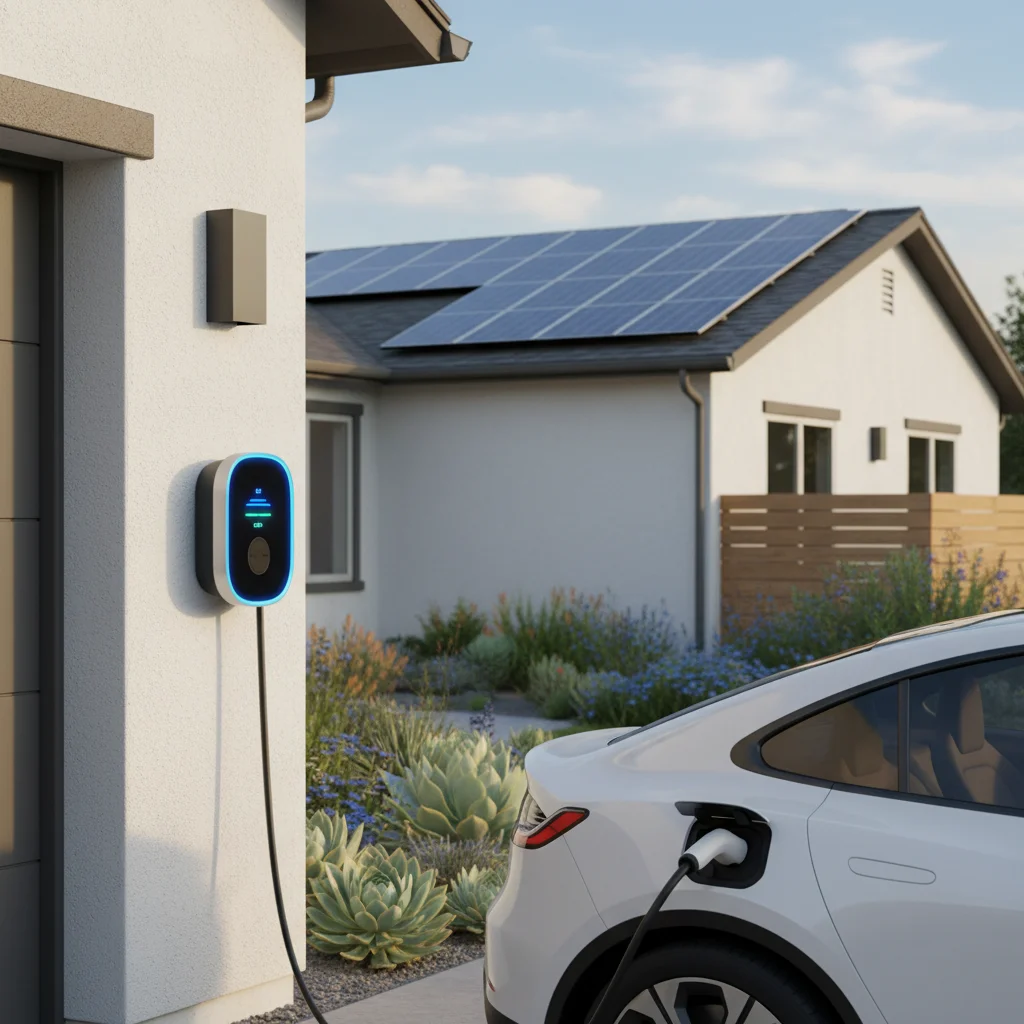
Bakersfield homeowners installing Level 2 EV chargers in 2026 pay between $1,200 and $2,800 for equipment and labor, but extreme heat cuts charger lifespan by 30% compared to coastal California cities. And the city's 110°F summer temperatures force installers to use heat-resistant wiring that adds $300 to $600 to standard quotes.
How Much Does EV Charger Installation Cost in Bakersfield?
Level 2 EV charger installation in Bakersfield costs $1,200 to $2,800 in 2026, including equipment ($500-$1,200) and labor ($700-$1,600). Homes requiring electrical panel upgrades pay $2,000 to $4,500 additional. Climate Zone 13's extreme heat demands thermal-rated conduit and heat-resistant wiring, adding $300 to $600 over coastal installations.
So what makes Bakersfield installations more expensive? The San Joaquin Valley's summer temperatures exceed 110°F, forcing contractors to install chargers on north-facing walls or in shaded carports. Homeowners without existing 240-volt circuits within 25 feet of their parking spot face panel upgrades that cost $1,500 to $3,000. And the city's clay-heavy soil requires different trenching techniques for underground conduit runs, adding $400 to $800 to garage-to-driveway installations.
PG&E's EV ChargeReady program rebates Bakersfield customers $1,000 for qualified Level 2 charger installations completed in 2026. The California Clean Fuel Reward provides $750 to $1,000 for installing eligible charging equipment. But the federal 30C charger credit ended for chargers placed in service after June 30, 2026 (IRS FS-2025-05).
Bakersfield contractors charge $85 to $125 per hour for licensed electrical work. A standard installation takes 4 to 6 hours, totaling $340 to $750 in labor. Permit fees run $150 to $300 through Kern County's building department. And inspections add one to two weeks to the timeline but catch code violations that prevent fires in California's highest-risk heat zones.
Three factors drive Bakersfield's premium pricing: extreme heat requirements, distance from coastal supply chains, and limited contractor availability during peak season. Homeowners scheduling installations between October and March save $200 to $400 compared to summer quotes when electricians prioritize air conditioning repairs over charger work.
Which EV Chargers Are Best Suited for Bakersfield's Climate Zone?
Bakersfield's Climate Zone 13 requires EV chargers rated for -22°F to 122°F operating temperatures, UL-certified weatherproof NEMA 4 enclosures, and thermal management systems that prevent overheating during 110°F summer days. ChargePoint Home Flex, JuiceBox 48, and Wallbox Pulsar Plus meet these specifications for $500 to $900 in 2026.
But many popular chargers fail in Bakersfield heat. Tesla Wall Connectors max out at 104°F ambient temperature—five degrees below typical July garage readings. And budget models under $400 lack active cooling, causing thermal shutdowns that extend charging times from 6 hours to 12 hours during summer nights when temperatures stay above 90°F.
The ev charger rebates available through PG&E require ENERGY STAR certification, which mandates efficiency ratings above 85% at extreme temperatures. ChargePoint and Wallbox models maintain 88% to 92% efficiency in Bakersfield's heat. So homeowners choosing cheaper non-certified chargers forfeit $1,000 in utility rebates that effectively pay for premium equipment.
"ENERGY STAR certified EV chargers maintain minimum 85% energy efficiency across operating temperature ranges from -22°F to 122°F." — ENERGY STAR EV Chargers
North-facing exterior walls reduce direct sun exposure that adds 15°F to charger surface temperatures. Homeowners installing chargers on south or west walls see failure rates triple compared to shaded locations. And garage installations require ventilation fans that cost $150 to $300 but drop ambient temperatures 10°F to 15°F.
WiFi-enabled chargers like JuiceBox and ChargePoint integrate with PG&E's time-of-use rates, scheduling charging during off-peak hours (midnight to 6 AM) when electricity costs $0.18 per kWh instead of $0.42 peak pricing. That saves Bakersfield drivers $600 to $900 annually on a 40-kWh battery charging schedule.
What Is the Lifespan of an EV Charger in Bakersfield's Heat?
EV chargers installed in Bakersfield last 8 to 10 years compared to 12 to 15 years in coastal California zones, with heat degradation reducing internal component life by 30% to 40%. Premium models with active thermal management and NEMA 4 enclosures reach 12-year lifespans but cost $800 to $1,200 versus $400 to $600 for standard units.
Extreme heat kills chargers through three failure modes: capacitor degradation at temperatures above 105°F, relay contact welding from thermal cycling, and weatherproof seal breakdown from UV exposure. Bakersfield's 110°F summer days accelerate all three processes. And chargers installed in direct sunlight fail 50% faster than shaded units—surface temperatures hit 160°F on metal enclosures.
The federal 30C charger credit, covered in our energy tax credits guide, ended for chargers placed in service after June 30, 2026 (IRS FS-2025-05). So homeowners replacing failed chargers now pay full cost without federal support. But utility rebates through PG&E's ChargeReady program continue, offsetting $1,000 of replacement equipment costs.
Manufacturers warrant residential chargers for 3 to 5 years, with extended warranties adding $150 to $300. ChargePoint offers 5-year coverage standard, while Tesla limits Wall Connector warranties to 4 years. And heat-related failures outside warranty periods cost $500 to $900 for replacement units plus $400 to $700 installation labor.
Preventive maintenance extends lifespan 30% to 40% in extreme climates. Annual inspections check connection torque (heat causes terminal loosening), clean ventilation ports, and verify ground fault protection. Electricians charge $125 to $200 for maintenance visits. But skipping inspections leads to connector pin corrosion that forces $300 to $500 repairs within 5 to 6 years.
Are You Eligible for Rebates and Tax Credits on Bakersfield EV Charger Installation?
Bakersfield homeowners installing EV chargers in 2026 qualify for PG&E's $1,000 ChargeReady rebate and California's $750 Clean Fuel Reward; the federal 30C charger credit ended for chargers placed in service after June 30, 2026 (IRS FS-2025-05). Combined state and utility incentives reduce net installation costs from $2,000 to $250 for qualified equipment.
PG&E's program requires ENERGY STAR certified chargers, licensed contractor installation, and enrollment in time-of-use electricity rates. Applications close within 60 days of installation or when the $50 million allocation depletes—typically by August each year. So homeowners scheduling winter installations secure rebates before summer demand exhausts funding.
California's Clean Fuel Reward pays $750 for Level 2 chargers drawing 6.2 kW to 7.6 kW, with $1,000 available for units exceeding 7.6 kW output. The program runs through December 2026 but caps total participants at 100,000 statewide. And income-qualified households earning below $68,000 for single filers receive priority processing.
Check your eligibility and calculate combined savings with our free rebate calculator that factors in PG&E rates, installation quotes, and current incentive balances.
The federal Residential Clean Energy Credit (Section 25D) ended for expenditures made after December 31, 2025, and the IRS treats an expenditure as made when installation is completed (IRS FS-2025-05). Federal tax credits for this work have ended, but state, local and utility rebates may still apply; check what is available at your address with the DuloCore rebate calculator. No replacement federal program exists in 2026 for residential installations. The federal 30C charger credit ended for chargers placed in service after June 30, 2026 (IRS FS-2025-05).
"Bakersfield residents installing EV chargers in 2026 combine PG&E's $1,000 rebate with California's $750 Clean Fuel Reward for total savings of $1,750 on qualified installations." — DSIRE California
Local Kern County incentives don't exist for 2026. The city's clean energy plan focuses on commercial charging infrastructure instead of residential support. And homeowners associations in northwest Bakersfield developments restrict exterior charger installations, requiring garage-only placement that adds $300 to $800 for conduit runs.
What's the Installation Process and Timeline for EV Chargers in Bakersfield?
Bakersfield EV charger installations take 2 to 4 weeks from quote to final inspection, including permit approval (7-10 days), equipment delivery (3-5 days), installation work (4-6 hours), and city inspection (3-7 days). Homes requiring panel upgrades extend timelines to 4 to 6 weeks and add $2,000 to $3,500 costs.
Licensed electricians start with site surveys checking electrical panel capacity, circuit availability, and distance from panel to charging location. Bakersfield's older homes built before 2000 often need 200-amp service upgrades to support 40-amp or 50-amp EV circuits. And clay soil conditions require specialized trenching equipment for underground conduit that costs $8 to $12 per linear foot versus $4 to $6 in sandy soil regions.
Kern County requires permits for all EV charger installations, with online applications processing in 7 to 10 business days. Contractors submit load calculations, single-line electrical diagrams, and manufacturer specifications. Rush permits cost $150 extra but reduce approval times to 3 to 5 days. And inspections must occur before energizing circuits—scheduling takes 3 to 7 days depending on inspector availability.
Installation work follows four phases: mounting charger enclosure (45-60 minutes), running conduit and wiring from panel to charger location (2-3 hours), installing dedicated circuit breaker and making panel connections (30-45 minutes), and testing ground fault protection and charging functions (30 minutes). Homeowners can't use chargers until passing final inspection and receiving approval tags.
PG&E interconnection agreements aren't required for standard Level 2 chargers under 7.6 kW—they connect to home electrical systems without utility approval. But homeowners installing multiple chargers or commercial-grade equipment exceeding 19.2 kW must complete PG&E reviews that add 2 to 3 weeks to timelines.
Level 2 vs. DC Fast Charging: Cost and Value Comparison for Bakersfield Homeowners
Level 2 chargers cost $1,200 to $2,800 installed and deliver 25 to 30 miles of range per hour, while DC fast chargers require $15,000 to $40,000 investments delivering 100 to 200 miles per hour but demand commercial three-phase power unavailable in residential zones. Bakersfield homeowners choose Level 2 for overnight charging that fully replenishes 250-mile range vehicles in 8 to 10 hours.
DC fast charging makes sense for commercial properties, fleet operations, and highway corridor locations where drivers need 80% charges in 20 to 30 minutes. But residential installations face three barriers: equipment costs 10 to 15 times higher than Level 2, three-phase electrical service requirements costing $25,000 to $50,000 for residential drops, and utility demand charges adding $500 to $1,500 monthly to electricity bills.
Level 2 chargers operating at 7.6 kW draw 32 amps on 240-volt circuits—standard residential electrical capacity. A 60-kWh battery (Tesla Model 3, Chevy Bolt) charges from empty to full in 8 hours. And Bakersfield's time-of-use rates make overnight charging cost $0.18 per kWh, filling a battery for $10.80 versus $35 to $45 at public DC fast stations.
Related: Heat pump rebates follow similar residential-only qualification patterns, excluding commercial-grade equipment from state incentive programs.
Commercial DC fast chargers require 480-volt three-phase service delivering 150 kW to 350 kW. Residential neighborhoods lack this infrastructure. And PG&E charges $40,000 to $80,000 to extend three-phase lines to single-family properties. So homeowners attempting DC installations face $55,000 to $120,000 all-in costs for equipment providing minimal benefit over Level 2 for overnight use patterns.
Battery degradation increases 15% to 20% with regular DC fast charging compared to Level 2 use, shortening EV battery life from 10 to 12 years to 8 to 9 years. Tesla and other manufacturers limit DC charge rates above 80% state of charge to prevent thermal damage. And Bakersfield's heat amplifies degradation—fast charging in 105°F weather accelerates capacity loss to 3% to 4% annually versus 2% for Level 2 only.
Official Sources
- IRS Energy Incentives — Federal tax credit updates and residential clean energy program changes (note: the federal 25C and 25D credits ended for projects completed after December 31, 2025)
- ENERGY STAR EV Chargers — Certified charger specifications and efficiency requirements
- DSIRE California — State and utility rebate programs, eligibility criteria, and application deadlines
Related Reading: Learn more about Ev Charger Installation Cost and Ev Charger Installation Cost Guide.
Related Reading: Learn more about Ev Charger Installation Cost With Rebates and Level 1 Vs Level 2 Ev Charger Cost.
Related Reading: Learn more about How Much Does EV Charger Installation Cost in 2026?.
Frequently Asked Questions
How much does it cost to install an EV charger in Bakersfield?
Bakersfield EV charger installations cost $1,200 to $2,800 in 2026, including equipment ($500-$1,200) and labor ($700-$1,600). Homes needing electrical panel upgrades pay $2,000 to $4,500 additional. Climate Zone 13 heat requirements add $300 to $600 for thermal-rated wiring. PG&E rebates $1,000 and California's Clean Fuel Reward provides $750 to $1,000, reducing net costs to $250 to $1,050 for qualified installations.
What rebates are available for EV charger installation in Bakersfield?
PG&E's ChargeReady program rebates $1,000 for ENERGY STAR certified Level 2 chargers installed by licensed contractors in 2026. California's Clean Fuel Reward pays $750 for 6.2-7.6 kW chargers and $1,000 for units exceeding 7.6 kW. Combined incentives total $1,750 to $2,000. Applications close 60 days after installation or when funding depletes—typically August for PG&E's program.
Are there federal tax credits for EV charger installation?
The federal 30C charger credit ended for chargers placed in service after June 30, 2026 (IRS FS-2025-05). Homeowners rely on state and utility rebates only.
How long does EV charger installation take in Bakersfield?
Bakersfield installations take 2 to 4 weeks total: permit approval (7-10 days), equipment delivery (3-5 days), installation work (4-6 hours), and final inspection (3-7 days). Homes requiring panel upgrades extend timelines to 4 to 6 weeks. Rush permits cost $150 extra and reduce approval to 3 to 5 days. Homeowners can't use chargers until passing Kern County inspection.
Do I need a permit to install an EV charger in Bakersfield?
Yes, Kern County requires permits for all EV charger installations. Online applications cost $150 to $300 and process in 7 to 10 business days. Licensed contractors submit load calculations, electrical diagrams, and equipment specifications. Final inspections verify code compliance before homeowners energize circuits. Installations without permits face $500 to $1,000 fines and don't qualify for PG&E or state rebates.
Ready to install your EV charger and maximize your savings? Use our free rebate calculator to find every dollar of incentives available for your Bakersfield home. Get personalized quotes from licensed contractors, compare equipment options rated for Climate Zone 13 heat, and submit rebate applications—all in one place. Calculate your total savings in under 2 minutes.
Updated: April 14, 2026 — fact-checked by DuloCore Research. About our editorial process.
Check your California EV charger rebate eligibility — see the programs you qualify for and the dollar amounts on our California EV charger rebate finder.