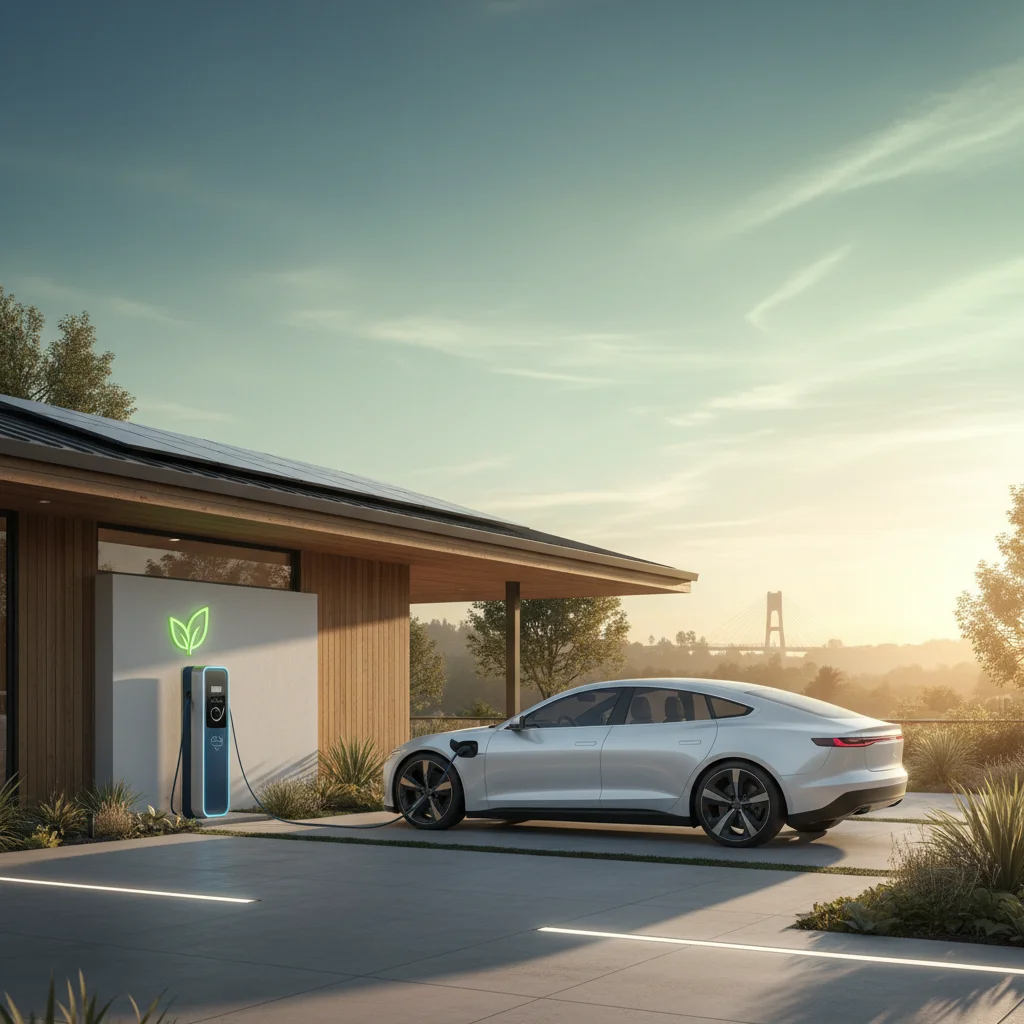
Sacramento drivers installed 14,000 residential Level 2 EV chargers in 2025, and that number is projected to hit 22,000 in 2026 as state rebates combine with federal tax credits to cut installation costs by $3,500 to $7,000. And the city's electrical grid upgrades mean faster permit approvals and lower panel upgrade costs for most neighborhoods.
What Do EV Chargers Cost in Sacramento in 2026? (Complete Price Breakdown)
Level 2 home EV chargers in Sacramento cost $400 to $1,200 for the equipment plus $800 to $2,500 for professional installation. ChargePoint Home Flex units retail at $699, while Tesla Wall Connectors cost $475. Hardwired installations run $200 to $400 more than plug-in models. But SMUD (Sacramento Municipal Utility District) rebates cover up to $500 of equipment costs, and federal IRA Alternative Fuel Infrastructure credits reduce total expenses by 30% with a $1,000 cap. So a complete $2,000 installation drops to $500 after stacking SMUD's rebate and the federal credit.
Which EV Chargers Qualify for California Rebates and Tax Credits?
California's Clean Vehicle Rebate Project (CVRP) doesn't directly rebate chargers in 2026, but SMUD offers $500 rebates for Energy Star-certified Level 2 chargers installed by licensed electricians. The federal 30C charger credit ended for chargers placed in service after June 30, 2026 (IRS FS-2025-05). Federal tax credits for this work have ended, but state, local and utility rebates may still apply; check what is available at your address with the DuloCore rebate calculator. Eligible brands include ChargePoint, JuiceBox, Wallbox Pulsar Plus, and Tesla Wall Connector. And the charger must deliver at least 7.2 kW and include smart features like load management or time-of-use scheduling to qualify for SMUD's program.
How Efficient Are Different EV Charger Models? (Efficiency Ratings Compared)
Level 2 chargers operate at 88% to 94% efficiency, losing 6% to 12% of electricity as heat during AC-to-DC conversion inside the vehicle. ChargePoint Home Flex delivers 11.5 kW at 91% efficiency, adding 37 miles of range per hour to a Tesla Model 3. Wallbox Pulsar Plus runs at 89% efficiency with a 7.6 kW output. So a Tesla Wall Connector at 48 amps and 11.5 kW charges a Chevy Bolt from 20% to 80% in 4.5 hours versus 7 hours for a 7.2 kW unit. But efficiency ratings matter less than amperage, which determines actual charging speed.
| Charger Model | Output (kW) | Efficiency | Miles Added/Hour | Cost |
|---|---|---|---|---|
| ChargePoint Home Flex | 11.5 | 91% | 37 | $699 |
| Tesla Wall Connector | 11.5 | 92% | 38 | $475 |
| Wallbox Pulsar Plus | 7.6 | 89% | 25 | $649 |
| JuiceBox 48 | 11.5 | 90% | 36 | $629 |
Top EV Charger Brands That Work Best in Sacramento's Climate Zone
Sacramento's Climate Zone 12 features summer temps above 100°F and winter lows near 35°F, requiring chargers rated for -22°F to 122°F operation. ChargePoint and Tesla chargers carry NEMA 3R outdoor enclosures that handle dust and rain. Wallbox Pulsar Plus units survive 140°F ambient temps without throttling output. And JuiceBox 48 models include thermal management systems that prevent overheating during July afternoons when garage temps hit 115°F. So outdoor-rated chargers with active cooling outperform budget models that derate power above 104°F, cutting charging speeds by 20% to 30% on peak summer days.
What's the Total Installation Cost for EV Chargers in Sacramento?
Total installation costs run $1,200 to $3,700 depending on electrical panel capacity and charger location. Homes with 200-amp panels and garages within 25 feet of the panel pay $800 to $1,200 for installation. But panel upgrades from 100 amps to 200 amps add $1,800 to $3,000. Trenching for detached garages costs $15 to $25 per linear foot. So a 50-foot run adds $750 to $1,250. SMUD's Time-of-Day rate plan offers $0.09/kWh overnight electricity versus $0.32/kWh peak, and installing a separate meter for the charger cuts annual charging costs by $240 to $400 for drivers charging 1,000 kWh monthly.
How Long Until Your EV Charger Pays for Itself? (ROI & Payback Period)
Home chargers pay back in 2.1 to 3.8 years compared to public DC fast charging at $0.45 to $0.65 per kWh. Sacramento drivers charging a Tesla Model Y (75 kWh battery, 15,000 miles/year) spend $405 annually at SMUD's $0.09/kWh overnight rate versus $1,620 using Electrify America stations. So the $1,215 annual savings covers a $2,500 installation in 2.1 years. And drivers using SMUD's $500 rebate and the $1,000 federal credit reduce net costs to $1,000, hitting breakeven in 10 months. Calculate your savings with our rebate calculator to see exact payback timelines.
EV Chargers vs. Alternatives: Is Home Charging Right for You?
Home Level 2 charging costs $0.09 to $0.16 per kWh versus $0.45 to $0.65 for public DC fast charging and $0.28 to $0.35 for workplace Level 2 stations. Drivers without dedicated parking or those renting apartments rely on public networks, spending $1,400 to $2,100 annually for 15,000 miles. But homeowners with garages save $1,000 to $1,800 per year using overnight charging. And Sacramento's 47 public DC fast chargers can't match the convenience of waking to a full battery daily. So renters in multi-unit buildings see slower ROI unless landlords install shared chargers through SMUD's multi-family rebate program.
How Long Do EV Chargers Last? (Lifespan and Maintenance Requirements)
Quality Level 2 chargers last 10 to 15 years with minimal maintenance beyond annual cable inspections and connector cleaning. ChargePoint units carry 3-year warranties, while Tesla Wall Connectors include 4-year coverage. And firmware updates extend functionality, adding features like load sharing and solar integration. But outdoor installations in Sacramento's high-UV environment degrade cable jackets faster, requiring replacement every 8 to 10 years at $150 to $250. So indoor garage installations outlast outdoor units by 2 to 3 years. Monthly visual checks for frayed cables and loose mounts prevent 90% of failures.
Official Sources
- DOE Alternative Fuels Data Center — Federal guidance on EV charging infrastructure and tax credits (note: the federal 25C and 25D credits ended for projects completed after December 31, 2025)
- ENERGY STAR Certified EV Chargers — List of qualified chargers for utility rebates
- DSIRE USA — Database of state and utility EV incentive programs
Frequently Asked Questions About Sacramento EV Chargers
What EV chargers are eligible for Sacramento rebates in 2026?
SMUD offers $500 rebates for Energy Star-certified Level 2 chargers delivering at least 7.2 kW with smart features like Wi-Fi connectivity or time-of-use scheduling. Eligible models include ChargePoint Home Flex, Wallbox Pulsar Plus, JuiceBox 48, and Tesla Wall Connector. And the charger must be installed by a California-licensed electrician (C-10 license) with a city permit to qualify. Applications open January 2026 with $2.5 million in funding for approximately 5,000 rebates.
How much can you save with Sacramento EV charger rebates?
Homeowners save $1,500 to $2,000 by stacking SMUD's $500 rebate with the federal IRA Alternative Fuel Infrastructure credit covering 30% of costs up to $1,000. So a $2,500 installation (equipment plus labor) drops to $1,000 after both incentives. And SMUD's Time-of-Day rate plan reduces electricity costs by $240 to $400 annually compared to standard residential rates. Learn more about energy tax credits and how to maximize savings.
What is the application process for EV charger rebates in Sacramento?
SMUD customers submit rebate applications online within 90 days of installation with proof of purchase, photos of the installed charger, and a copy of the electrical permit. The utility reviews applications in 4 to 6 weeks and issues rebates via check or bill credit. The federal 30C charger credit ended for chargers placed in service after June 30, 2026 (IRS FS-2025-05). So keep invoices showing equipment costs, labor, and permit fees separately for IRS documentation.
Are there income limits for Sacramento EV charger rebate programs?
SMUD's standard $500 rebate has no income limits, but the Energy Assistance Program Rate (EAPR) adds $200 for households earning below 200% of federal poverty level ($60,000 for a family of four in 2026). Federal IRA credits phase out at $300,000 modified adjusted gross income for joint filers and $150,000 for single filers. So most Sacramento homeowners qualify for both programs. And SMUD reserves 40% of rebate funds for disadvantaged communities identified by CalEnviroScreen 4.0.
Which EV charger brands qualify for California state rebates?
California's 2026 programs prioritize Energy Star-certified chargers from ChargePoint, Wallbox, JuiceBox, Tesla, ClipperCreek, and Grizzl-E. And the charger must support Open Charge Point Protocol (OCPP) for utility load management programs. SMUD requires UL 2594 or UL 2202 safety certifications and Wi-Fi or cellular connectivity for demand response integration. So generic Amazon chargers without smart features don't qualify. Compare options and check eligibility for heat pump rebates and other home efficiency upgrades.
Ready to install a home EV charger? Use our free rebate calculator to find every federal, state, and utility incentive you qualify for in Sacramento. Get your personalized savings report in 60 seconds.
Last updated: April 14, 2026. Reviewed by the DuloCore Editorial Team. About our authors.
Check your California EV charger rebate eligibility — see the programs you qualify for and the dollar amounts on our California EV charger rebate finder.