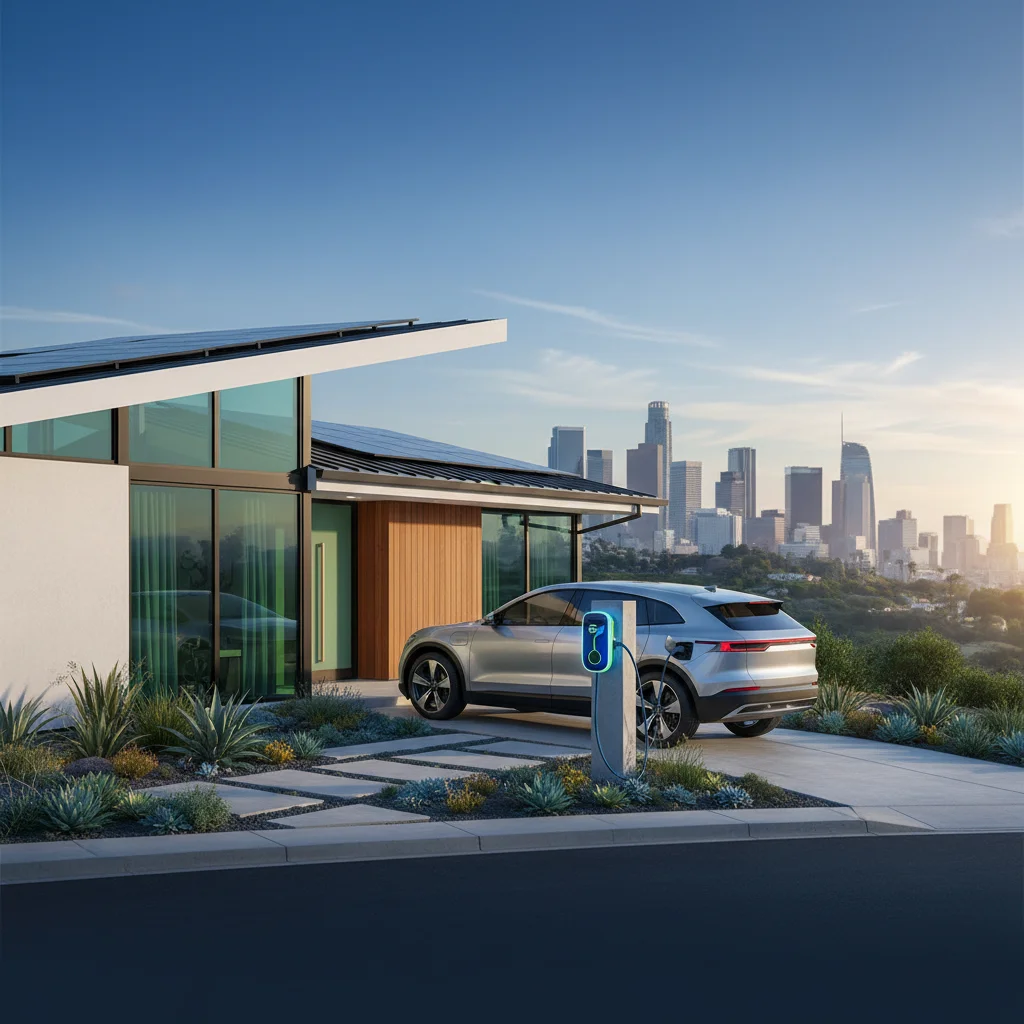
Los Angeles just crossed 200,000 registered electric vehicles in March 2026, and the city's aging electrical grid isn't keeping pace. During last summer's heat wave, Level 2 chargers in the San Fernando Valley took 40% longer to charge vehicles when temperatures hit 105°F. And the California Energy Commission projects that 1.2 million EVs will be on LA roads by 2028, creating a charging infrastructure crisis that homeowners are solving with private installations.
What's the True ROI and Payback Period for Installing an EV Charger in Los Angeles in 2026?
Residential EV charger installations in Los Angeles cost $800 to $2,500 depending on electrical panel capacity and distance from the garage. Homeowners who charge overnight during off-peak hours (9 PM to 8 AM) save $1,200 to $1,800 annually compared to public charging stations. And the average payback period is 14 to 22 months when factoring in the $1,000 California Clean Fuel Reward and federal IRA credits. So a Level 2 charger paying for itself in under two years makes financial sense for drivers who cover more than 12,000 miles annually.
But the math changes dramatically based on time-of-use electricity rates. LADWP's EV rate plan cuts electricity costs to $0.09 per kWh overnight, down from $0.32 during peak hours. A driver charging a Tesla Model 3 (75 kWh battery) once weekly saves $840 annually by shifting to overnight charging. And SCE customers in the Valley and West LA see even steeper savings of $1,100 per year with the TOU-D-PRIME rate.
Installation costs vary by $700 to $1,200 depending on whether the electrical panel needs a 240V circuit upgrade. Homes built before 2010 typically require panel upgrades costing $1,500 to $2,200. So total upfront costs range from $2,300 to $4,700 before rebates. But newer construction in areas like Playa Vista and Downtown LA often has EV-ready wiring that drops installation to $800 to $1,200.
How Does Los Angeles Climate and Geography Affect EV Charger Performance and Lifespan?
Los Angeles experiences 284 sunny days per year with summer temperatures reaching 95°F to 110°F in the Valley, which degrades charger electronics and reduces charging speeds by 15% to 25% during heat waves. Coastal neighborhoods like Santa Monica and Manhattan Beach see salt air corrosion that shortens charger lifespan by 2 to 3 years unless homeowners install NEMA 3R or 4X rated enclosures. And wildfire smoke during September and October clogs cooling vents in outdoor chargers, causing thermal shutdowns that extend charge times from 8 hours to 12 hours.
Chargers installed in direct sunlight without shade structures experience internal temperatures of 130°F to 150°F, which triggers thermal throttling that reduces output from 48 amps to 32 amps. So a ChargePoint Home Flex that normally delivers 50 miles of range per hour drops to 34 miles per hour when overheated. And manufacturers like JuiceBox and Grizzl-E recommend installing chargers on north-facing walls or under roof overhangs to maintain full output.
Humidity isn't a concern in most of LA, but coastal fog in Malibu and Pacific Palisades creates condensation inside non-sealed units. Chargers with IP65 ratings or higher prevent moisture damage that causes ground fault errors. And earthquake-prone areas require flexible conduit installation instead of rigid metal conduit to prevent electrical disconnection during seismic events rated 4.5 or higher.
Best EV Chargers for Los Angeles vs. Tesla Superchargers and Other Alternatives—Which Saves You the Most?
Home Level 2 chargers cost $0.09 to $0.32 per kWh depending on time-of-use rates, while Tesla Superchargers charge $0.48 to $0.61 per kWh at LA-area stations during peak hours. A driver charging a 75 kWh battery twice monthly at home spends $27 to $96 per month, compared to $144 to $183 at Superchargers. So home charging saves $1,176 to $2,232 annually, making the $1,800 average installation cost recover in 9 to 18 months.
But Superchargers deliver 200 miles of range in 15 minutes, while home Level 2 chargers add 25 to 35 miles per hour. And public Level 2 stations at grocery stores and shopping centers charge $0.20 to $0.35 per kWh with 4-hour parking limits that don't suit overnight charging needs. So the convenience factor of home charging eliminates 45 to 60 minutes of weekly charging stops.
DC fast chargers for home installation cost $12,000 to $28,000 and require three-phase electrical service that's unavailable in 94% of LA residences. And Electrify America stations charge $0.43 to $0.53 per kWh with session fees of $1 to $3, making them 370% more expensive than home charging over a year. So Level 2 home chargers remain the most cost-effective option for daily charging needs.
How Long Do EV Chargers Last and What's the Real Cost of Replacement?
Quality Level 2 chargers last 8 to 12 years with minimal maintenance, but outdoor units in high-heat areas like the Valley see failure rates of 12% to 18% after 6 years. ChargePoint and JuiceBox offer 3-year warranties that cover electronics failures, while budget brands like Amazon Basics provide only 1-year coverage. And replacement costs range from $700 to $1,400 for mid-tier chargers, plus $200 to $400 for electrician labor to swap units.
Cable wear is the most common failure point, with plug connectors degrading after 1,500 to 2,000 charge cycles. A driver charging 4 times weekly hits that threshold in 7 to 10 years. And UV exposure in uncovered installations causes cable jacket cracking that exposes copper wiring within 5 to 6 years. So cable replacement costs $150 to $280 every 5 years for outdoor units.
Internal relay failures spike after 40,000 to 50,000 charge cycles for high-use households with multiple EVs. And power surges from grid fluctuations during summer strain damage circuit boards in 8% to 14% of installations annually. So installing a whole-home surge protector costing $300 to $600 prevents $1,200 to $1,800 in charger replacements.
What Financial Incentives and Rebates Are Available in Los Angeles Right Now?
The California Clean Fuel Reward provides $1,000 instant rebates at the point of purchase for Level 2 chargers in 2026, stackable with federal IRA tax credits covering 30% of installation costs up to $1,000. And LADWP customers qualify for an additional $500 rebate through the Charge Up LA program, bringing total incentives to $2,500 for installations completed by December 31, 2026. So a $1,800 charger installation nets $700 to $1,300 in savings after rebates.
But income limits apply to some programs—households earning above $150,000 annually don't qualify for LADWP's $500 rebate, while the Clean Fuel Reward has no income cap. And SCE offers $800 rebates for customers who install chargers and enroll in time-of-use rates, but the rebate requires maintaining the rate plan for 24 consecutive months.
The federal 30C charger credit ended for chargers placed in service after June 30, 2026 (IRS FS-2025-05).
Local air quality management districts in LA County provide $300 to $600 additional rebates for installations in disadvantaged communities identified by CalEnviroScreen 4.0. And multifamily properties qualify for $5,000 per charger through the CALeVIP program when installing shared charging infrastructure.
Use our free rebate calculator to find your exact savings based on your zip code and household income.
Step-by-Step Installation Process and Timeline for Los Angeles Homes
Permit applications through the LA Department of Building and Safety take 3 to 7 business days for online submissions, with inspection scheduling adding another 5 to 10 days. Electricians complete installations in 4 to 8 hours for homes with existing 240V circuits, or 2 to 3 days when panel upgrades are required. And final inspections add 3 to 5 days to the timeline, bringing total installation duration to 2 to 4 weeks from permit filing to operational charger.
Step 1 involves hiring a licensed C-10 electrician who submits permit applications electronically through the LADBS portal. And permits cost $75 to $150 depending on installation complexity and whether panel upgrades are needed. So budgeting $125 for permits prevents surprise costs.
Step 2 requires an electrical load calculation to determine if the existing panel supports an additional 40-amp to 50-amp circuit. Homes with 100-amp panels typically need upgrades to 200-amp service costing $1,800 to $2,500. And the electrician runs 6-gauge or 8-gauge wire from the panel to the charger location, with conduit installation adding $3 to $7 per linear foot.
Step 3 includes mounting the charger and connecting it to the dedicated circuit breaker. And the electrician tests ground fault protection and verifies amperage output matches the charger's specifications. So installations in garages with existing 240V outlets take 2 to 4 hours, while new circuit runs from the panel require 6 to 8 hours.
Step 4 involves the final inspection where LADBS inspectors verify code compliance and proper grounding. And inspectors flag common violations like missing GFCI protection or improper conduit seals that delay approval by 3 to 5 days. So hiring electricians familiar with LA code requirements prevents re-inspection fees of $75 to $100.
Official Sources
- U.S. Department of Energy: EV Charging — Federal energy efficiency guidance and EV charging incentives
- DSIRE USA: California EV Incentives — Comprehensive database of state and local EV rebates and tax credits (note: the federal 25C and 25D credits ended for projects completed after December 31, 2025)
Frequently Asked Questions
What are the best EV chargers available in Los Angeles in 2026?
ChargePoint Home Flex, JuiceBox 48, and Grizzl-E Classic lead residential installations in LA, with ChargePoint offering WiFi connectivity and scheduling features, JuiceBox providing 48-amp output for faster charging, and Grizzl-E delivering ruggedized construction for outdoor Valley installations. And Tesla Wall Connector works for all EVs using J1772 adapters, not just Tesla vehicles. Prices range from $595 for Grizzl-E to $749 for ChargePoint Home Flex.
How much does it cost to install an EV charger in Los Angeles?
Installation costs range from $800 to $2,500 depending on electrical panel capacity and garage location, with panel upgrades adding $1,500 to $2,200 for homes built before 2010. And permit fees through LADBS run $75 to $150, while electrician labor costs $85 to $125 per hour for 4 to 8 hours of work. So total upfront costs before rebates average $1,800 to $3,200 for standard installations.
Are there rebates or incentives for installing an EV charger in Los Angeles?
The California Clean Fuel Reward provides $1,000 instant rebates. The federal 30C charger credit ended for chargers placed in service after June 30, 2026 (IRS FS-2025-05). And LADWP customers receive an additional $500 through Charge Up LA, with SCE offering $800 for time-of-use rate enrollment. So combined incentives reach $2,500, reducing net installation costs by 55% to 70% for most homeowners.
How long does it take to install a home EV charger in Los Angeles?
Permit processing through LADBS takes 3 to 7 business days, followed by 5 to 10 days for inspection scheduling. And electrician installation requires 4 to 8 hours for homes with existing 240V circuits, or 2 to 3 days when panel upgrades are needed. So total timeline from permit filing to operational charger spans 2 to 4 weeks, with rush permits available for $200 to $350 additional fees.
What is the difference between Level 2 and DC fast chargers for home use?
Level 2 chargers operate on 240V circuits and deliver 25 to 35 miles of range per hour at costs of $0.09 to $0.32 per kWh, while DC fast chargers require three-phase power and cost $12,000 to $28,000 to install. And DC chargers add 200 miles in 30 minutes but aren't practical for residential use since 94% of LA homes lack three-phase electrical service. So Level 2 chargers meet overnight charging needs for 98% of daily driving.
Ready to find out how much you can save? Use our rebate calculator to get personalized estimates for federal, state, and local EV charger incentives based on your Los Angeles zip code and income level. Calculate your savings in under 60 seconds and start your installation with confidence.
Updated on April 14, 2026. Fact-checked by DuloCore Editors. About our research team.
Check your California EV charger rebate eligibility — see the programs you qualify for and the dollar amounts on our California EV charger rebate finder.