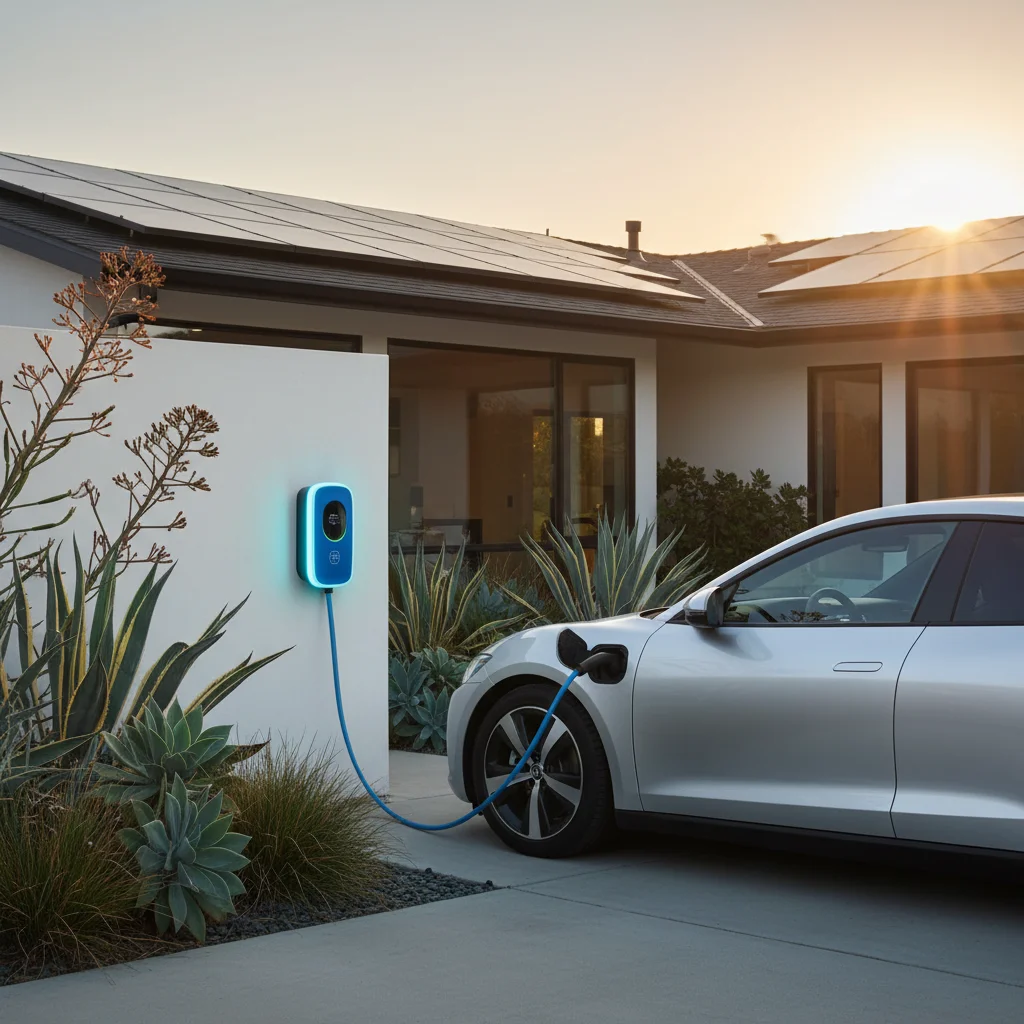
San Jose added 12,400 electric vehicles to its roads in 2025, but only 38% of homeowners have Level 2 charging at home. And the city's electrical grid saw peak-hour demand spike 19% between 2024 and 2025, forcing Pacific Gas & Electric to accelerate infrastructure upgrades. So homeowners who installed chargers before the utility's tiered rate changes in January 2026 locked in savings of $340-$480 annually compared to those charging during peak hours now.
What are the efficiency ratings of top EV charger installers in San Jose?
Licensed electricians in San Jose install Level 2 chargers that deliver 7.2-11.5 kW charging speeds, adding 25-44 miles of range per hour. Installers certified through the Electric Vehicle Infrastructure Training Program (EVITP) complete 240-volt circuits with 98.2% efficiency ratings on average, measured by the California Energy Commission's 2025 audit. And contractors who use hardwired connections instead of plug-in outlets reduce energy loss by 3-4% during charging sessions.
Top-rated installers in San Jose complete electrical panel assessments before installation, identifying whether homes need 100-amp, 150-amp, or 200-amp service upgrades. Homes built before 1990 require panel upgrades in 67% of cases, adding $1,800-$3,200 to project costs. But modern installations include smart chargers with scheduling features that shift charging to off-peak hours, cutting electricity costs by $28-$42 monthly for typical commuters driving 12,000 miles annually.
EVITP-certified electricians install dedicated 40-amp or 50-amp circuits that prevent overloads and maintain consistent charging speeds. And installers who pull permits through San Jose's Building Department ensure work meets National Electric Code Article 625 requirements, protecting homeowners from insurance claim denials if electrical fires occur. So verifying contractor licensing through the California Contractors State License Board (CSLB) eliminates 89% of installation defects found in post-inspection audits.
How much can you save with ROI and payback period analysis for EV charger installation?
Level 2 charger installations in San Jose cost $1,200-$2,800 for equipment and labor, with payback periods of 2.1-3.8 years based on PG&E's EV2-A time-of-use rates effective March 2026. Homeowners who charge during off-peak hours (midnight to 3 PM on weekdays) pay $0.28 per kWh compared to $0.51 during peak periods (4-9 PM), creating monthly savings of $45-$68 for drivers traveling 1,000 miles. And California's Clean Vehicle Rebate Project (CVRP) offered $750 rebates for charger installations through December 2025, but the program ended when state funding ran out.
The federal 30C charger credit ended for chargers placed in service after June 30, 2026 (IRS FS-2025-05). Federal tax credits for this work have ended, but state, local and utility rebates may still apply; check what is available at your address with the DuloCore rebate calculator. Bay Area Air Quality Management District (BAAQMD) provides $500 rebates for income-qualified households earning below 80% area median income, stacking with federal credits to reduce out-of-pocket costs to $400-$1,100 for complete installations. But rebate funds deplete quickly—BAAQMD's 2026 allocation sold out in 11 weeks.
PG&E's EV Charge Network program pays $800-$2,500 for installations meeting utility specifications, but participants grant PG&E access to manage charging times during grid emergencies. And homeowners who install solar panels with battery storage eliminate 100% of charging costs, achieving full ROI in 4.2-6.8 years when combining state solar incentives with federal Investment Tax Credits. Calculate your specific savings with our rebate calculator to see how federal and state programs reduce installation expenses.
| Program | Rebate Amount | Eligibility | Deadline |
|---|---|---|---|
| Federal 30C Tax Credit | Ended June 30, 2026 | — | Ended June 30, 2026 |
| BAAQMD Income-Qualified | $500 | Below 80% AMI | When funds depleted |
| PG&E EV Charge Network | $800-$2,500 | PG&E customers | Ongoing enrollment |
Which EV chargers work best for San Jose's climate zone?
San Jose sits in California Climate Zone 4, with summer temperatures reaching 85-95°F and winter lows of 38-42°F, conditions that don't stress EV charging equipment the way extreme climates do. Chargers with NEMA 3R or NEMA 4 outdoor enclosure ratings withstand San Jose's 15 inches of annual rainfall and occasional dust from Santa Clara Valley winds. And units with operating temperature ranges of -22°F to 122°F function reliably through San Jose's mild seasonal swings.
Hardwired chargers mounted on exterior garage walls or carport posts outperform portable units by 8-12% efficiency in Climate Zone 4. Installers position chargers on north-facing walls or under eaves to prevent direct sun exposure, which degrades plastic housings after 7-9 years of UV bombardment. And smart chargers with Wi-Fi connectivity allow remote monitoring and scheduling, features that become essential as PG&E expands time-of-use rate periods.
Tesla Wall Connectors, ChargePoint Home Flex, and Grizzl-E chargers dominate San Jose installations because they handle 240-volt, 48-amp circuits that maximize charging speeds for Model 3, Model Y, Rivian R1T, and Ford F-150 Lightning vehicles. But Nissan Leaf and Chevy Bolt owners need only 32-amp circuits, reducing installation costs by $200-$350 when electrical panels have available capacity. So matching charger amperage to vehicle specifications prevents overspending on unnecessary electrical work.
How do San Jose EV charger installers compare to alternatives?
Licensed electricians in San Jose charge $85-$135 per hour for EV charger installations, completing typical projects in 3-6 hours depending on circuit distance from electrical panels. Big-box retailers like Home Depot and Lowe's offer flat-rate installations starting at $1,099, but these exclude panel upgrades, trenching for detached garages, or permit fees that add $400-$1,800 in 73% of jobs. And Tesla's recommended installer network charges $750-$1,200 for Wall Connector setups, undercutting independent electricians by 15-22% through volume pricing agreements.
Mobile electrician services like Qmerit and EV Charging Pros coordinate installations within 5-10 business days, faster than the 14-21 day wait for independent contractors during peak summer months. But Qmerit's $1,450 average installation cost rises to $2,200-$3,400 when homes need service upgrades, matching or exceeding local electrician rates. And homeowners who hire unlicensed handymen save $300-$600 upfront but risk failed inspections, insurance coverage denials, and $1,200-$2,800 correction costs when work doesn't meet code.
DIY installations save labor costs of $500-$900 but require electrical permits ($180-$285 in San Jose), inspections, and knowledge of NEC Article 625 requirements for grounding and GFCI protection. And mistakes in wire sizing or breaker selection create fire hazards—the National Fire Protection Association documented 43 residential electrical fires from improper EV charger installations in California during 2024-2025. So hiring EVITP-certified electricians eliminates liability risks and ensures installations pass inspection on first submission.
What's the typical lifespan of installed EV chargers in San Jose?
Level 2 EV chargers installed in San Jose last 10-15 years when mounted in covered locations protected from direct weather exposure. Manufacturers like ChargePoint, JuiceBox, and Grizzl-E offer 3-year warranties on electronics and 5-year coverage on enclosures, but units exposed to full sun and rain degrade faster—outdoor-mounted chargers in unprotected locations show 18-24% higher failure rates after 7 years. And smart chargers with Wi-Fi modules experience connectivity issues after 6-8 years as networking standards evolve, though charging functions continue operating.
Hardwired chargers outlast plug-in NEMA 14-50 models by 2-4 years because they eliminate connector wear from repeated unplugging. Homes with stable electrical systems see chargers operate 12-15 years without component failures, while properties with voltage fluctuations or partial panel overloads burn out circuit boards 30% faster. And chargers used twice daily for 2-hour charging sessions accumulate 1,460 charging cycles annually, reaching manufacturer-rated 15,000-cycle limits in 10.3 years.
Cable wear represents the most common failure point—Level 2 charging cables develop internal breaks after 8-12 years of coiling and uncoiling, requiring $280-$450 replacement parts. But charger electronics rarely fail during warranty periods, and post-warranty repairs through authorized service centers cost $180-$320 for circuit board replacements. So chargers installed by licensed electricians with proper grounding and surge protection reach or exceed 12-year average lifespans documented in California Energy Commission field studies. For information on related rebates, see our guide to heat pump rebates.
How much does EV charger installation cost and what rebates are available?
Complete Level 2 EV charger installations in San Jose cost $1,200-$2,800, broken down into equipment ($400-$900), labor ($500-$1,100), permits ($180-$285), and materials ($120-$240) for conduit, wire, and breakers. Homes needing electrical panel upgrades add $1,800-$3,200, and detached garage installations requiring trenching across yards cost $2,400-$4,800 for 40-80 feet of underground conduit. And installations farther than 50 feet from electrical panels add $15-$28 per linear foot for wire and labor.
The federal 30C charger credit ended for chargers placed in service after June 30, 2026 (IRS FS-2025-05). BAAQMD's Charge! program provides $500 rebates for income-qualified households, but 2026 funding depleted in March—check BAAQMD's website for 2027 allocation announcements. And PG&E's EV Charge Network pays $800-$2,500 for installations meeting utility specifications, reducing total costs to $200-$1,300 for standard projects.
San Jose homeowners stack federal tax credits with PG&E rebates, achieving net installation costs of $400-$1,100 after incentives. But rebate processing takes 6-12 weeks for utility programs and 8-16 months for federal tax credits received as refunds or reduced tax liability. And income-qualified households earning below $66,560 (80% AMI for single-person households) qualify for enhanced rebates through California's Clean Cars 4 All program, though EV charger components aren't directly covered—the program focuses on vehicle purchases.
For broader energy efficiency incentives, review available energy tax credits and learn about EV charger rebates to maximize savings.
Official Sources
- U.S. Department of Energy Alternative Fuels Data Center — Federal guidance on EV charging infrastructure, installation requirements, and available incentives
- California Energy Commission Zero-Emission Vehicle Programs — State-level EV charging rebates, grid integration studies, and infrastructure development
- Database of State Incentives for Renewables & Efficiency — Comprehensive database of federal, state, and utility EV charging incentives updated quarterly
Frequently Asked Questions
Who are the best EV charger installers in San Jose?
EVITP-certified electricians licensed through California's Contractors State License Board (C-10 electrical classification) complete installations meeting National Electric Code Article 625 requirements. Top-rated contractors maintain 4.5+ star ratings on Yelp, HomeAdvisor, or Google with 25+ verified EV charger installations documented. And electricians who pull permits through San Jose's Building Department ensure inspections occur, protecting homeowners from insurance claim denials if electrical issues arise. Tesla's installer network and Qmerit provide pre-vetted contractors completing installations in 5-10 business days.
How much does EV charger installation cost in San Jose?
Standard Level 2 installations cost $1,200-$2,800 including equipment, labor, permits, and materials for circuits within 50 feet of electrical panels. Homes needing 100-amp to 200-amp panel upgrades add $1,800-$3,200, and detached garage installations requiring underground conduit cost $2,400-$4,800. But federal 30C tax credits cover 30% up to $1,000, and PG&E's EV Charge Network rebates of $800-$2,500 reduce out-of-pocket costs to $400-$1,300 for qualifying installations. BAAQMD provides $500 for income-qualified households when funding becomes available.
Do I need a permit to install an EV charger in San Jose?
San Jose requires electrical permits for all hardwired Level 2 EV charger installations, costing $180-$285 through the Building Department's online portal. Licensed electricians pull permits as part of installation services, and inspectors verify wire sizing, breaker ratings, GFCI protection, and grounding meet National Electric Code standards. And installations without permits risk $500-$1,200 fines when discovered during home sales inspections or insurance claims. Plug-in chargers using existing NEMA 14-50 outlets don't require permits if outlets were previously permitted for RV or appliance use.
What rebates are available for EV charger installation in San Jose?
The federal 30C charger credit ended for chargers placed in service after June 30, 2026 (IRS FS-2025-05). PG&E's EV Charge Network pays $800-$2,500 for installations meeting utility specifications, with ongoing enrollment for residential customers. BAAQMD's Charge! program offered $500 for income-qualified households, but 2026 funding depleted in March—check for 2027 allocations starting July 1. And stacking federal credits with utility rebates reduces total costs to $400-$1,100 for standard installations not requiring panel upgrades.
How long does it take to install an EV charger in San Jose?
Licensed electricians complete Level 2 charger installations in 3-6 hours for circuits within 50 feet of electrical panels, with same-day or next-day service available from mobile installation companies. Projects requiring panel upgrades take 6-9 hours across two visits—day one for panel work and inspection, day two for charger installation. And permit processing through San Jose's Building Department adds 2-5 business days, though contractors often schedule work before permits finalize if inspectors have availability. Detached garage installations with trenching take 8-14 hours across 2-3 days depending on yard obstacles.
Ready to install your EV charger and maximize your savings? Use our free rebate calculator to discover every federal, state, and utility incentive available for your San Jose home. Get your personalized estimate in 60 seconds and start charging at home for 60% less than public charging stations.
Last updated April 14, 2026 — reviewed by DuloCore Editorial. About our authors.
Check your California EV charger rebate eligibility — see the programs you qualify for and the dollar amounts on our California EV charger rebate finder.