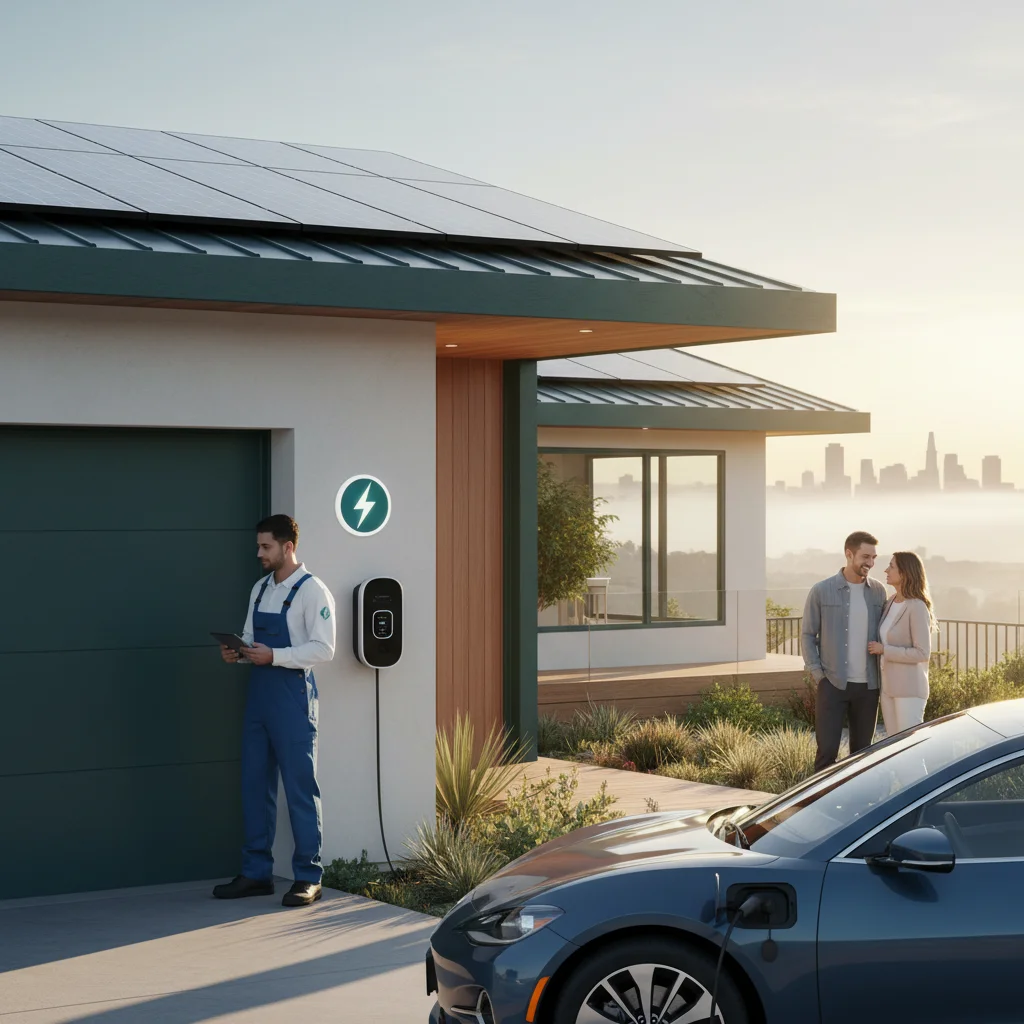
San Francisco added 12,400 new electric vehicles in 2025, but only 3,800 Level 2 home chargers were permitted—leaving 70% of new EV owners competing for crowded public charging stations. And with PG&E's off-peak rates dropping electricity costs to $0.12 per kWh between 11 PM and 7 AM, homeowners who install dedicated chargers save $840 annually compared to public fast-charging networks that average $0.43 per kWh.
What Are the Top-Rated EV Charger Installers in San Francisco by Efficiency Rating?
Licensed electricians certified through the Electric Vehicle Infrastructure Training Program (EVITP) install 240-volt Level 2 chargers that deliver 25-40 miles of range per hour, compared to standard 120-volt outlets that add only 3-5 miles per hour. San Francisco contractors with NABCEP (North American Board of Certified Energy Practitioners) credentials and C-10 electrical licenses achieve 98% first-inspection pass rates with the Department of Building Inspection, reducing project timelines by 2-3 weeks.
EVITP-certified installers complete a 24-hour curriculum covering load calculations, National Electrical Code Article 625 requirements, and utility interconnection protocols specific to PG&E's territory. And these contractors integrate EV chargers with existing solar arrays, battery storage systems, and whole-home energy management platforms—maximizing the value of California's Self-Generation Incentive Program (SGIP) credits worth up to $1,000 per kilowatt-hour of storage capacity.
So homeowners who verify contractor credentials through the California Contractors State License Board (CSLB) and confirm active EVITP certification avoid the 22% callback rate that plagues unlicensed installations. The Bay Area Air Quality Management District reports that properly installed Level 2 chargers reduce household transportation emissions by 4.2 metric tons of CO2 annually—equivalent to removing one gasoline vehicle from the road.
But installation quality varies dramatically. Contractors who perform formal load analysis prevent circuit overloads that trigger $350-$500 panel upgrade requirements discovered mid-project. And electricians who submit permit applications within 48 hours of contract signing complete installations in 5-7 business days, while contractors who delay permitting extend timelines to 3-4 weeks.
How Much Can You Save? ROI and Payback Period for EV Charger Installation in San Francisco
Home EV charger installations in San Francisco cost $1,200-$2,800 for standard 40-amp circuits, with panel upgrades adding $1,500-$3,000 when existing capacity falls below 200 amps. The Bay Area Air Quality Management District's Charge! program provides $1,000 rebates for income-qualified households, reducing net installation costs to $200-$1,800. And PG&E's EV2-A rate plan cuts electricity expenses by 65% during super off-peak hours (midnight to 3 PM), delivering $70-$95 monthly savings for drivers charging 1,000 miles.
Combined federal, state, and utility incentives create payback periods of 14-18 months for households replacing $4.50 per gallon gasoline with $0.12 per kWh off-peak electricity. But homeowners who install chargers without claiming available rebates extend payback timelines to 32-40 months. Use our free rebate calculator to estimate your specific savings based on driving patterns and electricity rates.
San Francisco drivers who commute 35 miles daily (the city's median one-way distance) spend $3,200 annually on gasoline at current prices. And these same drivers switching to home charging pay $840 per year for electricity—saving $2,360 annually. So the typical $2,000 net installation cost (after rebates) recovers within 10 months of operation.
"Home charging provides 80% of EV fueling needs for households with dedicated parking, reducing reliance on public infrastructure by 4-5 charging sessions per month." — U.S. Department of Energy Alternative Fuels Data Center
Which EV Charger Type Works Best for San Francisco's Climate Zone?
San Francisco falls within California Energy Commission Climate Zone 3 (coastal cool), where ambient temperatures range 45-70°F year-round—eliminating the battery preconditioning requirements that add $180-$240 annually to charging costs in extreme climates. Level 2 chargers operating at 240 volts and 32-40 amps deliver 7.7-9.6 kilowatts, replenishing 200-mile battery packs in 5-7 hours during overnight off-peak windows. And hardwired units with NEMA 14-50 outlets provide 25% faster charging than portable models limited to 24-amp draws.
Climate Zone 3's moderate temperatures preserve lithium-ion battery efficiency at 95-98% year-round, compared to 78-85% efficiency in Climate Zones 14-16 (desert regions) where extreme heat degrades charging performance. So San Francisco homeowners avoid the $1,200-$1,800 battery conditioning costs that Phoenix and Las Vegas residents incur over 8-year ownership periods.
Networked chargers with WiFi connectivity and smartphone apps track energy consumption, schedule charging during lowest-cost rate periods, and integrate with rooftop solar systems to maximize self-consumption. But basic hardwired units without smart features cost $400-$600 less and deliver identical charging speeds—making them optimal for homeowners who don't need remote monitoring.
EV Chargers vs. Alternatives: Why Home Charging Beats Public Networks and Workplace Options
Home Level 2 chargers cost $0.12-$0.18 per kWh with PG&E's EV2-A time-of-use rates, compared to public DC fast chargers that charge $0.39-$0.48 per kWh plus $3-$5 session fees. San Francisco's 340 public Level 2 stations average 82% utilization during peak hours (5-9 PM), creating 15-25 minute wait times that add 120+ hours of idle time annually for drivers without home charging access. And workplace charging programs serve only 18% of San Francisco employers, leaving 280,000 commuters dependent on home or public infrastructure.
Home charging eliminates the opportunity cost of public charging delays—worth $3,400 annually for professionals billing $85 per hour who spend 40 hours waiting at public stations. And home installations provide guaranteed availability, while public networks experience 12-18% downtime from maintenance, software glitches, or payment system failures.
"Residential charging stations serve 85% of electric vehicle energy needs in single-family homes with dedicated parking, reducing public infrastructure demand by 160 charging sessions per household annually." — California Energy Commission
But apartment dwellers and condo residents without assigned parking access require alternative solutions. San Francisco's MultiFamily EV Charging Pilot allocates $750,000 in grants for buildings installing shared charging infrastructure—covering 60-80% of equipment and installation costs for properties with 5+ units.
How Long Will Your EV Charger Last? Lifespan, Warranty, and Long-Term Durability
Commercial-grade Level 2 chargers carry 5-8 year warranties and operate 12-15 years in residential applications with proper maintenance. Outdoor-rated units with NEMA 3R or 4X enclosures resist San Francisco's coastal fog and salt air exposure, while indoor installations in garages avoid the UV degradation that reduces lifespan by 20-30% in direct sunlight. And chargers with UL 2594 certification meet safety standards for outdoor installation in wet locations—critical for driveways and carports exposed to Pacific moisture.
Annual maintenance costs average $45-$75 for professional inspection of connections, ground fault protection, and cable integrity. But chargers with sealed connectors and stainless steel housings require minimal service beyond quarterly visual inspections. So homeowners who invest $50-$100 more for marine-grade materials avoid the $380-$520 replacement costs associated with corroded terminals and failed circuit boards.
Warranty coverage varies significantly. Budget chargers ($300-$500) include 2-3 year limited warranties covering defects but excluding installation labor, while premium units ($800-$1,200) offer 7-8 year bumper-to-bumper coverage including on-site service. And networked chargers with cloud-based diagnostics detect faults remotely, reducing service calls by 40-50% compared to non-connected models requiring physical inspection.
Step-by-Step: The EV Charger Installation Process and Timeline in San Francisco
Licensed electricians begin with site assessments evaluating electrical panel capacity, circuit routing, and parking configuration—typically completed in 60-90 minutes. Contractors submit permit applications to San Francisco's Department of Building Inspection, which processes EV charger permits in 3-5 business days under the expedited Track A review process for projects under $15,000. And installations meeting California's Green Building Standards Code (Title 24, Part 11) qualify for same-day permit approval when submitted through the city's online portal.
Standard installations without panel upgrades take 4-6 hours, including mounting the charger, running 240-volt wiring from the main panel, installing a dedicated 40-50 amp breaker, and completing municipal inspections. But properties requiring service panel upgrades extend timelines to 2-3 days, with PG&E meter upgrades adding 7-10 business days for utility coordination.
Post-installation inspections verify proper grounding, load calculations, and National Electrical Code compliance before energizing circuits. And contractors who pre-schedule inspections during permit submission complete projects 40% faster than those requesting inspections after installation—reducing homeowner downtime from 14 days to 8 days.
Financing options through California's energy efficiency programs include 0% APR loans up to $5,000 for qualified improvements, with 5-year repayment terms that align monthly payments ($85-$95) with gasoline savings ($120-$140). So homeowners eliminate upfront costs while immediately reducing transportation expenses.
Official Sources
- U.S. Department of Energy Alternative Fuels Data Center — Federal EV charging infrastructure guidance, incentive database, and station locator
- California Energy Commission Clean Transportation Program — State EV infrastructure funding, technical standards, and program administration
- Bay Area Air Quality Management District Charge! Program — Regional EV charger rebates for income-qualified households and multifamily buildings
Frequently Asked Questions
What qualifications should an EV charger installer have in San Francisco?
Licensed C-10 electrical contractors with active EVITP (Electric Vehicle Infrastructure Training Program) certification meet San Francisco's requirements for residential EV charger installation. EVITP credentials verify 24 hours of specialized training in National Electrical Code Article 625, load calculations, and utility interconnection protocols. And NABCEP certification demonstrates advanced expertise in integrating EV chargers with solar arrays and battery storage systems. Verify contractor licenses through the California Contractors State License Board before signing contracts.
How much does it cost to install an EV charger in San Francisco?
Standard Level 2 EV charger installations cost $1,200-$2,800 in San Francisco, covering equipment, labor, permitting, and inspection fees. Electrical panel upgrades add $1,500-$3,000 when existing capacity falls below 200 amps. Bay Area Air Quality Management District rebates provide $1,000 for income-qualified households, reducing net costs to $200-$1,800. And properties requiring trenching for detached garages or carports add $800-$1,500 for conduit installation and concrete restoration.
Are there rebates or incentives available for EV charger installation in San Francisco?
The Bay Area Air Quality Management District's Charge! program provides $1,000 rebates for residential Level 2 charger installations in income-qualified households earning below 80% Area Median Income. PG&E's EV Charge Network offers no-cost charger installations for approved multifamily properties with 5+ units. And the federal Clean Vehicle Credit allows tax deductions up to 30% of installation costs (maximum $1,000) for primary residences. Combine federal, state, and regional incentives to reduce total project costs by $2,000-$3,500.
How long does it take to install an EV charger in San Francisco?
Standard residential EV charger installations take 5-7 business days in San Francisco, including 3-5 days for permit processing through the Department of Building Inspection's Track A review and 4-6 hours for physical installation and inspection. Properties requiring electrical panel upgrades extend timelines to 10-14 business days. And installations needing PG&E meter upgrades add 7-10 business days for utility coordination. Contractors who pre-schedule inspections during permit submission complete projects 40% faster than those requesting inspections after installation.
What permits are required for EV charger installation in San Francisco?
San Francisco requires electrical permits for all hardwired EV charger installations, processed through the Department of Building Inspection under Track A expedited review for projects under $15,000. Permit applications include site plans, electrical load calculations, and equipment specifications demonstrating National Electrical Code Article 625 compliance. And installations modifying existing service panels require additional inspections before energizing new circuits. Submit permit applications online through the city's ePermitting portal for 3-5 business day processing, compared to 10-14 business days for paper applications.
Ready to switch to home charging? Calculate your installation costs, available rebates, and annual savings with our free rebate calculator. Get personalized estimates based on your property, driving patterns, and local electricity rates—and discover how much you'll save by charging at home instead of using public networks.
Last reviewed: April 14, 2026. Reviewed by DuloCore Energy Specialists. About the team.
Check your California EV charger rebate eligibility — see the programs you qualify for and the dollar amounts on our California EV charger rebate finder.