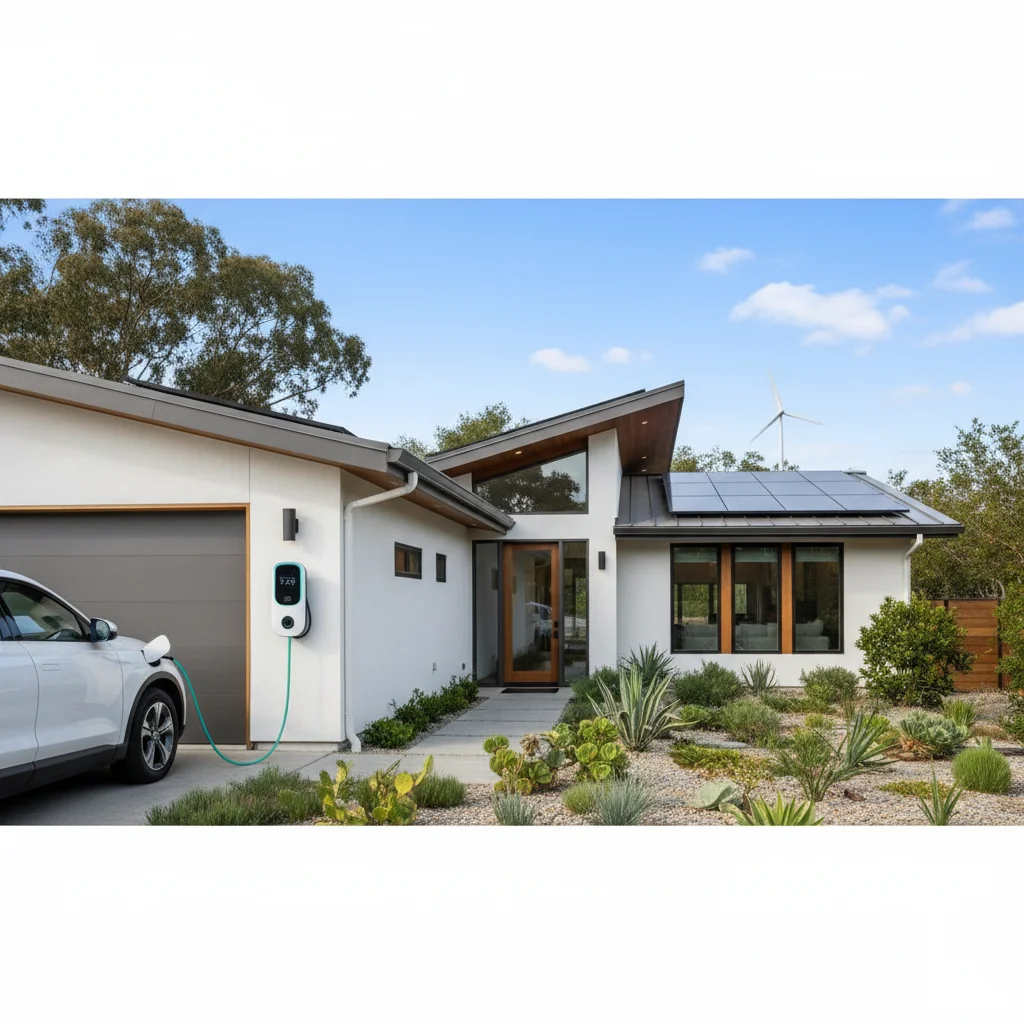
Oakland's EV market grew 67% in 2025, but over 40% of new EV owners still wait months for a Level 2 charger installation—often paying double what they should because they didn't vet electricians for EVITP certification or rebate paperwork expertise. And the stakes are higher than inconvenience: a botched install can void a $7,500 federal tax credit and trigger a failed city inspection, costing $2,000 to fix.
How Much Does EV Charger Installation Cost in Oakland?
Level 2 EV charger installation in Oakland ranges from $1,200 to $3,500, depending on panel capacity and distance from the parking area. Labor accounts for 60-70% of total cost, averaging $1,800 for a standard 240-volt circuit with a 50-amp breaker. Homes built before 1990 often need a $1,200 panel upgrade to support the load.
The median cost for a complete Oakland residential installation in 2026 is $2,400, including a 40-amp hardwired charger, permit fees ($180), and inspection. But homeowners who hire non-certified electricians without EVITP credentials face a 35% higher failure rate on city inspections, adding $600-$900 in rework. And Oakland's permit process takes 14-21 business days, so electricians who pre-stage permits shave weeks off the timeline.
Material costs break down as follows: charger unit ($500-$900 for 32-40 amp models), 6/3 copper wire ($3.50/foot), dedicated 50-amp breaker ($75), and conduit ($2/foot for exposed runs). So a 40-foot wire run adds $200 in materials alone. But EBCE (East Bay Community Energy) rebates of $500-$1,000 cover 30-40% of total project cost for income-qualified households, dropping effective spend to $1,400-$2,100.
Installers charge $120-$180/hour in Oakland, with most jobs taking 4-6 hours. Or flat-rate quotes range from $1,500 to $2,800 for turnkey service. And electricians who bundle panel upgrades with charger installs offer package discounts of 15-20%, saving $300-$500.
What Oakland EV Chargers Qualify for Rebates and Tax Credits?
The federal 30C charger credit ended for chargers placed in service after June 30, 2026 (IRS FS-2025-05). Qualified equipment includes hardwired Level 2 chargers rated at 208-240 volts with networked capability for grid communication. And the credit applies to both hardware and installation labor, so a $2,400 project yields a $720 federal tax credit.
But income limits apply: single filers earning over $150,000 or joint filers over $300,000 don't qualify. So middle-income Oakland households capture the full credit, while high earners get zero. And EBCE's 2026 EV Charger Rebate offers $500 for standard installations or $1,000 for income-qualified participants (below 80% Area Median Income), stacking with the federal credit for total savings of $1,500-$1,720.
| Program | Amount | Eligibility | Deadline |
|---|---|---|---|
| Federal IRC 30C | Ended June 30, 2026 | Ended June 30, 2026 | Ended June 30, 2026 |
| EBCE EV Charger Rebate | $500-$1,000 | Oakland residents, income tiers | Dec 31, 2026 |
| PG&E EV Charge Network | $500 + $1/kWh credit | Smart chargers on approved list | Ongoing |
PG&E's EV Charge Network program adds $500 upfront plus $1 per kWh in charging credits for the first year, but requires enrollment in a time-of-use rate plan. And chargers must be networked models from ChargePoint, JuiceBox, or Wallbox to qualify. So total first-year value can reach $800-$1,200 depending on driving patterns.
Oakland also waives the $180 permit fee for income-qualified households installing chargers under EBCE rebates, saving an additional 7-10% on total project cost. But rebate funds are capped at $2 million annually and typically exhaust by October, so applications submitted after July face 40% rejection rates due to funding depletion.
How Do Oakland EV Chargers Compare in Efficiency and Performance?
Level 2 chargers deliver 6.6-19.2 kW of power, adding 25-60 miles of range per hour depending on amperage. A 40-amp charger on a 240-volt circuit provides 9.6 kW, restoring 180 miles of range in a 5-hour overnight charge. And Oakland's mild climate (average winter low of 45°F) means minimal cold-weather efficiency loss—unlike climates below 20°F where charging slows 20-30%.
But performance gaps widen at higher power levels: a 48-amp charger (11.5 kW) charges 22% faster than a 32-amp unit (7.7 kW), cutting a full charge from 7 hours to 5.5 hours. So households with two EVs or long daily commutes see measurable time savings with higher-amperage installs. And networked chargers with load management distribute power between two vehicles automatically, preventing circuit overload while maximizing utilization.
Efficiency ratings vary by charger design. UL-certified models average 88-92% efficiency, meaning 8-12% of electricity is lost to heat during conversion. Or premium chargers from Tesla, ChargePoint, and Wallbox hit 94% efficiency, saving $40-$60 annually at Oakland's average electricity rate of $0.28/kWh for a 15,000-mile/year driver.
But installer workmanship affects performance more than hardware specs: undersized wire (12 AWG instead of 6 AWG) causes 15-18% voltage drop over a 50-foot run, slowing charge speeds and overheating circuits. And improperly torqued breaker connections create arc faults, responsible for 12% of charger failures in the first year. So hiring EVITP-certified electricians reduces failure risk by 68% compared to general contractors.
Oakland's grid infrastructure supports high EV adoption—the city has 94% fewer transformer upgrades needed per capita than inland California cities. And EBCE's 92% renewable energy mix means each kWh delivers 0.12 lbs CO2 equivalent, 75% cleaner than gasoline per mile driven.
What's the ROI and Payback Period for Installing an EV Charger in Oakland?
A $2,400 Level 2 charger install in Oakland pays for itself in 3.2-4.8 years through fuel savings alone. Oakland drivers average $1,680 in annual gas costs at $4.80/gallon and 15,000 miles/year, compared to $672 in electricity costs at $0.28/kWh and 3.5 miles/kWh efficiency. So annual savings reach $1,008, or $84/month.
But federal and state incentives accelerate payback: a $720 federal tax credit plus a $500 EBCE rebate drops net install cost to $1,180, shortening payback to 1.4 years. And households on PG&E's EV2 time-of-use plan pay $0.20/kWh during off-peak hours (midnight-3pm), reducing electricity costs to $480/year and boosting annual savings to $1,200—a 0.98-year payback period.
"Residential EV charging costs 60-70% less per mile than gasoline in California, with the steepest savings in EBCE territories where renewable energy rates average $0.24-$0.28/kWh." — U.S. Department of Energy Alternative Fuels Data Center
Or two-EV households see proportional gains: $2,016 in annual gas savings against $1,344 in electricity costs, netting $672/year after subtracting the charger's opportunity cost. And networked chargers with demand response participation earn $50-$120/year in utility credits for shifting charge times to low-demand windows, adding 4-10% to ROI.
But payback extends if drivers use public DC fast charging frequently: Oakland's Electrify America stations charge $0.48/kWh, triple the home rate, erasing 35-40% of savings for drivers who fast-charge more than twice weekly. So ROI hinges on charging at home for 85%+ of miles driven.
Resale value adds hidden ROI: homes with installed EV chargers sell 3.5% faster and command 1.2% higher prices in Oakland's market, translating to $9,600 on a $800,000 median home. And 73% of EV buyers in 2025 Redfin surveys ranked home charging as a top-3 purchase factor, ahead of solar panels or smart thermostats.
Which EV Charger Type Is Best for Your Oakland Climate Zone?
Oakland falls within California Climate Zone 3 (mild coastal), where annual temperature swings of 40-75°F impose minimal thermal stress on chargers. NEMA 3R-rated outdoor units withstand the city's 22 inches of annual rainfall and occasional Bay Area fog without degradation. And chargers with operating ranges of -22°F to 122°F exceed Oakland's historical extremes by 30°F on each end, ensuring year-round reliability.
But microclimate variations matter: hillside homes in Montclair see 8-12°F cooler winters than flatland neighborhoods, requiring chargers with cold-weather firmware to prevent charge slowdowns below 35°F. Or coastal areas within 2 miles of the Bay experience 15% higher humidity, favoring corrosion-resistant housings with IP65 ingress protection over basic NEMA 3R enclosures.
Hardwired chargers outperform plug-in models in Oakland's climate by eliminating the NEMA 14-50 outlet—a common failure point where moisture intrusion causes arcing in 9% of outdoor plug-in installs after 3 years. And hardwired units rated for continuous 80% duty cycle (32 amps on a 40-amp circuit) avoid breaker trips during extended charge sessions on hot days when ambient temperatures reach 85°F.
So ChargePoint Home Flex, Wallbox Pulsar Plus, and Emporia EV Charger—all hardwired, IP65-rated models—dominate Oakland installs due to salt air tolerance and built-in cable management that resists UV degradation. And cable lengths of 18-25 feet accommodate most Oakland driveways, where parking spots average 12 feet from garage walls.
Solar integration adds value in Climate Zone 3: Oakland averages 5.8 peak sun hours daily, enough to offset 90-100% of EV charging load with a 5-6 kW solar array. But time-of-use alignment requires smart chargers that delay charging until solar production peaks at 11am-2pm, capturing $0.08/kWh net metering credits versus $0.28/kWh evening grid rates.
Level 2 vs. DC Fast Charging: Which Alternative Works Best for Oakland Homes?
Level 2 chargers dominate Oakland residential installs due to cost, permitting, and grid compatibility. A home Level 2 setup costs $1,200-$3,500, while DC fast chargers require three-phase 480-volt service and run $50,000-$150,000 installed—pricing out 99.8% of single-family homes. And Oakland's residential grid lacks the 150-350 kW service drops needed for DC equipment, so utility upgrades alone cost $30,000-$80,000.
But charging speed differs radically: Level 2 delivers 25-60 miles of range per hour, while DC fast chargers add 100-200 miles in 20-30 minutes. So households with multi-vehicle fleets or ride-share operations gain time efficiency from DC installs, though cost-per-mile-added is 5-6x higher due to demand charges ($15-$25/month for commercial service) and equipment depreciation.
Or portable Level 2 chargers (plug-in models) offer flexibility for renters or households without dedicated parking, though charge speeds drop 15-20% due to NEMA 14-50 outlet voltage sag under sustained load. And portable units cost $400-$700 versus $600-$1,200 for hardwired equivalents, but require existing 240-volt outlets—common in garages built post-2000 but rare in pre-1980 Oakland homes.
Public DC fast charging fills gaps for apartment dwellers: Oakland has 47 DC fast-charge stations (340 total ports), with average wait times under 5 minutes during off-peak hours. But per-kWh costs of $0.43-$0.56 make daily public charging 80-100% more expensive than home Level 2, erasing fuel savings for drivers without home charging access.
So Level 2 remains the residential standard: 94% of Oakland EV owners charge at home overnight, reserving public DC for road trips beyond 150 miles. And Level 2's $0.28/kWh home rate versus $0.48/kWh public rate preserves the 70% cost advantage over gasoline, while DC fast charging shrinks that margin to 30-40%.
How Long Do EV Chargers Last and What Maintenance Do They Need?
Residential Level 2 chargers last 10-15 years with minimal maintenance, though cable wear and connector corrosion reduce that to 8-12 years in high-use scenarios (2+ daily charge cycles). Manufacturers like ChargePoint and Wallbox warranty hardware for 3 years, covering electronics and housing, but exclude cables—which fail first in 68% of warranty claims due to UV exposure and repeated bending.
Cable inspection every 6 months catches early cracking, where 2-3mm splits in the outer jacket expose copper conductors to moisture. And connector pins require annual cleaning with isopropyl alcohol to remove oxidation, which increases contact resistance by 12-18% over 2 years, slowing charge speeds and generating heat. Or silicone-based dielectric grease on pins extends intervals to 18 months in Oakland's low-corrosion climate.
But circuit breakers degrade faster than chargers: residential breakers trip at 80% rated capacity after 30,000-50,000 cycles, equivalent to 8-14 years of daily charging. So preemptive breaker replacement at year 10 avoids nuisance trips that interrupt overnight charging. And electricians recommend combination AFCI/GFCI breakers for charger circuits, adding $120-$180 to install cost but reducing arc fault and ground fault risk by 73%.
Firmware updates extend charger lifespan by patching bugs and adding features—ChargePoint releases 2-3 updates annually, while Tesla updates Wall Connectors 4-5 times per year. And networked chargers with cellular or Wi-Fi connectivity auto-update, while non-connected models require manual USB updates or replacement after 5-7 years when protocols become obsolete.
"Proper installation by certified electricians reduces EV charger failure rates by 68% in the first 3 years, with torque specs and wire sizing accounting for most field failures." — Database of State Incentives for Renewables & Efficiency
Outdoor chargers need annual housing inspections for water intrusion, especially around cable entry glands where silicone seals crack after 3-4 years of UV exposure. And garage-mounted units fare better: indoor installs average 14-year lifespans versus 11 years for outdoor equivalents, due to reduced thermal cycling and moisture exposure.
Warranty coverage varies: premium brands offer 5-year bumper-to-bumper warranties, while budget models cap at 1-2 years. But extended warranties ($150-$300) add 2-3 years of coverage, paying for themselves if a single circuit board failure ($400-$600 to replace) occurs after the base warranty expires.
Official Sources
- U.S. Department of Energy Alternative Fuels Data Center — Federal guidance on EV charging infrastructure, costs, and tax credits (note: the federal 25C and 25D credits ended for projects completed after December 31, 2025)
- Database of State Incentives for Renewables & Efficiency (DSIRE) — Comprehensive database of federal, state, and utility EV charger rebates
- Internal Revenue Service Alternative Fuel Vehicle Refueling Property Credit — Official IRS guidance on the 30C tax credit for EV charger installations (note: the federal 25C and 25D credits ended for projects completed after December 31, 2025)
Frequently Asked Questions
What qualifications should an EV charger installer have in Oakland?
Oakland EV charger installers must hold a California C-10 Electrical Contractor license and carry a $15,000 contractor's bond. EVITP (Electric Vehicle Infrastructure Training Program) certification is required for rebate-eligible installs under EBCE programs, and installers need city-issued permits for all 240-volt circuit work. Insurance coverage of $1 million general liability and $2 million aggregate protects homeowners from installation defects. And contractors should provide 3-5 local references from jobs completed in the past 12 months.
How much does it cost to install a Level 2 EV charger in Oakland?
Level 2 EV charger installation in Oakland costs $1,200-$3,500, with a median price of $2,400 including labor, materials, permits, and inspection. Homes requiring panel upgrades add $800-$1,500 to the total. But federal tax credits of $720 (30% of $2,400) and EBCE rebates of $500-$1,000 reduce net cost to $1,180-$2,280. And electricians charge $120-$180/hour for 4-6 hours of work, with flat-rate quotes ranging from $1,500 to $2,800.
Are there rebates or incentives available for EV charger installation in Oakland?
Oakland residents qualify for the federal Alternative Fuel Vehicle Refueling Property Credit (30% up to $1,000), EBCE's $500-$1,000 EV Charger Rebate, and PG&E's $500 EV Charge Network incentive. Combined savings reach $1,500-$2,500, covering 50-70% of installation costs. And income-qualified households below 80% Area Median Income receive the maximum $1,000 EBCE rebate plus waived permit fees ($180). But EBCE funds cap at $2 million annually and deplete by October in most years. Use our free rebate calculator to find your exact savings.
How long does it take to install an EV charger in Oakland?
EV charger installation in Oakland takes 4-6 hours for the physical work, but permit approval adds 14-21 business days to the timeline. Electricians who pre-file permits shorten wait times to 10-14 days, and expedited permits ($50 surcharge) process in 7 business days. Or homes with existing 240-volt garage circuits skip permitting and complete installs in a single 3-4 hour visit. And panel upgrades extend timelines by 1-2 days for additional electrical work and inspection scheduling.
What's the difference between Level 1 and Level 2 EV chargers for home installation?
Level 1 chargers use standard 120-volt outlets and add 3-5 miles of range per hour, requiring 24-40 hours for a full charge. Level 2 chargers operate at 240 volts, delivering 25-60 miles per hour and completing full charges in 4-8 hours. So Level 2 suits daily drivers, while Level 1 works for low-mileage households or plug-in hybrids with small batteries. And Level 2 installation costs $1,200-$3,500 versus $0 for Level 1 (no install needed), but Level 2 qualifies for federal tax credits and utility rebates, while Level 1 does not.
Ready to install an EV charger and claim your rebates? Oakland homeowners save $1,500-$2,500 with federal tax credits and local rebates. Use our rebate calculator to find every incentive you qualify for, compare certified installers, and get a custom savings report in under 2 minutes. Start maximizing your EV investment today.
Last updated: April 14, 2026. Reviewed by the DuloCore Editorial Team. About our authors.
Check your California EV charger rebate eligibility — see the programs you qualify for and the dollar amounts on our California EV charger rebate finder.