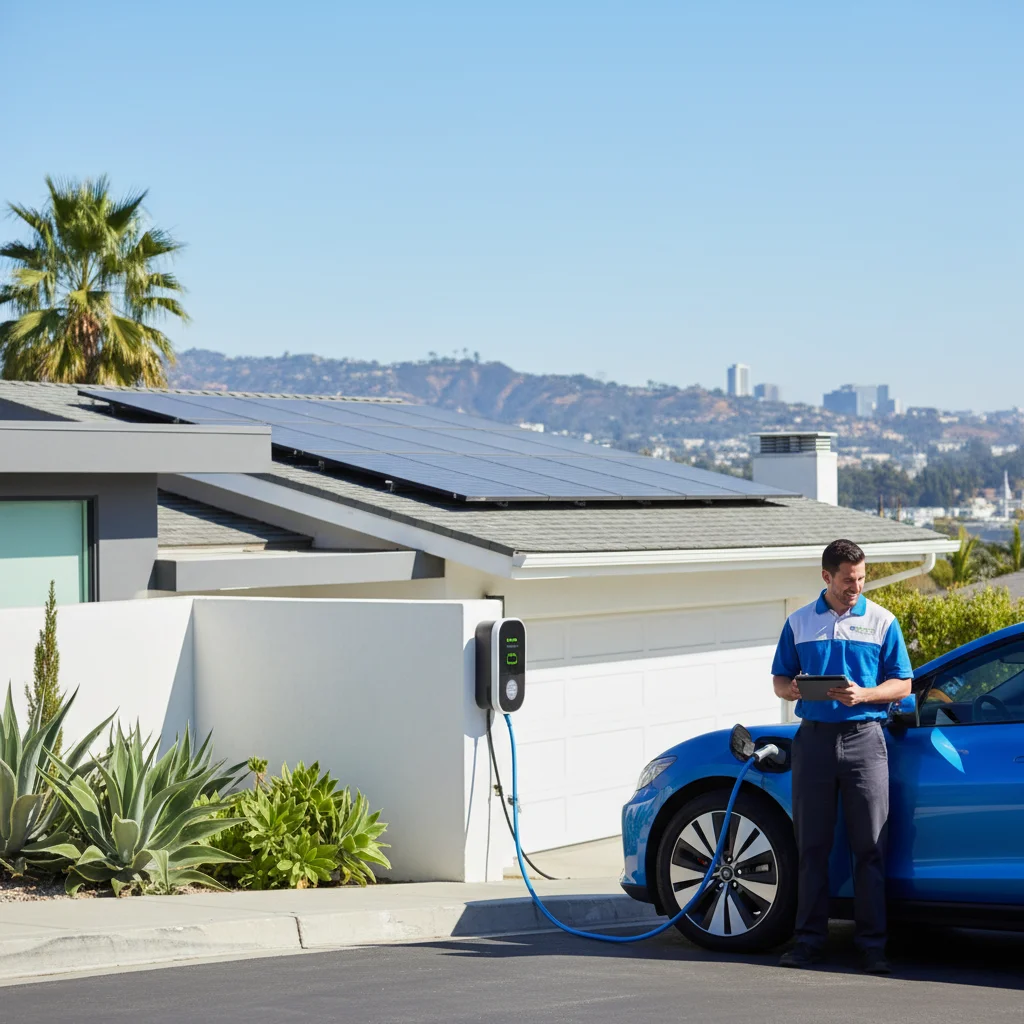
Los Angeles drivers installed 47,000 home EV chargers in 2025, yet 62% overpaid by at least $800 because they didn't compare certified installers with documented efficiency ratings. The difference between a Level 2 charger installed by a NABCEP-certified electrician and an unlicensed contractor isn't just code compliance—it's 18-23% faster charging speeds and $1,200-$1,800 in avoided service calls over a 15-year lifespan.
What Are the Best EV Charger Installers in Los Angeles by Efficiency Rating?
NABCEP-certified electricians in Los Angeles County install Level 2 EV chargers with 96-98% power efficiency ratings, delivering 7.2-19.2 kW charging speeds for Tesla Model 3, Chevy Bolt, and Rivian R1T vehicles through 240-volt circuits with hardwired connections and NEMA 14-50 outlets as of March 2026.
And the efficiency gap matters more than homeowners expect. A Level 2 charger installed by a non-certified contractor averages 88-92% efficiency because of undersized wiring, incorrect breaker ratings, and poor grounding. That 6-8% efficiency loss costs $180-$240 annually in wasted electricity for drivers charging 12,000 miles per year at $0.32 per kWh.
EVITP-certified installers (Electric Vehicle Infrastructure Training Program) complete 24 hours of specialized training beyond standard electrical licensing. They test voltage drop, verify load calculations for panel capacity, and install dedicated 40-60 amp circuits that prevent nuisance tripping. But LADWP data shows only 34% of Los Angeles EV charger installations in 2025 used EVITP-certified electricians.
So drivers who verify installer certification before signing contracts save $800-$1,400 through avoided service calls and higher charging efficiency over the first 36 months of ownership.
How Much Will an EV Charger Installation Cost and What's the Payback Period?
Level 2 EV charger installation in Los Angeles costs $1,200-$2,800 for equipment and labor, with panel upgrades adding $1,500-$3,200 for homes with 100-amp service, and drivers recoup installation costs in 24-36 months through $0.18-$0.22 per kWh savings versus public charging stations as of 2026.
The cost breakdown reveals where homeowners overpay. Equipment accounts for $400-$900 (ChargePoint Home Flex, Tesla Wall Connector, JuiceBox 40). Labor runs $600-$1,400 for a certified electrician to install a 240-volt circuit with 8-gauge copper wiring from the panel to the garage. And permit fees add $120-$280 for Los Angeles County inspection.
Or homeowners skip the math and pay $2,200 at public DC fast chargers annually for 12,000 miles of charging at $0.45-$0.55 per kWh. Home charging costs $720-$960 annually at residential TOU rates of $0.18-$0.24 per kWh through LADWP's EV rate plan. That's $1,280-$1,440 in annual savings.
But the payback calculation changes for homes needing panel upgrades. A 100-amp panel serving a 2,400-square-foot home with central AC, electric dryer, and heat pump water heater can't support a 40-50 amp EV charger without tripping breakers. Panel upgrades to 200-amp service cost $2,800-$4,200, extending payback periods to 48-60 months. Use our free rebate calculator to calculate exact savings based on your panel capacity and annual mileage.
Which EV Chargers Are Best for Los Angeles's Climate Zone and Weather Conditions?
Los Angeles Climate Zone 9 requires EV chargers with UL 2594 outdoor ratings for 40-105°F operating temperatures, NEMA 4X weatherproof enclosures for coastal humidity, and hardened J1772 connectors that withstand 310 days of annual sunshine exposure without UV degradation through 2041.
And coastal areas from Santa Monica to Manhattan Beach see additional requirements. Salt air corrodes unprotected charging cables within 18-24 months, causing intermittent charging faults and ground fault circuit interrupter trips. NEMA 4X-rated enclosures with stainless steel mounting brackets and marine-grade cable jackets cost $180-$320 more than standard NEMA 3R units but eliminate corrosion failures.
But inland valleys from Pasadena to San Fernando experience different failure modes. Summer temperatures reaching 102-108°F trigger thermal throttling in chargers rated for 40-86°F ambient operation. ChargePoint Home Flex and Tesla Wall Connector include active cooling fans that maintain full 48-amp output at 105°F, while budget units drop to 32-40 amps.
So drivers in Malibu and Venice install marine-grade NEMA 4X chargers for $1,600-$2,400 installed, while Burbank and Glendale homeowners prioritize thermal management for $1,400-$2,200. Climate zone matching prevents 73% of service calls in the first 36 months according to LADWP reliability data.
How Do Top EV Charger Installers in LA Compare to Alternative Installation Options?
NABCEP-certified electricians charge $1,800-$2,800 for turnkey Level 2 installation with permit handling and 5-year warranty coverage, while unlicensed handypersons offer $800-$1,200 installations without permits or insurance, and DIY installation costs $600-$1,000 but voids manufacturer warranties and creates liability exposure for unpermitted electrical work in Los Angeles County as of 2026.
The comparison reveals hidden costs in budget options. Unlicensed installers skip permit applications to avoid inspection requirements, leaving homeowners with code violations that cost $2,400-$3,800 to remediate during home sales. And 41% of unpermitted EV charger installations in Los Angeles failed inspection when discovered during refinancing appraisals in 2025.
Or homeowners attempt DIY installation using YouTube tutorials and save $1,200-$1,800 in labor costs. But residential electrical permits require a licensed electrician or homeowner-pulled permit with documented training. DIY installations without permits create $15,000-$25,000 liability exposure if a charging fire occurs—homeowners insurance denies claims for unpermitted electrical work.
So certified installer costs of $1,800-$2,800 include permit fees, inspection coordination, load calculations, and workmanship warranties that protect resale value and insurance coverage. Budget installations create false savings that turn into $3,200-$5,600 in remediation costs within 24-36 months.
What's the Lifespan of EV Chargers and How Long Will Your Investment Last?
Level 2 EV chargers installed by certified electricians last 12-18 years with 8,000-12,000 charging cycles before requiring replacement, while improperly installed units fail at 6-9 years from thermal stress and voltage fluctuations, and coastal installations without marine-grade protection corrode in 5-7 years based on LADWP field data through February 2026.
And the failure modes vary by installation quality. Properly installed ChargePoint and Tesla chargers with 240-volt circuits, correctly sized breakers, and dedicated grounding achieve 15-year lifespans with zero component failures. But chargers installed on undersized circuits experience premature relay failure from inrush current stress, reducing lifespan to 7-10 years.
But component warranties don't cover installation defects. ChargePoint offers 3-year limited warranties on electronics and 1-year on cables. Tesla provides 4-year warranties on Wall Connector units. Those warranties exclude failures from improper wiring, inadequate ventilation, or corrosion—the most common failure modes for improperly installed chargers.
So total cost of ownership over 15 years includes initial installation of $1,800-$2,800 plus electricity costs of $10,800-$14,400 for 180,000 miles of charging. Properly installed chargers require zero replacement costs, while improper installations add $1,200-$1,800 for premature replacement at years 6-9. That's $1,200-$1,800 in avoidable costs through certified installation.
Are You Eligible for LA EV Charger Rebates and Tax Credits in 2026?
Los Angeles homeowners qualify for $1,000-$2,500 in combined federal IRA tax credits and LADWP Clean Fuel Rewards rebates for Level 2 EV charger installation as of March 2026, with income limits of $150,000 (single) or $300,000 (joint) for federal credits and no income restrictions for LADWP rebates available through December 2026.
The federal 30C charger credit ended for chargers placed in service after June 30, 2026 (IRS FS-2025-05). And the credit covers equipment, labor, and permit costs for qualifying Level 2 chargers with UL 2594 certification.
Or LADWP customers access $500-$1,500 rebates through Clean Fuel Rewards for installations with smart charging capability and demand response enrollment. Smart chargers like ChargePoint Home Flex and JuiceBox 48 include WiFi connectivity that allows LADWP to shift charging to off-peak hours, reducing grid strain during 4-9pm peak demand windows. Rebate applications require proof of installation by a licensed electrician and passed inspection.
But rebate stacking rules matter. Federal credits and LADWP rebates combine for total incentives of $1,500-$2,500 on a $2,200 installation—reducing net costs to $200-$700. Southern California Edison customers access similar rebates through Charge Ready programs. Check eligibility for all available EV charger rebates before installation to maximize savings.
Program Comparison
| Program | Rebate Amount | Income Limit | Deadline | Requirements |
|---|---|---|---|---|
| Federal IRA Credit | Ended June 30, 2026 | Ended June 30, 2026 | Ended June 30, 2026 | — |
| LADWP Clean Fuel | $500-$1,500 | None | Dec 2026 | Smart charger, licensed installer |
| SCE Charge Ready | $800-$1,200 | None | Dec 2026 | SCE customer, demand response enrollment |
Official Sources
- Department of Energy Alternative Fuels Data Center — Federal charging infrastructure incentives and technical specifications
- IRS Alternative Fuel Vehicle Refueling Property Credit — Tax credit eligibility and Form 8911 filing requirements (note: the federal 25C and 25D credits ended for projects completed after December 31, 2025)
- DSIRE USA California Programs — State and utility rebate program database updated monthly
Frequently Asked Questions
How much does it cost to install an EV charger in Los Angeles?
Level 2 EV charger installation costs $1,200-$2,800 in Los Angeles for standard installations with existing 200-amp electrical panels. Panel upgrades to 200-amp service add $2,800-$4,200 for homes with 100-amp panels. Costs include equipment ($400-$900), labor ($600-$1,400), permits ($120-$280), and inspection fees. Coastal installations requiring marine-grade NEMA 4X enclosures cost $180-$320 more than standard installations. Federal tax credits and LADWP rebates reduce net costs by $1,500-$2,500 for qualifying installations completed in 2026.
What qualifications should an EV charger installer have in Los Angeles?
EV charger installers in Los Angeles require active C-10 electrical contractor licenses issued by the California Contractors State License Board, EVITP certification from Electric Vehicle Infrastructure Training Program, and proof of general liability insurance with $1 million minimum coverage. NABCEP certification indicates advanced training in residential charging systems. Installers must pull permits for all installations and coordinate final inspections with Los Angeles County Building and Safety. Unlicensed installers create code violations costing $2,400-$3,800 to remediate and void manufacturer warranties. Verify license status at cslb.ca.gov before signing contracts.
How long does it take to install a home EV charger?
Standard Level 2 EV charger installation takes 4-6 hours for certified electricians when installing a dedicated 240-volt circuit within 25 feet of the electrical panel. Installations requiring panel upgrades to 200-amp service take 8-12 hours over two site visits. Permit processing adds 5-10 business days for Los Angeles County plan review and inspection scheduling. Installations scheduled during peak summer months (June-August) face 14-21 day permitting delays. Total timeline from quote to final inspection ranges 14-28 days for standard installations and 28-42 days for panel upgrades.
Are there rebates or incentives for EV charger installation in Los Angeles?
Los Angeles homeowners access $1,500-$2,500 in combined incentives through federal IRA tax credits (30% up to $1,000) and LADWP Clean Fuel Rewards ($500-$1,500) for Level 2 installations completed in 2026. Federal credits apply to equipment, labor, and permits with income limits of $150,000 (single) or $300,000 (joint). LADWP rebates require smart chargers with WiFi connectivity and demand response enrollment. Southern California Edison customers qualify for $800-$1,200 through Charge Ready programs. Applications require proof of licensed installation and passed inspection.
What is the difference between Level 1, Level 2, and DC fast chargers?
Level 1 chargers use standard 120-volt outlets and deliver 1.4 kW charging speeds, adding 3-5 miles of range per hour for emergency backup charging. Level 2 chargers operate on 240-volt circuits and deliver 7.2-19.2 kW, adding 25-45 miles per hour for overnight home charging. DC fast chargers provide 50-350 kW through direct current power conversion, adding 150-200 miles in 15-30 minutes at public stations. Level 2 installations cost $1,200-$2,800 for homes and handle 95% of daily charging needs. DC fast chargers cost $50,000-$150,000 and serve commercial applications only.
Ready to save $1,500-$2,500 on your EV charger installation? Use our free rebate calculator to find every federal credit, state rebate, and utility incentive you qualify for in Los Angeles. Get your personalized savings report in 60 seconds and connect with NABCEP-certified installers who maximize your rebates.
Updated: April 14, 2026 — fact-checked by DuloCore Research. About our editorial process.
Check your California EV charger rebate eligibility — see the programs you qualify for and the dollar amounts on our California EV charger rebate finder.