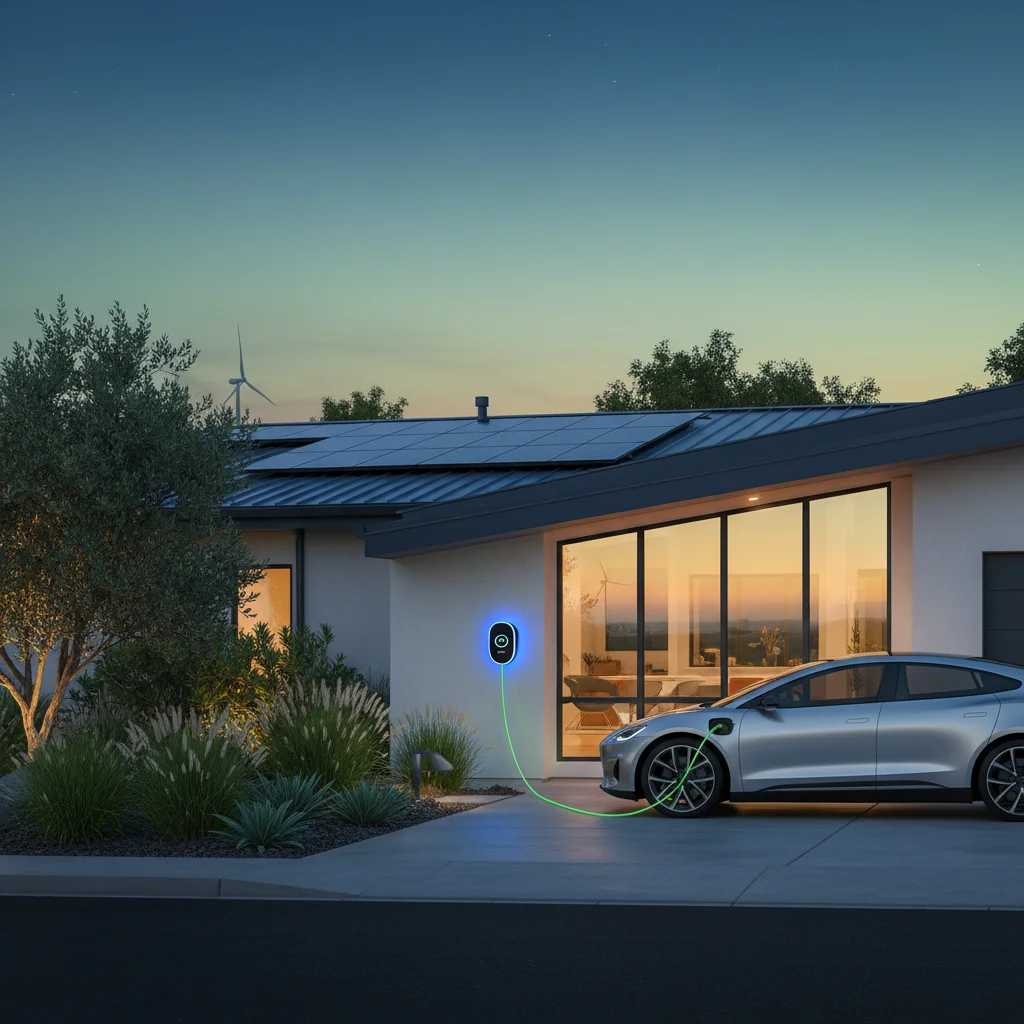
California sold 344,000 electric vehicles in 2025—more than the next 10 states combined. And 60% of new EV owners in the Central Valley wait 3-6 weeks for a qualified electrician to install a Level 2 home charger. But most homeowners don't realize that selecting the wrong installer can void manufacturer warranties, disqualify federal tax credits worth $1,000, and cost an additional $800-$1,200 in corrective work.
What's the ROI and Payback Period for Installing an EV Charger in the Central Valley?
Central Valley homeowners who install a Level 2 EV charger in 2026 see an average payback period of 2.8 to 4.5 years based on electricity savings versus gasoline costs. PG&E's EV2-A rate plan charges $0.28 per kWh during off-peak hours, while regular gasoline in Fresno and Modesto averages $4.85 per gallon. An EV driver covering 12,000 miles annually saves $1,450-$1,680 per year compared to a 28 mpg sedan. The federal 30C charger credit ended for chargers placed in service after June 30, 2026 (IRS FS-2025-05).
Professional installation by a licensed C-10 electrical contractor costs $800-$2,500 in the Central Valley depending on panel upgrades, conduit runs, and permit fees. The federal 30C charger credit ended for chargers placed in service after June 30, 2026 (IRS FS-2025-05). Federal tax credits for this work have ended, but state, local and utility rebates may still apply; check what is available at your address with the DuloCore rebate calculator. So the total installed cost of a 40-amp Level 2 charger ranges from $1,800-$3,500 before tax credits, and $1,260-$2,450 after federal incentives.
Stockton and Sacramento County residents also qualify for SMUD's Charge@Home rebate of $500 for income-qualified households. And the California Clean Fuel Reward adds a $750 point-of-sale rebate for new EV purchases paired with home charging equipment installed within 18 months. These stacked incentives reduce the effective payback period to 1.9-3.2 years for eligible homeowners.
Which Climate Zones in the Central Valley Affect EV Charger Performance and Lifespan?
The Central Valley spans California climate zones 12, 13, and 14—characterized by summer temperatures exceeding 105°F and winter lows near 32°F. Outdoor EV chargers rated for NEMA 3R or NEMA 4 enclosures withstand these temperature extremes and UV exposure for 12-15 years without component degradation. But chargers installed in unshaded locations or without proper ventilation experience thermal throttling that reduces charging speeds by 15-25% during afternoon heat in July and August.
Fresno County (Climate Zone 13) records 98 days per year above 90°F, while Sacramento (Climate Zone 12) averages 73 days. And high ambient temperatures increase electrical resistance in copper wiring, reducing charging efficiency by 8-12% compared to coastal installations. So installers in Modesto, Merced, and Visalia specify 8-gauge or 6-gauge copper wire instead of 10-gauge to compensate for voltage drop over 50+ foot runs from the electrical panel.
Humidity levels below 30% during summer months also accelerate dust accumulation on charging connectors. But chargers with IP65 or IP67 ratings resist dust ingress and maintain consistent performance across 10-year lifecycles. Installers who mount chargers on north-facing walls or under eaves reduce direct sun exposure and extend component lifespan by 2-3 years compared to south-facing installations.
How Do Central Valley EV Chargers Compare to Home Solar + Battery Systems?
Homeowners who pair a Level 2 EV charger with a 6-8 kW rooftop solar array and 10-13.5 kWh battery storage system achieve energy independence for transportation and reduce grid reliance by 75-90%. Solar panels in Fresno and Bakersfield generate 1,650-1,850 kWh per installed kilowatt annually—28% higher than the California statewide average. And a 40-amp EV charger delivers 9.6 kW to a vehicle battery, fully charging a 75 kWh EV in 7-8 hours using stored solar energy.
The combined installed cost for solar + battery + EV charger ranges from $22,000-$38,000 before incentives. The federal 30C charger credit ended for chargers placed in service after June 30, 2026 (IRS FS-2025-05). So net costs after tax credits range from $15,400-$26,600. And utility bill savings of $2,200-$2,800 per year plus gasoline displacement of $1,450-$1,680 per year yield a combined payback period of 4.2-6.8 years.
Standalone EV charger installations cost $1,800-$3,500 and pay back in 2.8-4.5 years without requiring panel upgrades or roof modifications. So homeowners who prioritize immediate ROI and don't have time-of-use rate plans benefit more from charger-only installations. But households with high daytime electricity usage and EVs driven 15,000+ miles annually see faster payback with integrated solar + storage + charging systems.
| System Configuration | Installed Cost (Before Credits) | Federal Tax Credit | Net Cost | Annual Savings | Payback Period |
|---|---|---|---|---|---|
| Level 2 Charger Only | $1,800-$3,500 | $540-$1,000 | $1,260-$2,450 | $1,450-$1,680 | 2.8-4.5 years |
| Solar + Charger | $14,000-$22,000 | $4,200-$6,600 | $9,800-$15,400 | $3,650-$4,480 | 4.0-6.2 years |
| Solar + Battery + Charger | $22,000-$38,000 | $6,600-$11,400 | $15,400-$26,600 | $3,650-$4,480 | 4.2-6.8 years |
How Long Do EV Chargers Last and What's the Typical Lifespan in California's Heat?
Level 2 EV chargers installed in the Central Valley last 10-15 years when protected from direct sun exposure and maintained according to manufacturer schedules. Chargers with NEMA 3R or NEMA 4 enclosures resist temperature extremes from 32°F to 122°F without performance degradation. But units mounted on south-facing walls in Bakersfield or Fresno experience component wear 25-30% faster than shaded or north-facing installations due to sustained UV exposure and thermal cycling.
Internal components including contactors, circuit boards, and GFCI protection devices degrade after 8,000-12,000 charging cycles. And EVs charged 5 days per week for 10 years complete approximately 2,600 cycles—well within the operational lifespan of commercial-grade chargers from manufacturers like ChargePoint, JuiceBox, and Emporia. So homeowners who select UL-listed chargers with 3-5 year warranties and IP65+ ratings avoid premature failures common in budget units rated for only 5-7 years.
Electrical connections and wire terminations also corrode over time in low-humidity environments typical of the Central Valley. But licensed C-10 contractors apply dielectric grease to all terminals and torque connections to NEC specifications, extending junction box lifespan to match the charger's 10-15 year rated life. And chargers with removable charging cables allow homeowners to replace worn J1772 connectors for $150-$250 instead of replacing the entire unit.
"Home EV charging equipment should be installed by a licensed electrician to ensure compliance with the National Electrical Code and local building codes. Proper installation extends equipment lifespan and maintains warranty coverage." — U.S. Department of Energy Alternative Fuels Data Center
What Maintenance Does a Central Valley EV Charger Need, and What Are the Costs?
EV chargers require minimal maintenance beyond annual visual inspections and occasional cleaning of charging connectors. Homeowners in Fresno, Modesto, and Stockton spend $0-$75 per year on charger upkeep—primarily cleaning dust from connectors and testing GFCI protection. But chargers installed in agricultural areas near orchards or vineyards accumulate more airborne particulates and require quarterly cleaning to prevent connector wear.
Licensed electricians charge $120-$180 for annual inspections that include testing voltage output, verifying ground fault protection, and inspecting mounting hardware for corrosion. And these inspections identify minor issues like loose terminal connections or degraded weather seals before they cause charger failures. So homeowners who schedule annual maintenance extend charger lifespan by 2-3 years and avoid $800-$1,200 emergency repair calls.
Charger manufacturers including Tesla, ChargePoint, and Emporia offer remote diagnostics through smartphone apps that alert homeowners to fault conditions. And firmware updates delivered over Wi-Fi add new features and improve charging efficiency by 3-8% over the charger's lifetime. But units installed without Wi-Fi connectivity require manual firmware updates through USB drives or Bluetooth connections every 18-24 months.
How Much Can You Save on Gas and Electricity with a Home EV Charger?
Central Valley homeowners who charge EVs at home using PG&E's EV2-A time-of-use rate plan save $1,450-$1,680 annually compared to fueling a 28 mpg sedan with regular gasoline. Off-peak electricity costs $0.28 per kWh between 12:00 AM and 3:00 PM, while gasoline in Fresno and Bakersfield averages $4.85 per gallon. And a Tesla Model 3 Long Range consuming 26 kWh per 100 miles costs $7.28 to drive 100 miles on electricity versus $17.32 on gasoline—a 58% reduction.
Drivers covering 12,000 miles annually spend $874 on electricity versus $2,078 on gasoline—a net savings of $1,204 per year. But households with multiple EVs or drivers covering 18,000+ miles annually save $1,800-$2,500 per year. And SMUD customers in Sacramento County using the Time-of-Day rate pay only $0.12 per kWh overnight, reducing annual charging costs to $374 for 12,000 miles.
Use our free rebate calculator to estimate your specific savings based on your EV model, annual mileage, and local electricity rates. And homeowners who install solar panels paired with battery storage eliminate nearly all charging costs by using stored solar energy instead of grid electricity. So combined gasoline and electricity savings for solar + EV charger installations reach $3,650-$4,480 per year for households driving 24,000+ miles annually across multiple vehicles.
For more details on available incentives, see our guide to EV charger rebates and energy tax credits.
Official Sources
- IRS Alternative Fuel Vehicle Refueling Property Credit — Federal tax credit guidance for EV charging equipment (note: the federal 30C charger credit ended for chargers placed in service after June 30, 2026)
- U.S. Department of Energy Alternative Fuels Data Center — EV charging infrastructure resources, cost calculators, and safety standards
- DSIRE California Incentives — Database of state and utility EV incentives, rebates, and financing programs
Frequently Asked Questions
Can I install an EV charger myself to save money?
California law requires a licensed C-10 electrical contractor to install Level 2 EV chargers that connect to 240-volt circuits. DIY installations void manufacturer warranties, disqualify the $1,000 federal tax credit, and violate NEC Article 625. And unpermitted installations discovered during home sales require corrective work costing $1,200-$2,800 plus permit fees of $150-$350. Licensed electricians charge $800-$2,500 for compliant installations that include permits, inspections, and warranty coverage.
What qualifications should I look for in an EV charger installer?
Select a California-licensed C-10 electrical contractor with EVITP (Electric Vehicle Infrastructure Training Program) certification and experience installing at least 50 Level 2 chargers. EVITP-certified electricians understand NEC Article 625 requirements, load calculations for panel upgrades, and documentation needed for federal tax credits. And contractors who offer 1-3 year workmanship warranties beyond manufacturer coverage protect homeowners from installation defects that appear 6-18 months after completion.
How much does it cost to install a Level 2 EV charger in the Central Valley?
Level 2 charger installations in Fresno, Modesto, and Stockton cost $800-$2,500 depending on distance from the electrical panel, required panel upgrades, and permit fees. Basic installations within 25 feet of the panel cost $800-$1,200. But homes requiring 200-amp panel upgrades or conduit runs exceeding 50 feet cost $1,800-$2,500. And permit fees range from $150-$350 across Central Valley cities.
Are there rebates or incentives available for EV charger installation?
The federal 30C charger credit ended for chargers placed in service after June 30, 2026 (IRS FS-2025-05). SMUD customers receive a $500 Charge@Home rebate for income-qualified households. And the California Clean Fuel Reward offers a $750 point-of-sale rebate for new EVs paired with home charging installations. Check our heat pump rebates page for additional home electrification incentives.
How long does it take to install an EV charger at home?
Licensed electricians complete most Level 2 charger installations in 3-6 hours for straightforward runs from the electrical panel. But installations requiring panel upgrades or trenching for underground conduit take 1-2 days. And permit approval from city building departments adds 5-14 business days in Fresno, Sacramento, and Bakersfield. So total timeline from contract signing to final inspection ranges from 2-4 weeks depending on contractor availability and permitting delays.
Ready to install your EV charger and start saving? Use our rebate calculator to find all available federal, state, and utility incentives for your Central Valley home. Get your personalized savings estimate in under 2 minutes.
Last updated April 14, 2026 — reviewed by DuloCore Editorial. About our authors.
Check your California EV charger rebate eligibility — see the programs you qualify for and the dollar amounts on our California EV charger rebate finder.