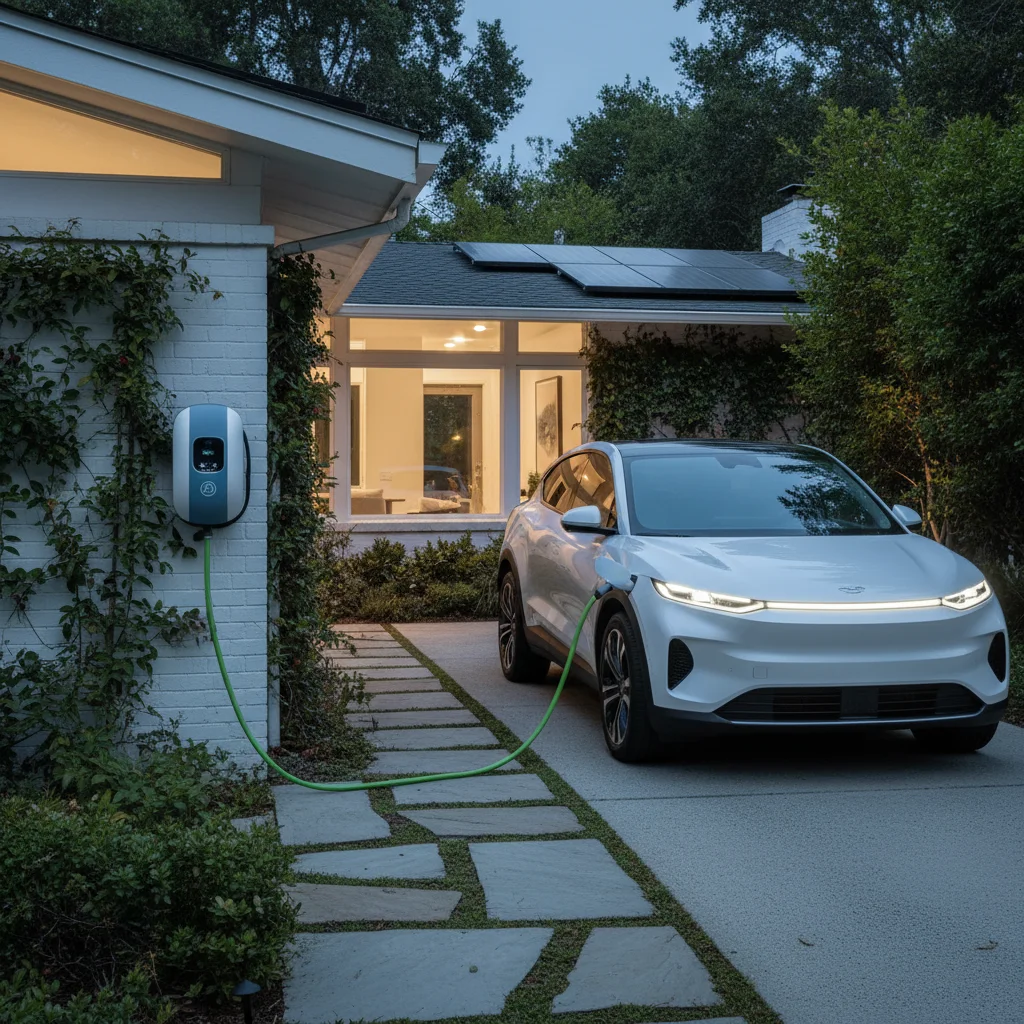
California leads the nation with 1.2 million electric vehicles on the road as of 2026, and nearly 40% of those drivers still rely on slow Level 1 charging because they haven't upgraded their home charging infrastructure. Bay Area residents face a unique challenge: robust state and utility rebates can cover up to $7,000 of installation costs, but only if homeowners choose qualified installers who meet California Energy Commission certification requirements and secure permits before the December 2026 program deadline.
What EV Charger Models Are Eligible for Bay Area Rebates and Tax Credits?
California's 2026 Clean Vehicle Rebate Project requires Level 2 chargers to deliver at least 7.2 kW output and carry ENERGY STAR certification to qualify for the $2,000 state rebate. PG&E customers receive an additional $500 through the EV Charge Network program when installers use networked chargers that support demand response. Bay Area Air Quality Management District offers another $1,000 for installations in low-income census tracts, bringing total potential rebates to $3,500 before federal incentives.
The federal 30C charger credit ended for chargers placed in service after June 30, 2026 (IRS FS-2025-05). So a typical $4,000 installation qualifies for $1,000 federal credit plus $2,000-$3,500 in state and utility rebates, reducing net costs to under $1,000 in optimal scenarios. But homeowners must install by December 31, 2026 to capture the full state rebate before funding reallocation.
Popular eligible models include the ChargePoint Home Flex (7.7 kW, $699 before rebates), Wallbox Pulsar Plus (11.5 kW, $849), and JuiceBox 48 (11.5 kW, $629). These units meet California's safety standards and integrate with PG&E's SmartRate program to charge during off-peak hours at rates as low as $0.09 per kWh.
"Networked Level 2 chargers that participate in utility demand response programs deliver grid benefits while reducing charging costs by up to 60% compared to standard residential rates." — California Energy Commission
How Much Can You Save? Understanding ROI and Payback Period for Home EV Charging Installation
Bay Area EV drivers who install Level 2 chargers see payback periods of 2-4 years compared to continued use of public charging networks. A typical Tesla Model 3 owner driving 12,000 miles annually pays $1,680 at commercial fast-charging stations versus $432 charging at home on PG&E's EV2 rate plan, saving $1,248 per year. After subtracting a $2,500 net installation cost (post-rebates), the payback window closes in 24 months.
But the calculation shifts for households with solar panels. Net metering credits from daytime solar generation can reduce charging costs to near-zero, and the ChargePoint Home Flex integrates with most home solar systems to automate sun-powered charging schedules. So solar households recover installation costs in under 18 months while avoiding $1,400 annual public charging fees.
Labor costs vary significantly across Bay Area counties. San Francisco permits require IBEW-certified electricians who charge $125-$175 per hour, while Alameda County contractors average $95-$130 per hour. Most installations take 4-6 hours including panel upgrades, bringing total labor to $500-$1,000 depending on panel capacity and wiring distance from the garage.
| Charging Method | Annual Cost (12k miles) | Installation Cost | Net Cost After Rebates | Payback Period |
|---|---|---|---|---|
| Public DC Fast Charging | $1,680 | $0 | N/A | N/A |
| Home Level 2 (PG&E EV2) | $432 | $4,000 | $2,500 | 24 months |
| Home Level 2 + Solar | $150 | $4,000 | $2,500 | 18 months |
And PG&E's EV2 rate plan offers overnight charging at $0.09 per kWh versus $0.45 per kWh during peak afternoon hours, making scheduled charging essential for maximizing savings. Use our free rebate calculator to model your specific savings based on vehicle model and driving patterns.
Which EV Charger Is Right for Your Bay Area Climate Zone?
Bay Area microclimates create distinct charging requirements across California Climate Zones 3 (coastal) and 12 (inland valleys). Coastal homeowners in San Francisco and Half Moon Bay face salt air corrosion that requires NEMA 4X-rated outdoor enclosures, adding $150-$300 to installation costs but preventing premature failure. And inland areas like Walnut Creek and Livermore experience summer temperatures exceeding 100°F that trigger thermal throttling in lower-grade chargers, extending charge times by up to 40% during heat waves.
Wallbox Pulsar Plus handles temperature extremes from -22°F to 122°F and carries IP54 weatherproofing for coastal installations. ChargePoint Home Flex operates in -40°F to 122°F ranges with optional hardwired installation that eliminates GFCI nuisance tripping common in damp garages. But budget models like the Grizzl-E Classic ($399) lack weatherization and fail prematurely in marine environments despite strong performance in controlled garages.
So coastal residents prioritize corrosion-resistant housings and sealed connectors, while inland homeowners need high-temperature operation certifications. San Jose and Oakland fall between these extremes and typically succeed with mid-range units like the JuiceBox 48, which balances cost and durability for moderate climates.
Installation height matters too. Bay Area building codes require chargers mounted 18-48 inches above finished floor level to prevent flood damage during winter storms. And garages without climate control need chargers rated for storage temperatures matching local extremes to avoid warranty voiding.
How Do Bay Area EV Chargers Compare to Alternative Charging Solutions?
Level 1 charging from standard 120V outlets delivers 3-5 miles of range per hour, requiring 40-50 hours to fully charge a Tesla Model Y. Level 2 chargers operating at 240V provide 25-30 miles per hour, completing the same charge in 8-10 hours overnight. And DC fast charging stations along Highway 101 deliver 200+ miles in 30 minutes but cost $0.40-$0.60 per kWh versus $0.09 per kWh for home charging during off-peak hours.
Public charging networks charge time-based fees in addition to electricity costs. Electrify America stations in San Francisco impose $0.12 per minute idle fees after charging completes, adding $7.20 for a 60-minute session even if the battery reached full capacity after 35 minutes. ChargePoint commercial stations average $2.50 per hour plus $0.30 per kWh, making a typical 50 kWh charge cost $17.50 versus $4.50 at home.
But workplace charging remains the most economical option when available. Bay Area employers offering free Level 2 charging eliminate home installation costs entirely, and California law requires companies with 100+ employees to allow installation of employee-funded chargers in designated parking spaces.
Battery capacity influences the decision. Plug-in hybrids like the Toyota Prius Prime carry 13.6 kWh batteries that fully charge overnight on Level 1, making Level 2 installation unnecessary. Pure EVs with 75+ kWh batteries like the Ford F-150 Lightning require Level 2 for practical daily use.
How Long Will Your EV Charger Last and What Maintenance Is Required?
Quality Level 2 chargers operate for 10-15 years with minimal maintenance when properly installed. ChargePoint warranties cover 3 years on hardware and lifetime on enclosures, while Tesla Wall Connectors carry 4-year warranties. And networked chargers receive firmware updates that extend functionality beyond the initial feature set, with ChargePoint adding solar integration capabilities to 2019 units through 2024 updates.
But cheaper units fail faster. Amazon-sourced generic chargers averaging $299 show 18-24 month lifespans before cable fraying or internal relay failure. These models lack UL certification required for California rebate eligibility and void homeowner insurance claims if they cause electrical fires.
Required maintenance includes quarterly visual inspection of cable insulation for cracks, annual tightening of mounting bolts, and biannual cleaning of connector pins with electrical contact cleaner. Bay Area's coastal fog deposits salt residue that accelerates corrosion on unsealed connectors, requiring monthly wipe-downs with dielectric grease in marine environments.
So charger selection directly impacts total cost of ownership. A $699 ChargePoint Home Flex operating for 12 years costs $58 annually, while replacing a $299 generic unit every 2 years costs $150 annually plus reinstallation labor. And warranty coverage matters: ChargePoint replaces failed units at no cost, while budget brands require full-price repurchase.
Professional installation by California-licensed C-10 electrical contractors ensures code compliance and prevents common failures like undersized circuit breakers that trip during charging. PG&E inspections reject 12% of DIY installations for missing ground-fault protection, delaying rebate approval by 6-8 weeks.
"Proper installation by certified electricians prevents 89% of premature charger failures and ensures full warranty coverage from manufacturers." — U.S. Department of Energy
What's the Installation Process and Timeline for Getting Your Rebates?
Bay Area EV charger installation follows a 4-stage process spanning 3-6 weeks from contractor selection to final rebate approval. Homeowners first schedule a site assessment where electricians evaluate panel capacity, existing wiring, and optimal charger placement. Panels with fewer than 100 amps require upgrades costing $1,800-$2,500, while 200-amp panels accommodate chargers without modification.
Permit applications to city building departments take 5-10 business days for approval. San Francisco requires detailed load calculations and arc-fault circuit interrupter documentation, while San Jose expedites permits for pre-approved ChargePoint and Tesla installations. And PG&E requires separate interconnection applications for chargers exceeding 7.2 kW, adding 2-3 weeks to timelines.
Installation typically completes in 4-6 hours including electrical panel modifications and final inspections. Contractors mount the charger, run 6-gauge copper wire to the panel, install a dedicated 40-50 amp breaker, and verify ground-fault protection. City inspectors review the completed work within 3-5 business days and issue approval certificates required for rebate applications.
Rebate submissions require proof of installation, permit copies, and charger specifications. California's Clean Vehicle Rebate Project processes applications in 6-8 weeks and issues checks directly to homeowners. PG&E's EV Charge Network provides instant rebates at point of sale when using approved contractors, reducing upfront costs by $500.
So the complete timeline runs: - Week 1: Site assessment and contractor selection - Week 2: Permit application and approval - Week 3: Installation and inspection - Weeks 4-10: Rebate processing and payment
And homeowners who install before December 31, 2026 lock in current rebate levels before potential reductions in 2027 funding cycles. Check the latest energy tax credits for additional federal incentives that stack with state programs.
Official Sources
- U.S. Department of Energy Alternative Fuels Data Center — Federal guidance on home EV charging installation and safety standards
- California Energy Commission Clean Transportation Program — State rebate programs and eligible equipment lists for 2026
- Database of State Incentives for Renewables & Efficiency — Comprehensive database of California utility rebates and federal tax credits (note: the federal 25C and 25D credits ended for projects completed after December 31, 2025)
Frequently Asked Questions
What qualifications do EV charger installers need in the Bay Area?
California requires EV charger installers to hold active C-10 Electrical Contractor licenses issued by the Contractors State License Board. Bay Area cities mandate additional certifications: San Francisco requires IBEW union membership for commercial installations, while Berkeley mandates EVITP (Electric Vehicle Infrastructure Training Program) certification. And installers must carry $1 million general liability insurance plus workers' compensation coverage to qualify for utility rebate programs. PG&E maintains a pre-approved contractor list at pge.com/evcontractors that guarantees fast-track rebate processing for homeowners.
How much does it cost to install an EV charger in the Bay Area?
Level 2 charger installation costs $2,500-$5,000 in the Bay Area depending on panel capacity and wiring distance. Homes with 200-amp panels and garages within 50 feet of the electrical panel average $2,800 for complete installation including permits and inspection. But 100-amp panel upgrades add $1,800-$2,500 to total costs, and installations requiring trenching for detached garages reach $6,000-$8,000. San Francisco labor rates run 15-20% higher than Alameda and Santa Clara counties due to union requirements. And homeowners recover $2,000-$3,500 through California and PG&E rebates, reducing net costs to $1,000-$3,000.
Are there rebates or incentives for EV charger installation in California?
California's 2026 Clean Vehicle Rebate Project provides $2,000 for qualifying Level 2 charger installations statewide. PG&E customers receive an additional $500 through the EV Charge Network program, and Bay Area Air Quality Management District adds $1,000 for installations in disadvantaged communities. The federal 30C charger credit ended for chargers placed in service after June 30, 2026 (IRS FS-2025-05). So total available incentives reach $4,500 before federal credits, reducing a typical $4,000 installation to under $1,000 net cost. Applications close December 31, 2026 for current funding cycles.
How long does it take to install a home EV charger?
Professional EV charger installation takes 4-6 hours for homes with adequate electrical panel capacity and garage proximity. Contractors spend 2-3 hours running dedicated 240V circuits from the panel to the charger location, 1 hour mounting the unit and making final connections, and 30-60 minutes testing operation and safety features. But panel upgrades extend timelines to 8-12 hours over two site visits. And permit approval adds 5-10 business days before installation begins, while final city inspections occur within 3-5 days after completion. Total project timelines from contractor selection to operational charger span 3-6 weeks including permit processing and rebate pre-approvals.
What's the difference between Level 1, Level 2, and DC fast chargers for home installation?
Level 1 chargers use standard 120V household outlets and deliver 3-5 miles of range per hour without installation costs. Level 2 chargers require 240V circuits and professional installation but provide 25-30 miles per hour, fully charging most EVs overnight. And DC fast chargers operate at 480V delivering 200+ miles in 30 minutes but cost $50,000+ to install residentially due to transformer requirements and utility coordination. So 98% of homeowners install Level 2 systems that balance charging speed with reasonable installation costs. Level 2 chargers qualify for California's $2,000 rebate and PG&E's $500 incentive, while Level 1 equipment receives no rebates and DC fast charging remains impractical for single-family homes.
Ready to start saving? Use our rebate calculator to estimate your total installation costs and available incentives based on your specific vehicle and location. Get personalized savings projections in under 2 minutes and find pre-approved installers in your area who guarantee rebate eligibility.
Updated on April 14, 2026. Fact-checked by DuloCore Editors. About our research team.
Check your California EV charger rebate eligibility — see the programs you qualify for and the dollar amounts on our California EV charger rebate finder.