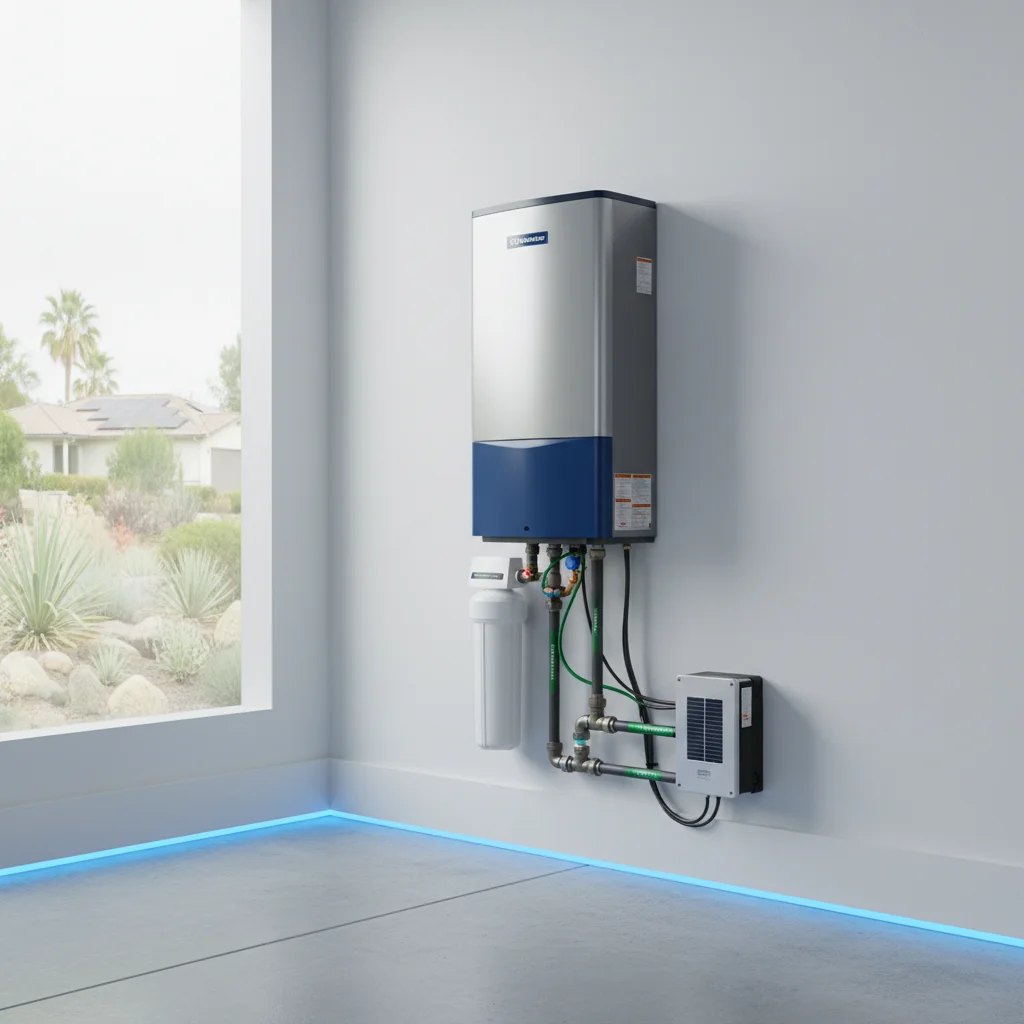
California's energy crisis of 2000-2001 drove electricity prices to triple their normal rates overnight. And in 2026, the state's push toward electrification means water heating accounts for 18% of a home's total energy consumption—second only to HVAC systems. Replacing an aging gas tank with a heat pump water heater can slash those costs by 60-70%, but the upfront investment ranges from $1,200 to $8,500 depending on technology, capacity, and installation complexity.
How Much Does Water Heater Replacement Cost in California?
Water heater replacement in California costs $1,200 to $8,500 installed in 2026, with conventional 40-50 gallon gas tanks at $1,200-$2,800, electric tanks at $800-$1,500, tankless gas units at $3,000-$5,500, and heat pump water heaters at $2,500-$8,500 including labor and permits.
So what drives the 7x price spread? Technology complexity, energy source, and labor intensity. Conventional tank replacements take 2-4 hours and require basic plumbing connections. But heat pump systems need dedicated 240V circuits, condensate drains, and 1,000 cubic feet of surrounding air space—pushing installation time to 6-10 hours in retrofit scenarios.
And the equipment itself varies wildly. A basic 40-gallon electric tank costs $400-$800 wholesale. A 50-gallon heat pump water heater with integrated controls runs $1,800-$3,200 before installation. Rheem, A.O. Smith, and Bradford White dominate the California market, with Energy Star-certified heat pump models qualifying for both federal tax credits and utility rebates.
California's Title 24 building code mandates specific efficiency standards. New construction and full replacements in climate zones 1-16 require water heaters with Uniform Energy Factor (UEF) ratings of 0.64 or higher for gas units, 0.93 or higher for electric resistance, and 2.0+ for heat pump models. Tankless condensing gas heaters typically hit 0.82-0.96 UEF, while premium heat pump units reach 3.5-4.0.
Labor costs vary by region and contractor licensing. Bay Area and coastal installations run $150-$250 per hour for licensed C-36 plumbing contractors. Inland Empire and Central Valley rates drop to $100-$175 per hour. Permit fees add $50-$200 depending on jurisdiction, and some cities require seismic strapping upgrades ($75-$150) or expansion tank installation ($125-$200) to meet current code.
"Heat pump water heaters use up to 60% less energy than conventional electric resistance water heaters" — U.S. Department of Energy
What's the ROI and Payback Period for Upgrading Your Water Heater?
Heat pump water heater upgrades in California deliver 8-12 year payback periods with $300-$600 annual energy savings, while federal 30% tax credit (this federal credit ended for property placed in service after December 31, 2025)s and $500-$2,000 utility rebates cut effective costs from $4,500 to $2,000-$2,500, reducing payback to 4-7 years for households using 50+ gallons daily.
The math changes dramatically based on household size and energy rates. A family of four using 64 gallons of hot water daily pays $450-$650 annually with a conventional electric tank at California's average $0.28/kWh rate. Switching to a heat pump model with 3.5 UEF drops that to $150-$250 annually—a $300-$400 difference.
But coastal households on tiered PG&E rates see faster returns. Tier 3 electricity hits $0.40-$0.52/kWh during summer months. And heat pump water heaters shift 60-70% of consumption to off-peak hours when paired with timer controls, avoiding peak pricing entirely in some cases.
Calculate your specific savings with DuloCore's free rebate calculator that factors in your zip code, household size, and current energy rates.
Which Water Heater Type Is Best for Your California Climate Zone?
Heat pump water heaters perform optimally in climate zones 3-10 (Central Valley, Inland Empire, Sacramento) with year-round ambient temperatures above 40°F, while coastal zones 1-2 and mountain zones 14-16 see 15-25% efficiency penalties requiring supplemental resistance heating during cold months.
California's 16 climate zones create vastly different operating conditions. Heat pump water heaters extract thermal energy from surrounding air—they're essentially reverse air conditioners for water. So garage or basement temperatures matter enormously. Fresno (zone 13) maintains 55-85°F ambient temps year-round, allowing heat pumps to operate in high-efficiency mode 95%+ of the time.
But Truckee (zone 16) drops below 40°F for 4-5 months annually. Heat pump efficiency plummets below 2.0 UEF when source air falls under 45°F, forcing the unit into backup resistance mode. That negates the efficiency advantage entirely during winter—the season with highest hot water demand.
Tankless gas heaters work universally across all zones but require adequate combustion air and venting. Condensing models need 1-2% slope on PVC vent pipes to drain acidic condensate, complicating retrofits in homes with existing metal B-vents. And California's push toward all-electric homes makes new gas connections increasingly difficult in cities like Berkeley, San Jose, and Santa Barbara that restrict gas hookups in new construction.
Southern California's zones 6-10 favor solar thermal systems with electric backup. Year-round sunshine and mild winters deliver 60-80% solar fraction—the percentage of hot water needs met by solar collectors. A 64-square-foot solar thermal array with 80-gallon storage tank costs $5,500-$8,500 installed but offsets 4,000-6,000 kWh annually in these zones.
How Does a New Water Heater Compare to Repair or Alternative Solutions?
Repairing a 10+ year old water heater costs $250-$800 for element/thermostat replacement but leaves existing inefficiency unchanged, while new heat pump installation delivers $300-$600 annual savings that recover the $2,000-$2,500 net cost (after rebates) within 4-7 years compared to keeping an aging 0.90 UEF tank.
The repair-versus-replace calculation hinges on remaining lifespan and efficiency gap. Conventional tanks last 8-12 years. A 9-year-old unit with a failed heating element costs $350-$500 to repair but likely fails again within 18-36 months. And that repair doesn't improve the baseline 0.90-0.95 UEF efficiency.
Point-of-use tankless heaters offer another path. Installing 2-3 small electric tankless units at high-demand fixtures (master bath, kitchen) costs $800-$1,500 total and eliminates standby heat loss entirely. But whole-house tankless gas systems require upsizing gas lines from 1/2" to 3/4" diameter ($1,200-$2,500) to supply the 150,000-199,000 BTU/hour burner input.
Hybrid approaches work well in larger homes. Keep the existing central tank for baseline demand, then add a heat pump booster or solar thermal preheat. That cuts replacement cost to $2,000-$3,500 while still capturing 40-60% of the total efficiency gain.
Maintenance matters too. Flushing sediment annually extends tank life by 2-4 years and maintains efficiency. Anode rod replacement every 5-6 years prevents tank corrosion. A $180 annual service contract covers both tasks and catches problems before they become $800 emergency repairs.
For homeowners exploring comprehensive efficiency upgrades, learn more about available energy tax credits that stack with water heater rebates.
What Rebates and Tax Credits Are Available for California Homeowners?
California homeowners in 2026 access federal 30% tax credits capped at $2,000 for heat pump water heaters under the Inflation Reduction Act, plus utility rebates of $500-$2,000 from PG&E, SoCalGas, SDG&E, and SMUD, with combined savings reducing $4,500 installations to $2,000-$2,500 net cost. (Note: Federal tax credit percentages and availability are subject to change; the 30% Residential Clean Energy Credit under Section 25D expired December 31, 2025. Verify current incentives at energy.gov.)
The federal Energy Efficient Home Improvement Credit (Section 25C) ended for property placed in service after December 31, 2025 (IRS FS-2025-05). Federal tax credits for this work have ended, but state, local and utility rebates may still apply; check what is available at your address with the DuloCore rebate calculator. That replaces the expired Section 25C credit structure. And the credit applies to primary residences, second homes, and rental properties alike—a significant expansion from prior programs.
But income limits apply to the full credit amount. Households earning under 80% of Area Median Income (AMI) qualify for the full 30%. Those above 80% AMI still get the credit but may face phase-outs after 150% AMI depending on filing status and location. For 2026, 80% AMI in San Francisco equals $104,400 for a family of four, while Fresno sits at $66,800.
The federal Residential Clean Energy Credit (Section 25D) ended for expenditures made after December 31, 2025, and the IRS treats an expenditure as made when installation is completed (IRS FS-2025-05).
PG&E offers $1,500-$2,000 for replacing gas tanks with 50+ gallon heat pump models in electrically heated homes. SoCalGas provides $800-$1,200 for condensing tankless gas upgrades. And SMUD's $750 heat pump water heater rebate requires no income qualification—just proof of purchase and AHRI certificate.
Tech Clean California launched a 2026 pilot in disadvantaged communities offering point-of-sale rebates up to $4,000 for heat pump water heaters, eliminating the need to finance upfront costs and wait for tax season. Check eligibility at the California Energy Commission's database.
Learn how these incentives integrate with broader heat pump rebates for whole-home electrification projects.
What's the Installation Process and How Long Does It Take?
Professional heat pump water heater installation takes 6-10 hours across two days for retrofit scenarios, including electrical circuit upgrades ($400-$800), condensate drain routing, expansion tank installation, permit inspection, and commissioning, while direct tank-to-tank replacements complete in 2-4 hours on the same day.
Day one starts with the site assessment. Contractors measure clearance requirements—heat pump units need 750-1,000 cubic feet of air space and 12-18 inches on all sides for airflow. Garage installations work best since ambient temperatures stay moderate and noise doesn't disrupt living spaces. Basement installs require dehumidification assessment since heat pumps cool and dehumidify surrounding air, potentially creating condensation issues.
Next comes electrical infrastructure. Heat pump water heaters draw 1,500-5,500 watts during operation, requiring dedicated 20-30 amp circuits at 240V. Homes built before 1990 often need panel upgrades or circuit additions. A licensed C-10 electrical contractor runs new wiring from the panel to the water heater location—1-3 hours of labor at $125-$200 per hour.
Day two handles removal, installation, and testing. The old tank gets drained (15-30 minutes), disconnected, and hauled away. The new unit goes in, plumbing connections get made with flexible supply lines and expansion tanks, condensate drains route to nearby floor drains or sump pumps, and the electrical connection finalizes. Then comes the 2-3 hour commissioning process: fill the tank, purge air from lines, test safety valves, verify proper heat pump operation, and set temperature controls to 120°F.
Permit inspections add 1-2 days depending on jurisdiction scheduling. Most cities allow rough-in and final inspection on the same visit for straightforward replacements. But homes built before 1978 may trigger lead pipe replacement requirements, and structures in seismic zones 3-4 need enhanced strapping that adds $150-$300 to material costs.
Official Sources
- U.S. Department of Energy - Energy Saver — Federal guidance on water heater efficiency, heat pump technology, and energy-saving strategies
- DSIRE USA — Comprehensive database of state incentives, utility rebates, and federal tax credits for renewable energy and efficiency upgrades (note: the federal 25C and 25D credits ended for projects completed after December 31, 2025)
- California Energy Commission — State-level efficiency standards, Title 24 code requirements, and California-specific rebate programs
Related Reading: Learn more about Free Water Heater Replacement Program.
Frequently Asked Questions
How much does a water heater replacement cost in California?
Water heater replacement costs $1,200-$8,500 in California depending on technology. Conventional 40-50 gallon gas tanks run $1,200-$2,800 installed, electric resistance tanks cost $800-$1,500, tankless gas systems range $3,000-$5,500, and heat pump water heaters cost $2,500-$8,500. Labor adds $100-$250 per hour for 2-10 hours depending on complexity. Permits add $50-$200. Bay Area installations cost 20-40% more than Central Valley.
What rebates are available for water heater replacement in California?
The federal Energy Efficient Home Improvement Credit (Section 25C) ended for property placed in service after December 31, 2025 (IRS FS-2025-05). Utility rebates include PG&E's $1,500-$2,000, SoCalGas's $800-$1,200, SMUD's $750, and SDG&E's $600-$1,000 depending on model efficiency. Tech Clean California offers $4,000 point-of-sale rebates in disadvantaged communities. Combined savings reduce $4,500 installations to $2,000-$2,500 net cost.
Do I qualify for water heater replacement rebates in California?
Federal tax credits require heat pump water heaters with 2.0+ Uniform Energy Factor ratings installed in primary or secondary residences. Utility rebates require account holder status, replacement of existing units, and Energy Star certification. Income limits apply to some programs—households under 80% Area Median Income ($66,800-$104,400 depending on county) qualify for enhanced rebates. Rental properties qualify for federal credits but not most utility programs.
How long does it take to get a water heater rebate in California?
Federal tax credits apply when filing annual returns—typically 2-14 months after installation depending on calendar timing. Utility rebates process in 6-12 weeks after submitting receipts, AHRI certificates, and proof of recycling. Tech Clean California's point-of-sale rebates apply instantly at participating retailers. And some contractors handle rebate paperwork as part of installation, reducing homeowner administrative burden to signing authorization forms.
What's the difference between federal and state water heater rebates?
The federal Energy Efficient Home Improvement Credit (Section 25C) ended for property placed in service after December 31, 2025 (IRS FS-2025-05). State and utility rebates arrive as checks or bill credits 6-12 weeks after installation, with fixed amounts ($500-$2,000) based on equipment type rather than percentages. Federal credits have no income limits for the credit itself, while many California utility programs prioritize low-moderate income households.
Ready to calculate your water heater replacement savings? Use our free rebate calculator to find federal tax credits, utility rebates, and total project costs based on your California zip code, household size, and current energy rates. Get your personalized estimate in 60 seconds.
Last reviewed: April 14, 2026. Reviewed by DuloCore Energy Specialists. About the team.
Check your California water heater rebate eligibility — see the programs you qualify for and the dollar amounts on our California water heater rebate finder.