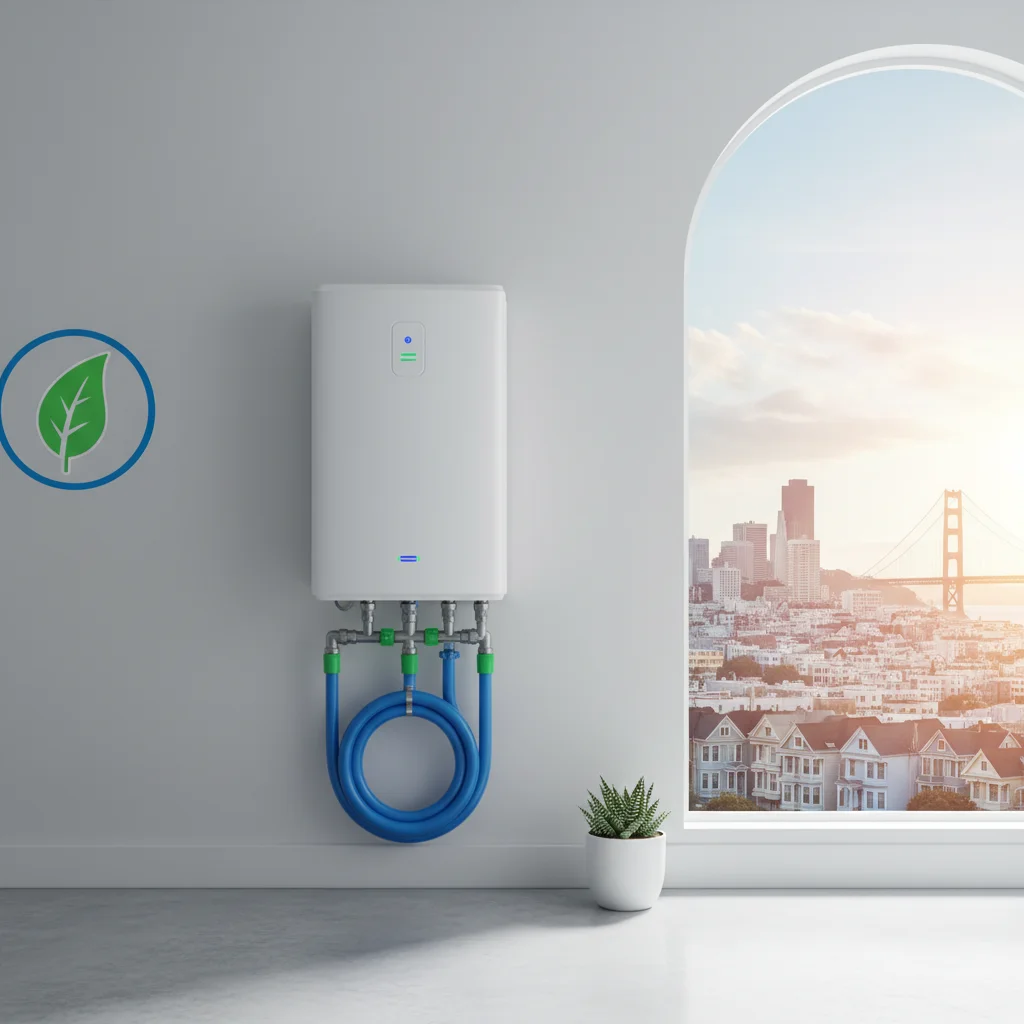
San Francisco homeowners replaced 4,200 gas water heaters with electric heat pump models in 2025, claiming $12.6 million in combined federal, state, and utility rebates. And that number's climbing fast. The city's aggressive building electrification ordinance, combined with stacked incentives from the Inflation Reduction Act and Bay Area Air Quality Management District, makes 2026 the most lucrative year yet to ditch gas and upgrade. But funding allocates on a first-come basis, and two of the four major programs impose pre-approval requirements that slow timelines by 3-4 weeks.
What water heater rebates are available in San Francisco right now?
San Francisco water heater rebates in 2026 combine federal IRA tax credits, California state programs, PG&E utility incentives, and Bay Area Air Quality Management District grants. The federal Energy Efficient Home Improvement Credit (Section 25C) ended for property placed in service after December 31, 2025 (IRS FS-2025-05). Federal tax credits for this work have ended, but state, local and utility rebates may still apply; check what is available at your address with the DuloCore rebate calculator. California's TECH Clean California offers point-of-sale rebates ranging from $500 to $3,750 depending on income level. PG&E provides $750 for qualified heat pump water heater installations. And BAAQMD's Bay Area Air Quality Incentive Program adds $1,500 for gas-to-electric conversions. These programs stack, allowing eligible households to claim $5,000-$7,250 in total incentives for a single heat pump water heater installation.
So a moderate-income household replacing a 50-gallon gas tank with an 80-gallon heat pump unit sees equipment costs of $3,800, installation of $2,200, total project cost of $6,000, minus $5,250 in combined rebates—net cost $750. But deadlines matter. TECH Clean California funding depletes quarterly, and BAAQMD's program closes applications when the annual $4.2 million budget exhausts, typically by October.
"Heat pump water heaters use up to 63% less energy than standard electric models and 73% less than gas units." — U.S. Department of Energy
Check your total available rebates with our free rebate calculator before starting your project.
How much money can you get back with San Francisco water heater rebates?
San Francisco water heater rebate amounts range from $2,000 to $7,250 depending on household income, equipment type, and program eligibility. Standard-income households qualify for $2,750 in stacked incentives: $2,000 federal tax credit plus $750 PG&E rebate. Moderate-income households earning 80-150% of area median income receive $5,250: $2,000 federal credit, $2,500 TECH Clean California rebate, $750 PG&E rebate, and $1,500 BAAQMD grant. Low-income households under 80% AMI access $7,250: $2,000 federal credit, $3,750 TECH rebate, $750 PG&E rebate, and $1,500 BAAQMD grant—plus zero-interest financing covers remaining costs. And the 2026 area median income threshold for San Francisco sits at $129,300 for a four-person household, meaning families earning up to $193,950 still qualify for moderate-income tiers.
| Program | Standard Income | Moderate Income (80-150% AMI) | Low Income (<80% AMI) |
|---|---|---|---|
| Federal IRA Tax Credit | Ended Dec 31, 2025 | Ended Dec 31, 2025 | Ended Dec 31, 2025 |
| TECH Clean California | $0 | $2,500 | $3,750 |
| PG&E Rebate | $750 | $750 | $750 |
| BAAQMD Grant | $1,500 | $1,500 | $1,500 |
| Total Available | $4,250 | $6,750 | $8,000 |
But these numbers assume full eligibility. Households must replace an existing gas or propane water heater to qualify for BAAQMD's $1,500 conversion incentive—new construction doesn't count. And the federal credit phases down to 26% in 2033, 22% in 2034, then expires, so 2026's 30% rate represents peak savings. Read more about timing considerations in our guide to energy tax credits.
What are the eligibility requirements for San Francisco water heater rebates?
San Francisco water heater rebate eligibility requires property type verification, income documentation, equipment specifications, and contractor licensing. The federal IRA tax credit applies to primary residences only—rental properties owned by individuals don't qualify unless the owner occupies one unit in a multi-family building. TECH Clean California and BAAQMD programs mandate replacement of existing fossil fuel water heaters, excluding new construction or electric-to-electric upgrades. Equipment must meet ENERGY STAR specifications with a Uniform Energy Factor (UEF) of 3.0 or higher and certified NEEA Advanced Water Heating Specification (AWHS) Tier 3 or Tier 4 rating. And installation requires a California-licensed C-36 plumbing contractor, C-20 HVAC contractor, or C-10 electrical contractor depending on scope.
Income documentation varies by program. TECH Clean California accepts IRS Form 1040 showing adjusted gross income for the prior tax year, or participation in qualifying assistance programs like CalFresh, Medi-Cal, or LIHEAP. BAAQMD's verification process requires W-2 forms, pay stubs covering the most recent 3 months, or a signed letter from a social service agency. So households without traditional income documentation still access rebates through program participation proof. But applications submitted without complete documentation face rejection rates of 40-50%, delaying installations by 4-8 weeks while applicants resubmit paperwork.
Property owners in rent-controlled units face additional restrictions under San Francisco's Residential Rent Stabilization Ordinance. Landlords can't pass through rebate-funded improvement costs as capital improvement passthroughs, since rebates reduce the net capitalized cost of upgrades. Review more details on heat pump rebates for multi-family applications.
Do you need pre-approval before installing a new water heater in San Francisco?
San Francisco water heater rebate programs split on pre-approval requirements, with two requiring advance application and two offering retroactive claims. BAAQMD's Bay Area Air Quality Incentive Program mandates pre-approval before equipment purchase or installation begins—applications submitted after project completion receive automatic rejection. TECH Clean California operates as a point-of-sale rebate processed by participating contractors at the time of purchase, so pre-enrollment with income verification must occur before the transaction. But PG&E's rebate accepts retroactive applications within 180 days of installation, requiring only proof of purchase and completed installation verification. Form 5695 only covers qualifying work completed by December 31, 2025 and claimed on a 2025 return; the federal 25C and 25D credits ended after that date (IRS FS-2025-05).
So the strategic timeline requires BAAQMD pre-approval first (3-4 weeks processing), TECH Clean California income verification second (1-2 weeks), contractor selection and equipment ordering third, installation fourth, then PG&E retroactive claim and federal tax credit filing. Homeowners who install first and apply later forfeit the two largest rebates, losing $2,500-$3,750 from TECH and $1,500 from BAAQMD. But pre-approval processing timelines extend project duration by 4-6 weeks compared to gas replacement without rebate claims, creating tension between immediate water heater failure replacement needs and maximum rebate capture.
"California's building electrification programs prevented 1.8 million metric tons of CO2 emissions in 2025, equivalent to removing 390,000 gasoline vehicles from roads for one year." — California Energy Commission
What is the deadline for claiming San Francisco water heater rebates?
San Francisco water heater rebate deadlines range from 180 days to open-ended depending on the program, with funding availability creating de facto cutoffs before official end dates. The federal Energy Efficient Home Improvement Credit (Section 25C) ended for property placed in service after December 31, 2025 (IRS FS-2025-05). PG&E's rebate requires application submission within 180 days of installation completion, with installations occurring January 1, 2026 forward eligible for current program year funding. TECH Clean California operates on a rolling basis until state funds deplete, with $30 million allocated for fiscal year 2026 (July 1, 2025 through June 30, 2026) and current spending rates suggesting depletion by May 2026. And BAAQMD's program year runs July 1, 2025 through June 30, 2026, with the $4.2 million budget historically exhausting 2-3 months before the fiscal year closes.
So realistic planning timelines account for funding depletion, not official deadlines. TECH Clean California funding depleted in April 2025, leaving May-June applicants without state rebates despite official program continuation. BAAQMD closed applications on October 15, 2025, after receiving requests totaling 340% of available funding. But both programs received supplemental appropriations in July 2025, extending access. The 2026 state budget includes $45 million for TECH Clean California, a 50% increase aimed at year-round availability, though demand modeling suggests November 2026 depletion.
Track real-time funding status on DSIRE USA, which updates California program availability weekly based on administrator reports.
How do San Francisco water heater rebates compare to other California cities?
San Francisco water heater rebates exceed most California cities by $1,500-$3,000 due to BAAQMD's fossil fuel conversion incentive and higher PG&E rebate amounts. San Francisco homeowners access $4,250-$8,000 in combined incentives compared to $2,750-$5,250 in Los Angeles (no BAAQMD equivalent, lower LADWP rebates), $3,250-$6,250 in San Diego (SDG&E offers $1,000 rebate but no air district conversion grant), and $2,750-$5,750 in Sacramento (SMUD provides $800 rebate). And income thresholds favor Bay Area residents—San Francisco's 80% AMI cutoff of $103,440 for a four-person household exceeds Sacramento's $66,800 and Fresno's $52,400, extending moderate-income rebate access to higher earners. But San Francisco's higher equipment and installation costs ($6,000 average total project cost) versus $4,800 in Riverside or $5,200 in Fresno partially offset rebate advantages.
The table below compares total available rebates across California's five largest metro areas for moderate-income households:
| Metro Area | Federal Credit | State/Local Programs | Utility Rebate | Air District | Total Available |
|---|---|---|---|---|---|
| San Francisco | $2,000 | $2,500 | $750 | $1,500 | $6,750 |
| Los Angeles | $2,000 | $2,500 | $750 | $0 | $5,250 |
| San Diego | $2,000 | $2,500 | $1,000 | $0 | $5,500 |
| Sacramento | $2,000 | $2,500 | $800 | $0 | $5,300 |
| Riverside | $2,000 | $2,500 | $500 | $0 | $5,000 |
San Francisco's advantage stems from Bay Area air quality mandates. BAAQMD's 2017 grant program targets Spare the Air nonattainment zones where ground-level ozone exceeds EPA standards 20+ days annually. So geographic-specific air quality challenges create localized incentive opportunities unavailable in compliant regions. Explore more regional differences in our water heater rebates overview.
Official Sources
- U.S. Department of Energy: Heat Pump Water Heaters — Federal guidance on equipment specifications, energy savings calculations, and tax credit eligibility (note: the federal 25C and 25D credits ended for projects completed after December 31, 2025)
- DSIRE USA: California Incentives — Comprehensive database of state, utility, and local rebate programs with current funding status and application links
- California Energy Commission: Building Electrification — State policy framework, program updates, and emissions reduction data
Frequently Asked Questions
What water heater rebates are available in San Francisco?
San Francisco offers four stacked water heater rebates in 2026: the federal IRA Heat Pump Water Heater Tax Credit ($2,000), TECH Clean California point-of-sale rebates ($500-$3,750 based on income), PG&E utility rebates ($750), and BAAQMD fossil fuel conversion grants ($1,500). Combined maximum reaches $8,000 for low-income households replacing gas water heaters with qualifying heat pump models. Standard-income households access $4,250 in total incentives.
How much money can I get for replacing my water heater in San Francisco?
San Francisco water heater rebate amounts total $4,250 for standard-income households, $6,750 for moderate-income households (80-150% AMI), and $8,000 for low-income households (under 80% AMI). The 2026 area median income for a four-person household in San Francisco is $129,300, so families earning up to $193,950 qualify for moderate-income tiers. Equipment must meet ENERGY STAR specifications with UEF 3.0+ and replace existing fossil fuel water heaters.
Am I eligible for a water heater rebate in San Francisco?
San Francisco water heater rebate eligibility requires replacing an existing fossil fuel water heater in a primary residence with an ENERGY STAR-certified heat pump model installed by a California-licensed contractor. Income verification applies to TECH Clean California and BAAQMD programs, with 2026 moderate-income thresholds at 80-150% of area median income ($103,440-$193,950 for four-person households). Rental properties don't qualify for federal credits unless owner-occupied. New construction installations exclude BAAQMD's $1,500 conversion grant.
What is the deadline for water heater rebates in San Francisco?
San Francisco water heater rebate deadlines vary by program. PG&E requires applications within 180 days of installation. BAAQMD's fiscal year runs July 1, 2025 through June 30, 2026, but funding typically depletes by October. TECH Clean California's $45 million allocation for fiscal year 2026 projects depletion by November based on current demand. The federal Energy Efficient Home Improvement Credit (Section 25C) ended for property placed in service after December 31, 2025 (IRS FS-2025-05). Apply for pre-approval programs (BAAQMD, TECH) before equipment purchase to avoid disqualification.
How do I apply for a water heater rebate in San Francisco?
San Francisco water heater rebate applications follow a four-step sequence: first submit BAAQMD pre-approval online at baaqmd.gov/incentives (3-4 week processing), second complete TECH Clean California income verification through a participating contractor (1-2 weeks), third install equipment with a licensed C-36/C-20/C-10 contractor, fourth submit PG&E rebate application at pge.com/rebates within 180 days with installation verification. Form 5695 only covers qualifying work completed by December 31, 2025 and claimed on a 2025 return; the federal 25C and 25D credits ended after that date (IRS FS-2025-05). Track all receipts, manufacturer certifications, and contractor license numbers for documentation requirements across programs.
Ready to calculate your total savings? Use our free rebate calculator to instantly see how much you can claim based on your income, location, and equipment choices. Get personalized rebate estimates in under 60 seconds and download a step-by-step application timeline for maximum incentive capture.
Last updated April 14, 2026 — reviewed by DuloCore Editorial. About our authors.
Check your California water heater rebate eligibility — see the programs you qualify for and the dollar amounts on our California water heater rebate finder.