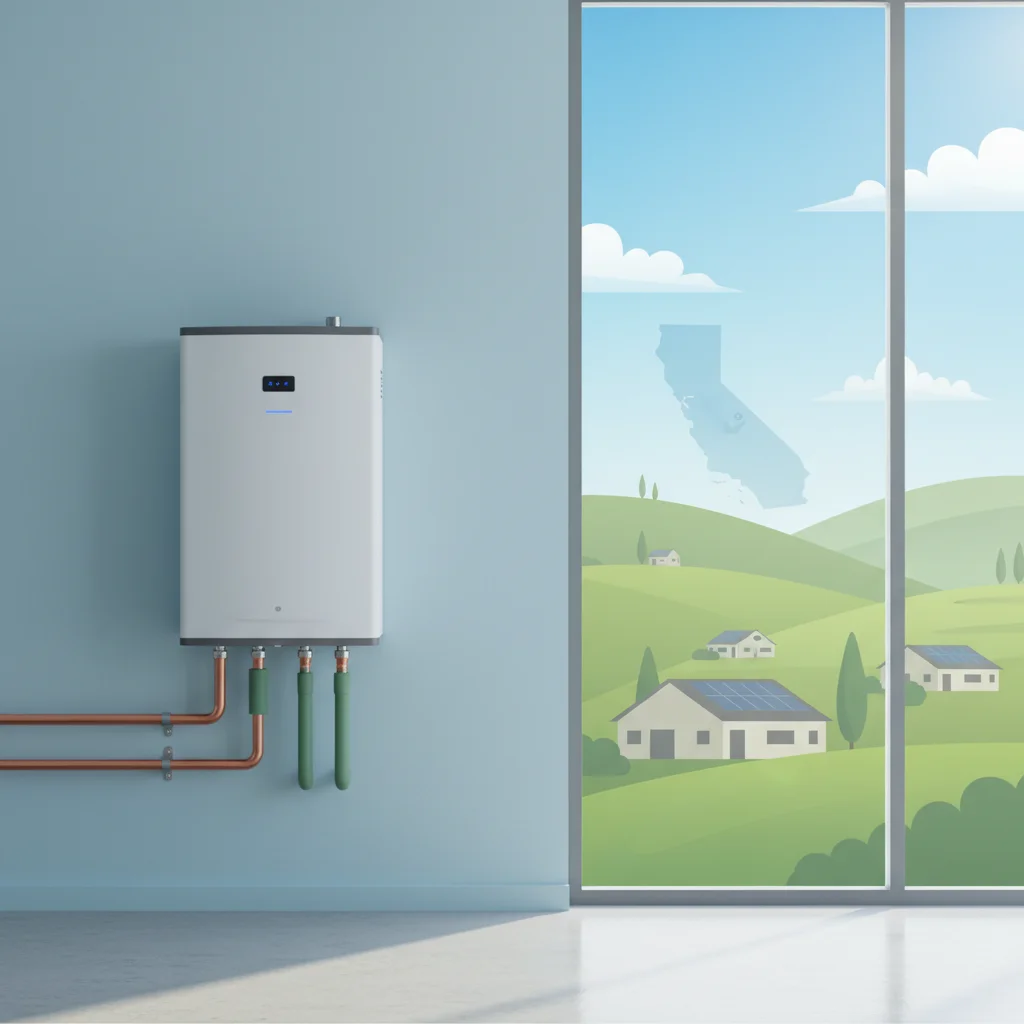
Water Heater Rebates California
Water Heater Rebates California: everything you need to know about eligibility, amounts, and the application process.
California homeowners replaced 1.2 million water heaters in 2025, but fewer than 18% claimed available rebates worth up to $8,500 per installation. Between state programs, utility incentives, and federal tax credits, households leave an average of $4,200 unclaimed every year—money that could offset the $3,500-$6,000 upfront cost of upgrading to an efficient heat pump water heater.
What Water Heater Rebates Are Available in California Right Now?
California offers three layers of water heater rebates in 2026: the California Energy Commission's Tech Clean California program provides up to $4,000 for heat pump water heaters, major utilities like PG&E and SoCal Gas offer $500-$2,500 for qualified units, and the federal IRA tax credit covers 30% of equipment and installation costs up to $2,000. These programs stack, allowing eligible homeowners to claim multiple incentives on a single water heater replacement.
And the availability varies by region. Tech Clean California operates statewide but prioritizes low-to-moderate income households earning below 80% of area median income. Utility rebates depend on your service provider—PG&E customers access different amounts than SDG&E or SMUD customers. So verifying your utility's current offerings through their online rebate portal before purchasing equipment ensures you qualify for the maximum available incentive.
But not all water heaters qualify. Programs require ENERGY STAR certification or a Uniform Energy Factor (UEF) rating of 2.0 or higher for heat pump models. And gas storage tank water heaters must meet UEF 0.67 or higher to qualify for most utility rebates, though incentive amounts are typically $300-$500 lower than heat pump equivalents.
"Heat pump water heaters use up to 60% less energy than standard electric resistance models, saving the average household $330 annually on utility bills." — U.S. Department of Energy
Or you can layer federal and state incentives. The IRA's Residential Energy Efficient Property Credit allows homeowners to claim 30% of the cost of heat pump water heaters as a tax credit, with a maximum of $2,000 per installation. This stacks with California's state and utility rebates, creating combined savings of $6,000-$8,500 for qualifying households installing a $4,500-$5,500 heat pump unit.
How Much Can You Save with California Water Heater Rebates?
Total rebate amounts range from $800 to $8,500 depending on household income, equipment type, and utility provider. Tech Clean California's base rebate of $1,500 increases to $4,000 for households earning below 80% of area median income—$90,400 for a family of four in Los Angeles County. And utility incentives add another $500-$2,500, while the federal tax credit contributes up to $2,000.
So a moderate-income household in PG&E territory installing a $5,000 heat pump water heater can claim $4,000 from Tech Clean California, $1,500 from PG&E, and $1,500 (30% of $5,000) from the federal tax credit—totaling $7,000 in combined rebates. That reduces the net cost to $3,000 for a system that saves $330 annually on energy bills, creating a payback period of 9 years.
But higher-income households still save significantly. Those earning above 80% AMI qualify for the $1,500 base Tech Clean California rebate plus utility incentives and federal credits. A household in San Diego installing a $4,500 unit through SDG&E receives $1,500 state, $800 utility, and $1,350 federal—totaling $3,650 in rebates for a net cost of $2,850.
And the savings multiply over time. Heat pump water heaters last 12-15 years and save $330-$500 annually compared to standard electric models. So the lifetime energy savings of $4,000-$7,500 exceed the initial net investment by 2-to-1, not counting the avoided replacement cost of a failing traditional water heater.
Or you can use our free rebate calculator to model your specific scenario. Input your zip code, household income, and current water heater type to see your exact rebate eligibility and estimated payback period based on your utility rates and available programs.
Are You Eligible for California Water Heater Rebates?
Eligibility requires three factors: California residency, property ownership or landlord approval, and equipment that meets program specifications. Tech Clean California requires applicants to own a single-family home or duplex and provide proof of income if claiming the enhanced $4,000 rebate tier. And utility rebates require an active account with the participating utility for at least 6 months prior to application.
But income thresholds determine rebate amounts. Households earning below 80% of area median income qualify for maximum rebates—$90,400 for a four-person household in Los Angeles, $102,400 in San Francisco, or $76,800 in Fresno. These limits adjust annually based on HUD data, so checking the current threshold for your county before applying ensures accurate expectations.
And renters face additional barriers. Most programs require property owner approval and permit applications, which landlords may resist due to upfront costs. So renters should present data showing the $330-$500 annual utility savings and offer to coordinate the rebate application process to reduce landlord burden.
Or manufactured homes and condos have special requirements. Mobile homes must meet HUD code standards and remain permanently affixed to a foundation. Condominiums require HOA approval for exterior heat pump installations, as units typically mount outside and may affect building aesthetics or noise levels.
But multifamily properties qualify for different programs. Buildings with 5+ units access California's Multifamily Energy Efficiency Rebate Program instead of Tech Clean California. These incentives pay $800-$1,200 per unit for centralized water heating upgrades, but require professional energy audits and contractor verification.
"California's low-income water heater programs have delivered $47 million in rebates since 2023, helping 12,600 households reduce energy costs by an average of $412 annually." — California Energy Commission
What's the Deadline for Claiming Your Water Heater Rebate?
Tech Clean California operates on a first-come, first-served basis until funds deplete, typically in Q3 or Q4 each fiscal year. The program allocated $180 million for water heater rebates in fiscal year 2026, but demand has exhausted funding 2-3 months before the June 30 deadline in prior years. So applications submitted after September 2026 face higher rejection risk as the budget nears depletion.
And federal tax credits follow the calendar year. Homeowners must complete installation and claim the IRA credit on their 2026 tax return filed by April 15, 2027. The credit doesn't carry forward—if you install in December 2026 but forget to claim it on your 2026 return, you forfeit the benefit. So keeping receipts and contractor invoices organized before tax season prevents lost savings.
But utility rebates have rolling deadlines. Most California utilities accept applications year-round with 60-90 day processing windows. PG&E requires submission within 180 days of installation, while SoCal Edison allows 6 months from the permit final inspection date. Missing these windows forfeits the utility incentive even if state and federal rebates remain available.
Or you can reserve funding before installation. Tech Clean California allows pre-qualification applications that hold a rebate allocation for 90 days while you complete the purchase and installation. This guarantees funding availability but requires submitting proof of income and contractor quotes upfront.
And program renewals aren't guaranteed. California's 2026-27 budget negotiations determine whether Tech Clean California receives continued funding past June 2027. Federal IRA credits remain authorized through 2032, but state programs depend on annual legislative appropriations. So monitoring the California Energy Commission's rebate portal for updates ensures you don't miss program changes.
Can You Stack Multiple Water Heater Rebates Together?
California allows stacking state, utility, and federal incentives on the same water heater installation—but the combined rebates can't exceed the total project cost. A household installing a $5,000 heat pump water heater can claim up to $5,000 in combined incentives from Tech Clean California ($4,000), utility rebates ($1,500), and federal credits (30% of equipment cost). And the federal tax credit calculates based on the gross cost before subtracting state and utility rebates.
But some utilities prohibit double-dipping. LADWP and Sacramento Municipal Utility District require applicants to declare all other rebates received and may reduce their incentive amounts if combined rebates exceed program limits. So reading your utility's rebate terms before applying prevents application rejection or reduced payments.
And manufacturer rebates complicate stacking. If a water heater manufacturer offers a $500 instant rebate at point of sale, some programs subtract that amount from their rebate calculation. The federal tax credit specifically excludes subsidized energy financing and manufacturer incentives from the basis for the 30% calculation. So a $5,000 water heater purchased with a $500 manufacturer rebate only qualifies for a $1,350 federal credit (30% of $4,500), not $1,500.
Or community solar participants face additional restrictions. Homeowners enrolled in shared renewable energy programs through their utility may see reduced rebate eligibility, as some programs calculate savings based on grid energy consumption. This primarily affects utility rebates, not state or federal programs. So checking with your utility before applying clarifies how community solar participation impacts your water heater rebate amount.
What Documentation Do You Need to Apply for a Water Heater Rebate?
All California water heater rebate programs require proof of purchase, installation certification, and equipment specifications. Tech Clean California mandates an itemized contractor invoice showing equipment make/model, labor costs, installation date, and permit numbers. And applicants must submit the water heater's AHRI certification number proving ENERGY STAR qualification or UEF rating compliance.
But income verification adds complexity. Households claiming the $4,000 enhanced Tech Clean California rebate must provide tax returns, W-2 forms, or pay stubs covering the most recent 12 months. And self-employed applicants submit IRS Form 1040 Schedule C showing net income below the 80% AMI threshold for their county and household size.
And utility rebates require account verification. Most programs need a copy of your most recent utility bill showing the service address, account number, and active status. PG&E additionally requires photos of the installed water heater's serial number plate and exterior heat pump unit if applicable. So keeping installation photos and receipts organized prevents application delays.
Or you can streamline federal tax credit claims. The IRS requires homeowners to file Form 5695 (Residential Energy Credits) with their tax return, attaching the manufacturer's certification statement and contractor invoice. And keeping a digital copy of the AHRI certificate downloaded from the manufacturer's website before losing the original prevents scrambling during tax season.
But permit documentation proves compliance. California building codes require permits for water heater replacements, and Tech Clean California rejects applications without permit final inspection approval. And some counties require energy efficiency certifications from Title 24 consultants for heat pump installations. So confirming your jurisdiction's requirements with your contractor before installation avoids rebate forfeiture.
How Do California Water Heater Rebates Compare to Federal Tax Credits?
Federal IRA tax credits provide 30% of equipment and installation costs up to $2,000 annually, while California's Tech Clean California offers fixed amounts of $1,500-$4,000 regardless of system cost. The federal credit favors higher-cost installations—a $6,500 heat pump system qualifies for the full $2,000 federal credit plus $1,500-$4,000 state rebate. But lower-cost systems like a $3,500 ENERGY STAR gas water heater receive only $1,050 federal credit (30% of $3,500) while still qualifying for the full $1,500 state rebate.
And payment timing differs. California and utility rebates arrive 45-90 days after application approval as checks or account credits. Federal tax credits reduce your tax liability on your annual return—if you owe $5,000 in taxes and claim a $2,000 water heater credit, you only pay $3,000. But if you owe $1,500, the credit reduces your bill to $0 without refunding the remaining $500. So households with low tax liability benefit less from federal credits than direct rebate programs.
But federal credits have no income restrictions. California's $4,000 enhanced rebate requires earning below 80% AMI, while the federal 30% credit applies to all taxpayers regardless of income. High-income households installing premium $7,000-$8,000 systems claim up to $2,000 federal credits even when qualifying only for California's $1,500 base rebate.
Or you can optimize by timing. Installing in December allows claiming the federal credit on the current tax year return while waiting for Tech Clean California's next fiscal year allocation if the current budget depletes. This strategy works when state funds exhaust in Q3 but federal deadlines favor end-of-year installations for immediate tax benefit.
And regional variations affect total savings. Households in energy tax credits overlap zones like Northern California access multiple utility programs—PG&E customers receive $1,500 utility rebates while SMUD customers get $2,000. So comparing your utility's incentives against neighboring providers clarifies whether your location maximizes available rebates.
Official Sources
- U.S. Department of Energy - Energy Saver — Federal energy efficiency guidance and rebate information
- California Energy Commission - Rebate Programs — Official state rebate program details and application portals
- Database of State Incentives for Renewables & Efficiency (DSIRE) — Comprehensive database of state and utility energy rebates
Frequently Asked Questions
What water heater rebates are available in California in 2026?
California offers Tech Clean California rebates of $1,500-$4,000 for heat pump water heaters based on income, utility rebates of $500-$2,500 from providers like PG&E and SoCal Gas, and federal IRA tax credits covering 30% of costs up to $2,000. These programs stack for combined savings of $2,800-$8,500 per installation. And eligibility requires ENERGY STAR certification or UEF ratings of 2.0+ for heat pumps.
How much can you save with a California water heater rebate?
Combined rebates range from $2,800 to $8,500 depending on household income, equipment type, and location. Low-income households (below 80% AMI) installing a $5,000 heat pump system save $4,000 state + $1,500 utility + $1,500 federal = $7,000 total. Higher-income households save $1,500 state + $800 utility + $1,500 federal = $3,800. And heat pump units save $330-$500 annually on energy bills over 12-15 year lifespans.
Are you eligible for California water heater rebates?
Eligibility requires California residency, property ownership or landlord approval, and ENERGY STAR certified equipment. Tech Clean California serves single-family homes and duplexes, with enhanced $4,000 rebates for households earning below 80% of area median income ($90,400 for a four-person household in Los Angeles). And utility rebates require an active account for 6+ months. Renters need landlord permission and may face permit approval barriers.
What is the process for applying for a water heater rebate in California?
Applications require an itemized contractor invoice, water heater AHRI certification number, permit final inspection approval, and proof of income for enhanced rebates. Submit applications to Tech Clean California's online portal within 90 days of installation. Utility rebates require separate applications to your provider (PG&E, SoCal Edison, etc.) within 180 days. And federal tax credits require filing IRS Form 5695 with your annual tax return by April 15.
When is the deadline to apply for California water heater rebates in 2026?
Tech Clean California operates first-come, first-served until its $180 million annual budget depletes, typically in September-October. Utility rebates accept applications year-round but require submission within 180 days of installation for PG&E or 6 months for SoCal Edison. And the federal IRA tax credit must be claimed on your 2026 tax return filed by April 15, 2027. Missing these windows forfeits unclaimed incentives.
Ready to find out how much you can save? Use our free rebate calculator to discover your exact eligibility for California's water heater rebates, utility incentives, and federal tax credits based on your zip code and household income. Get a personalized estimate in under 2 minutes.
Last updated: April 14, 2026. Reviewed by the DuloCore Editorial Team. About our authors.
Find Your Rebates
Use our calculator to see how much you can save on your home improvement project.
Calculate My Savings