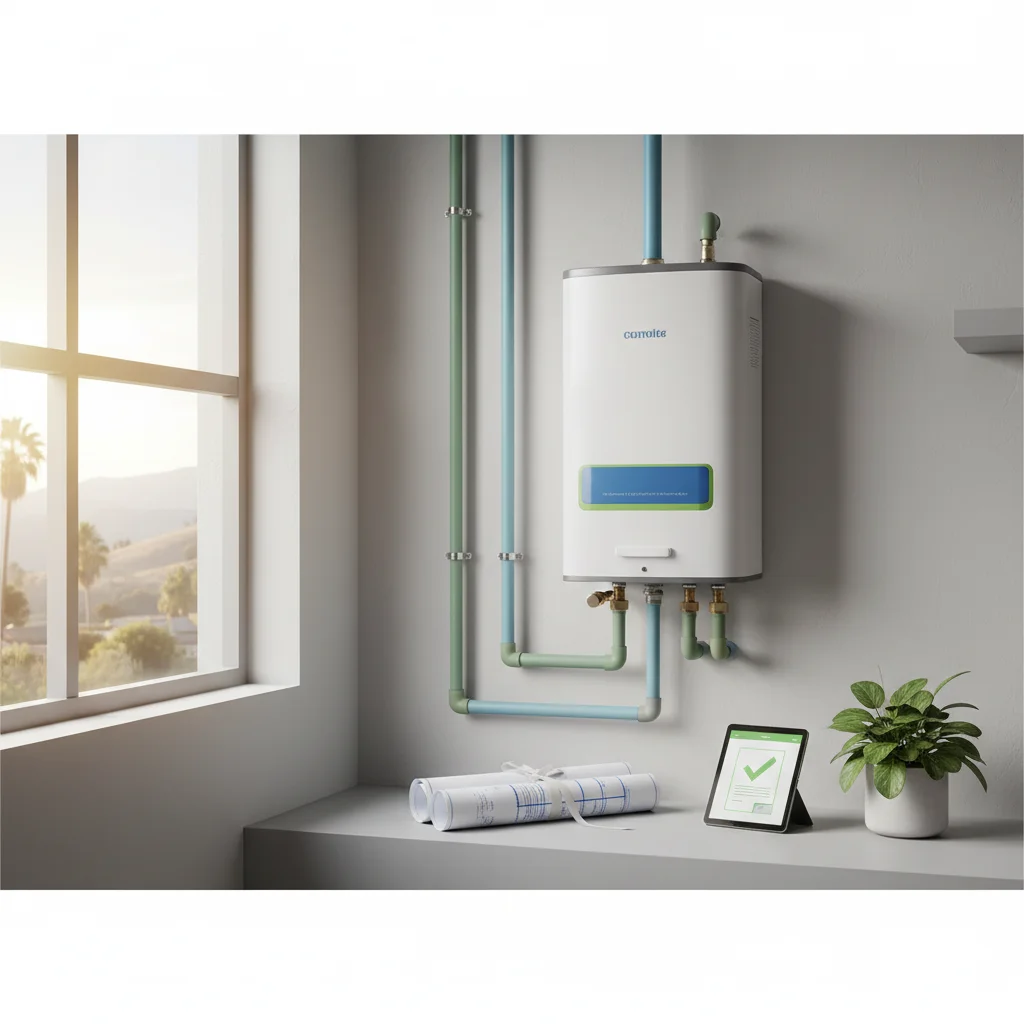
Water heater replacements are one of the most common jobs that need a permit in California, even for a like-for-like swap, because the installation has to meet seismic and safety rules in the California Plumbing Code.
What Are the Specific Permit Requirements for Water Heater Installation in California?
Most California cities require a plumbing permit to install or replace a water heater. Pleasanton's water heater handout, checked November 3, 2026, requires one "to install, remove, relocate or replace a water heater." The inspector checks the code requirements, including seismic straps in the upper and lower thirds of the tank, temperature/pressure relief-valve discharge piping, an expansion tank where the water system needs one, and 18-inch elevation of gas burners in garages unless the unit is listed as flammable-vapor-ignition-resistant. In many cities the permit can be issued to a licensed contractor or to the homeowner. Check your city or county building department.
Permits are generally required for tank, tankless and heat pump water heaters; check your local building department for its rules. For how the types differ, see tankless vs tank water heaters in California and our water heater sizing guide. The installation must pass the building department's inspection before the permit is finaled.
Are There New Hot Water Heater Laws in California for Gas Units?
Yes, but only in the Bay Area: on November 4, 2026, the Bay Area Air District board adopted amendments to Rule 9-6 that delay its zero-NOx standard for home gas water heaters to January 1, 2028. Before you replace a water heater, compare heat pump water heater rebates and check your address on the rebate finder linked at the end of this page.
- What the rule does: a water heater manufactured after the compliance date must emit zero nitrogen oxides (NOx) to be sold or installed in the Bay Area. Heat pump water heaters are the zero-NOx option the Air District points to.
- Who it covers: the Bay Area only. The rule applies only when a water heater is replaced. A working water heater can stay in place until it burns out.
- Dates: units of 75,000 BTU/hour or less (most home tanks) move from January 1, 2027 to January 1, 2028. Larger units, up to 2 million BTU/hour, move from January 1, 2031 to January 1, 2033.
- Who gets until 2033: the adopted amendments set January 1, 2033 for "water heaters installed in multifamily buildings and deed restricted affordable housing as well as certain product categories such as hydronic units, specialized high heat uses, and large water heaters." Gas tankless water heaters usually fall in the larger tier, which the Air District staff report describes as "typically commercial and multifamily as well as tankless units". The staff report defines multifamily as five or more units and says of the 2033 exemptions: "Eligible installations would be limited to water heaters manufactured before January 1, 2033."
- Exemptions: the Air District lists three groups. Low-income owners: "earning less than 80 percent of Area Median Income and including participants in programs such as Medi-Cal or CalFresh; or households paying more than 28 percent of their income toward their mortgage and property taxes." Electrical limits: "such as panels below 100 amps, insufficient panel capacity or a need to run electrical lines more than 50 feet." Space limits: properties "without enough room or ventilation to install a compliant unit." The staff report treats the electrical and space exemption as one-time, and each exemption needs an Air District certificate before installation.
- Not covered at all: "Water heaters with capacity of 30 gallons or less and mobile home water heaters are not required to comply with the zero-NOx standard" (Air District news release 2026-041, November 4, 2026, listed under Official Sources).
- If you replace now: a gas water heater manufactured before the compliance date can still be sold and installed. The permit and inspection rules on this page apply either way.
What the Inspector Checks
The City of Pleasanton's water heater handout (2019 California Plumbing Code references) lists the items an inspector typically looks at:
- Two seismic straps, one in the upper third and one in the lower third of the tank, with the lower strap at least 4 inches above the controls (CPC 507.2).
- A temperature/pressure relief-valve drain extended outside to discharge 6 to 24 inches above grade (CPC 608.5), or, in a garage, ending within 6 inches of the floor where the slab drains away from the house.
- An expansion tank where a check valve, backflow preventer or similar device makes the water system closed (CPC 608.3).
- Gas water heaters in garages elevated 18 inches unless listed as flammable-vapor-ignition-resistant, plus barriers if the unit is exposed to vehicle damage (CPC 507.13).
- Adequate combustion air (CPC 506).
- Vent clearances and termination (CPC 509).
- Insulation on the first 5 feet of the hot and cold pipes (Energy Code 150.0(j)).
- A drain pan where the water heater is installed in an attic or on wood floors (CPC 507.5).