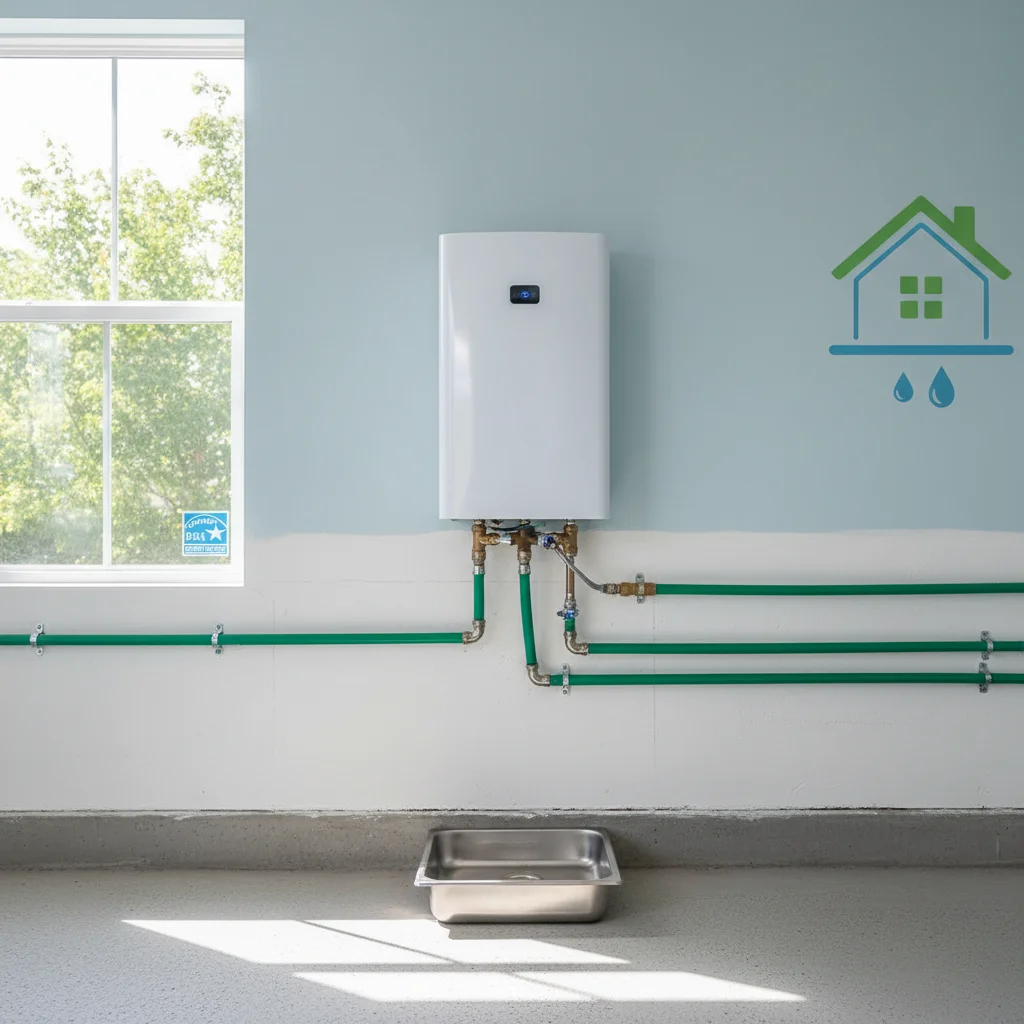
The average Inland Empire household spends $512 annually on water heating — second only to HVAC in home energy costs. And with California's 2026 energy efficiency mandates now in effect, thousands of homeowners across Riverside and San Bernardino counties face replacement decisions for aging tank-style units that no longer meet state performance standards. Installation costs vary from $1,800 for basic gas tank models to $8,500 for heat pump water heaters, but federal tax credits and utility rebates now cover 30-75% of qualified system costs.
How Much Does Water Heater Installation Cost in the Inland Empire?
Water heater installation costs in the Inland Empire range from $1,800 to $8,500 in 2026, depending on system type and fuel source. Standard 50-gallon gas tank models average $2,200 installed, while electric tanks cost $1,950. Heat pump water heaters run $3,800-$5,200. Tankless gas systems cost $3,500-$4,800 installed, and electric tankless units average $2,800-$3,600.
Labor accounts for 40% of total installation costs in the region. So contractors in Riverside charge $85-$110 per hour, while San Bernardino installers average $80-$105 hourly. Permit fees add $150-$400 depending on the municipality. And electrical panel upgrades for heat pump or high-demand electric systems add $800-$2,500 to project totals.
Material costs fluctuate seasonally. Summer demand drives prices up 12-18% across Southern California. But winter installations from November through February often qualify for contractor discounts of 8-15%. Homeowners who bundle water heater replacement with other energy upgrades (insulation, HVAC, solar) typically negotiate 10-20% lower per-unit costs.
The federal Energy Efficient Home Improvement Credit (Section 25C) ended for property placed in service after December 31, 2025 (IRS FS-2025-05). Federal tax credits for this work have ended, but state, local and utility rebates may still apply; check what is available at your address with the DuloCore rebate calculator. California's Self-Generation Incentive Program offers $1,800-$2,400 rebates for qualified heat pump systems. So the net cost for a $4,500 heat pump installation drops to $100-$700 after incentives.
"Heat pump water heaters are two to three times more efficient than conventional electric resistance water heaters." — U.S. Department of Energy
What's the ROI and Payback Period for a New Water Heater Installation?
Heat pump water heaters deliver 8-12 year payback periods in the Inland Empire based on 2026 energy rates. Southern California Edison customers pay $0.28-$0.42 per kWh during peak hours. San Diego Gas & Electric rates run $0.30-$0.48 per kWh. Heat pump systems reduce water heating energy consumption by 60-70% compared to standard electric resistance tanks.
A household using 64 gallons of hot water daily spends $592 annually with a standard electric tank at $0.32 per kWh. The same household pays $207 annually with a heat pump water heater — a $385 annual saving. After federal tax credits and utility rebates, the net $700 investment pays back in 1.8 years.
Gas tankless water heaters show longer payback periods. Installation costs average $4,200, minus no federal incentives (tankless gas units don't qualify). Annual savings versus standard gas tanks run $120-$180. So payback extends to 23-35 years without incentives.
But climate matters. The Inland Empire spans three climate zones: hot-dry desert (Zone 15), warm-dry valley (Zone 10), and mountain regions (Zone 16). Heat pump efficiency peaks in warm climates — Riverside and San Bernardino valley locations see 270-290% efficiency ratings. Mountain communities above 3,000 feet experience reduced performance during winter months when ambient temperatures drop below 40°F.
Homeowners can calculate project-specific ROI using the rebate calculator with local energy rates and household water consumption data.
Which Water Heater Type Is Best for the Inland Empire's Climate Zone?
Heat pump water heaters perform optimally in Climate Zones 10 and 15 that cover 85% of Inland Empire residential areas. These zones average 280+ cooling days annually with summer temperatures exceeding 95°F for 60-90 days. Heat pump systems extract thermal energy from ambient air — hot garage and utility room temperatures boost efficiency by 15-22% during summer months.
Standard electric resistance tanks suit households with minimal hot water demand (1-2 occupants using under 40 gallons daily). But they cost 2.5-3 times more to operate than heat pump alternatives. And California's 2026 Title 24 building codes now require heat pump or solar thermal systems for new construction and major renovations.
Gas tank water heaters remain common in areas with natural gas service. The Inland Empire's natural gas rates average $1.85-$2.20 per therm — competitive with electric resistance but 40-55% more expensive than heat pump operation. So gas systems make sense only where electrical panel capacity prevents heat pump installation or where households already use gas for heating and cooking.
Mountain communities in Zone 16 (Big Bear, Running Springs, Idyllwild) face unique challenges. Ambient temperatures below 40°F reduce heat pump efficiency by 30-45%. These locations benefit from high-efficiency gas tankless systems or hybrid heat pump units with electric resistance backup elements.
Pairing water heaters with solar panels changes the equation. Inland Empire solar installations average $2.80 per watt after federal tax credits. A 5 kW system generates 7,800-8,400 kWh annually — enough to offset a heat pump water heater's 2,100-2,400 kWh consumption plus additional household loads. Learn more about solar incentives in our energy tax credits guide.
Tank vs. Tankless vs. Heat Pump: Which Alternative Saves You the Most Money?
Heat pump water heaters deliver the lowest lifecycle costs in the Inland Empire — $8,200-$9,400 over 15 years including installation, energy, and maintenance. Electric resistance tanks cost $14,600-$16,200 over the same period. Gas tanks run $12,800-$14,400. And tankless gas systems total $13,200-$15,800.
Annual operating costs tell the story. A four-person household using 80 gallons of hot water daily pays these amounts at 2026 Inland Empire rates:
- Heat pump: $260-$310 annually ($0.28-$0.32 per kWh)
- Gas tank: $420-$510 annually ($1.85-$2.20 per therm)
- Electric tank: $740-$890 annually ($0.28-$0.32 per kWh)
- Gas tankless: $380-$460 annually ($1.85-$2.20 per therm, factoring 92-96% efficiency)
But upfront costs vary dramatically. Electric resistance tanks cost $1,800-$2,200 installed with zero incentives. Heat pump systems run $3,800-$5,200 before rebates, dropping to $0-$1,400 after federal credits and utility programs. So the net installed cost often favors heat pumps despite higher equipment prices.
Maintenance factors in. Tank systems require anode rod replacement every 3-5 years ($150-$220) and sediment flushing annually (DIY or $80-$120 professional service). Tankless units need annual descaling in hard water areas — the Inland Empire's water hardness averages 180-240 ppm, necessitating $120-$180 yearly service. Heat pump systems need air filter cleaning quarterly (DIY, 5 minutes) and refrigerant checks every 5 years ($180-$250).
Space requirements matter. Standard tanks occupy 16-20 square feet. Heat pump units need 1,000+ cubic feet of air space and 8+ feet of vertical clearance. Tankless systems mount on walls, freeing floor space but requiring larger gas lines (3/4" minimum) and dedicated 120V electrical circuits for controls.
Families comparing options should review water heater rebates to understand current incentive amounts before making purchase decisions.
How Long Will Your New Water Heater Last and What Affects Its Lifespan?
Gas and electric tank water heaters last 8-12 years in the Inland Empire's hard water conditions. Tankless systems run 15-20 years with proper maintenance. And heat pump water heaters deliver 13-15 years of service — 30-50% longer than standard electric tanks due to reduced heating element stress.
Water quality drives replacement timelines. The Inland Empire's municipal water contains 180-280 ppm dissolved minerals. Calcium and magnesium precipitate inside tanks, forming sediment layers that insulate heating elements and corrode tank interiors. Homes receiving water from the Riverside Public Utilities system (220-240 ppm hardness) see 15-20% shorter tank lifespans than households served by San Bernardino Municipal Water (160-180 ppm).
Annual maintenance extends service life by 3-5 years. Flushing sediment prevents corrosion and maintains heating efficiency. Anode rod replacement stops tank perforation — magnesium rods last 3-4 years in hard water versus 5-6 years in soft water. But only 18% of Inland Empire homeowners perform recommended maintenance, according to 2025 California Energy Commission surveys.
Installation quality matters. Water heaters installed with expansion tanks experience 25-35% fewer pressure-related failures. Seismic strapping (required by California code) prevents earthquake damage — the Inland Empire sits adjacent to the San Andreas and San Jacinto fault zones with elevated seismic risk. And proper temperature settings (120°F maximum) reduce mineral precipitation by 30-40% versus factory default 140°F settings.
Heat pump systems last longer because they generate heat through vapor compression rather than electrical resistance. Heating elements in standard tanks cycle 8-12 times daily, accumulating 35,000-45,000 heating cycles over 10 years. Heat pump compressors cycle less frequently and distribute thermal stress across multiple components. So heat pump water heaters in moderate-use households often exceed 15-year lifespans.
Climate matters. Desert communities (Palm Springs, Indio, Coachella Valley) experience 110°F+ summer temperatures that stress water heater components. Inlet water temperatures reach 80-85°F in summer versus 55-60°F in mountain areas — reducing temperature rise requirements but increasing bacterial growth risk at lower tank temperatures.
Are There Rebates or Tax Credits Available for Water Heater Installation in California?
The federal Energy Efficient Home Improvement Credit (Section 25C) ended for property placed in service after December 31, 2025 (IRS FS-2025-05). This credit covers 30% of equipment and installation costs, capped at $2,000 per household annually. Gas and standard electric resistance water heaters don't qualify for federal incentives in 2026.
California's Self-Generation Incentive Program (SGIP) offers $1,800-$2,400 rebates for qualified heat pump water heaters when paired with solar panels or battery storage. Southern California Edison administers SGIP funds for the Inland Empire — households in equity resilience or equity budget categories receive $2,400 rebates, while general market customers get $1,800.
Local utility programs add another layer. Southern California Edison's Energy Savings Assistance Program provides free heat pump water heater installation for income-qualified households (at or below 250% of federal poverty guidelines). Imperial Irrigation District customers receive $300-$500 rebates for Energy Star certified gas tankless units and $800-$1,200 for heat pump systems.
The federal Energy Efficient Home Improvement Credit (Section 25C) ended for property placed in service after December 31, 2025 (IRS FS-2025-05).
Income limits apply to enhanced incentive tiers. California's equity budget qualifications require household income below 80% of area median income — $76,800 for a family of four in Riverside County, $81,600 in San Bernardino County. But the federal $2,000 credit has no income restrictions.
Processing timelines vary. Federal tax credits claim through annual IRS returns — homeowners receive credits within 60-90 days of filing. Utility rebates require pre-approval in most programs — applications take 14-21 days to process, with rebate checks arriving 45-60 days after installation verification. SGIP funds face high demand with occasional waitlists of 60-120 days.
Combining incentives maximizes savings. A $4,800 heat pump installation receives $2,000 federal credit plus $1,800 SGIP rebate — total $3,800 in benefits against $4,800 cost, leaving $1,000 net expense. Use the rebate calculator to model incentive stacking for specific systems and household circumstances.
Official Sources
- U.S. Department of Energy: Energy Saver — Federal guidance on water heater efficiency, rebates, and technology comparisons
- Database of State Incentives for Renewables & Efficiency — Comprehensive database of federal, state, and utility energy efficiency incentives
- California Public Utilities Commission: SGIP — Self-Generation Incentive Program details, application process, and eligibility requirements
Frequently Asked Questions
How much does a water heater installation cost in the Inland Empire?
Water heater installation costs range from $1,800 to $8,500 depending on system type. Standard 50-gallon gas tanks average $2,200 installed. Electric resistance tanks cost $1,950. Heat pump water heaters run $3,800-$5,200 before rebates. Labor accounts for 40% of total costs at $80-$110 per hour. Permit fees add $150-$400. After federal tax credits and utility rebates, heat pump installations cost $0-$1,400 net.
What rebates are available for water heater installation in the Inland Empire?
The federal Energy Efficient Home Improvement Credit (Section 25C) ended for property placed in service after December 31, 2025 (IRS FS-2025-05). California's SGIP program provides $1,800-$2,400 rebates when paired with solar or battery storage. Southern California Edison offers free installation for income-qualified households through the Energy Savings Assistance Program. Imperial Irrigation District customers receive $800-$1,200 rebates. Total available incentives reach $3,800-$4,400 for qualified installations.
Are there income limits for water heater installation rebates?
The federal $2,000 tax credit has no income restrictions. California's SGIP equity budget tier requires household income below 80% of area median income — $76,800 for a family of four in Riverside County. Southern California Edison's free installation program serves households at or below 250% of federal poverty guidelines ($73,000 for a family of four in 2026). Standard utility rebates have no income limits.
How long does the water heater installation rebate process take?
Federal tax credits process through annual IRS returns within 60-90 days of filing. Utility rebate applications require 14-21 days for pre-approval. Rebate checks arrive 45-60 days after installation verification and submission of final documentation. SGIP funds face occasional waitlists of 60-120 days during peak demand periods. Total timeline from application to payment runs 90-180 days for combined incentive programs.
What is the difference between tank and tankless water heater installation costs?
Tank water heaters cost $1,800-$2,200 installed for standard gas or electric models. Tankless gas systems run $3,500-$4,800 due to larger gas line requirements (3/4" minimum) and dedicated electrical circuits. Electric tankless units cost $2,800-$3,600. But tankless systems eliminate standby heat loss, saving $120-$180 annually on gas bills versus tank models. Tankless units also last 15-20 years compared to 8-12 years for tanks.
Ready to find out exactly how much you'll save? California's 2026 heat pump rebates and federal tax credits can cover up to 75% of your water heater installation costs. Use our free rebate calculator to get a personalized estimate based on your location, household size, and energy usage — it takes less than 2 minutes and shows you every incentive you qualify for.
Updated on April 14, 2026. Fact-checked by DuloCore Editors. About our research team.
Check your California water heater rebate eligibility — see the programs you qualify for and the dollar amounts on our California water heater rebate finder.