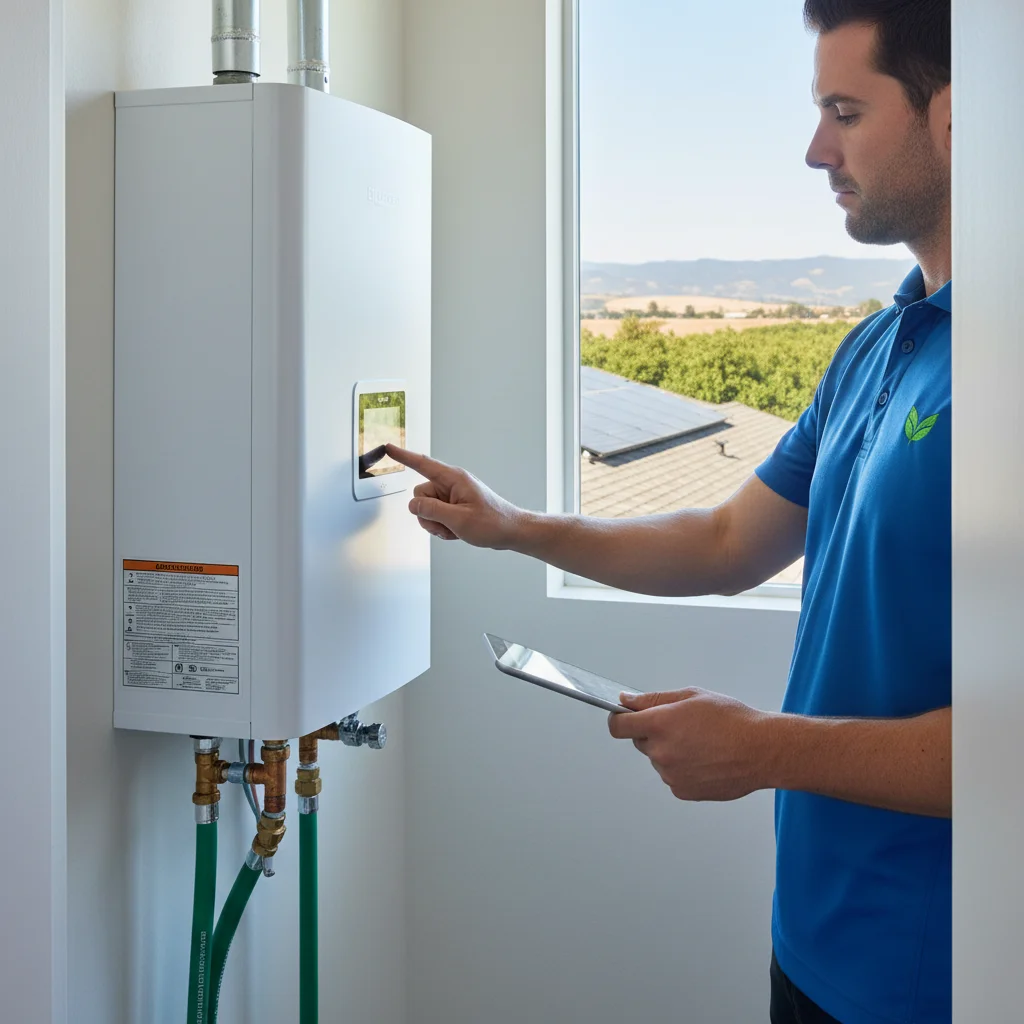
Central Valley homeowners paid an average of $2,847 for water heater installations in 2025, but federal and state rebates now cut that figure by $2,000 or more in 2026. And with new IRA credits extending through 2032, the math on upgrading from a standard tank unit to a heat pump water heater has fundamentally shifted. The upfront premium of $1,200-$3,500 for heat pump models now pays back in 3-6 years through energy savings of $300-$550 annually, making the Central Valley's hot summers and mild winters an ideal testing ground for efficiency upgrades.
How Much Does Water Heater Installation Cost in the Central Valley?
Standard tank water heater installations range from $1,200-$2,200 for 40-50 gallon units, including labor and disposal. Tankless gas systems cost $2,500-$4,500 installed, while heat pump water heaters run $2,400-$5,700 fully installed with electrical upgrades. Labor accounts for 40-50% of total costs, or $480-$1,800 depending on complexity and permit requirements in Fresno, Sacramento, Stockton, and Modesto.
So the type of unit, fuel source, and installation complexity create a $4,500 price range across the Central Valley. But rebates from TECH Clean California and federal IRA credits now cover $1,000-$2,000 of that upfront cost, bringing heat pump water heater net prices down to $1,400-$3,700 after incentives.
Permit fees add $50-$150 in most Central Valley jurisdictions. And if your home needs electrical panel upgrades to support a 240V heat pump unit, expect an additional $800-$2,000 for that work. But those upgrades also qualify for separate federal tax credits worth up to $600 under the IRA Electrification Rebate program.
Standard 40-gallon gas tank water heaters remain the cheapest upfront option at $1,200-$1,600 installed, but they cost $300-$400 annually to operate in the Central Valley's Climate Zone 12-13 regions. Or heat pump models cost $2,400-$3,800 before rebates but only $150-$250 per year to run, creating a $150-$250 annual savings that compounds over the unit's 10-15 year lifespan.
Use our free rebate calculator to estimate your specific installation costs and incentive amounts based on your home's location and current water heater type.
What's the Energy Efficiency Rating System and How Does It Affect Your Costs?
Water heaters use the Uniform Energy Factor (UEF) rating system, where higher numbers mean greater efficiency and lower operating costs. Standard gas tank models score 0.58-0.64 UEF, while heat pump water heaters achieve 3.0-3.75 UEF by moving heat rather than generating it. And that 5x efficiency gap translates directly to operating costs: a 0.60 UEF gas tank costs $380/year to run in the Central Valley, while a 3.5 UEF heat pump unit costs only $140/year at current electricity rates.
Energy Factor (EF) ratings measure first-hour delivery and standby losses combined into a single metric. Heat pump models qualify for ENERGY STAR certification at 2.0 UEF or higher, while gas storage tanks need at least 0.67 UEF and tankless gas units require 0.87 UEF minimum.
"ENERGY STAR certified heat pump water heaters use up to 70% less energy than standard electric resistance models, saving the average household $330 per year on utility bills." — ENERGY STAR Water Heater Guide
But the Central Valley's Climate Zone 12-13 designation affects performance. Or heat pump efficiency drops in spaces below 40°F, making garage installations less effective during December-February when overnight lows hit 35-42°F in Fresno and Modesto. So indoor utility room installations maintain peak 3.0+ UEF performance year-round.
The UEF rating also determines rebate eligibility. TECH Clean California requires 3.3 UEF minimum for heat pump water heaters, while federal IRA credits mandate 2.0 UEF for smaller units under 55 gallons. And those thresholds eliminate about 30% of budget heat pump models that score 2.0-3.2 UEF from qualifying for the full $2,000 combined rebate stack.
What's the ROI and Payback Period for Different Water Heater Types?
Heat pump water heaters deliver 5.2-year average payback in the Central Valley when factoring $1,800 net premium after rebates against $346 annual energy savings. Standard tankless gas units show 8-11 year payback against conventional tanks, while high-efficiency gas tanks (0.67-0.70 UEF) break even in 6-9 years through modest $60-$90 annual savings.
ROI calculations shift dramatically with rebate stacking. A $3,200 heat pump installation minus $1,000 TECH rebate minus $2,000 federal credit equals $200 net cost, creating a 0.6-year payback against $346 annual savings—essentially free money. But those rebates phase down: TECH funding may exhaust by Q3 2026, and federal credits drop to 26% in 2033.
Or the ROI story changes for large households using 80+ gallons daily. And a family of 5 in Fresno running a 0.60 UEF tank heater spends $520/year on water heating, while upgrading to a 3.5 UEF heat pump drops that to $175/year—a $345 annual savings that pays back a $2,000 net investment in 5.8 years.
"The average household can save over $3,750 in electricity costs over the lifetime of a heat pump water heater compared to a standard electric water heater." — Department of Energy
So lifecycle value matters more than initial payback. But a heat pump unit lasting 15 years at $346 annual savings generates $5,190 total return, minus the $2,000 net premium for a $3,190 net gain. Or conventional gas tanks deliver zero net gain beyond avoided replacement costs.
And time-of-use electricity rates in PG&E and SMUD territories amplify savings. Heat pump water heaters can heat during off-peak hours (11pm-7am) when electricity costs $0.18-$0.24/kWh, then coast on stored hot water during peak $0.42-$0.51/kWh periods. That arbitrage adds $80-$120 to annual savings for households that manually schedule heating cycles or use timer switches.
Which Water Heater Type Works Best for Central Valley's Climate Zone?
Heat pump water heaters perform optimally in Climate Zones 12-13 where ambient temperatures stay above 45°F year-round. And the Central Valley's 45-52°F winter garage temperatures maintain 2.8-3.5 UEF efficiency, while summers above 85°F boost performance to 3.7-4.0 UEF as less energy is needed to extract heat from hot air. So the region's 275 annual cooling days create ideal conditions for heat pump operation.
Climate Zone 12 covers Fresno, Visalia, and Tulare with 2,730 annual cooling degree days and 2,560 heating degree days. Zone 13 includes Sacramento, Stockton, and Modena with 1,390 cooling days and 2,840 heating days. But both zones maintain mild enough winters that heat pump efficiency rarely drops below 2.5 UEF, preserving the economic advantage over gas alternatives.
Tankless gas units underperform in the Central Valley's hard water conditions. Fresno and Modesto water supplies measure 180-240 mg/L calcium carbonate, requiring annual descaling that costs $150-$200 or voids warranties. And mineral buildup reduces efficiency by 15-25% within 2-3 years unless professionally maintained.
Standard tank heaters work reliably but waste energy through standby losses. A 50-gallon gas tank in a 65°F garage loses $120-$180 annually just keeping water hot when not in use. Or heat pump models equipped with vacation mode drop to minimal power draw during extended absences.
The Central Valley's seismic activity also matters for installation. And water heater strapping requirements under California Building Code Title 24 add $60-$120 to installation costs, but reduce earthquake damage risk that averages $800-$1,500 per incident for ruptured gas lines or flooded utility rooms.
How Do Tank, Tankless, and Heat Pump Water Heaters Compare in Cost and Performance?
| Feature | Tank Gas | Tankless Gas | Heat Pump Electric |
|---|---|---|---|
| Installed Cost | $1,200-$2,200 | $2,500-$4,500 | $2,400-$5,700 |
| After 2026 Rebates | $1,200-$2,200 | $2,500-$4,500 | $400-$3,700 |
| UEF Rating | 0.58-0.67 | 0.87-0.96 | 3.0-3.75 |
| Annual Operating Cost | $320-$420 | $280-$360 | $140-$250 |
| Lifespan | 8-12 years | 15-20 years | 10-15 years |
| Recovery Rate | 40-60 gal/hr | Unlimited | 50-70 gal/hr |
Tank gas heaters deliver the lowest upfront cost and simplest installation but consume $320-$420 annually in fuel. And their 8-12 year lifespan means replacing every decade, adding $1,200-$2,200 to lifecycle costs. But they handle peak demand well, delivering 60-90 gallons of hot water in the first hour before recovery time kicks in.
Tankless gas units eliminate standby losses and last 15-20 years but require $2,500-$4,500 upfront and $150-$250 annual maintenance in hard water regions. So they make sense for high-use households needing unlimited hot water or homes lacking space for a 24-inch diameter tank. But they don't qualify for major rebates in 2026, leaving the full cost burden on homeowners.
Heat pump models win on operating costs at $140-$250/year but need 12-16 square feet of utility space for air circulation. And they deliver 50-70 gallons in the first hour, adequate for 2-4 person households but potentially limiting for families of 5+ running multiple showers simultaneously.
Noise levels differ substantially. Tank units operate silently, tankless models produce 50-60 dB during firing, and heat pump compressors run at 40-50 dB continuously during heating cycles—about as loud as a modern refrigerator. But garage installations isolate that noise from living spaces.
Or maintenance requirements favor tanks (minimal) over tankless (annual descaling) and heat pump units (air filter cleaning every 3 months, coil inspection annually). But total maintenance costs over 12 years run $200-$400 for tanks, $1,800-$3,000 for tankless, and $300-$600 for heat pumps.
Learn more about related incentives in our guide to heat pump rebates.
What Rebates and Incentives Can Lower Your Installation Costs?
TECH Clean California offers $1,000 instant rebates on qualifying heat pump water heaters with 3.3 UEF minimum, available through participating contractors. Federal IRA credits provide 30% of installation costs up to $2,000 as a tax credit for heat pump (currently available through December 2032 under the Inflation Reduction Act) water heaters meeting ENERGY STAR Most Efficient criteria. And those two programs stack, creating a $3,000 maximum combined benefit. (Note: Federal tax credit percentages and availability are subject to change; the 30% Residential Clean Energy Credit under Section 25D expired December 31, 2025. Verify current incentives at energy.gov.)
| Program | Amount | Eligibility | Deadline |
|---|---|---|---|
| TECH Clean California | $1,000 | 3.3 UEF minimum, income limits apply | Dec 31, 2026 (subject to funding) |
| Federal IRA Heat Pump Credit | 30% up to $2,000 | 2.0 UEF minimum, no income limits | Dec 31, 2032 |
| PG&E Heat Pump Water Heater Rebate | $500 | ENERGY STAR certified, PG&E customers | Ongoing through 2026 |
| SMUD Heat Pump Incentive | $800 | 3.0 UEF minimum, SMUD territory | June 30, 2026 |
Income-qualified households earning below 80% area median income qualify for enhanced TECH rebates of $1,500-$3,000 with no cost-sharing requirements. And the IRA High-Efficiency Electric Home Rebate (HEEHRA) adds $1,750 for households below 150% federal poverty level, bringing total potential rebates to $4,750-$5,000 for lower-income Central Valley families.
But rebate timing matters. TECH processes applications in 6-8 weeks, while federal tax credits apply when filing annual returns. So homeowners installing in January 2026 won't see federal savings until filing in April 2027, creating a 15-month cash flow gap unless financing through participating contractors who buy down the credit upfront.
Or utility rebates vary by service territory. PG&E customers in Fresno and Stockton access $500 heat pump water heater rebates on top of state and federal programs. SMUD territory (Sacramento) offers $800 incentives but doesn't stack with TECH—households must choose one or the other. And rural Central Valley areas served by Turlock Irrigation District or Modesto Irrigation District offer smaller $200-$400 rebates with stricter efficiency requirements.
Check our energy tax credits guide for complete federal incentive details.
Official Sources
- Department of Energy Water Heating Guide — Federal efficiency standards, operating cost calculators, and technology comparisons
- ENERGY STAR Water Heater Specifications — Certified product database and efficiency requirements
- TECH Clean California Program — Current rebate amounts, eligible models, and participating contractors
Related Reading: Learn more about Water Heater Contractor Central Valley.
Frequently Asked Questions
How much does a water heater installation cost in the Central Valley?
Standard tank installations run $1,200-$2,200, tankless gas systems cost $2,500-$4,500, and heat pump units range from $2,400-$5,700 before rebates. After combining TECH Clean California's $1,000 rebate with federal IRA credits worth 30% of costs up to $2,000, heat pump water heater net costs drop to $400-$3,700. Labor accounts for 40-50% of total installation costs, or $480-$1,800 depending on complexity.
What rebates are available for water heater installation in California?
TECH Clean California provides $1,000 instant rebates on heat pump water heaters with 3.3 UEF minimum. Federal IRA credits offer 30% of installation costs up to $2,000 for ENERGY STAR Most Efficient models. PG&E customers receive an additional $500 rebate, while SMUD territory homeowners access $800 incentives. And income-qualified households earning below 80% area median income qualify for enhanced rebates of $1,500-$3,000 with zero cost-sharing.
Are there income limits for water heater rebate programs?
TECH Clean California standard $1,000 rebates have no income limits, but enhanced $1,500-$3,000 rebates require household income below 80% area median income—$73,600 for a family of 4 in Fresno County. Federal IRA tax credits have no income restrictions. And the HEEHRA program adds $1,750 for households below 150% federal poverty level, or $46,500 for a family of 4 in 2026.
How long does it take to get a water heater rebate after installation?
TECH Clean California processes rebate applications in 6-8 weeks after submission with required documentation. Federal IRA tax credits apply when filing annual tax returns—installations completed in 2026 generate credits claimed in April 2027. PG&E and SMUD utility rebates typically process in 4-6 weeks. Or some contractors offer instant point-of-sale rebates that reduce upfront costs immediately through pre-approved program participation.
What's the difference between tank and tankless water heater installation costs?
Tank water heaters cost $1,200-$2,200 installed and require only basic plumbing connections to existing gas or electric lines. Tankless units run $2,500-$4,500 due to upgraded gas line requirements (often ¾-inch instead of ½-inch), electrical upgrades for electronic controls, and venting modifications. And tankless installations take 6-8 hours compared to 2-4 hours for tank replacements, adding $300-$600 in labor costs.
Ready to calculate your exact savings? Use our rebate calculator to see how much you can save on a heat pump water heater installation in your Central Valley zip code. Get personalized estimates based on your current water heater type, household size, and available 2026 rebates in under 60 seconds.
Updated on April 14, 2026. Fact-checked by DuloCore Editors. About our research team.
Check your California water heater rebate eligibility — see the programs you qualify for and the dollar amounts on our California water heater rebate finder.