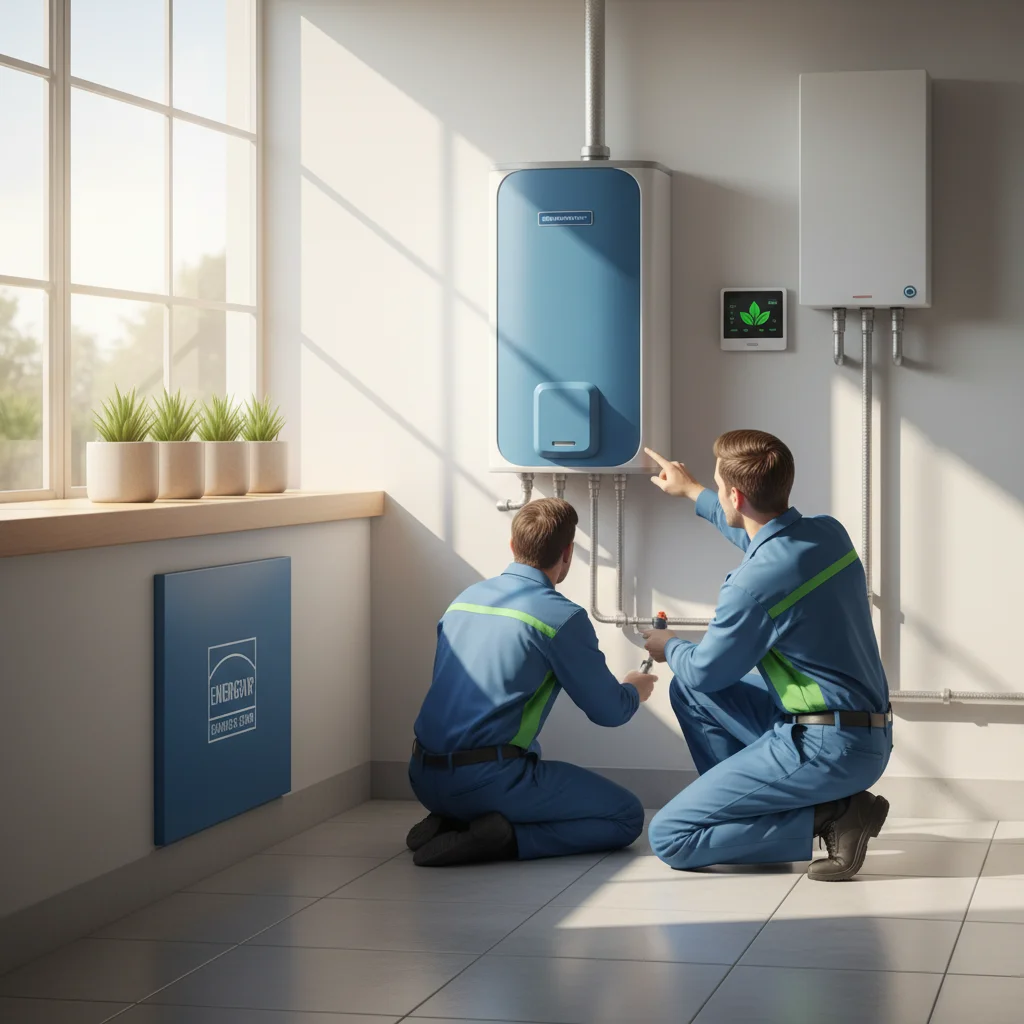
A conventional 50-gallon tank water heater installed in California averages $1,800 to $3,500 in 2026, but homeowners who upgrade to an electric heat pump water heater can claim a $2,000 federal tax credit and up to $4,000 in state and utility rebates—effectively cutting the $3,500 to $5,500 installation cost in half. And those savings don't include the $300 to $550 per year in reduced energy bills that heat pump models deliver compared to gas or standard electric tanks.
How Much Does Water Heater Installation Cost in California?
Water heater installation costs in California range from $1,800 to $8,000 in 2026, with conventional 40-50 gallon gas or electric tanks averaging $1,800 to $3,500 installed, tankless gas units costing $3,000 to $6,500, and electric heat pump water heaters running $3,500 to $5,500 including labor and permits. Labor accounts for $500 to $1,500 of the total, while permits add $50 to $200 depending on jurisdiction.
So why does California installation cost 15-20% more than the national average? Stricter building codes, mandatory seismic strapping, and prevailing wage requirements in some counties push labor costs higher. But the state's aggressive rebate programs offset the premium. A Bay Area homeowner replacing a 15-year-old gas tank with a heat pump water heater paid $4,800 after installation but received $2,000 from the federal IRA tax credit, $2,000 from the California Tech Clean California program, and $500 from PG&E—netting out at just $300 for a system that will save $450 per year on utility bills.
The unit itself accounts for 50-65% of total cost. Standard 50-gallon electric resistance tanks retail for $400 to $900, while comparable gas models run $500 to $1,200. Tankless gas heaters cost $1,000 to $3,000 for the unit alone. And electric heat pump water heaters—the most efficient option—range from $1,200 to $2,500 before installation. Labor varies by installer type: independent contractors charge $60 to $100 per hour, licensed plumbers bill $100 to $150 per hour, and large franchise services cost $150 to $200 per hour.
"Heat pump water heaters use up to 60% less energy than standard electric resistance water heaters." — U.S. Department of Energy
Additional costs include removal and disposal of the old unit ($100 to $300), electrical upgrades if switching from gas to electric ($500 to $2,000), gas line modifications ($200 to $1,000), expansion tanks ($150 to $300), and code-required earthquake straps ($50 to $150). And homeowners in fire hazard zones may need additional clearance work or fireproof enclosures, adding $200 to $800.
What's the ROI and Payback Period for Installing a New Water Heater?
Electric heat pump water heaters deliver a 200-350% ROI over their 12-15 year lifespan in California, with payback periods of 3-6 years when factoring in rebates and annual energy savings of $300-$550 compared to conventional electric or gas tanks. A $4,800 heat pump installation that receives $4,500 in combined federal and state rebates costs just $300 upfront and pays for itself in under 1 year through utility bill reductions alone.
The ROI math works in California because electricity rates average $0.28 per kWh—41% higher than the national average—making efficiency gains more valuable. A conventional electric tank uses 4,500 kWh per year at a cost of $1,260, while a heat pump model uses 1,500 kWh for $420 annually—a $840 difference. But even in lower-cost electricity zones like Sacramento ($0.21 per kWh), the payback period stretches only to 4-5 years for a heat pump system.
Tankless gas water heaters show weaker ROI because California natural gas prices increased 22% from 2024 to 2026, now averaging $2.10 per therm. A tankless unit saves 30-40% over a conventional gas tank, translating to $120-$180 per year. So the $3,000 to $6,500 installation cost requires 16-35 years to break even—well beyond the 15-20 year lifespan of most tankless models.
ROI calculations must account for maintenance costs. Heat pump water heaters require air filter cleaning every 3 months (DIY) and coil cleaning every 1-2 years ($100-$150 professional service). Tankless units need annual descaling in hard water areas ($150-$250 per service), while conventional tanks require anode rod replacement every 3-5 years ($150-$300). And California's strict NOx emissions standards mean gas water heaters need more frequent burner adjustments, adding $80-$120 to annual maintenance.
Resale value matters. Homes with heat pump water heaters sell for 1-2% more in California markets, according to 2025 Zillow data—equivalent to $8,000 to $16,000 on an $800,000 median home. But tankless gas units show no statistically significant resale premium, likely because buyers anticipate higher maintenance costs. Use our free rebate calculator to model your specific payback period based on local utility rates and available incentives.
Which Water Heater Type Is Best for Your California Climate Zone?
Electric heat pump water heaters operate most efficiently in California Climate Zones 6-16 (coastal and inland valleys) where ambient temperatures stay above 50°F year-round, delivering 2.5-3.5 coefficient of performance ratings and $400-$550 annual savings, while homeowners in Zones 1-5 (mountain regions) see reduced efficiency below 40°F and may need supplemental resistance heating that cuts savings to $200-$300 per year.
Climate zone determines efficiency because heat pump water heaters extract thermal energy from surrounding air. In Zone 10 (Riverside, inland valleys), average garage temperatures stay at 65-75°F year-round, allowing the compressor to run at peak efficiency. But in Zone 1 (mountain communities like Truckee), winter garage temperatures drop to 35-45°F, forcing the unit into less-efficient resistance mode 40-60% of heating cycles.
Tankless gas water heaters excel in Zones 1-5 where well water temperatures drop to 45-55°F in winter. Because tankless units heat water on demand, they avoid the standby losses that plague tank models in cold climates—saving 30-50% compared to conventional gas tanks when inlet water is cold. But in coastal Zone 6 (San Francisco, moderate year-round), inlet temperatures stay at 60-65°F and tankless efficiency gains shrink to 15-25%.
"In warm climates (CZ 10-15), heat pump water heaters can operate with a coefficient of performance above 3.0, meaning they produce 3 units of heat for every 1 unit of electricity consumed." — California Energy Commission
Solar water heaters deliver the highest ROI in Zones 12-16 (deserts and southern inland valleys) where average daily solar radiation exceeds 6 kWh per square meter. A $6,000 to $9,000 solar thermal system with 30% federal tax credit and $1,500 state rebate costs $2,700 to $4,800 net and eliminates 80-95% of water heating energy use in Bakersfield or Palm Springs. But in foggy coastal zones like Eureka (Zone 1), cloud cover reduces efficiency to 40-60%, extending payback to 15-20 years.
Conventional gas tanks remain cost-effective in Zones 7-9 (Central Valley) where natural gas infrastructure is widespread and electricity rates exceed $0.30 per kWh. A $2,200 installed gas tank uses $380 per year in gas versus $420 for a heat pump system—not enough savings to justify the $2,000+ price premium unless rebates cover the difference. And gas tanks don't require electrical panel upgrades, saving $500-$2,000 for homes with 100-amp service.
How Does a New Water Heater Compare to Repair, Tankless, and Heat Pump Alternatives?
Replacing a 10+ year old conventional tank water heater with a new heat pump model costs $3,500 to $5,500 installed but saves $300-$550 per year, while repairing a failing gas tank averages $400-$800 and extends its life only 2-4 years—making replacement the better financial choice once repair costs exceed 50% of replacement value or the unit reaches 12 years old.
The repair-versus-replace calculation hinges on three factors: unit age, repair cost, and available rebates. A 7-year-old tank with a $350 thermostat replacement can justify repair because it has 5-8 years of useful life remaining. But a 13-year-old tank needing a $650 tank liner repair should be replaced—the repair buys only 1-3 years, and the homeowner misses out on $2,000-$6,500 in current rebates that may not exist in 2029.
Tankless water heaters cost $3,000-$6,500 installed and save 30-40% on water heating energy compared to conventional tanks, but their 20-30% higher upfront cost requires 12-18 years to break even without rebates. California offers zero state rebates for tankless gas models in 2026, and the federal tax credit doesn't cover them. So tankless makes financial sense only for households using 80+ gallons per day (4+ people) where unlimited hot water justifies the premium.
Heat pump water heaters cost $1,300-$2,000 more than conventional electric tanks but qualify for $2,000 federal IRA tax credit, $2,000 California Tech Clean California rebate, and $300-$1,000 utility incentives—often making the heat pump cheaper upfront after incentives. A Sacramento homeowner paid $4,200 for a heat pump installation but received $3,500 in combined rebates, netting $700—versus $1,800 for a conventional electric tank with zero rebates.
Hybrid water heaters (heat pump with built-in resistance backup) solve the cold-climate efficiency problem for Zones 1-5. Models from Rheem and Bradford White automatically switch to resistance mode when ambient temperature drops below 45°F, maintaining 2.0+ coefficient of performance year-round. And the $3,800-$5,000 installed cost qualifies for the same rebates as pure heat pump models.
Point-of-use electric heaters (2-10 gallons) work well as supplements in California homes with long pipe runs. A $300-$600 installed unit under a distant bathroom sink eliminates 30-60 seconds of wait time and reduces water waste by 2-5 gallons per use. But point-of-use heaters don't replace whole-home systems and aren't eligible for federal or state rebates. Check out water heater rebates to see which models qualify for the most incentives.
How Long Will Your New Water Heater Last and What Affects Its Lifespan?
Conventional tank water heaters last 8-12 years in California, tankless gas models 15-20 years, and electric heat pump water heaters 12-15 years, with lifespan determined by water hardness (140-180 ppm in most of California accelerates corrosion and scale buildup), maintenance frequency, and installation quality—homes with water softeners extend tank life by 30-50% by reducing anode rod depletion and sediment accumulation.
Water chemistry directly impacts lifespan. California water hardness averages 150-200 ppm in Central Valley and inland regions, causing mineral deposits that insulate heating elements and force them to work harder—reducing efficiency 10-25% and shortening element life to 3-5 years. Coastal areas like San Francisco have softer water (50-100 ppm) where tank corrosion from chlorine and dissolved oxygen becomes the limiting factor, eating through anode rods in 4-6 years versus 8-10 years in hard water areas.
Maintenance schedules determine whether units reach maximum lifespan. Annual tank flushing removes sediment that accelerates bottom corrosion and reduces capacity by 20-40%. Anode rod inspection every 2-3 years catches depletion before tank walls corrode through. And descaling tankless heat exchangers every 1-2 years prevents the 40-60% efficiency loss that occurs when scale buildup restricts flow. But only 18% of California homeowners perform annual maintenance, according to 2025 American Water Works Association data.
"Regular maintenance, including annual flushing and anode rod inspection, can extend water heater lifespan by 3-5 years." — U.S. Department of Energy
Installation quality matters as much as the unit itself. Undersized gas lines cause incomplete combustion that leaves carbon deposits on burners, reducing efficiency 15-25% and requiring burner replacement every 5-7 years. Improper heat pump placement in confined spaces restricts airflow, dropping coefficient of performance from 3.0 to 1.8 and forcing the compressor to run 50-80% longer per cycle—cutting compressor lifespan from 15 years to 8-10 years.
California building codes require seismic strapping for all water heaters, preventing earthquake damage that accounts for 12-18% of premature failures in coastal zones. Expansion tanks (required for closed-loop systems) prevent pressure spikes that rupture tanks and blow out relief valves. And proper venting for gas units prevents backdrafting that corrodes flue pipes and releases carbon monoxide—a defect found in 8% of installations during 2025 California Public Utilities Commission inspections.
Warranty terms signal expected lifespan. Residential tank water heaters carry 6-12 year tank warranties and 1-3 year parts warranties. Tankless models offer 10-15 year heat exchanger warranties and 5-7 year parts coverage. And heat pump water heaters include 10-year tank warranties and 5-6 year sealed system (compressor) warranties. But warranties require proof of annual professional maintenance—a clause that voids 40% of warranty claims, according to industry data.
What Installation Rebates and Tax Credits Are Available in California?
California homeowners installing electric heat pump water heaters in 2026 qualify for a $2,000 federal IRA tax credit, $2,000 state Tech Clean California rebate for income-qualified households, and $300-$1,000 utility incentives from PG&E, SCE, SDG&E, and SoCalGas—totaling up to $5,000 in combined incentives that reduce a $4,500 installation cost to near-zero for low-to-moderate income families earning up to 150% of area median income.
The federal Energy Efficient Home Improvement Credit (Section 25C) ended for property placed in service after December 31, 2025 (IRS FS-2025-05). Federal tax credits for this work have ended, but state, local and utility rebates may still apply; check what is available at your address with the DuloCore rebate calculator. The credit covers equipment and installation labor, doesn't require income limits, and applies to both primary and secondary residences. But the credit phases down to 26% in 2033 and 22% in 2034 before expiring in 2035.
California's Tech Clean California program offers $2,000 to $4,000 for heat pump water heater installations, with amounts tiered by income: $2,000 for households earning 80-150% of area median income, $3,000 for 50-80% AMI, and $4,000 for below 50% AMI. A family of four in Los Angeles County earning $120,000 (115% AMI) qualifies for the $2,000 rebate, while a $65,000 household (62% AMI) receives $3,000. Applications go through participating contractors who apply incentives at point-of-sale.
Utility rebates vary by provider and change annually. PG&E offers $500 for heat pump water heaters plus $300 for recycling an old electric resistance tank—$800 total. Southern California Edison provides $600-$800 depending on model efficiency. San Diego Gas & Electric pays $750-$1,000 for ENERGY STAR Most Efficient models. And SoCalGas discontinued gas water heater rebates in 2025 to prioritize electrification, offering $300 for customers switching from gas to electric heat pump models.
Local air quality management districts add another layer. South Coast AQMD (Los Angeles region) offers $3,000 for low-income households replacing gas water heaters with heat pump models—stacking with state and federal incentives for up to $9,000 total. Bay Area AQMD provides $2,000-$4,000 for similar replacements. And San Joaquin Valley APCD pays $1,500-$3,000 to reduce NOx emissions from gas appliances.
Income limits use HUD area median income (AMI) thresholds that vary by county. A four-person household in San Francisco County earning $150,000 falls at 100% AMI and qualifies for base rebates. But the same family in Fresno County at $90,000 also hits 100% AMI because median incomes differ regionally. And rebate programs stack—homeowners often combine federal credit + state rebate + utility incentive + air district incentive for total savings exceeding installation cost. Explore energy tax credits to understand how federal and state programs combine.
Official Sources
- U.S. Department of Energy - Energy Saver — Federal guidance on water heater efficiency, maintenance, and rebate programs
- California Energy Commission — State building standards, climate zone maps, and appliance efficiency regulations
- Database of State Incentives for Renewables & Efficiency (DSIRE) — Comprehensive database of federal, state, and utility rebate programs
Frequently Asked Questions
What is the average cost of water heater installation in California?
The average water heater installation in California costs $1,800 to $3,500 for conventional 40-50 gallon tank models, $3,000 to $6,500 for tankless gas units, and $3,500 to $5,500 for electric heat pump water heaters including labor, permits, and materials in 2026. Labor accounts for $500-$1,500, permits add $50-$200, and the unit itself costs $400-$2,500 depending on type and capacity. Installation costs run 15-20% higher than national averages due to stricter California building codes, mandatory seismic strapping, and prevailing wage requirements.
How much does California rebate you for installing a new water heater?
California's Tech Clean California program rebates $2,000 to $4,000 for heat pump water heater installations in 2026, with amounts based on household income relative to area median: $2,000 for 80-150% AMI, $3,000 for 50-80% AMI, and $4,000 for below 50% AMI. These state rebates stack with the $2,000 federal IRA tax credit and $300-$1,000 utility incentives from providers like PG&E, SCE, and SDG&E, enabling total combined savings of $3,300-$6,000 per installation.
Are there tax credits available for water heater replacement in California?
The federal Energy Efficient Home Improvement Credit (Section 25C) ended for property placed in service after December 31, 2025 (IRS FS-2025-05). California offers no additional state tax credit beyond the federal program, but Tech Clean California provides direct rebates of $2,000-$4,000 that don't reduce the federal credit amount. Conventional gas and electric resistance water heaters don't qualify for any federal tax credits in 2026.
How long does it take to install a new water heater in California?
A standard tank water heater replacement takes 2-4 hours for a like-for-like swap (gas-to-gas or electric-to-electric), while heat pump installations require 3-6 hours due to electrical requirements and airflow considerations. Fuel conversions (gas-to-electric or vice versa) extend installation to 6-10 hours because contractors must cap gas lines or run new electrical circuits, upgrade panels if needed, and obtain additional permits. Tankless installations take 4-8 hours for new gas line sizing, venting modifications, and code-required combustion air provisions.
Can you get a rebate for water heater installation if you're renting in California?
Renters can access California heat pump water heater rebates only if the property owner applies for and installs the unit, as rebate programs require proof of property ownership or landlord authorization through participating contractors. Some utility programs like PG&E's multifamily incentives allow property managers to claim rebates on behalf of rental units, but individual renters cannot apply directly. The federal $2,000 IRA tax credit applies only to homeowners who can claim the residence on their tax return, excluding renters from that benefit entirely.
Ready to calculate your water heater rebates? Use our free rebate calculator to see exactly how much you qualify for based on your income, location, and current water heater type. Get personalized federal, state, and utility incentive estimates in under 60 seconds—and find pre-qualified contractors who handle rebate applications at point-of-sale.
Last updated April 14, 2026 — reviewed by DuloCore Editorial. About our authors.
Check your California water heater rebate eligibility — see the programs you qualify for and the dollar amounts on our California water heater rebate finder.