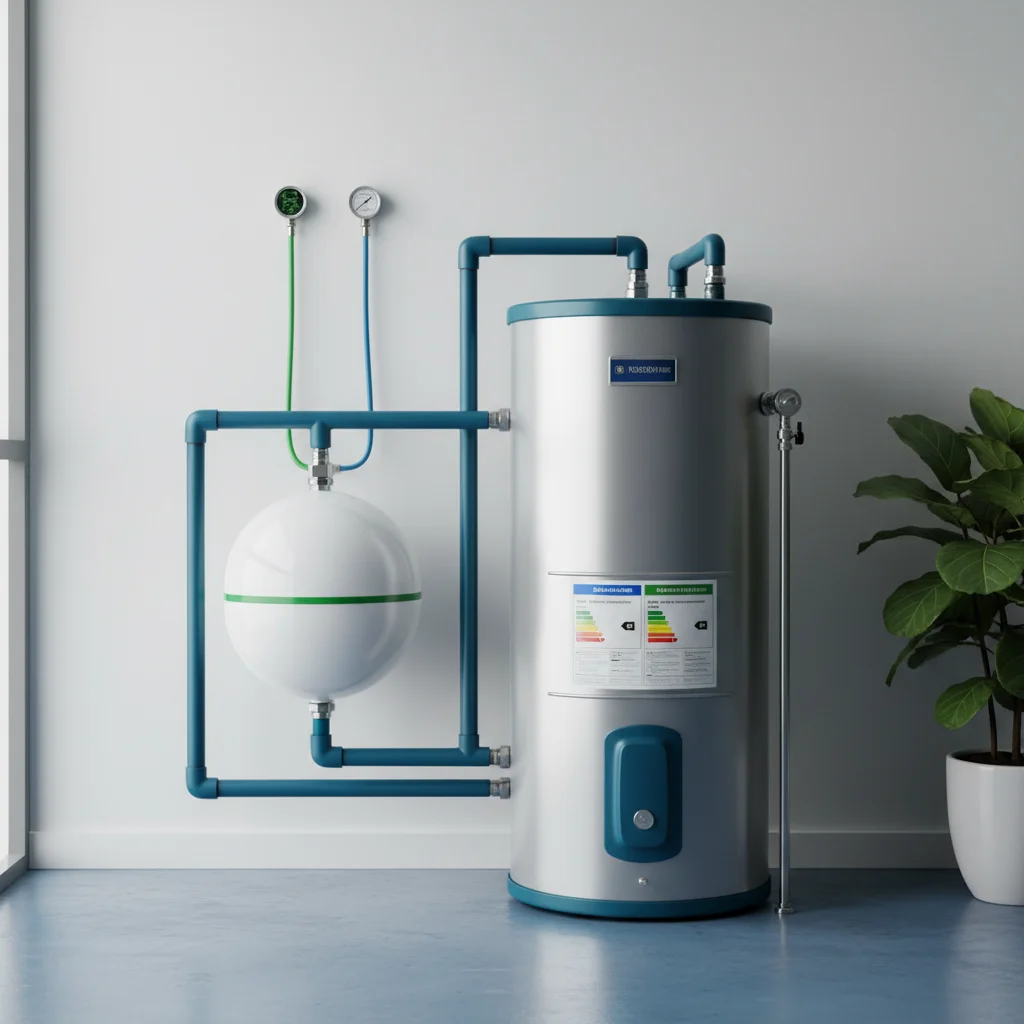
A faulty expansion tank costs homeowners $1,200-$3,000 in emergency plumbing repairs when water heaters rupture from excess pressure. And yet 40% of residential water heating systems installed before 2015 lack this $150 safety device. The 2026 plumbing code in California now mandates expansion tanks on all closed-loop systems, turning a neglected component into a compliance requirement that protects both property and occupants.
What Is a Water Heater Expansion Tank and Why Do You Need One?
A water heater expansion tank is a pressurized steel vessel that absorbs thermal expansion in closed-loop plumbing systems, preventing pressure spikes that damage pipes, valves, and the water heater itself. Thermal expansion occurs when heated water increases in volume by 2-3%, raising system pressure from a safe 50-60 PSI to a dangerous 150+ PSI without an expansion path. California's 2026 plumbing code requires expansion tanks on all systems with backflow preventers, pressure-reducing valves, or check valves that block expanded water from flowing back into municipal supply lines.
The tank contains a flexible diaphragm separating air and water chambers. And when water heats and expands, it compresses the air chamber instead of stressing plumbing components. But without this buffer, repeated pressure cycles crack pipe joints, blow relief valves, and rupture water heater tanks within 3-5 years of installation. So the $150 expansion tank eliminates $1,500-$4,000 in premature equipment replacement costs.
Closed-loop systems are now standard in California homes built after 2010. But older homes retrofitted with backflow prevention devices or tankless water heaters also require expansion tanks under current code. Use our free rebate calculator to identify qualifying efficiency upgrades bundled with expansion tank installation.
How Much Does a Water Heater Expansion Tank Cost to Buy and Install?
Expansion tanks range from $50 for 2-gallon residential units to $250 for 10-gallon commercial models, with installation adding $100-$300 in labor for a total project cost of $150-$550. Tank sizing follows a 10% rule: systems with 40-50 gallon water heaters need 2-gallon expansion tanks, while 75-80 gallon systems require 4.5-gallon tanks. And oversizing by one capacity tier ($20-$40 extra) extends service life by reducing diaphragm stress cycles.
Professional installation takes 45-90 minutes and includes mounting hardware, tee fittings, and pressure testing. But DIY installation saves $100-$200 for homeowners with basic plumbing skills and access to the cold water supply line near the water heater. So total out-of-pocket costs drop to $50-$250 for self-installed systems using pre-charged tanks from home improvement retailers.
Premium models with stainless steel construction and butyl rubber diaphragms cost $180-$250 but last 12-15 years versus 7-10 years for standard galvanized steel tanks with EPDM diaphragms. California water quality impacts longevity—hard water regions with 180+ PPM calcium carbonate see 30% shorter tank life without regular maintenance. Check water heater rebates for programs that bundle expansion tank costs with efficiency upgrades.
Which Expansion Tanks Qualify for Rebates and Tax Credits?
The federal Residential Clean Energy Credit (Section 25D) ended for expenditures made after December 31, 2025, and the IRS treats an expenditure as made when installation is completed (IRS FS-2025-05). Federal tax credits for this work have ended, but state, local and utility rebates may still apply; check what is available at your address with the DuloCore rebate calculator. And California's Tech Clean California program provides $1,200-$1,800 point-of-sale rebates for heat pump water heater installations that include code-required expansion tanks in the total equipment cost.
Utility programs from PG&E, SoCal Gas, and SDG&E offer $500-$800 rebates for ENERGY STAR certified water heaters with expansion tank installation documented in contractor invoices. But the expansion tank itself doesn't need efficiency ratings—only the primary water heating equipment requires ENERGY STAR or AHRI certification. So homeowners capture $650-$2,400 in combined incentives by bundling expansion tank installation with qualifying efficiency upgrades rather than installing tanks separately.
Municipal programs in San Francisco, Los Angeles, and San Diego provide $200-$400 code compliance rebates for retrofit expansion tank installations in pre-2010 homes with documented closed-loop systems. Or property owners claim these incentives through annual water conservation audits that identify missing code-required components. Explore energy tax credits to maximize state incentives on water heating projects; federal tax credits no longer apply (IRS FS-2025-05).
The federal Energy Efficient Home Improvement Credit (Section 25C) ended for property placed in service after December 31, 2025 (IRS FS-2025-05).
How Do Expansion Tank Efficiency Ratings Impact Your Energy Savings?
Expansion tanks carry no efficiency ratings because they're passive pressure management devices that don't consume energy or affect water heating performance. But proper tank sizing and installation prevent energy waste from relief valve discharge, which dumps heated water and forces the system to reheat replacement cold water. A correctly sized expansion tank eliminates 15-25 gallons of daily relief valve discharge in homes with aggressive thermal expansion, saving $85-$140 annually in water heating costs at California's average electricity rate of $0.32/kWh.
Pre-charged tanks arrive set to 40 PSI air pressure, which must match system water pressure within ±5 PSI for optimal performance. And mismatched pressure causes premature diaphragm failure or inadequate expansion capacity that negates energy savings. So homeowners should verify system pressure with a gauge before installation and adjust tank pre-charge using a standard tire pump or compressor.
Tank location affects system efficiency—mounting expansion tanks on cold water supply lines prevents heat loss from the stored water volume, while hot-side installations waste $25-$40 annually by radiating heat from the tank shell. California's Title 24 energy code requires cold-side mounting within 5 feet of the water heater inlet for all new construction and major renovations. But retrofit installations often place tanks where space allows, sacrificing minor efficiency gains for accessibility. Review heat pump rebates for high-efficiency water heating alternatives that maximize expansion tank benefits.
What's the ROI and Payback Period for Installing an Expansion Tank?
Expansion tank installation delivers 300-800% ROI by preventing $1,200-$3,000 in emergency plumbing repairs and premature water heater replacement over the tank's 7-15 year service life. The payback period ranges from immediate to 18 months depending on system vulnerability and installation costs. And homes with existing closed-loop systems lacking expansion tanks face 60% higher risk of pressure-related failures within 24-36 months, making installation a break-even proposition within the first year from avoided emergency service calls alone.
DIY installations achieve payback in 3-6 months by eliminating $100-$300 in labor costs while preventing the same pressure damage as professional installations. But improper sizing or installation voids ROI by failing to protect against thermal expansion. So homeowners should follow manufacturer sizing charts and pressure-matching guidelines to ensure full financial benefits.
Bundling expansion tank installation with water heater replacement improves ROI by capturing $650-$2,400 in equipment rebates while meeting code compliance in a single project. California building departments require expansion tanks on all new water heater permits issued after 2016, making standalone installations unnecessary for homeowners planning equipment upgrades within 2-3 years. Or property owners install tanks proactively to prevent interim damage while waiting for rebate program funding cycles.
Is an Expansion Tank Right for Your Climate Zone and Home Setup?
Expansion tanks are mandatory in California climate zones 1-16 for all closed-loop water heating systems, regardless of temperature extremes or usage patterns. And the determining factor isn't climate but system configuration—homes with backflow preventers, pressure-reducing valves, check valves, or tankless water heaters require expansion tanks under the 2026 California Plumbing Code. So geographic location within the state doesn't affect necessity, only the inspection enforcement rigor that varies by municipality.
Closed-loop identification requires checking for backflow devices on the main water supply line or pressure-reducing valves that prevent expanded water from returning to municipal systems. Tankless water heaters create closed-loop conditions by design because their compact heat exchangers can't tolerate reverse flow. And water softeners with check valves also create closed systems that mandate expansion tank installation.
Hard water regions including Inland Empire, Central Valley, and desert communities see 30% shorter expansion tank service life from mineral buildup on diaphragms, requiring 5-7 year replacement intervals versus 10-12 years in coastal areas with softer water. But the code requirement remains universal regardless of water quality. So homeowners in high-TDS areas should budget for more frequent tank replacement while maintaining the same installation standards as soft water regions.
Official Sources
- DOE Energy Saver Guide — Federal water heating efficiency and safety standards
- DSIRE Database — Comprehensive state and utility rebate program directory
- California Energy Commission Title 24 — State plumbing and energy code requirements for water heating systems
Expansion Tank vs. Pressure Relief Valve: Which Alternative Works Best?
Expansion tanks and pressure relief valves serve different functions and aren't interchangeable—both components are required in properly configured water heating systems. Relief valves protect against catastrophic overpressure by venting water when system pressure exceeds 150 PSI, while expansion tanks prevent reaching dangerous pressure levels by absorbing thermal expansion before it stresses system components. And relying solely on relief valves causes 200-400 annual discharge cycles that waste $85-$180 in heated water while corroding the valve mechanism, leading to failure within 3-5 years.
California code requires T&P (temperature and pressure) relief valves on all storage water heaters with discharge pipes terminating within 6 inches of the floor, plus separate expansion tanks on cold supply lines. But tankless systems substitute high-temperature cutoff switches for T&P valves while still requiring expansion tanks to prevent heat exchanger damage from pressure spikes.
Bladder-style expansion tanks with replaceable air chambers offer longer service life than diaphragm tanks but cost $180-$280 versus $50-$150 for standard models. Or commercial installations use inline pressure regulators with integral expansion capacity for systems exceeding 100-gallon storage volume. So residential applications under 80 gallons should use standard diaphragm expansion tanks as the most cost-effective solution.
"Water expands by roughly 2% when heated from 50°F to 140°F, and in a closed plumbing system without an expansion tank, this can increase pressure to dangerous levels exceeding 150 PSI." — Energy.gov Water Heating Information
How Long Do Expansion Tanks Last and What Maintenance Do They Need?
Expansion tanks last 7-15 years depending on water quality, installation location, and maintenance frequency, with hard water systems requiring replacement every 5-8 years and soft water systems achieving 12-15 year service life. Annual maintenance takes 10 minutes and involves checking pre-charge pressure, inspecting for corrosion, and verifying proper system pressure at 50-60 PSI. And neglecting maintenance reduces tank life by 40% through diaphragm stress from pressure mismatches or waterlogging from air chamber leaks.
Pre-charge pressure should match system water pressure within ±5 PSI and requires annual verification using a standard tire pressure gauge on the air valve. Homeowners should drain system pressure, remove the protective cap on the tank's Schrader valve, and check air pressure when the system is cold. Or property owners hire plumbers for $75-$125 annual inspections that include expansion tank pressure checks with water heater servicing.
Waterlogging occurs when the diaphragm fails and water fills the air chamber, eliminating expansion capacity. A waterlogged tank feels heavy when tapped and produces a dull thud instead of a hollow ring. But replacement takes 30-60 minutes and costs $150-$300 including a new pre-charged tank and labor. So homeowners should budget for one replacement every 8-10 years as part of water heater system lifecycle costs.
Frequently Asked Questions
What is a water heater expansion tank and why is it needed?
An expansion tank is a pressure-relief vessel that absorbs the 2-3% volume increase when water heats from 50°F to 140°F in closed-loop plumbing systems. Without this device, thermal expansion raises system pressure from safe operating levels of 50-60 PSI to dangerous levels exceeding 150 PSI, damaging pipes, valves, and water heaters. California code requires expansion tanks on all systems with backflow preventers, pressure-reducing valves, or check valves that block expanded water from returning to municipal supply lines.
How much does a water heater expansion tank cost to install?
Expansion tank installation costs $150-$550 including $50-$250 for the tank and $100-$300 for professional labor. DIY installations save $100-$200 by eliminating labor costs, bringing total project expenses to $50-$250 for homeowners with basic plumbing skills. Premium stainless steel tanks with 12-15 year service life cost $180-$250 versus $50-$150 for standard galvanized models lasting 7-10 years. And bundling installation with water heater replacement reduces costs by capturing $650-$2,400 in available rebates.
Do I need an expansion tank if I have a water softener?
Water softeners with integrated check valves create closed-loop plumbing systems that require expansion tanks under California's 2026 plumbing code. The check valve prevents softened water from flowing backward into the municipal supply, blocking the thermal expansion path that open systems use to relieve pressure. So all softener-equipped homes need expansion tanks regardless of water heater type or age. And installation follows the same sizing and placement requirements as non-softener systems, with 2-gallon tanks sufficient for 40-50 gallon water heaters.
What size expansion tank do I need for my water heater?
Expansion tank sizing follows a 10% capacity rule: 40-50 gallon water heaters require 2-gallon expansion tanks, 50-60 gallon systems need 2-4.5 gallon tanks, and 75-80 gallon water heaters use 4.5-gallon expansion tanks. Oversizing by one capacity tier costs $20-$40 extra but extends service life by 20-30% through reduced diaphragm stress. And system water pressure affects sizing—homes with incoming pressure exceeding 80 PSI should upsize expansion tanks by one tier to maintain adequate expansion capacity. Calculate your complete water heating costs with our rebate calculator.
How often should a water heater expansion tank be replaced or serviced?
Expansion tanks require annual pressure checks taking 10 minutes and replacement every 7-15 years depending on water quality and maintenance frequency. Hard water systems need replacement every 5-8 years from mineral buildup on diaphragms, while soft water installations achieve 12-15 year service life with proper maintenance. Annual service includes verifying pre-charge pressure matches system pressure within ±5 PSI, inspecting for corrosion, and testing for waterlogging by tapping the tank shell. Neglected tanks fail 40% sooner from pressure mismatches that stress the diaphragm through excessive cycling.
Ready to maximize your water heating efficiency and capture available rebates? Use our free rebate calculator to identify $650-$2,400 in state programs and utility incentives for water heater upgrades that include code-required expansion tank installation. Get your personalized savings estimate in under 60 seconds.
Last updated: April 14, 2026. Reviewed by the DuloCore Editorial Team. About our authors.
Check your California water heater rebate eligibility — see the programs you qualify for and the dollar amounts on our California water heater rebate finder.