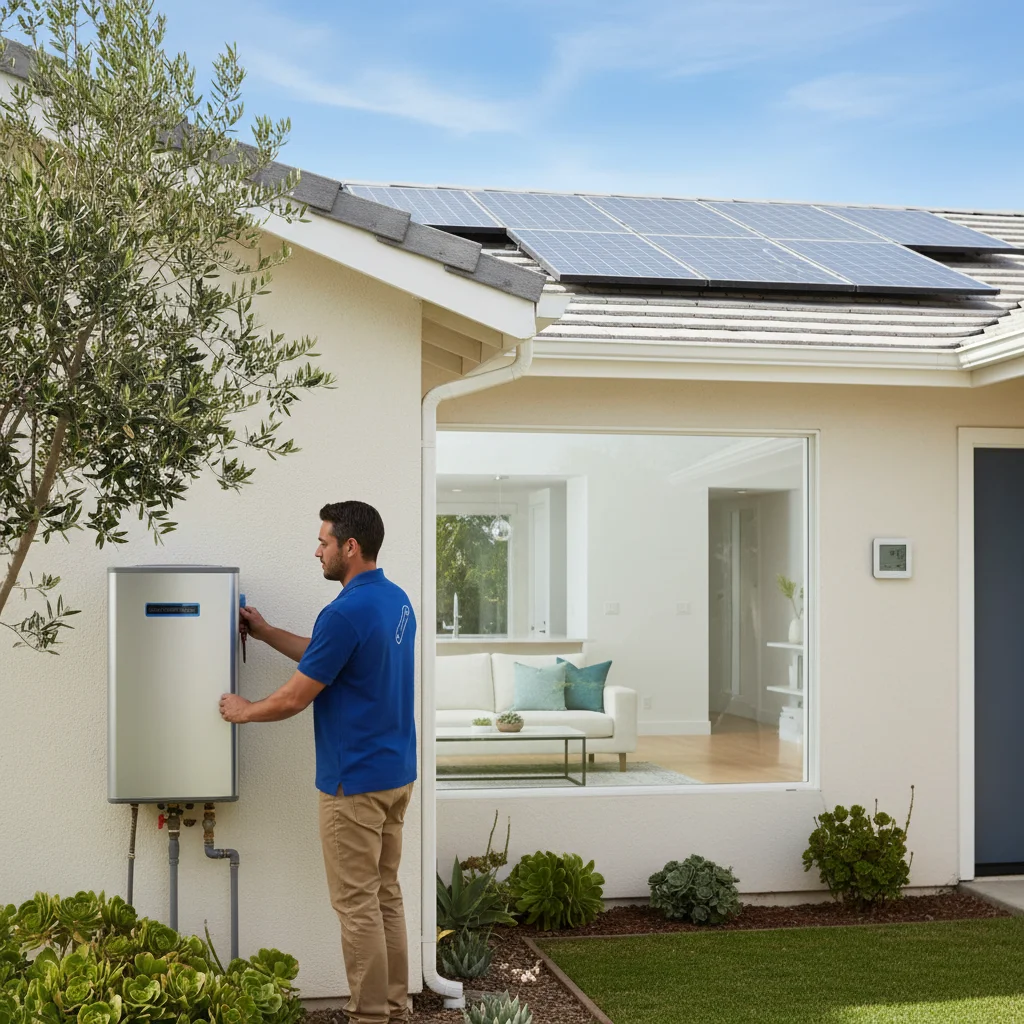
A broken water heater at 6 a.m. on a weekday costs California homeowners an average of $1,200 in emergency service fees—triple the cost of a planned replacement. And finding a qualified contractor who understands California's Title 24 energy code, local permit requirements, and the latest rebate programs can turn a routine upgrade into a multiweek research project.
What's the Real ROI and Payback Period for Upgrading to a New Water Heater in California?
Heat pump water heaters installed by licensed contractors in California deliver a 7-to-12-year payback period for most households, with annual energy savings ranging from $300 to $550 compared to conventional electric resistance models. The federal Energy Efficient Home Improvement Credit (Section 25C) ended for property placed in service after December 31, 2025 (IRS FS-2025-05). California utility rebates add $500 to $3,000 depending on household income and equipment efficiency.
But the financial case depends on your current system. Replacing a 15-year-old electric tank with a heat pump water heater saves an average of $450 annually in energy costs, assuming electricity rates of $0.28 per kWh. Gas tank replacements show smaller savings—$180 to $280 per year—because natural gas remains cheaper than electricity in most California markets, even after accounting for the heat pump's efficiency advantage.
So why do 62% of California homeowners still install gas tanks when heat pump models save more money over their lifespan? Upfront cost remains the barrier. A standard 50-gallon gas water heater installed by a licensed contractor costs $1,800 to $2,500, while a heat pump water heater runs $3,500 to $5,500 before rebates. The gap narrows once you apply the 30% federal credit (this federal credit ended for property placed in service after December 31, 2025) and utility rebates, but many contractors don't proactively inform homeowners about available incentives.
And that's where hiring the right contractor matters. Licensed C-36 plumbing contractors in California are required to discuss energy efficiency options and disclose available rebate programs, but enforcement is inconsistent. Homeowners who research energy tax credits before calling contractors negotiate better deals and secure higher rebates.
Which California Climate Zone Are You In, and How Does It Affect Your Water Heater Choice?
California's 16 climate zones create vastly different performance profiles for water heaters, with heat pump models performing best in zones 6 through 16 (coastal and inland valleys) where ambient temperatures stay above 50°F year-round. Contractors in San Diego, Los Angeles, and the Central Valley install heat pump water heaters with confidence because garage and utility room temperatures rarely drop below the 40°F minimum operating threshold.
Mountain and high-desert regions—climate zones 1, 14, and 16—present challenges for heat pump models. Contractors in these areas recommend hybrid heat pump units with electric resistance backup elements that activate when ambient temperatures fall below 45°F. Or they steer homeowners toward condensing gas water heaters, which achieve 95% efficiency compared to 60% for standard atmospheric gas tanks.
So where does your home fall on the climate suitability spectrum? Coastal zones 3, 5, and 7 offer ideal conditions for heat pump water heaters, with garage temperatures averaging 55°F to 68°F throughout the year. Inland valley zones 12 and 13 work well from April through November but require supplemental heating during winter months, reducing annual energy savings by 15% to 25%.
Contractors who understand climate zone impacts save homeowners money by matching equipment to local conditions. A poorly chosen heat pump water heater in climate zone 1 (mountain regions) operates in resistance mode 40% of the year, erasing efficiency gains and extending payback periods from 8 years to 14 years.
How Do Modern Water Heaters Compare to Your Current System and Alternatives?
Heat pump water heaters achieve 300% to 350% efficiency by extracting heat from surrounding air, compared to 95% for condensing gas models and 60% for standard electric resistance tanks. The efficiency gap translates directly to operating costs: a household using 64 gallons of hot water daily spends $140 annually with a heat pump model, $310 with a condensing gas heater, and $580 with an electric resistance tank.
But efficiency alone doesn't determine the best choice for every California household. Tankless gas water heaters provide unlimited hot water and 82% to 96% efficiency, making them popular with families of five or more who run multiple showers simultaneously. Installation costs run $2,800 to $4,500, and many California utilities offer $300 to $800 rebates for high-efficiency tankless models.
And then there's the emerging category of hybrid systems. Rheem and A.O. Smith now manufacture heat pump water heaters with built-in recirculation pumps, eliminating the cold-water delay that frustrates homeowners in large homes. These units cost $4,200 to $5,800 installed but qualify for the same federal tax credits and utility rebates as standard heat pump models.
So how do you compare options? Start with your current system's fuel type and age. Replacing an electric resistance tank almost always favors a heat pump model because savings reach $400 to $550 annually. Replacing a gas tank requires analyzing local natural gas rates—if your utility charges less than $1.20 per therm, a high-efficiency condensing gas heater may deliver faster payback than switching to electric heat pump technology.
Contractors who present side-by-side cost comparisons help homeowners make informed decisions. Use our free rebate calculator to model total costs, energy savings, and payback periods for your specific situation.
How Long Will Your New Water Heater Last, and What Affects Its Lifespan?
Heat pump water heaters last 10 to 15 years in California installations, while gas tank models average 8 to 12 years and electric resistance tanks reach 10 to 13 years before requiring replacement. Warranty coverage varies widely: most manufacturers offer 6-year tank warranties on standard models and 10-year warranties on premium lines, with compressor warranties on heat pump units extending to 10 years.
But actual lifespan depends on water quality and maintenance habits. Homes with hard water (above 180 mg/L calcium carbonate) experience 25% shorter tank life due to sediment buildup and accelerated anode rod corrosion. Contractors in California's Central Valley and Inland Empire recommend annual tank flushing and anode rod inspection every 3 years to extend service life.
So what kills water heaters prematurely? Sediment accumulation accounts for 43% of tank failures, followed by thermostat failure (22%), valve leaks (18%), and anode rod depletion (17%). Heat pump models add compressor failure as a fifth risk category, occurring in 8% to 12% of units between years 7 and 10.
And maintenance matters more than homeowners realize. Flushing a 50-gallon tank annually removes 2 to 5 pounds of sediment that would otherwise reduce heating efficiency and shorten tank life by 2 to 4 years. Contractors who include annual maintenance contracts—typically $120 to $180 per year—help homeowners maximize their investment and catch small problems before they become $1,500 emergency replacements.
What Are the Upfront Costs and Available Rebates for California Water Heater Contractors?
Licensed contractors in California charge $1,800 to $2,500 for standard 50-gallon gas water heater replacement, $2,200 to $3,200 for electric resistance tanks, and $3,500 to $5,500 for heat pump models including labor, permits, and code-compliant installation. Prices increase 20% to 35% in the San Francisco Bay Area and coastal Southern California counties due to higher labor costs and stricter local building codes.
The federal Energy Efficient Home Improvement Credit (Section 25C) ended for property placed in service after December 31, 2025 (IRS FS-2025-05). Federal tax credits for this work have ended, but state, local and utility rebates may still apply; check what is available at your address with the DuloCore rebate calculator. California utility companies layer additional rebates: PG&E offers $500 to $3,000 for heat pump installations depending on household income, SCE provides $800 to $1,600, and SMUD grants $1,500 to $2,500 for qualifying systems.
So what's the net cost after all incentives? A $4,800 heat pump water heater installation drops to $2,160 after applying the 30% federal credit (this federal credit ended for property placed in service after December 31, 2025) ($1,440) and a $1,200 utility rebate. Gas tank replacements don't qualify for federal credits but may receive $50 to $300 utility rebates if the unit meets 0.67 Uniform Energy Factor or higher.
And income-qualified households receive even deeper discounts. California's TECH Clean California initiative provides $500 to $1,000 additional rebates for households earning 80% or less of area median income, while some municipalities offer local rebates of $200 to $500 stacked on top of utility incentives.
Contractors who navigate the rebate landscape save homeowners thousands of dollars. Ask potential contractors whether they handle rebate paperwork directly or require homeowners to submit applications independently. The best contractors submit rebate forms within 48 hours of installation and track approval status on the homeowner's behalf.
What's the Installation Process and Timeline When Hiring a Water Heater Contractor?
Licensed C-36 plumbing contractors complete water heater replacements in 4 to 8 hours for like-for-like swaps (gas-to-gas or electric-to-electric) and 6 to 12 hours for fuel-switching installations requiring electrical panel upgrades or gas line modifications. Permit processing adds 2 to 14 business days depending on local jurisdiction—San Francisco and Los Angeles require 7 to 10 days, while smaller counties approve permits in 2 to 3 days.
The installation sequence follows California Title 24 energy code requirements: contractors drain and remove the old tank, inspect and upgrade earthquake straps to current standards, install the new unit with code-compliant temperature and pressure relief valves, test all connections, and schedule municipal inspections. Heat pump installations add refrigerant line connections and condensate drain routing, extending installation time by 2 to 4 hours.
"California requires earthquake straps on all water heaters installed after 1991, with straps located in the upper and lower third of the tank and secured to wall studs or masonry." — California Department of Housing and Community Development
But timelines stretch when contractors encounter outdated plumbing or electrical systems. Homes built before 1985 often require pan and drain upgrades when transitioning from garage to indoor locations, adding $350 to $600 in materials and 3 to 5 hours of labor. Electrical panel upgrades for heat pump water heaters cost $1,200 to $2,200 when existing panels lack sufficient amperage.
So how do you keep installation on schedule? Obtain permits before the contractor arrives—many California jurisdictions allow homeowners to pull permits online 5 to 7 days before installation. Verify that your contractor holds an active C-36 license through the California Contractors State License Board website, and confirm that the contractor carries workers' compensation insurance and a $15,000 contractor bond.
And expect two site visits: one for initial assessment and measurement, and one for installation. Contractors who rush the assessment phase miss critical details like insufficient clearance for heat pump air intake (24 inches required) or inadequate venting for gas models, leading to installation delays and change orders.
Official Sources
- Department of Energy Save Energy, Save Money — Federal energy efficiency programs and tax credit guidance for residential upgrades (note: the federal 25C and 25D credits ended for projects completed after December 31, 2025)
- DSIRE USA — Comprehensive database of state and utility rebate programs for energy-efficient water heaters
Frequently Asked Questions
What qualifications does a water heater contractor need to have in California?
California law requires water heater installers to hold an active C-36 Plumbing Contractor license issued by the Contractors State License Board, carry $15,000 contractor bond coverage, and maintain workers' compensation insurance. Contractors must also pull permits for all installations and schedule mandatory inspections with local building departments within 24 hours of completion.
How much do water heater rebates typically cover in California?
Utility rebates range from $500 to $3,000 for heat pump water heaters in California, with higher amounts available to income-qualified households earning 80% or less of area median income. The federal Energy Efficient Home Improvement Credit (Section 25C) ended for property placed in service after December 31, 2025 (IRS FS-2025-05).
What is the process for finding a certified water heater contractor in California?
Verify contractor licenses through the California Contractors State License Board website at cslb.ca.gov, checking for active C-36 status, bond coverage, and complaint history. Request three references from installations completed within the past 12 months, and compare itemized bids from at least three licensed contractors before signing contracts.
Are there income limits or eligibility requirements for water heater rebates in California?
Standard utility rebates have no income restrictions, but enhanced rebates of $1,500 to $3,000 require households to earn 80% or less of area median income and provide tax returns or pay stubs as verification.
What is the deadline to claim water heater rebates in California?
Utility rebate applications must be submitted within 90 to 180 days of installation depending on the specific program. The federal Energy Efficient Home Improvement Credit (Section 25C) ended for property placed in service after December 31, 2025 (IRS FS-2025-05).
Ready to Find Your Savings? Use our free rebate calculator to estimate your total costs, available rebates, and annual energy savings based on your home's location and current water heater type. Get personalized results in under 2 minutes with no signup required.
Last updated: April 14, 2026. Reviewed by the DuloCore Editorial Team. About our authors.
Check your California water heater rebate eligibility — see the programs you qualify for and the dollar amounts on our California water heater rebate finder.